



Foundry, the operator of the world’s largest Bitcoin mining pool, has officially announced its intention to expand its services into the Zcash ecosystem. The company, a subsidiary of Digital Currency Group (DCG), revealed plans to launch an institutional-grade Zcash (ZEC) mining pool in April 2026. This move marks a significant diversification for Foundry, which currently dominates the Bitcoin mining landscape through Foundry USA, a pool that consistently leads the global network in total computing power, or hashrate. The upcoming Zcash pool is specifically designed to address the growing demand from institutional entities and publicly traded companies for secure, compliant, and robust infrastructure within the privacy-preserving cryptocurrency sector.
The announcement comes at a pivotal moment for the cryptocurrency mining industry, which is increasingly seeking to balance the demands of regulatory transparency with the technical requirements of decentralized protocols. By leveraging its experience as a North American leader in Bitcoin mining, Foundry aims to bring a new level of professionalization to the Zcash network. This expansion is not merely a technical addition to Foundry’s portfolio but a strategic effort to fill what the company describes as a critical void in the current Zcash mining infrastructure.
The Strategic Vision Behind Institutional Zcash Mining
The decision to enter the Zcash market is rooted in the maturation of ZEC as an asset class. Mike Colyer, the Chief Executive Officer of Foundry, emphasized that while Zcash has established itself as a premier privacy-focused digital asset, the underlying mining infrastructure has struggled to keep pace with the needs of large-scale financial players. "Zcash has matured into an institutional-grade asset, but the mining infrastructure supporting it hasn’t kept pace," Colyer stated in a recent press release. The goal of the new pool is to provide a reliable, US-based platform that offers the same level of transparency and operational excellence that institutional miners have come to expect from the Bitcoin sector.
Foundry USA’s success in the Bitcoin market provides a blueprint for this new venture. By providing a decentralized network of miners with a collaborative platform to combine their hashrate, Foundry increases the mathematical probability of earning block rewards, which are then distributed among participants. Bringing this model to Zcash involves navigating the unique technical and regulatory nuances of privacy coins. Unlike Bitcoin, which utilizes a public and transparent ledger where all transaction details are visible, Zcash offers users the option of "shielded" transactions. These transactions use zero-knowledge proofs (specifically zk-SNARKs) to encrypt sender, receiver, and transaction amounts while still allowing the network to verify the transaction’s validity.

Technical Foundations and Zcash Tokenomics
Zcash was launched in 2016, built upon the original Bitcoin codebase. This shared heritage means that Zcash adheres to several of the same economic principles that have made Bitcoin a "digital gold" equivalent. The total supply of ZEC is capped at 21 million tokens, and the issuance schedule includes "halving" events approximately every four years, which reduce the block rewards granted to miners by 50%. This scarcity-driven model is a primary factor in Zcash’s appeal to long-term institutional investors.
However, the divergence from Bitcoin lies in the privacy features. In the broader cryptocurrency market, assets like Bitcoin and Ethereum are often described as pseudonymous; while identity verification is not required at the protocol level, every transaction is traceable via blockchain analysis tools. Zcash addresses this by providing a dual-address system: transparent addresses (t-addresses) that function like Bitcoin, and shielded addresses (z-addresses) that offer true anonymity.
The press release from Foundry highlights that Zcash demonstrates how financial privacy and compliant digital infrastructure can coexist. For institutions, the ability to conduct business with proprietary privacy while remaining within a verified, audited mining pool environment represents a significant step forward. This is particularly relevant for public companies that must balance their fiduciary duties with the need for secure, private financial operations.
Market Context: The Recent Surge in Zcash Hashrate
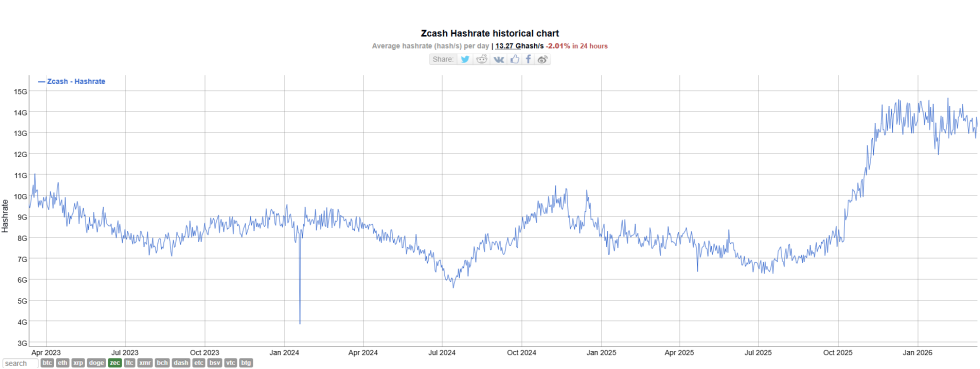
Foundry’s entry into the Zcash space is timed alongside a notable increase in the network’s total computing power. Data from BitInfoCharts indicates that the ZEC hashrate has experienced a significant upward trend over the past six months. In October of the previous year, the Zcash hashrate was measured at less than 8 Ghash/s. As of early 2024, that figure has surged to over 13 Ghash/s, representing a substantial increase in network security and miner interest.
A rising hashrate is generally viewed as a bullish indicator for a blockchain’s health. It suggests that more miners are committing hardware and electricity to the network, often in anticipation of future price appreciation or in response to improved mining efficiency. The introduction of more powerful Application-Specific Integrated Circuit (ASIC) miners designed specifically for the Equihash algorithm (which Zcash uses) has also contributed to this growth. By launching a pool in 2026, Foundry is positioning itself to capture a significant share of this expanding computing power, potentially becoming the dominant force in ZEC mining just as it has in Bitcoin.

Industry Reactions and Collaborative Efforts
The announcement has been met with enthusiasm from key stakeholders within the Zcash ecosystem. Shielded Labs, an independent organization based in Switzerland that provides support and development for the Zcash protocol, has welcomed Foundry’s involvement. Zooko Wilcox, the founder of Zcash and the Chief Product Officer at Shielded Labs, expressed the organization’s support for the initiative.
"We at Shielded Labs are delighted that Foundry—the largest Bitcoin mining pool, and one based in North America—is launching an enterprise-grade Zcash mining pool," Wilcox stated. The collaboration between a North American infrastructure giant and a Swiss-based development lab underscores the global nature of the Zcash project and its commitment to decentralized, high-level security. Wilcox’s endorsement is seen as a validation of Foundry’s technical approach and its ability to meet the rigorous standards of the Zcash community.
Chronology of Foundry’s Expansion and Market Positioning
To understand the impact of this move, it is necessary to look at the timeline of Foundry’s growth within the digital asset space:
- 2020: Foundry is established by Digital Currency Group to provide institutional-grade services to the North American mining industry.
- 2021-2023: Foundry USA rises to the top of the Bitcoin mining pool rankings, often accounting for 25% to 30% of the total Bitcoin hashrate.
- Late 2023 – Early 2024: Zcash experiences a hashrate boom, growing from 8 Ghash/s to over 13 Ghash/s, signaling renewed miner interest.
- March 2024: Foundry officially announces its Zcash mining pool project, targeting an April 2026 launch date.
- 2024-2026 (Planned): Foundry will engage in technical development, regulatory vetting, and hardware onboarding to prepare for the launch.
This two-year lead time before the official launch suggests that Foundry is taking a meticulous approach to compliance and technical integration. Building a pool that meets the requirements of public companies involves extensive auditing, insurance considerations, and the implementation of Know Your Customer (KYC) and Anti-Money Laundering (AML) protocols for pool participants, even while the underlying asset provides privacy features for end-users.
Implications for the Privacy Coin Landscape
The entry of a major institutional player like Foundry into the Zcash mining market has broader implications for the "privacy coin" category. In recent years, privacy-focused assets have faced scrutiny from global regulators, leading some exchanges to delist coins like Monero (XMR) and Zcash. However, Zcash has distinguished itself by maintaining a "view key" feature, which allows users to selectively disclose transaction details to third parties for auditing or tax purposes.
Foundry’s move suggests a confidence that Zcash’s approach to "programmable privacy" is compatible with the evolving regulatory frameworks in the United States and Europe. If a US-based entity can successfully operate a major ZEC mining pool, it could serve as a powerful argument for the legitimacy of privacy-preserving technologies in the regulated financial system. It signals to other institutions that privacy is not synonymous with illicit activity, but is rather a necessary component of sophisticated financial infrastructure.
Financial Analysis and Asset Performance
At the time of the announcement, the market performance of Zcash reflected the broader volatility seen across the cryptocurrency sector. ZEC was trading at approximately $209, marking an 11% decline over a seven-day period. Despite this short-term retracement, the long-term outlook remains a subject of intense debate among analysts.
The current price of $209 is a significant recovery from the lows seen during the previous "crypto winter," yet it remains well below its all-time highs. For miners, the profitability of ZEC is tied to both the token’s market price and the difficulty of the network, which adjusts as the hashrate fluctuates. Foundry’s decision to commit to a 2026 launch indicates a long-term bullish view on the asset’s value proposition. By the time the pool launches, Zcash will likely have undergone another halving event, further reducing the supply of new tokens entering the market and potentially putting upward pressure on the price, provided demand continues to grow.
Conclusion and Future Outlook
Foundry’s expansion into Zcash mining represents a maturing of the privacy coin sector. By bridging the gap between the cutting-edge privacy technology of Zcash and the rigorous operational standards of institutional finance, Foundry is setting the stage for a new era of digital asset mining. The April 2026 launch will be closely watched by miners, investors, and regulators alike, as it will serve as a litmus test for the viability of institutional-grade privacy infrastructure in North America.
As the industry moves toward 2026, the focus will remain on how Foundry balances its dominant position in Bitcoin with this new venture, and whether the Zcash network can continue its current trajectory of hashrate growth. For now, the announcement serves as a significant vote of confidence in the enduring relevance of Zcash and the essential role of professionalized mining pools in the future of the decentralized economy.














