Foundry, the digital asset infrastructure giant and operator of Foundry USA—currently the world’s largest Bitcoin mining pool by computing power—has officially announced its strategic expansion into the Zcash (ZEC) ecosystem. The company plans to debut a dedicated, institutional-grade Zcash mining pool in April 2026, a move designed to bridge the existing gap between the growing institutional demand for privacy-centric assets and the technical infrastructure required to support them. This expansion marks a significant milestone for Zcash, a veteran privacy coin that has recently experienced a notable resurgence in network security and hash power.
The decision to launch a Zcash-specific pool follows a period of sustained growth for the Foundry USA Bitcoin pool, which has consistently dominated the global market share of Bitcoin’s hashrate. By leveraging its proven expertise in large-scale mining operations, Foundry aims to provide public companies and institutional entities with a secure, US-based platform to participate in the Zcash network. According to the company’s leadership, the current mining landscape for Zcash lacks the enterprise-level rigor that modern financial institutions require, particularly regarding transparency, regulatory compliance, and operational reliability.
Strategic Objectives and the Institutional Infrastructure Gap
The primary catalyst for Foundry’s entry into the Zcash market is the perceived immaturity of the asset’s supporting infrastructure relative to its market capitalization and utility. Mike Coyler, CEO of Foundry, emphasized that while Zcash has matured into an asset class capable of attracting institutional interest, the backend infrastructure—specifically mining pools—has not evolved at the same pace. The new pool is intended to offer the same level of professional oversight and domestic operational security that has made Foundry USA a preferred choice for North American Bitcoin miners.
Institutional participation in Proof-of-Work (PoW) mining requires more than just hardware; it necessitates robust reporting tools, tax compliance features, and a stable legal jurisdiction. By basing the Zcash pool operations in the United States, Foundry addresses the concerns of public companies that are often hesitant to direct their computing power toward offshore pools with opaque ownership structures or fluctuating regulatory environments. This move is expected to attract a new wave of corporate miners who have previously stayed on the sidelines due to the perceived risks associated with existing ZEC mining infrastructure.

Technical Context: Zcash, Privacy, and the Bitcoin Connection
To understand the significance of Foundry’s move, it is essential to examine the technical foundations of Zcash. Launched in 2016, Zcash was developed as a privacy-preserving alternative to Bitcoin. While Bitcoin is often characterized as anonymous, it is more accurately described as pseudonymous. Every transaction, including the sender’s address, receiver’s address, and the amount transferred, is recorded on a public ledger accessible to anyone with an internet connection.
Zcash addresses this lack of financial privacy by utilizing Zero-Knowledge Succinct Non-Interactive Arguments of Knowledge (zk-SNARKs). This cryptographic breakthrough allows the network to verify transactions without revealing the sensitive data behind them. Users can choose between "transparent" transactions (similar to Bitcoin) and "shielded" transactions, which provide total privacy. The Zcash press release highlighted that this balance between cutting-edge privacy and transparent verification demonstrates how financial confidentiality can coexist with compliant digital infrastructure.
From an economic perspective, Zcash shares a close lineage with Bitcoin. It was originally built on Bitcoin’s codebase, inheriting several of its core "sound money" principles. These include a hard supply cap of 21 million tokens and a "halving" mechanism that occurs approximately every four years. During a halving event, the reward given to miners for adding a new block to the blockchain is reduced by 50%, effectively slowing the rate at which new ZEC enters circulation. This scarcity model is a primary driver of institutional interest in Zcash as a long-term store of value.
Analyzing the Zcash Network Hashrate Boom
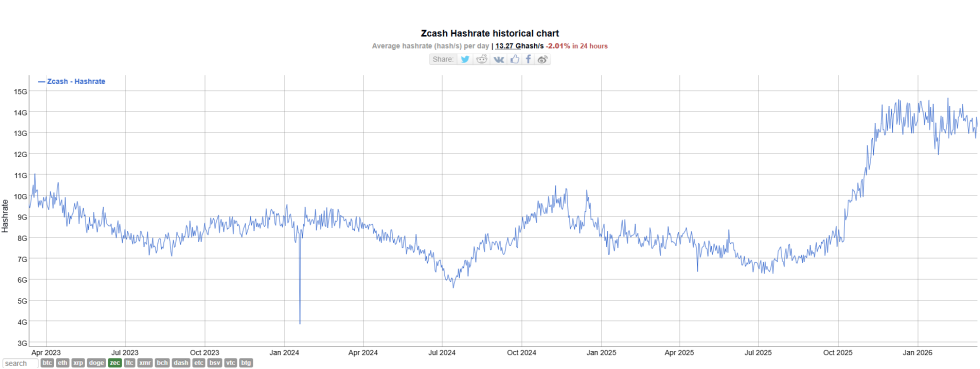
The timing of Foundry’s announcement coincides with a dramatic increase in the Zcash network’s total computing power, or hashrate. Data from BitInfoCharts indicates a significant upward trend in network security over the final months of 2025 and the beginning of 2026. In October 2025, the Zcash hashrate was measured at approximately 8 Gigahashes per second (Ghash/s). By March 2026, that figure had surged to over 13 Ghash/s, representing a growth of more than 60% in a relatively short window.
A rising hashrate is generally viewed as a bullish indicator for a Proof-of-Work blockchain. It suggests that more miners are dedicating hardware to the network, which increases the cost of a 51% attack and enhances overall security. This surge can be attributed to several factors, including the release of more efficient Application-Specific Integrated Circuit (ASIC) miners designed for the Equihash algorithm (the mining algorithm used by Zcash) and a growing consensus that privacy-focused assets will play a critical role in the future of decentralized finance (DeFi).

Foundry’s entry is likely to accelerate this trend. As the largest Bitcoin mining pool operator, Foundry brings a massive network of existing clients who may seek to diversify their mining portfolios by allocating a portion of their resources to Zcash.
Industry Reactions and the Role of Shielded Labs
The announcement has been met with enthusiasm from the Zcash development community. Zooko Wilcox, the founder of Zcash and current Chief Product Officer at Shielded Labs, expressed strong support for the initiative. Shielded Labs, an independent organization based in Switzerland dedicated to supporting the Zcash ecosystem, views the involvement of a North American giant like Foundry as a validation of the network’s long-term viability.
"We at Shielded Labs are delighted that Foundry—the largest Bitcoin mining pool, and one based in North America—is launching an enterprise-grade Zcash mining pool," Wilcox stated. His reaction underscores the importance of geographic decentralization in mining. While much of the global hashrate for various coins has historically been concentrated in regions with low oversight, the establishment of a major US-based pool provides a counterbalance that enhances the network’s resilience against regional regulatory crackdowns.
Market Performance and Economic Outlook
Despite the positive infrastructure news, the Zcash market has experienced recent volatility. At the time of the announcement, ZEC was trading at approximately $209, marking an 11% decline over the preceding week. This price retracement reflects a broader period of consolidation in the cryptocurrency markets following a sustained recovery.
However, analysts suggest that the introduction of institutional-grade mining tools could provide a floor for the asset’s value. When institutional miners enter a space, they typically bring long-term capital and a more disciplined approach to selling rewards compared to retail-oriented "hobbyist" miners. This shift in the miner profile can lead to reduced sell-side pressure, as enterprise miners are more likely to hold (or "HODL") their earned ZEC as part of a corporate treasury strategy.
Furthermore, the integration of Zcash into the Foundry ecosystem provides the asset with increased visibility among the world’s largest mining firms. This exposure is critical for Zcash as it competes for dominance in the privacy sector against other assets like Monero (XMR), which has faced challenges due to its lack of "transparent" transaction options that some regulators prefer.
Chronology of Key Events Leading to the 2026 Launch
The road to Foundry’s April 2026 launch is defined by several pivotal moments in the Zcash timeline:
- 2016: Zcash is officially launched, introducing zk-SNARKs to the public blockchain space.
- 2020-2024: The network successfully navigates its first and second halving events, solidifying its disinflationary monetary policy.
- Late 2025: The network sees an unprecedented surge in hashrate, jumping from 8 Ghash/s to 13 Ghash/s, signaling renewed interest from industrial-scale miners.
- March 11, 2026: Foundry issues a formal press release announcing the development of an institutional Zcash mining pool.
- April 2026 (Projected): The Foundry Zcash pool is scheduled to go live, offering US-based, enterprise-grade mining services.
Implications for the Broader Crypto Mining Industry
Foundry’s expansion into Zcash is a clear indicator of the professionalization of the mining industry. The era of mining pools being run as loose collectives is being replaced by sophisticated corporate entities that prioritize compliance and infrastructure stability. This move also suggests that Foundry is looking to diversify its revenue streams beyond Bitcoin, anticipating a future where multiple PoW assets coexist as specialized financial tools.
For the Zcash network, the arrival of Foundry USA’s sister pool represents a "coming of age." It transitions the asset from a niche privacy tool into a mainstream financial asset supported by the same caliber of infrastructure that powers Bitcoin. As the launch date in April 2026 approaches, the industry will be watching closely to see how many public companies and institutional funds migrate their hash power to the new pool, potentially reshaping the security and economic landscape of privacy-focused digital assets.
In conclusion, the launch of the Foundry Zcash mining pool is more than just a technical expansion; it is a strategic endorsement of Zcash’s technology and its place in a regulated financial future. By providing a bridge for institutional capital and computing power, Foundry is setting the stage for the next chapter of growth for one of the industry’s most enduring privacy protocols.