



Foundry, the digital asset infrastructure firm and operator of the world’s largest Bitcoin mining pool, has officially announced its strategic expansion into the privacy-centric cryptocurrency sector with the planned launch of a Zcash (ZEC) mining pool. Scheduled for an April 2026 debut, this initiative represents a significant pivot for the Rochester-based company, which has traditionally focused its massive computing resources on the Bitcoin network. The move is designed to address a perceived lack of enterprise-ready infrastructure for Zcash, a blockchain that has seen renewed interest from institutional investors and public corporations seeking to balance financial privacy with regulatory compliance.
The upcoming Zcash mining pool will operate under the same institutional-grade standards as Foundry USA, which currently dominates the Bitcoin mining landscape by providing a significant portion of the global network’s hashrate. By entering the Zcash ecosystem, Foundry aims to provide a secure, transparent, and US-based platform for miners who utilize the Equihash algorithm. This expansion comes at a time when the technical and market dynamics of Zcash are undergoing a period of rapid evolution, characterized by a substantial increase in network hashrate and a maturing governance structure.
The Strategic Importance of Foundry’s Expansion
Foundry’s entry into the Zcash market is not merely a diversification of its service offerings but a calculated response to the growing demand for sophisticated mining infrastructure outside of the Bitcoin network. As a subsidiary of Digital Currency Group (DCG), Foundry has established itself as a cornerstone of the North American mining industry. Its Bitcoin pool, Foundry USA, gained prominence following the 2021 mining migration from China to the United States, quickly rising to the top of the global rankings by offering high uptime, competitive fee structures, and a focus on regulatory compliance.
The decision to target Zcash (ZEC) highlights a gap in the current market. While Zcash has existed since 2016, much of the mining infrastructure supporting it has remained fragmented or catered primarily to retail participants. Mike Colyer, CEO of Foundry, emphasized that while Zcash has matured as an asset class, the underlying mining support has not reached the same level of sophistication. By introducing an institutional-grade pool, Foundry intends to provide the reliability and reporting standards required by public companies and large-scale funds that are increasingly looking to add privacy-preserving assets to their portfolios.
Understanding Zcash: Privacy in a Transparent Ecosystem
To understand the significance of this move, one must examine the unique value proposition of Zcash. Launched in 2016 by a team of world-renowned cryptographers, Zcash was built on the foundation of Bitcoin’s codebase but introduced a revolutionary technology known as zk-SNARKs (Zero-Knowledge Succinct Non-Interactive Arguments of Knowledge). This technology allows users to prove that a transaction is valid without revealing the sender, receiver, or the amount involved.

While mainstream cryptocurrencies like Bitcoin and Ethereum are often described as anonymous, they are more accurately characterized as pseudonymous. Every transaction is recorded on a public ledger, allowing chain analysis firms to trace the flow of funds and, in many cases, link wallet addresses to real-world identities. Zcash offers "shielded" addresses that provide true financial privacy by default. However, it also includes features for selective disclosure, such as "view keys," which allow users to share transaction details with auditors or regulators if necessary. This dual nature—combining cutting-edge privacy with the potential for compliant oversight—is what Foundry and other proponents argue makes Zcash an institutional-grade asset.
A Chronology of Zcash Development and Hashrate Growth
The timeline leading up to Foundry’s announcement is marked by several key technical and organizational milestones. Since its inception, Zcash has undergone numerous network upgrades, including "Overwinter," "Sapling," and "Canopy," each aimed at improving the efficiency of shielded transactions and the sustainability of the network.
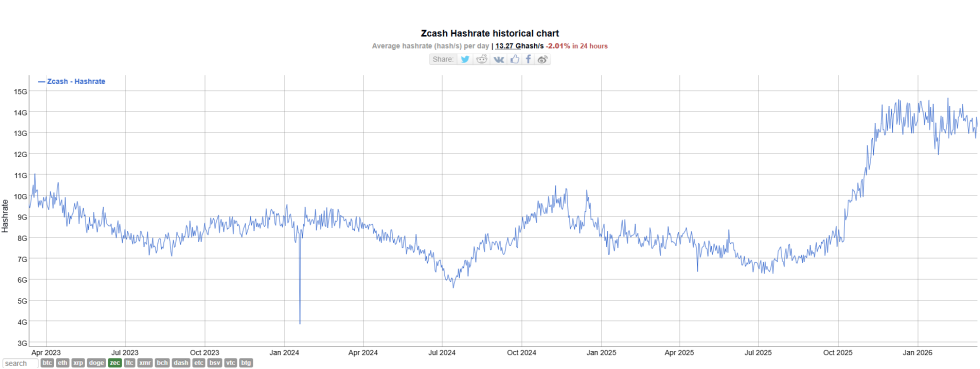
In recent months, the Zcash network has experienced a dramatic surge in computing power, or hashrate. According to data from BitInfoCharts, the total hashrate connected to the Zcash blockchain sat at approximately 8 Ghash/s in October. By early 2026, that figure has climbed to over 13 Ghash/s. This spike in hashrate suggests a significant influx of new mining hardware, likely driven by the deployment of more efficient Application-Specific Integrated Circuit (ASIC) miners designed for the Equihash algorithm.
A rising hashrate is generally viewed as a sign of network health and security, as it increases the cost and difficulty for a malicious actor to conduct a 51% attack. For Foundry, this trend signals a robust and growing market of miners who require a stable and professional pool environment. The planned April 2026 launch aligns with this upward trajectory, positioning Foundry to capture a significant share of the newly expanded mining market.
Collaborative Efforts and Industry Reactions
The announcement has been met with enthusiasm from the Zcash development community. Zooko Wilcox, the founder of Zcash and currently the Chief Product Officer at Shielded Labs, expressed strong support for the initiative. Shielded Labs, an independent organization based in Switzerland, has taken a leading role in supporting the ZEC ecosystem, focusing on protocol development and user privacy.
Wilcox noted that having a North American-based, enterprise-grade pool operated by the world’s leading Bitcoin pool operator is a major milestone for Zcash. This sentiment reflects a broader industry trend where established crypto infrastructure players are beginning to recognize the long-term viability of privacy-focused protocols. The involvement of Foundry is expected to bring a level of professionalization to ZEC mining that has previously been reserved for Bitcoin, including advanced payout schemes, detailed sub-account management, and robust security protocols.

Market Context: ZEC Price Performance and Volatility
Despite the positive infrastructure developments, the market price of Zcash has remained subject to the volatility inherent in the broader cryptocurrency space. At the time of the announcement, ZEC was trading at approximately $209, representing an 11% decline over a seven-day period. This retracement followed a period of recovery, highlighting the sensitive nature of the asset to macroeconomic factors and shifts in investor sentiment.
The token economics of Zcash closely mirror those of Bitcoin. It has a hard supply cap of 21 million coins and undergoes "halving" events roughly every four years, which reduce the rate at which new supply enters the market. These scarcity mechanics are a primary draw for investors, and the entry of Foundry suggests a belief that the long-term value of the network will be supported by its utility as a privacy-preserving store of value.
Addressing the Regulatory Landscape
One of the most critical challenges facing Zcash and its mining infrastructure is the evolving regulatory environment. Globally, regulators have expressed concerns regarding privacy coins and their potential for use in illicit activities. This has led some exchanges to delist privacy-focused assets like Monero and Zcash in certain jurisdictions.
However, the "institutional-grade" label applied to Foundry’s new pool is specifically designed to mitigate these concerns. By operating within the United States and adhering to strict Know Your Customer (KYC) and Anti-Money Laundering (AML) standards, Foundry provides a layer of legitimacy to the mining process. Furthermore, the Zcash protocol’s ability to allow for selective transparency means that institutional participants can prove compliance with financial regulations while still maintaining the privacy of their sensitive business data.
The press release accompanying the announcement highlighted this balance, stating that Zcash demonstrates how financial privacy and compliant digital infrastructure can coexist. For institutional miners, this distinction is vital, as it allows them to participate in the network without running afoul of regulatory requirements.
Broader Implications for the Mining Industry
Foundry’s move into Zcash mining is likely to have ripple effects across the entire mining industry. First, it underscores the importance of geographic diversification. By establishing a major US-based pool for Zcash, Foundry is reducing the network’s reliance on pools located in regions with less certain regulatory or political climates.
Second, the move may encourage other major pool operators to look beyond Bitcoin. As the Bitcoin mining industry becomes increasingly competitive and margins are squeezed by rising energy costs and halving events, operators are searching for "altcoin" opportunities where they can leverage their existing expertise and infrastructure. Zcash, with its established history and technical similarities to Bitcoin, represents a natural next step.
Finally, the entry of a player like Foundry could spur further innovation in mining hardware. As more institutional capital flows into ZEC mining, hardware manufacturers may be incentivized to develop next-generation Equihash ASICs, further driving the hashrate and security of the network.
Conclusion and Outlook
The launch of Foundry’s Zcash mining pool in April 2026 marks a pivotal moment for both the company and the Zcash ecosystem. For Foundry, it is an opportunity to cement its status as a multi-asset infrastructure leader. For Zcash, it provides the institutional validation and technical support necessary to transition from a niche privacy tool to a mainstream financial asset.
As the launch date approaches, the industry will be watching closely to see how the influx of institutional mining power affects the decentralization and security of the Zcash network. While market volatility and regulatory scrutiny remain ongoing hurdles, the commitment of the world’s largest mining pool operator suggests a confident outlook for the future of digital privacy. In an era where financial data is increasingly scrutinized, the success of an institutional-grade Zcash pool could serve as a blueprint for the future of private, compliant, and secure digital finance.














