Foundry, the digital asset infrastructure giant and operator of Foundry USA—the world’s largest Bitcoin mining pool—has officially announced its strategic expansion into the Zcash (ZEC) ecosystem. The company plans to launch a dedicated, institutional-grade Zcash mining pool in April 2026, a move designed to address a critical deficiency in the privacy-preserving cryptocurrency’s current infrastructure. By leveraging its dominant position in the North American mining sector, Foundry aims to provide public companies and large-scale institutional entities with a secure, compliant, and robust platform to participate in the Zcash network. This initiative marks a significant milestone for Zcash, which has seen a surge in network activity and computing power despite a challenging regulatory landscape for privacy-focused digital assets.
The decision to enter the Zcash market is rooted in the observation that while Zcash has matured into a sophisticated financial asset, the underlying mining infrastructure has struggled to meet the rigorous standards required by institutional investors. Mike Coyler, CEO of Foundry, emphasized that Zcash has achieved institutional-grade status in terms of its technological maturity and market presence, yet the tools available to miners have not kept pace. The upcoming pool is intended to bridge this gap, offering the same level of reliability and transparency that has made Foundry USA a leader in the Bitcoin mining space.
The Evolution and Architecture of Zcash
To understand the significance of Foundry’s entry, one must examine the unique position Zcash holds within the cryptocurrency market. Launched in 2016, Zcash was developed by the Electric Coin Company, led by Zooko Wilcox, as a fork of the Bitcoin codebase. While it shares many of Bitcoin’s fundamental properties—including a hard supply cap of 21 million tokens and a four-year halving cycle—it introduced a revolutionary cryptographic tool known as zk-SNARKs (Zero-Knowledge Succinct Non-Interactive Arguments of Knowledge).
This technology allows Zcash users to prove that a transaction is valid without revealing the sender, receiver, or the amount involved. Unlike Bitcoin or Ethereum, which operate on "pseudonymous" but fully transparent public ledgers, Zcash offers users the choice between transparent addresses (t-addresses) and shielded addresses (z-addresses). This dual-layer approach provides a bridge between the need for financial privacy and the requirements of modern regulatory frameworks. The Foundry press release noted that by combining cutting-edge privacy with transparent verification options, Zcash serves as a model for how financial privacy and compliant digital infrastructure can coexist in a regulated global economy.
Strategic Significance of the April 2026 Launch
The timeline for the launch, set for April 2026, suggests a long-term commitment to the Zcash network’s security and growth. Foundry’s approach is expected to mirror the success of Foundry USA, which currently commands a significant portion of the global Bitcoin hashrate. By basing operations in the United States, Foundry provides a level of jurisdictional certainty and regulatory alignment that is often lacking in the global mining landscape.

For institutional miners and public companies, the availability of a US-based, enterprise-grade pool is a prerequisite for entry. These entities require detailed reporting, audited financial statements, and rigorous security protocols—features that Foundry has already refined through its Bitcoin operations. The expansion into Zcash is seen as a vote of confidence in the long-term viability of Proof of Work (PoW) mining for privacy assets.
Zooko Wilcox, the founder of Zcash and current Chief Product Officer at Shielded Labs—a Switzerland-based independent support organization for the protocol—welcomed the move. Wilcox noted that the involvement of the largest North American mining pool operator represents a major step forward for the decentralization and security of the Zcash network. The partnership between Foundry and organizations like Shielded Labs highlights a collaborative effort to fortify the ecosystem ahead of the 2026 launch.
Analyzing the Recent Surge in Zcash Hashrate
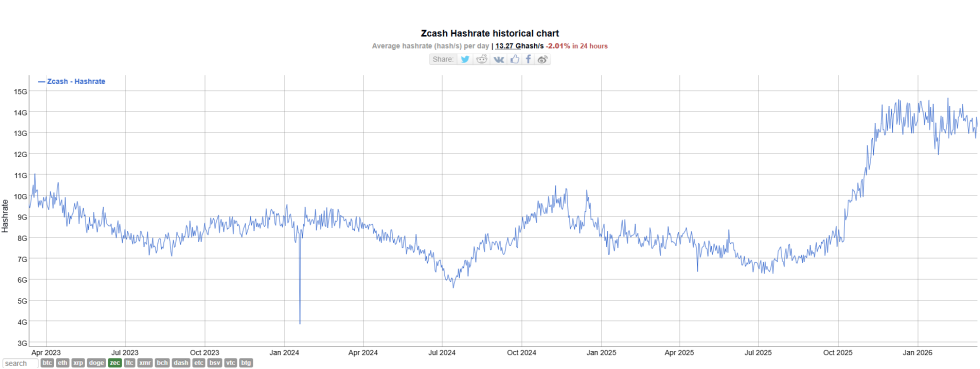
Foundry’s announcement comes at a time of unprecedented growth for the Zcash network’s computing power. Data from BitInfoCharts reveals a significant upward trajectory in network hashrate over the final quarter of 2025 and into early 2026. In October 2025, the Zcash hashrate was recorded at approximately 8 Gigahashes per second (Ghash/s). By the time of the announcement, that figure had climbed to over 13 Ghash/s, representing an increase of more than 60% in a few short months.
This surge in hashrate is a critical indicator of network health. In a Proof of Work system, a higher hashrate means the network is more resistant to 51% attacks, as an adversary would need to command more computing power to compromise the blockchain. The influx of computing power suggests that miners are increasingly finding Zcash profitable or are positioning themselves in anticipation of increased institutional interest.
The growth is also linked to the advancement of specialized mining hardware. Zcash utilizes the Equihash algorithm, which requires Application-Specific Integrated Circuits (ASICs) to mine efficiently. Recent hardware iterations from manufacturers like Bitmain have significantly improved the energy efficiency and hash output of ZEC-compatible rigs, encouraging miners to upgrade their fleets and contribute more power to the network.
The Economic Model: Scarcity and Incentives
The economic structure of Zcash is designed to mirror the scarcity-driven model of Bitcoin. With a total supply limit of 21 million ZEC, the asset is inherently disinflationary. New coins enter circulation through block rewards, which are distributed to miners for their role in verifying transactions and securing the chain.

A central feature of this model is the "halving," an event that occurs roughly every four years (or every 840,000 blocks) and reduces the block reward by 50%. This mechanism is intended to control inflation and simulate the extraction curve of precious metals. For miners, the halving presents a dual challenge: it reduces their immediate revenue while historically acting as a catalyst for price appreciation due to the reduced supply of new tokens. Foundry’s entry into the space suggests that the firm views the long-term price potential and network utility of Zcash as sufficient to offset the diminishing block rewards.
Market Performance and Institutional Sentiment
Despite the positive news regarding infrastructure development, the market price of Zcash has experienced volatility. At the time of the announcement, ZEC was trading near the $209 mark, reflecting a decline of approximately 11% over a seven-day period. This retracement followed a period of recovery, highlighting the speculative nature of the privacy coin market.
However, institutional interest often looks past short-term price fluctuations toward long-term network fundamentals. The "institutional gap" mentioned by Mike Coyler refers to the lack of "white-glove" services for Zcash. Most existing mining pools for ZEC are decentralized or based in jurisdictions that may not meet the compliance standards of a Nasdaq-listed company or a regulated investment fund. By providing a transparent, US-domiciled option, Foundry is effectively lowering the barrier to entry for capital-intensive players who have previously stayed on the sidelines due to operational risks.
Regulatory Landscape and the Future of Privacy
One of the most complex aspects of Foundry’s expansion is the regulatory environment surrounding privacy coins. Global regulators, including the Financial Action Task Force (FATF) and the US Securities and Exchange Commission (SEC), have frequently scrutinized assets that offer anonymity features, citing concerns over money laundering and illicit finance.
Zcash, however, has consistently marketed itself as "regulation-friendly privacy." Because the protocol allows for selective disclosure—where a user can provide a "view key" to an auditor or regulator to reveal transaction details without making them public—it occupies a unique niche. This feature is particularly attractive to institutions that must balance the privacy rights of their clients with their own legal reporting obligations. Foundry’s involvement is likely to further legitimize this "compliant privacy" narrative, signaling to the market that privacy-preserving technology is a permanent and necessary fixture of the digital asset landscape.
Broader Implications for the Mining Industry
Foundry’s move into Zcash may signal a broader trend of diversification among major mining pool operators. As the Bitcoin mining industry becomes increasingly competitive and energy-intensive, operators are looking for alternative PoW chains where they can apply their technical expertise and hardware management capabilities.
Furthermore, the launch of a North American-based ZEC pool contributes to the geographic decentralization of the mining industry. Historically, a significant portion of the hashrate for various PoW coins was concentrated in Asia. The growth of North American infrastructure enhances the resilience of the global network by ensuring that no single geopolitical region has a monopoly over block production.
Conclusion and Outlook
The announcement that Foundry will launch an institutional-grade Zcash mining pool in April 2026 represents a pivotal moment for the privacy coin sector. By providing a bridge for institutional capital and public companies, Foundry is not only securing the Zcash network but also validating the necessity of financial privacy in the digital age.
As the launch date approaches, the industry will be watching closely to see how the influx of institutional miners affects the network’s hashrate, difficulty, and overall decentralization. With the backing of the world’s largest Bitcoin mining pool operator, Zcash is positioned to transition from a niche privacy tool to a foundational element of the institutional digital asset portfolio. The combination of surging hashrate, maturing hardware, and now, enterprise-grade mining infrastructure, sets the stage for a new era in the evolution of Zcash.