


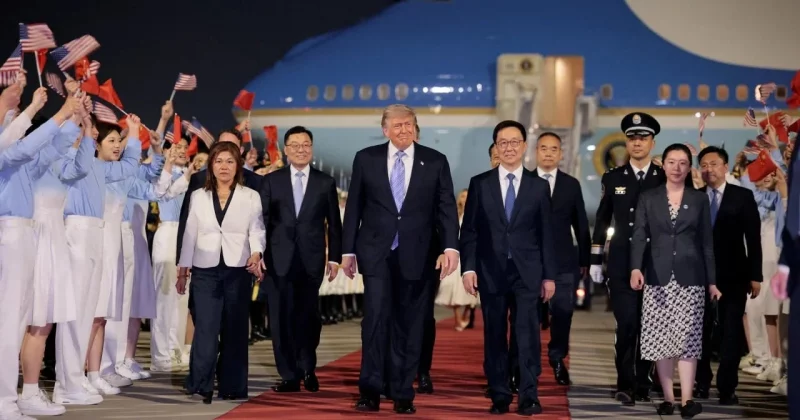
President Donald Trump is scheduled to arrive in Beijing for a high-stakes summit with Chinese President Xi Jinping, marking a pivotal moment in the complex relationship between the world’s two largest economies. While the official diplomatic itinerary focuses on the perennial issues of trade imbalances, technological competition, and the curbing of fentanyl precursor chemical flows, a more subtle battle for financial dominance is unfolding in the background. For global cryptocurrency investors and digital asset strategists, this summit represents more than just a diplomatic exchange; it is a crossroads for the future of decentralized finance, stablecoin regulation, and the global distribution of blockchain infrastructure.
The meeting comes at a time of heightened regulatory scrutiny in the United States and a continued, rigorous crackdown on private digital assets within the borders of the People’s Republic of China. As both leaders sit down to negotiate the terms of their future economic engagement, the underlying structural decisions regarding cross-border payments, financial surveillance, and artificial intelligence (AI) export controls will inevitably dictate the next chapter of the crypto industry.
The Fentanyl Connection and the Rise of Stablecoin Enforcement
One of the most pressing items on the summit agenda is the flow of fentanyl precursors from Chinese chemical manufacturers to cartels in the Western Hemisphere. However, the mechanism of payment for these illicit goods has increasingly drawn the attention of the United States Department of the Treasury and the Office of Foreign Assets Control (OFAC). Recent enforcement actions have highlighted that stablecoins—digital assets pegged to the value of the U.S. dollar—have become a preferred rail for some of these transactions due to their speed and perceived anonymity.
Washington has moved aggressively to tighten the noose around stablecoin issuers, specifically targeting entities like Tether (USDT). The U.S. government’s strategy is two-fold: to disrupt the financial supply chains of the opioid crisis and to assert regulatory authority over the digital dollar ecosystem. By framing stablecoin regulation as a matter of national security and public health, the Trump administration is positioning the U.S. to demand greater transparency from international financial hubs.
The implications for the crypto market are profound. If the summit results in a joint commitment to track and freeze assets related to the precursor trade, it could lead to unprecedented levels of cooperation—or friction—between U.S. regulators and Chinese financial authorities. Such a move would likely necessitate more stringent Know Your Customer (KYC) and Anti-Money Laundering (AML) protocols for stablecoin issuers globally, potentially impacting the liquidity and "permissionless" nature of these assets.
A Chronology of Divergent Digital Strategies
To understand the weight of the current summit, one must look at the divergent paths the U.S. and China have taken over the last decade regarding digital assets.
- 2017–2019: During President Trump’s first term, the U.S. saw a period of significant institutional maturation. While the President himself expressed skepticism toward Bitcoin, his administration oversaw the approval of the first Bitcoin futures contracts on the CME and CBOE. Simultaneously, major American banks began exploring custody solutions, and the Securities and Exchange Commission (SEC) began its long-running effort to define the boundaries of digital securities.
- 2021: China delivered a decisive blow to the global crypto ecosystem by banning all domestic cryptocurrency trading and mining. This move effectively ended China’s reign as the world’s largest Bitcoin mining hub, where it once controlled over 65% of the global hashrate.
- 2022–2023: The U.S. focused on "regulation by enforcement," with the collapse of FTX and Celsius prompting a wave of lawsuits and legislative proposals aimed at stablecoins and exchange transparency. Meanwhile, China accelerated the pilot programs for its Central Bank Digital Currency (CBDC), the e-CNY, integrating it into public transport, retail, and government payrolls.
- 2024: The current summit takes place against a backdrop where the U.S. is the primary hub for institutional crypto (following the approval of Spot Bitcoin and Ethereum ETFs) and China is the leader in state-controlled digital fiat.
The Great Hashrate Migration and Energy Geopolitics
The 2021 Chinese ban on mining triggered what was described as the "Great Migration" of hardware. Thousands of ASIC miners were shipped from Chinese provinces like Sichuan and Xinjiang to the United States, Kazakhstan, and Russia. Today, the United States holds the largest share of the global Bitcoin hashrate, with significant operations located in Texas, Wyoming, and Georgia.
The summit in Beijing may touch upon the energy requirements of the digital age. As both nations race for AI supremacy, the demand for high-performance computing (HPC) centers—which share infrastructure similarities with crypto mining farms—is skyrocketing. If the U.S. continues to restrict the export of high-end semiconductors (such as those produced by Nvidia) to China, it hampers not only China’s AI ambitions but also its ability to develop next-generation mining hardware. China’s domestic semiconductor firms, such as SMIC, are working to bridge this gap, but the technological divide remains a central point of contention in the trade war.
Stablecoins as Instruments of Dollar Hegemony
A critical point of analysis for market observers is the role of dollar-backed stablecoins in international trade. Despite the adversarial relationship between Washington and the crypto industry, stablecoins like USDC and USDT have inadvertently served to strengthen the U.S. dollar’s global dominance. In emerging markets where local currencies are volatile, the demand for digital dollars is immense.
Beijing views this "digital dollarization" with concern. The e-CNY is not merely a tool for domestic surveillance; it is a strategic attempt to create a cross-border payment system that bypasses the SWIFT network and the U.S. banking system. This is often referred to as the "mBridge" project, a collaboration between the central banks of China, Thailand, the UAE, and Hong Kong to facilitate instant, low-cost cross-border payments using CBDCs.
If the Trump-Xi summit results in increased trade friction, China may accelerate its efforts to encourage international partners to settle trade in e-CNY rather than U.S. dollars or dollar-pegged stablecoins. This would set up a direct competition between decentralized, dollar-backed digital assets and state-backed, yuan-denominated digital assets.
Data Points: The Economic Backdrop
The scale of the economic relationship between the U.S. and China provides the necessary context for these digital asset shifts. According to U.S. Census Bureau data, the trade deficit with China remains a significant political talking point, hovering in the hundreds of billions of dollars annually.
- Stablecoin Market Cap: The total market capitalization of stablecoins has recently fluctuated between $150 billion and $170 billion, with Tether (USDT) accounting for a dominant share. Much of this liquidity flows through offshore exchanges that have historically had ties to the Chinese market.
- Mining Hashrate: The U.S. currently accounts for approximately 35-40% of the global Bitcoin hashrate, a dramatic shift from 2020 when it was under 10%.
- e-CNY Adoption: As of late 2023, the People’s Bank of China (PBoC) reported that transaction volume for the digital yuan had reached roughly 1.8 trillion yuan ($250 billion), with over 120 million wallets opened.
These figures illustrate that while the U.S. leads in private sector innovation and market valuation, China leads in the state-mandated adoption of digital currency infrastructure.
Official Responses and Inferred Perspectives
While the White House and the Zhongnanhai have not released specific statements regarding cryptocurrency in relation to this summit, the positions of key figures offer a glimpse into the likely rhetoric.
U.S. Treasury officials have repeatedly stated that "digital assets must not be used to circumvent sanctions or facilitate the flow of illicit drugs." This suggests that any agreement on fentanyl will include a financial component involving increased monitoring of blockchain addresses.
On the other side, Chinese officials have maintained a consistent "zero-tolerance" policy toward decentralized cryptocurrencies, citing risks to financial stability and the potential for capital flight. However, Beijing has been more welcoming of "blockchain technology" as a broader category, emphasizing its use in supply chain management and administrative efficiency, provided it remains under the purview of the state.
Industry leaders in the U.S., including CEOs of major exchanges and stablecoin issuers, have urged the administration to provide a clear regulatory framework to prevent the industry from moving entirely offshore. They argue that a "pro-innovation" stance is necessary to counter China’s state-led digital currency initiatives.
Broader Implications for Global Investors
The outcome of the Trump-Xi summit will likely ripple through the digital asset markets in several ways.
First, any move toward increased financial surveillance could lead to a "bifurcation" of the crypto market. We may see the emergence of a "compliant" ecosystem, where assets are strictly tracked and regulated by Western standards, and a "non-compliant" or "gray" market that operates in jurisdictions with less oversight.
Second, the summit could influence the valuation of "privacy coins" and decentralized protocols. If centralized stablecoins become too heavily regulated or monitored, users seeking privacy may migrate toward decentralized alternatives or privacy-focused assets, though these face their own set of regulatory hurdles.
Third, the technological "cold war" over semiconductors will continue to impact the hardware side of the industry. Investors in mining companies must account for the geopolitical risks associated with hardware procurement and the potential for new tariffs on Chinese-made mining rigs.
In conclusion, while the mainstream headlines will focus on the handshake between President Trump and President Xi and the traditional metrics of trade and diplomacy, the underlying current of the summit is the battle for the future of money. The U.S. enters the room with the power of the digital dollar and the world’s most robust institutional crypto market. China enters with a state-controlled digital currency and a firm grip on the supply chains that power the digital age. The "quiet contest" for the future of the blockchain will be decided not just in code, but in the high-level negotiations taking place in Beijing. For the crypto investor, the takeaway is clear: the industry is no longer an outsider to global politics; it is now a central piece of the geopolitical puzzle.














