


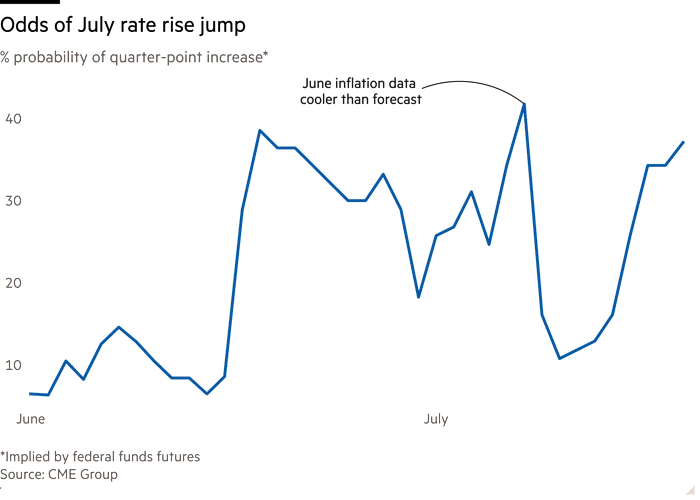
Investors have sharply increased their expectations for a Federal Reserve interest rate hike, driven by a dramatic surge in Brent crude oil prices that briefly pushed the benchmark above $100 a barrel. This renewed inflationary pressure stems directly from intensified supply fears linked to the ongoing Iran conflict and the heightened shipping risks across critical Middle East maritime routes. Futures markets now indicate a 38% probability of a quarter-point increase in the federal funds rate at the Federal Open Market Committee (FOMC) meeting scheduled for July 28-29, a significant jump from just 13% recorded one week prior. The rapid shift in sentiment underscores the market’s sensitivity to energy price volatility and its potential to derail disinflationary trends, forcing central bankers to consider more aggressive monetary tightening.
The ripple effects of rising oil prices have permeated global financial markets, leading to a notable uptick in Treasury yields and a broad tightening of financial conditions. This environment has put considerable pressure on risk assets, with cryptocurrencies feeling the pinch. Bitcoin, for instance, traded near the $64,000 mark during a particularly volatile week, as investors recalibrated their demand for speculative assets in anticipation of the upcoming FOMC policy decision. The confluence of geopolitical instability, commodity price inflation, and a hawkish shift in central bank expectations creates a complex and challenging backdrop for policymakers and market participants alike.
The Geopolitical Undercurrent: Oil’s Ascent and Supply Fears
The recent spike in crude oil prices is inextricably linked to a worsening geopolitical landscape, particularly in the Middle East. Brent crude, the international benchmark, settled above $100 on Thursday, recording a substantial 7% gain during that single session. Similarly, West Texas Intermediate (WTI), the U.S. benchmark, climbed past $92, as traders rapidly priced in the likelihood of significant supply disruptions. This recent move positions Brent crude approximately 25% above its level observed during the Federal Reserve’s June meeting, signaling a material change in the global energy market dynamics. The primary catalyst for this surge is the escalating conflict involving Iran and its proxies, which has amplified concerns over the security of oil transit through vital waterways such as the Strait of Hormuz and the Red Sea.
The Strait of Hormuz, a narrow choke point between the Persian Gulf and the Gulf of Oman, is one of the world’s most strategically important oil passages, through which roughly a fifth of global oil consumption flows. Any perceived threat to this waterway immediately triggers anxiety among energy traders, leading to speculative buying and price hikes. Concurrently, ongoing disruptions in the Red Sea, largely attributed to attacks on commercial shipping, have forced many vessels to reroute around Africa, adding significant costs and delays to global supply chains. These developments exacerbate an already tight global oil market, where OPEC+ production cuts and robust demand, particularly from emerging economies, have kept inventories lean. Higher fuel costs are not merely an abstract market phenomenon; they swiftly translate into increased expenses for transportation, manufacturing, and ultimately, household budgets, fueling broader inflationary pressures across economies.
Historically, oil price shocks have often preceded periods of economic slowdown or recession, as they act as a tax on consumers and businesses, reducing disposable income and corporate profits. The 1970s oil crises and the run-up to the 2008 financial crisis both serve as stark reminders of crude oil’s profound impact on macroeconomic stability. The current situation, with geopolitical tensions directly threatening key supply arteries, injects an element of unpredictability that is particularly challenging for central banks aiming to manage inflation expectations.

Monetary Policy in Focus: The Federal Reserve’s Tightrope Walk
The recent surge in oil prices presents the Federal Reserve with an increasingly difficult challenge in balancing its dual mandate of achieving maximum employment and maintaining price stability. While the central bank has made considerable strides in taming inflation over the past year, the renewed energy shock threatens to undo some of that progress. The inflation picture currently facing policymakers is a complex mosaic of conflicting signals.
Data released for June showed a monthly decline in consumer prices, falling 0.4% from May, which contributed to a slowdown in the annual inflation rate to 3.5%. The core inflation rate, which strips out volatile food and energy components, held steady at 2.6%. These figures have been cited by some officials as a justification for continued patience, arguing that underlying inflationary pressures are moderating. However, the Personal Consumption Expenditures (PCE) price index, the Fed’s preferred inflation gauge, tells a different story. May PCE inflation reached 4.1% year-over-year, with core PCE standing at 3.4%. Both of these readings remain significantly above the Fed’s long-term target of 2%, indicating that the battle against inflation is far from over.
At its June meeting, the Federal Reserve opted to maintain the federal funds target rate within the range of 3.5% to 3.75%. The accompanying statement explicitly acknowledged that inflation remained elevated, partly attributing this to "supply shocks, including energy." This recognition of energy’s role underscores the dilemma now faced by the FOMC. A rate hike next week would lift the target range by 25 basis points, marking a rapid and decisive response to the re-emerging inflationary threat. Such a move would signal the Fed’s commitment to its inflation mandate, even if it means potentially sacrificing some economic growth in the short term. The CME Group’s FedWatch Tool, which tracks the probability of future rate changes based on federal funds futures trading, reflects this heightened uncertainty, with trading volume reportedly 50% higher than before the comparable July 2025 decision, signaling broad disagreement on whether policymakers will act immediately or await further evidence.
Market Repercussions: Treasury Yields and Financial Conditions
The increased likelihood of a Federal Reserve rate hike, fueled by soaring oil prices, has profoundly impacted bond markets, leading to a significant rise in Treasury yields. Short-term Treasury yields, which are particularly sensitive to immediate monetary policy expectations, have seen the most pronounced movements. The two-year Treasury yield, a key indicator of short-term interest rate expectations, reached 4.37% on July 23, marking its highest level since early 2025. Concurrently, the benchmark ten-year Treasury yield approached 4.7%, reflecting broader concerns about long-term inflation and borrowing costs.
This upward trajectory in Treasury yields translates directly into higher borrowing costs across the economy. For corporations, it means more expensive debt financing, potentially dampening investment and expansion plans. For households, rising yields directly impact mortgage rates, making homeownership less affordable and potentially cooling the housing market. Auto loans and other forms of consumer credit also become more costly, tightening the financial conditions that influence consumer spending.
Tightening financial conditions generally refer to a reduction in the availability of credit and an increase in its cost. This environment typically leads to a deceleration in economic activity as businesses and consumers become more cautious about spending and investment. Historically, periods of rapidly rising Treasury yields have often exerted downward pressure on equity valuations, particularly for growth stocks and companies with high debt loads, as the present value of future earnings is discounted at a higher rate. Moreover, the allure of higher-yielding, low-risk government bonds can draw capital away from more speculative assets, contributing to a broader market re-evaluation of risk.
Bitcoin and Risk Assets: Navigating a Hawkish Environment
The prospect of a Federal Reserve rate hike and the consequent tightening of financial conditions create a challenging backdrop for risk assets, including Bitcoin and other cryptocurrencies. During periods when Treasury yields rise and expectations for abundant liquidity diminish, speculative assets typically face headwinds. Bitcoin, which traded near $63,993 on July 25 after fluctuating between approximately $63,700 and $65,055 over the week, exemplifies this vulnerability.
A Federal Reserve rate hike, by increasing the return on cash and government bonds, makes these instruments more attractive to investors. Unlike Bitcoin, which carries significant price volatility, cash and government bonds offer a relatively stable, income-generating alternative. This shift in relative attractiveness can lead investors to reallocate capital from riskier, non-yielding assets like cryptocurrencies to safer, yielding assets. The narrative that Bitcoin acts as an "inflation hedge" also comes under scrutiny when inflation is driven by supply shocks that central banks cannot directly address with interest rate hikes, and when the policy response itself tightens financial conditions.
The current environment underscores the sensitivity of the crypto market to macroeconomic factors. While Bitcoin’s long-term value proposition often rests on its decentralized nature and limited supply, its short-to-medium-term price action remains highly correlated with broader market liquidity and investor risk appetite. As borrowing costs increase globally, the cost of capital for crypto ventures rises, and the speculative fervor that often drives crypto valuations can diminish. Investors are increasingly reassessing the demand for risk assets, prioritizing capital preservation and yield in an environment characterized by rising interest rates and economic uncertainty.
The Fed’s Conundrum: Supply Shocks vs. Demand Management
The oil shock introduces a particularly vexing policy problem for the Federal Reserve because it is largely a supply-side phenomenon that interest rate adjustments cannot directly resolve. While higher borrowing costs can effectively reduce aggregate demand in the economy, they are impotent in restoring disrupted crude oil supplies or mitigating geopolitical risks. This fundamental trade-off amplifies concerns about a potential recession or stagflation, especially if energy prices remain stubbornly high while credit conditions continue to tighten. Policymakers must therefore closely monitor not only inflation data but also the evolving geopolitical landscape and its implications for commodity markets.

The Federal Reserve officials themselves appear to be divided ahead of the critical July 28-29 meeting. A faction of policymakers, often referred to as "hawks," has consistently argued that elevated inflation requires prompt and decisive action, advocating for faster rate hikes to anchor inflation expectations. Conversely, other officials, often termed "doves," prefer a more patient approach, favoring a wait-and-see strategy until September to gather more conclusive evidence on both price trends and the broader economic activity, particularly labor market conditions. This internal disagreement within the FOMC renders markets acutely sensitive to every fluctuation in oil prices, every public comment from a Fed official, and every new inflation data release.
Adding to the complexity, the next Personal Consumption Expenditures (PCE) report, a crucial inflation metric for the Fed, is scheduled for release on July 30 – a full day after the FOMC decision. This means policymakers will not have access to this critical piece of information when casting their votes. Instead, they must base their decision on a mosaic of available data, including June’s Consumer Price Index (CPI), May’s PCE figures, the dynamics of energy markets, the impact of tariffs, trends in services inflation, and the latest labor market conditions. This limitation in real-time data significantly raises the risk of a divided committee and could lead to a policy decision that is either perceived as premature or insufficient by different segments of the market.
Looking Ahead: Key Indicators and Geopolitical Watchpoints
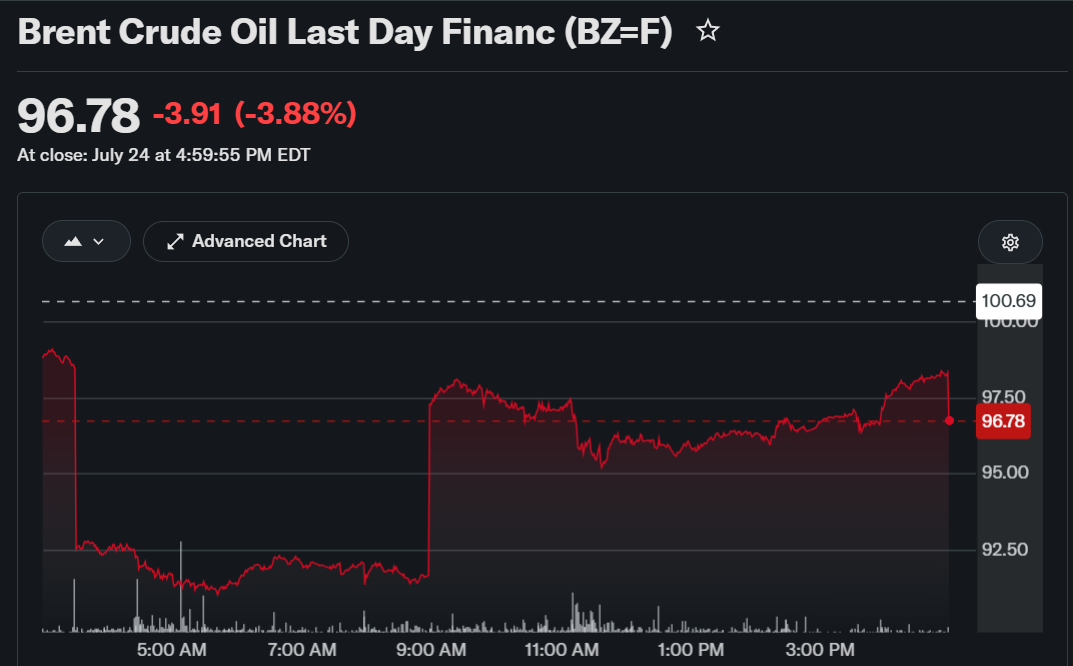
While oil prices eased below $100 on Friday, with Brent crude ending the week near $96.78, the volatility and underlying supply risks persist. A sustained retreat in crude prices could potentially alleviate immediate pressure for a Federal Reserve rate hike, offering policymakers more room for a cautious approach. However, any new supply disruption or escalation of geopolitical tensions could quickly reverse this temporary relief.
Going forward, markets will meticulously monitor several key indicators and geopolitical flashpoints. The Strait of Hormuz and Red Sea shipping lanes will remain under intense scrutiny for any signs of further disruption. Treasury yields, particularly the two-year and ten-year benchmarks, will be watched closely as a barometer of market expectations for future interest rates and economic growth. Federal Reserve guidance, particularly any forward-looking statements from Chairman Jerome Powell during the post-FOMC press conference, will be critical in shaping investor sentiment.
Beyond the immediate FOMC decision, market participants will be keenly awaiting the July 30 PCE report for a clearer picture of underlying inflation. Subsequent employment figures and other economic activity indicators will also play a crucial role in determining the Fed’s trajectory for the remainder of the year. The delicate balance between taming inflation and avoiding a recession will continue to define monetary policy debates, making the coming weeks pivotal for global financial markets and the broader economy. The interaction between energy market dynamics, geopolitical developments, and central bank policy will likely remain the dominant narrative, requiring constant vigilance from investors and policymakers alike.














