


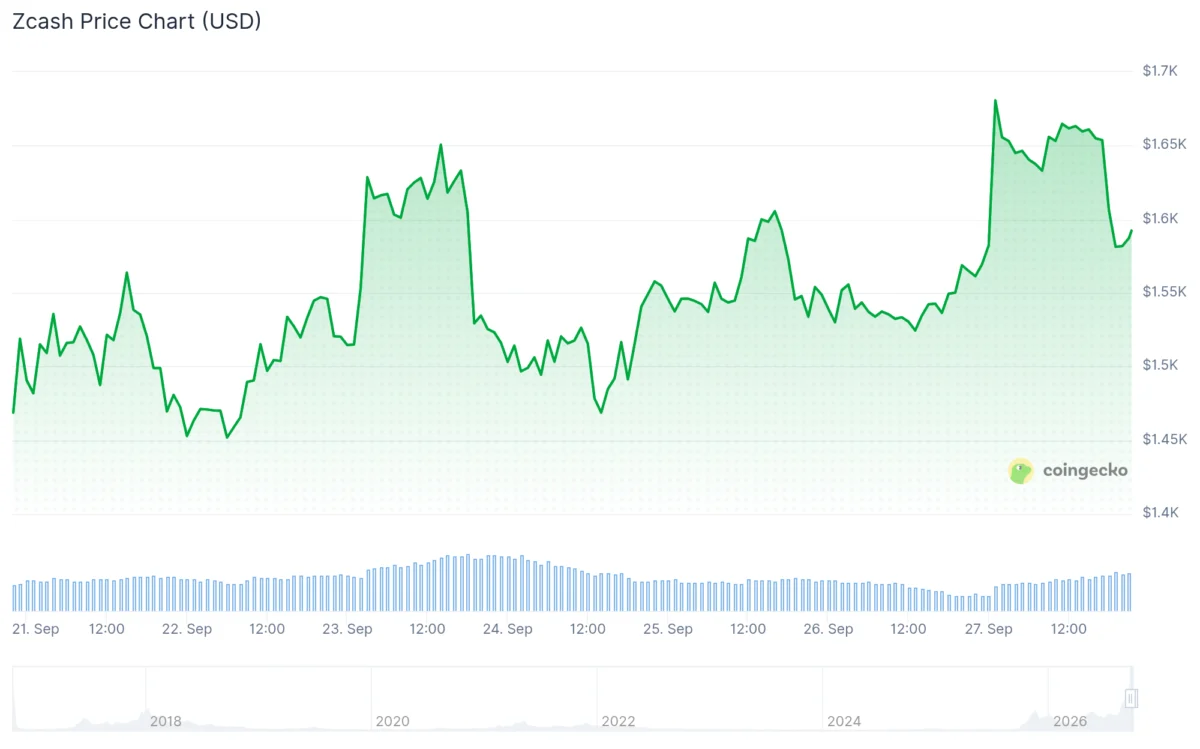
Grayscale Investments, a prominent digital asset manager, has submitted a proposal to the U.S. Securities and Exchange Commission (SEC) for a new Zcash exchange-traded fund (ETF) designed to generate income through options strategies linked to Zcash exchange-traded products. This significant filing, dated September 25, arrives as Grayscale’s existing ZCSH fund, which provides direct exposure to Zcash (ZEC), nears an impressive $1 billion in assets under management. Concurrently, the price of ZEC has experienced a notable September advance, trading near $1,580 following the announcement, with investors closely scrutinizing the implications of this novel investment vehicle.
Understanding the Proposed ZCSH High Income ETF
The newly proposed fund, to be named the ZCSH High Income ETF, aims to deliver consistent shareholder distributions, specifically targeting a bi-weekly payout schedule. Crucially, its investment strategy diverges significantly from traditional cryptocurrency ETFs or even Grayscale’s own ZCSH fund. Rather than holding Zcash tokens directly, the ZCSH High Income ETF intends to invest primarily in options that reference existing Zcash exchange-traded products, such as Grayscale’s current ZCSH offering. This distinction is vital for potential investors, as it implies a different risk-reward profile, where the fund’s returns could vary considerably from the direct price movements of ZEC or the performance of the ZCSH fund itself. The filing describes an actively managed strategy, combining current income generation with some potential for capital appreciation.
Under normal market conditions, the fund would commit at least 80% of its notional value to options tied to Zcash exchange-traded products. The core of its strategy involves a synthetic covered call approach. This entails the manager purchasing call options and selling put options to establish exposure to the underlying product’s price. Simultaneously, the fund would sell other call options to collect premiums, which would then contribute to the income distributed to shareholders. These income-generating call options are generally expected to have short expirations, typically one month or less. While Grayscale’s existing ZCSH fund, which holds ZEC directly, is explicitly mentioned as a potential underlying product for these options, the specific ticker and fee figures for the new fund were left blank in the initial SEC filing.
The Mechanics of a Synthetic Covered Call Strategy
The synthetic covered call strategy is a sophisticated financial technique commonly employed in traditional markets to generate income, particularly in sideways or moderately bullish environments. In the context of the ZCSH High Income ETF, the fund would:
- Buy Call Options: This provides the fund with the right, but not the obligation, to buy the underlying Zcash ETP (e.g., ZCSH) at a specified price (strike price) before a certain date. This leg helps capture some upside potential of the underlying.
- Sell Put Options: This obligates the fund to buy the underlying Zcash ETP at a specified strike price if the price falls below that level. This generates premium income but also exposes the fund to potential losses if the underlying asset declines significantly.
- Sell Call Options (Income Generation): This is the "covered call" aspect. The fund sells call options on the underlying Zcash ETP. By selling these calls, the fund collects an upfront premium. However, this strategy caps the fund’s upside participation. If the underlying Zcash ETP price rises above the strike price of the sold calls, the fund may be obligated to sell the underlying at that strike, thus missing out on any further gains.
This combination aims to create a stream of income from the premiums collected. However, it comes with inherent risks. While the option premiums provide cash, they do not guarantee a profit, especially if the underlying Zcash ETP experiences a sharp decline. Selling puts, in particular, leaves the strategy exposed to significant losses if the underlying fund’s value drops substantially. Furthermore, the strategy’s performance will differ markedly from simply holding ZEC or the ZCSH fund, as its upside potential is constrained by the sold calls, and it remains vulnerable to downturns. Grayscale explicitly states that its proposed distributions have no guaranteed amount or yield, and some payments could even represent a return of investors’ capital if the income generated proves insufficient.
Zcash (ZEC): A Brief Background and Market Position

Zcash (ZEC) is a decentralized cryptocurrency that prioritizes privacy and selective transparency. Launched in 2016, it was developed by Zcash Company (now Electric Coin Co.) and is built on a codebase derived from Bitcoin. Its distinguishing feature is the use of zero-knowledge proofs, specifically zk-SNARKs (Zero-Knowledge Succinct Non-Interactive Argument of Knowledge), which allow transactions to be verified without revealing sensitive information such as the sender, recipient, or amount. This cryptographic innovation enables "shielded transactions," offering a high degree of anonymity, a feature that sets it apart from many other cryptocurrencies where transaction details are publicly visible on the blockchain.
The emphasis on privacy has positioned Zcash as a contender in the niche of privacy coins. However, it has also brought increased scrutiny from regulators globally, who often express concerns about the potential for privacy features to facilitate illicit activities. Despite these regulatory challenges, Zcash has maintained a dedicated community and continued development, focusing on enhancing its privacy features and expanding its utility. Its market performance, like many cryptocurrencies, is subject to broader market trends, technological developments, and regulatory sentiment. The September rally of ZEC, leading up to and coinciding with Grayscale’s filing, indicates renewed investor interest or positive market sentiment surrounding the asset.
Grayscale’s Pioneering Role in Digital Asset Investment
Grayscale Investments has been a trailblazer in bringing digital assets to traditional investment vehicles. Known primarily for its Grayscale Bitcoin Trust (GBTC), which for years offered institutional and accredited investors indirect exposure to Bitcoin, the firm has consistently sought to bridge the gap between the nascent crypto market and established financial systems. Grayscale’s strategy has involved launching a suite of single-asset trusts, including the Zcash Trust, which allowed investors to gain exposure to ZEC without the complexities of direct custody.
A pivotal moment for Grayscale, and indeed for the broader crypto market, was the conversion of several of its trusts into spot ETFs. This process began in earnest with its push for a Bitcoin spot ETF, and eventually, the Zcash Trust successfully converted into the ZCSH ETF. This conversion, which saw ZCSH begin trading on NYSE Arca on August 25, marked a significant milestone, offering greater liquidity and accessibility to investors. The firm’s continuous innovation in product development, from simple trusts to spot ETFs and now to income-generating options-based ETFs, underscores its commitment to meeting diverse investor demands and expanding the institutional adoption of digital assets. The successful conversion of the Zcash Trust into ZCSH and its rapid asset growth to nearly $1 billion by September 25 laid the groundwork for the current income-focused ETF proposal, creating the necessary underlying product for its options strategy.
Chronology of ZCSH and the New Filing
The timeline leading up to the ZCSH High Income ETF proposal demonstrates Grayscale’s strategic progression:
- Prior to August 25: The Grayscale Zcash Trust operated, holding ZEC for investors, with assets around $155 million as of June 30.
- August 25: The Grayscale Zcash Trust officially converted into the ZCSH ETF, commencing trading on NYSE Arca, significantly increasing accessibility and liquidity.
- September 8: Listed options on ZCSH became available, creating the financial instruments that the proposed income strategy could utilize. On the same day, Digital Currency Group (Grayscale’s indirect parent company) exchanged 85,705 ZEC for approximately $100 million in new ZCSH shares, contributing to the fund’s asset growth.
- September 25: Grayscale filed the proposal for the ZCSH High Income ETF with the SEC. On this date, the existing ZCSH fund held roughly $996 million in total assets, reflecting both new subscriptions, the DCG contribution, and the appreciation of ZEC.
- September 30 (Planned): Grayscale plans a three-for-one share split for ZCSH. This administrative change will adjust the number of shares outstanding and the price per share proportionally, without altering the total fund assets.
Market Reaction and ZEC Price Dynamics
Following the filing, ZEC’s market performance showed notable strength. At the time of the announcement, ZEC traded around $1,580, exhibiting a modest gain over the preceding 24 hours. Data from CoinGecko indicated that ZEC had risen approximately 9.6% over the previous seven days, extending a broader September advance. While the SEC filing itself does not definitively establish causation for this price movement, it undoubtedly contributed to positive market sentiment surrounding Zcash, alongside other factors like overall cryptocurrency market trends and any specific Zcash network developments.
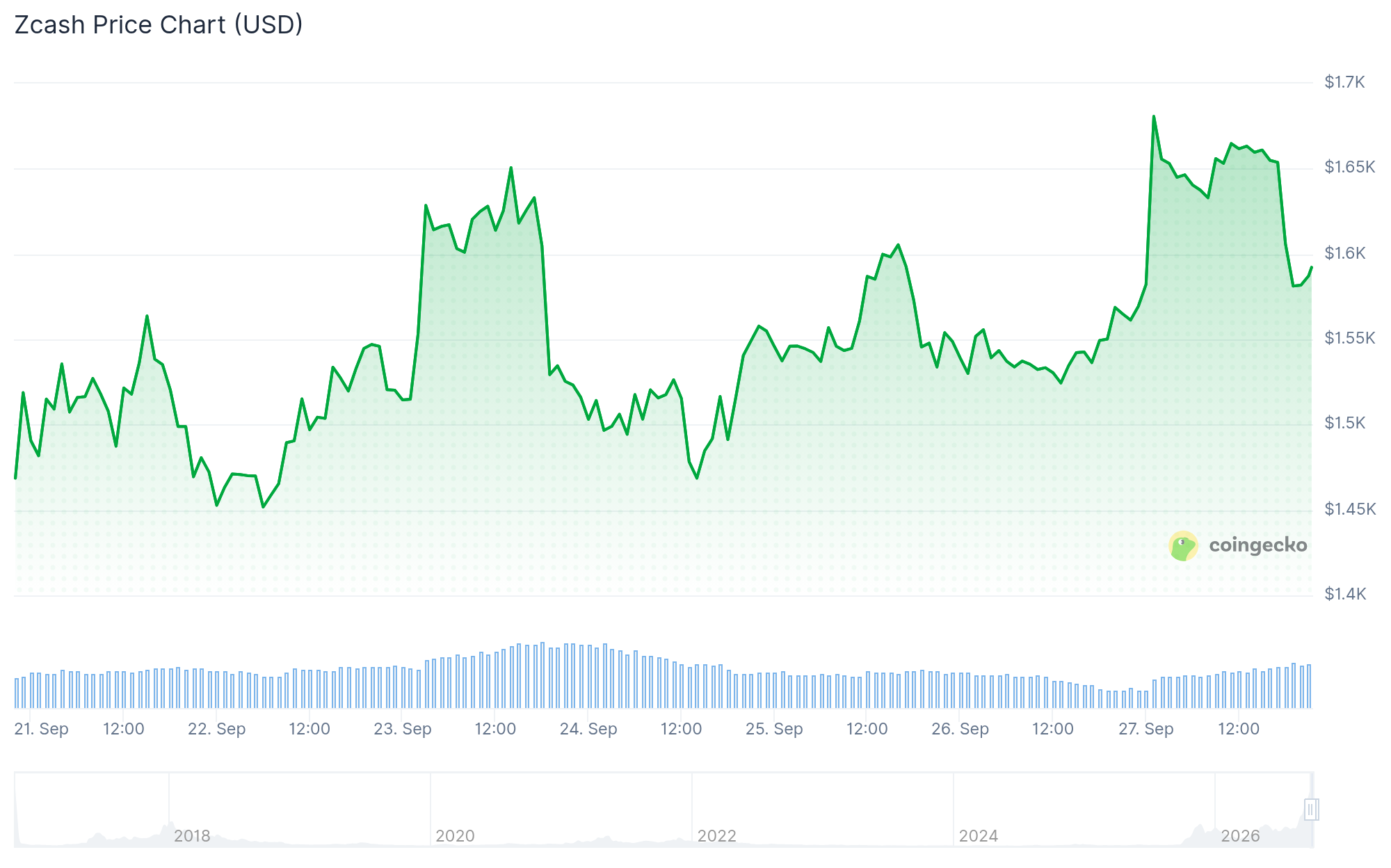
From a technical analysis perspective, the price action placed $1,592 as a key near-term resistance level, with the recent high around $1,670 serving as an upper target. A decisive move through $1,592 would likely bring the $1,670 area back into focus for traders. Conversely, a slip below the $1,534 level would suggest a weakening of the short-term bullish setup, potentially inviting further price corrections. The interplay between institutional interest, as signaled by Grayscale’s filing, and the underlying asset’s market dynamics highlights the evolving maturity of the cryptocurrency space.
Regulatory Landscape and Potential Hurdles
The journey for any new cryptocurrency-related ETF in the United States invariably involves navigating the stringent regulatory environment overseen by the SEC. The Commission has historically adopted a cautious, often skeptical, approach to approving spot cryptocurrency ETFs, citing concerns related to market manipulation, investor protection, and the nascent nature of crypto markets. While Bitcoin spot ETFs have faced numerous rejections, the landscape has slowly begun to shift, particularly with growing calls for regulatory clarity and the increasing sophistication of market surveillance tools.
For a Zcash-related ETF, especially one that leverages options, additional layers of scrutiny might apply. While the ZCSH High Income ETF would not directly hold ZEC, its strategy is intrinsically linked to Zcash exchange-traded products. The privacy features of Zcash have, in the past, raised questions among regulators about potential misuse, although proponents argue that Zcash’s transparent option allows for compliance. The SEC will likely assess whether the proposed synthetic covered call strategy adequately protects investors, whether the underlying Zcash ETPs and their reference markets are sufficiently regulated, and whether there are adequate mechanisms to prevent fraud and manipulation. The "actively managed" nature of the fund and its complex options strategy will also require thorough review to ensure transparency and proper risk disclosure to investors. The SEC’s review process is typically extensive, involving public comment periods, and approvals are by no means guaranteed.
Broader Implications for Investors and the Crypto Market
The filing for the ZCSH High Income ETF carries significant implications across several fronts:
- For Income-Seeking Investors: This product could open a new avenue for traditional investors seeking yield in the volatile cryptocurrency market. By offering bi-weekly distributions, it appeals to a demographic traditionally interested in income-generating assets like dividend stocks or bond funds, potentially attracting capital from outside the existing crypto investor base. It provides a means to gain exposure to the performance of a digital asset without the complexities of direct ownership or the high volatility of unhedged positions.
- For the Zcash Ecosystem: An approved income-generating ETF would further legitimize Zcash as an investable asset class. It could increase visibility, institutional interest, and potentially drive demand for the underlying ZEC, even if the fund itself doesn’t hold the token directly. This institutional endorsement can foster greater trust and adoption within the broader financial community.
- For Grayscale’s Product Portfolio: This innovative ETF proposal further diversifies Grayscale’s offerings, moving beyond simple exposure products to more sophisticated, strategy-based funds. It positions Grayscale as an innovator capable of developing complex financial instruments tailored to evolving investor needs, solidifying its leadership in the digital asset investment space.
- Precedent for the Broader Crypto Market: If approved, the ZCSH High Income ETF could set a precedent for other income-generating crypto ETFs, particularly for altcoins. This could pave the way for a new generation of structured products that offer diversified exposure and yield opportunities across various digital assets, potentially accelerating the convergence of traditional finance and cryptocurrency markets. It could encourage other asset managers to explore similar options-based strategies for other cryptocurrencies, expanding the range of institutional-grade crypto investment products available.
- Risks and Investor Education: Despite the potential benefits, investors must be acutely aware of the risks involved. The options strategy introduces complexity and potential for returns that diverge significantly from the underlying asset. Market volatility, regulatory uncertainties, and the performance of the options themselves are critical factors. Grayscale’s caution regarding non-guaranteed distributions and the possibility of returning capital underscores the importance of comprehensive investor education.
In conclusion, Grayscale’s filing for the ZCSH High Income ETF represents a forward-thinking step in the institutionalization of cryptocurrency investments. By proposing a product designed to generate income through sophisticated options strategies, Grayscale is attempting to cater to a broader segment of the investment community, particularly those seeking yield. While the path to SEC approval remains uncertain and subject to rigorous scrutiny, the initiative underscores the ongoing evolution of financial products leveraging digital assets, potentially reshaping how investors interact with and gain exposure to the dynamic world of cryptocurrencies. The success of this proposed fund could significantly influence future product development in the digital asset management sector and further integrate cryptocurrencies into mainstream financial portfolios.














