The digital asset landscape is currently navigating a period of profound structural transition, characterized by a stark divergence between surface-level sentiment and underlying capital flows. While the broader cryptocurrency market has been defined by months of grueling sideways price action, declining retail engagement, and a prevailing sense of exhaustion, new data from on-chain analytics firm CryptoQuant suggests that a significant shift is occurring within the altcoin sector. This phenomenon, described as a "behavioral divergence," indicates that while the majority of market participants have disengaged due to persistent volatility and macro headwinds, a sophisticated cohort of investors is quietly building positions in assets outside the traditional market leaders.
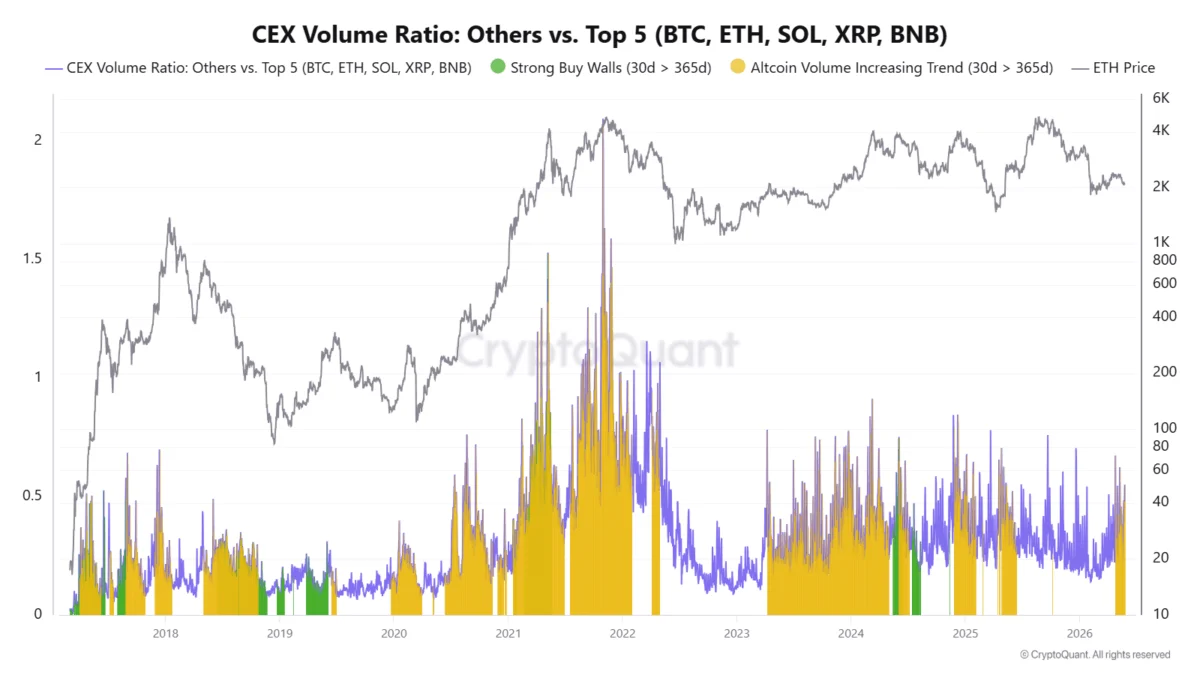
The current market environment is one of localized stagnation. Since the brief recovery attempt in February, which saw Bitcoin reach new all-time highs fueled by institutional inflows into spot ETFs, the momentum has largely dissipated. Investor sentiment has trended progressively negative as the anticipated "altcoin season"—a period where smaller-cap assets outperform Bitcoin—has failed to materialize in any meaningful way. However, beneath this veneer of apathy, exchange volume for altcoins excluding the top five assets (Bitcoin, Ethereum, Solana, XRP, and BNB) has begun to climb. This increase in activity, occurring amidst a general decline in total market volume, suggests a deliberate and strategic re-entry into the most speculative corners of the market.
The Mechanics of the Volume Divergence
To understand the significance of the current signal, one must examine the broader context of crypto trading volumes. Typically, in a healthy bull market, volume increases across the board as rising prices attract new participants. Conversely, in a bear market or a consolidation phase, volume tends to dry up as liquidity exits the system. The current anomaly lies in the fact that while overall market participation is shrinking, the "OTHERS" category—representing the thousands of smaller-cap altcoins—is seeing a relative surge in central exchange (CEX) volume.
According to CryptoQuant, this divergence is rarely accidental. When volume rises in a quiet market, it is usually driven by "smart money" or institutional-grade participants who are positioning themselves ahead of a perceived shift in market structure. These participants are not reacting to price spikes; rather, they are generating the volume themselves through consistent accumulation. By focusing on assets outside the top five, these investors are targeting the segment of the market that offers the highest potential for asymmetric returns, albeit at a higher risk profile.

This specific data point stands out because it contradicts the "retail exhaustion" narrative. Retail investors are typically momentum-driven; they buy when prices are already rising and sell when the market feels "dead." The fact that volume is increasing while the market feels stagnant suggests that the current activity is being driven by conviction-based buyers rather than reactive speculators.
Historical Context and the Multi-Year Downtrend
The altcoin market has been in a state of structural decline relative to Bitcoin for much of the last two years. The OTHERS/BTC index, which tracks the total market capitalization of all cryptocurrencies excluding the top 10 assets against the price of Bitcoin, provides a clear visual representation of this struggle. Since the peak of the last cycle, capital has remained stubbornly concentrated in Bitcoin, bolstered by its status as "digital gold" and the successful launch of regulated investment vehicles in the United States.
Throughout 2024 and the early months of 2025, the OTHERS/BTC ratio has faced relentless selling pressure. Smaller projects, ranging from decentralized finance (DeFi) protocols to gaming tokens and infrastructure layers, have struggled to maintain their value as Bitcoin dominance reached multi-year highs. This period of underperformance has led to a widespread belief that the "altcoin season" model of previous cycles might be broken or permanently altered by the professionalization of the industry.
However, the technical structure of the OTHERS/BTC chart is beginning to show signs of what analysts call "momentum deterioration." While the ratio remains in a macro downtrend—trading significantly below its 50-week, 100-week, and 200-week moving averages—the aggressive, vertical sell-offs that defined 2024 have transitioned into a prolonged sideways consolidation. This stabilization near the 0.12 region is a critical development. In technical analysis, markets often bottom through "time" rather than just "price." A long period of sideways movement suggests that the supply of motivated sellers is finally being exhausted, allowing a new floor to be established.
Stabilization and the Search for a Bottom
The repeated defense of the 0.12 level on the OTHERS/BTC ratio is a signal that buyers are stepping in to absorb selling pressure whenever the index threatens to break lower. This behavior is a prerequisite for any meaningful trend reversal. Historically, major rotations of capital from Bitcoin into altcoins do not happen overnight; they are preceded by months of base-building and decreasing volatility.

The CryptoQuant report highlights that the increasing volume during this stabilization phase is a key differentiator. If the ratio were flat on low volume, it would suggest a lack of interest. But a flat ratio on rising volume indicates a high-stakes "tug-of-war" between remaining bears and emerging bulls. If the "OTHERS" segment can successfully reclaim the 50-week moving average—a feat it has not accomplished in over a year—it would serve as a powerful confirmation that the multi-year bear market for altcoins has concluded.
Market Sentiment vs. On-Chain Reality
The disconnect between how the market feels and what the data shows is currently at an extreme. On social media and within trading communities, the consensus remains overwhelmingly skeptical. Many investors, having been "burned" by several false starts in the altcoin market over the past 18 months, have pivoted toward safer assets or exited the space entirely. This "disbelief phase" is a common characteristic of market bottoms.
From a behavioral finance perspective, the most profitable entries often occur when the narrative is at its bleakest. The CryptoQuant data suggests that the participants currently generating altcoin volume are looking past the immediate negativity. They are likely focused on several emerging themes that could drive the next leg of the cycle, including:
- Regulatory Clarity: As global jurisdictions continue to refine their frameworks for digital assets, the legal cloud hanging over many "utility tokens" is slowly lifting, making them more attractive to institutional venture capital.
- Technological Maturity: Many projects launched in 2021 and 2022 have spent the bear market building and are now reaching significant milestones in terms of mainnet launches, scalability, and user adoption.
- Liquidity Rotation: Historically, once Bitcoin enters a period of price discovery or high-level consolidation, the "wealth effect" takes hold, and investors move down the risk curve to seek higher returns in smaller assets.
Implications for the Broader Ecosystem
If the volume divergence identified by CryptoQuant leads to a sustained breakout in the altcoin sector, the implications for the broader cryptocurrency ecosystem would be significant. A revitalized altcoin market typically leads to increased on-chain activity, higher fee generation for layer-1 and layer-2 networks, and a renewed interest in decentralized applications (dApps).
However, the path forward is not without risks. The macro-economic environment remains a wildcard. Persistent inflation or hawkish signals from central banks could dampen the appetite for high-risk speculative assets. Furthermore, the altcoin market of 2025 is far more fragmented than that of 2017 or 2021. With thousands of new tokens entering the market via memecoin launchpads and automated protocols, capital is more diluted than ever before. This suggests that even if an "altcoin season" occurs, it may be highly selective, favoring projects with genuine utility, strong communities, or unique technological advantages rather than a "rising tide lifts all boats" scenario.

Chronology of the Current Cycle
To place the current divergence in context, it is helpful to look at the timeline of the 2024-2025 cycle:
- January – February 2024: Bitcoin ETFs launch, leading to a massive surge in BTC price and a brief, speculative "echo bubble" in several altcoin sectors, particularly AI and Meme coins.
- Q2 – Q3 2024: Bitcoin reaches new highs but enters a volatile range. Altcoins begin a deep correction as liquidity stays concentrated in BTC. The OTHERS/BTC ratio begins its descent toward the 0.12 level.
- Q4 2024: Total crypto market volume hits a yearly low. Sentiment turns bearish as many altcoins drop 70-80% from their yearly peaks.
- January – February 2025: A brief relief rally in February fails to flip macro resistance. Retail interest hits a multi-year low, and the "altcoins are dead" narrative gains mainstream traction.
- Present Day: CryptoQuant identifies the rising volume in the "OTHERS" category despite the quiet market, signaling a quiet accumulation phase and the potential start of a structural rotation.
Conclusion: A Market in Waiting
The data provided by CryptoQuant offers a compelling counter-narrative to the prevailing gloom in the cryptocurrency market. While the "Top 5" assets continue to command the majority of headlines and institutional capital, the quiet increase in trading volume for smaller-cap altcoins suggests that a foundation is being laid for the next phase of the cycle.
The stabilization of the OTHERS/BTC ratio at historical support levels, combined with a deliberate increase in exchange activity, indicates that the market may be closer to a turning point than the current sentiment suggests. For investors and analysts, the coming weeks will be crucial. A successful reclaim of key moving averages would validate the accumulation signal, potentially marking the end of the long-standing Bitcoin dominance and the beginning of a more diversified and active market environment. Until then, the divergence remains a subtle but powerful reminder that in the world of digital assets, the most significant moves often begin when the rest of the market is no longer watching.