


The integrity of Apple’s meticulously curated App Store, long a cornerstone of trust for millions of users, is facing significant scrutiny following a series of incidents where sophisticated cryptocurrency scams have remained live for extended periods, even after explicit and repeated warnings from the very projects being impersonated. This pattern of delayed response, which appears to prioritize confirmed financial loss over proactive trademark infringement complaints, has not only resulted in substantial monetary damages for unsuspecting users but also exposed a critical vulnerability in Apple’s app review and moderation processes, particularly concerning the rapidly evolving digital asset space. The incidents highlight a specific kind of frustration: legitimate developers meticulously reporting fraudulent applications, only to watch Apple’s platform allow the scams to persist, often for months, until a documented theft finally triggers decisive action.
This alarming trend is not an isolated anomaly but a recurring structural gap, as evidenced by the experiences of prominent decentralized finance (DeFi) analytics platform DeFiLlama and leading crypto wallet provider Rabby Wallet. Both entities encountered identical obstacles in getting Apple to remove imposter applications that leveraged their brand recognition to defraud users, ultimately leading to significant financial losses that could have been prevented with more timely intervention.
The DeFiLlama Ordeal: A Precedent of Reactive Enforcement
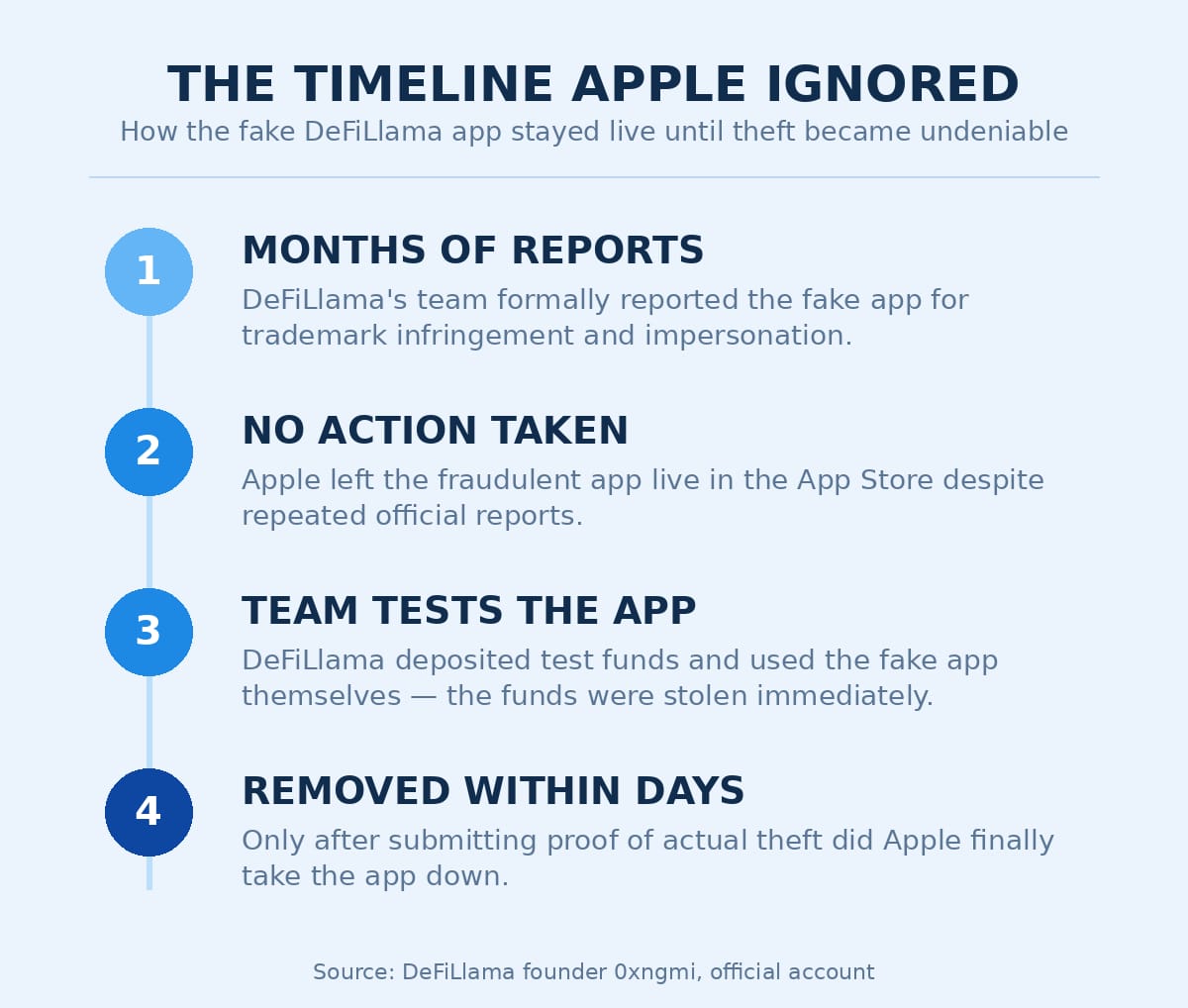
The timeline of the DeFiLlama incident serves as a stark illustration of Apple’s reactive approach. According to 0xngmi, the founder of DeFiLlama, his team spent several months engaged in a frustrating cycle of reporting a fake DeFiLlama application on the Apple App Store. These reports consistently cited clear instances of trademark infringement and blatant impersonation, foundational issues that, in a perfect world, should trigger immediate investigation and removal within a platform priding itself on user safety and intellectual property protection. Yet, despite these formal complaints, the fraudulent app remained accessible to millions of iPhone users.
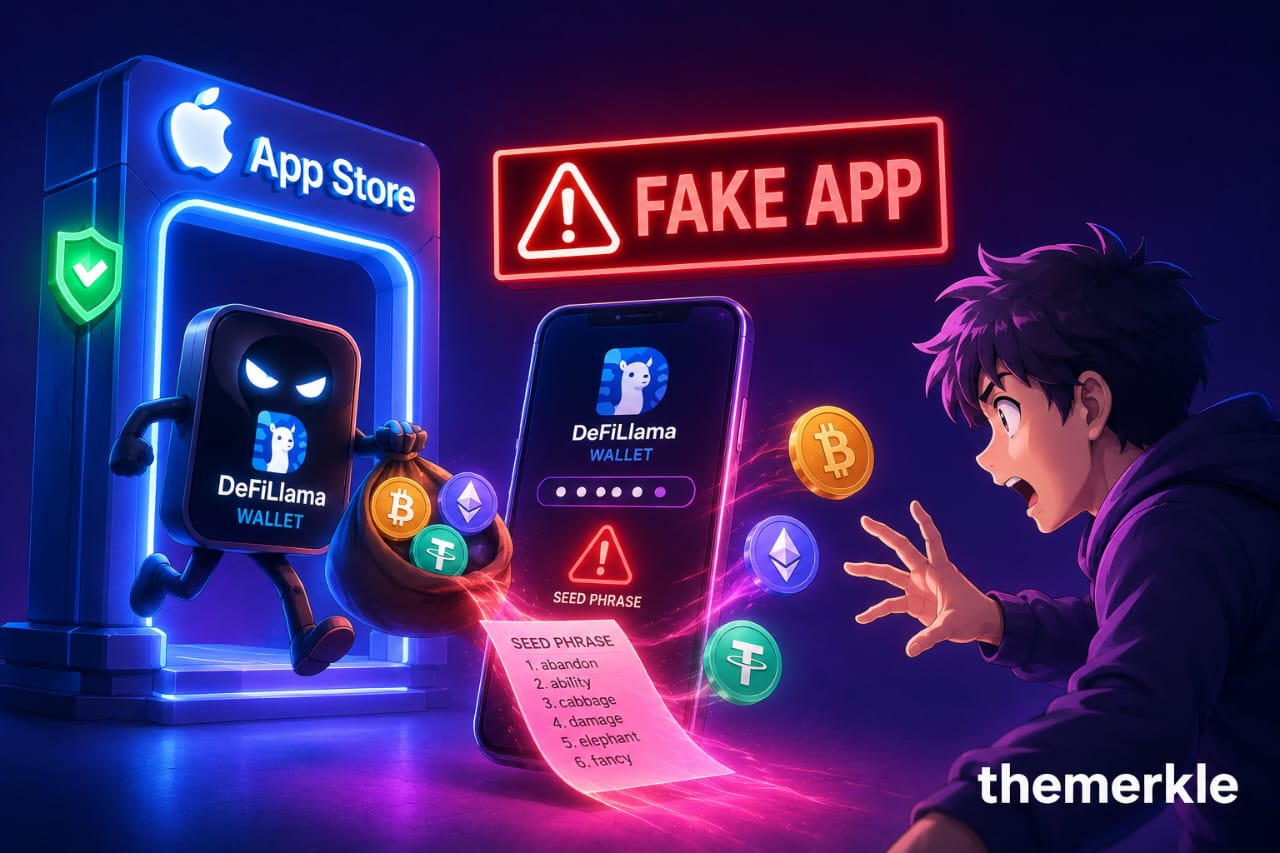
The inaction continued until the DeFiLlama team took an extraordinary and drastic step. In a desperate attempt to force Apple’s hand, they deposited a small amount of funds into a test wallet and, using the fake app, deliberately entered the seed phrase as instructed by the fraudulent interface. Predictably, the funds were stolen almost immediately. It was only after this irrefutable proof of financial theft was submitted as hard evidence that Apple finally acted, removing the imposter application within a matter of days. This sequence of events, as 0xngmi highlighted, sends an uncomfortable message: a legitimate team’s months-long efforts to report trademark violations apparently carried less weight with Apple than a single, concrete instance of financial loss directly attributable to the malicious app.
Further exacerbating concerns, 0xngmi revealed that the same attackers responsible for the fake DeFiLlama app were operating a broader scheme, having developed similar fake applications targeting multiple other major crypto brands. This indicates a sophisticated, scalable operation designed to systematically exploit perceived weaknesses in app store review processes, rather than a one-off attempt against a single target. The implications are profound: if a well-known project like DeFiLlama struggles for months to get a clear scam removed, what hope do smaller projects or individual users have?
Rabby Wallet’s Parallel Predicament: Approval Before Legitimacy
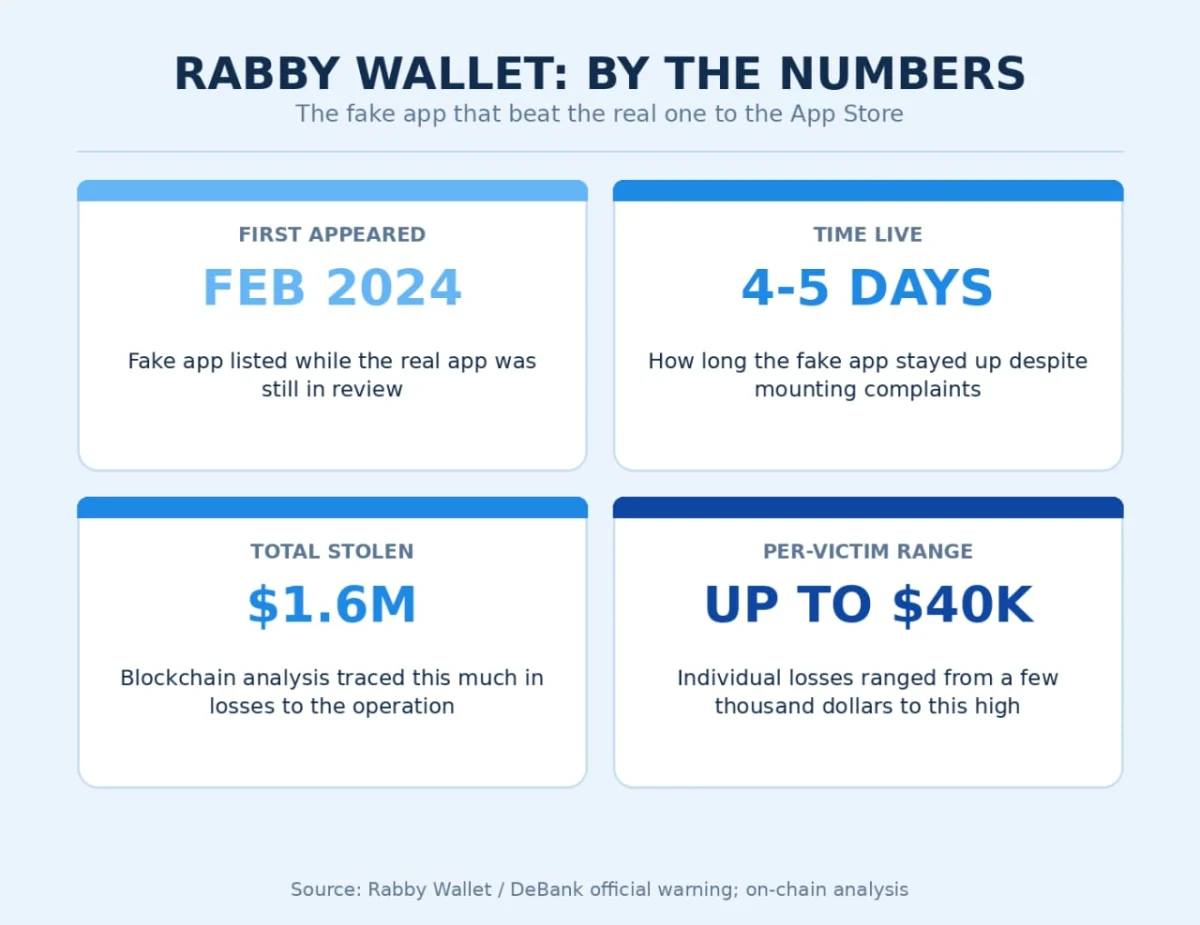
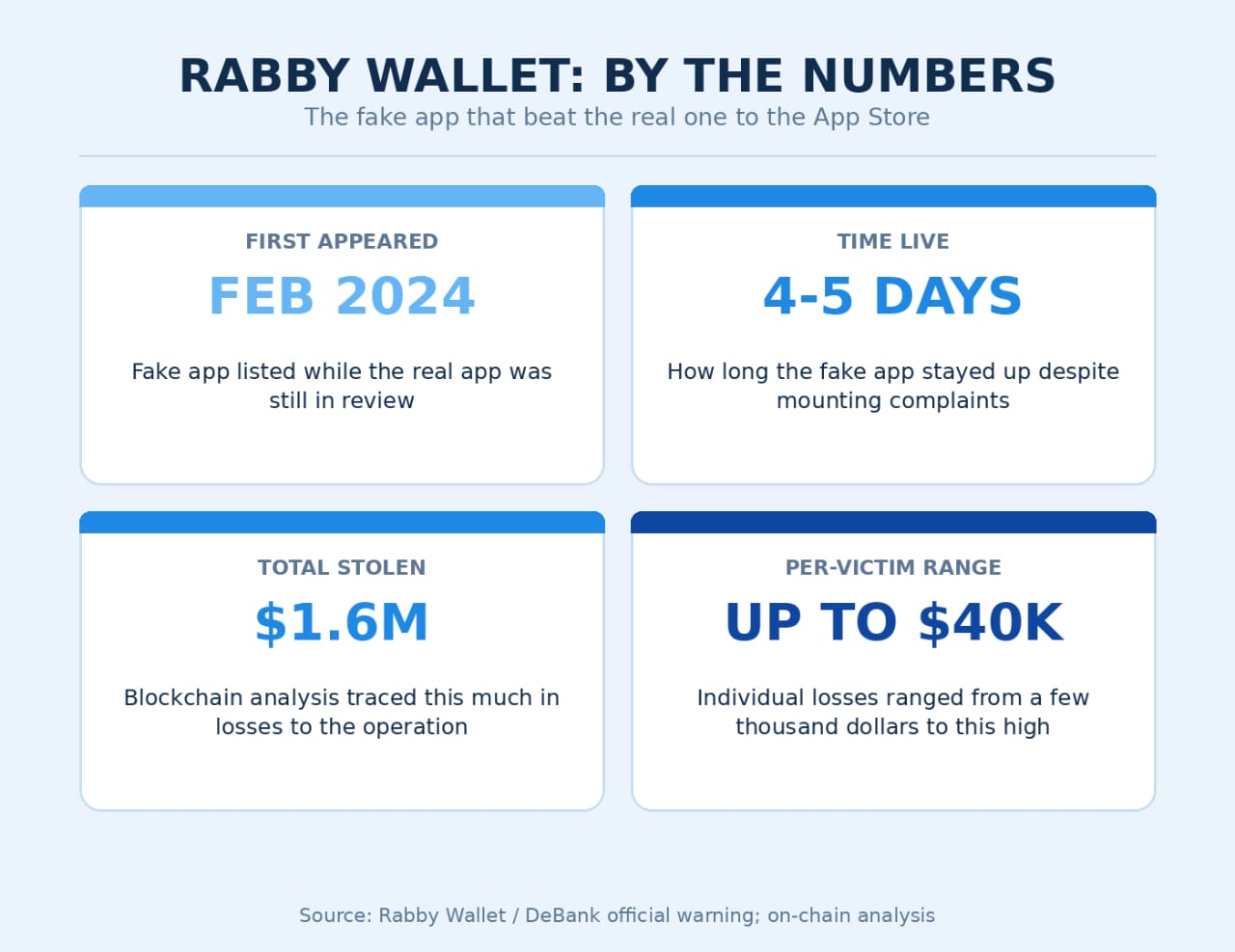
The experience of Rabby Wallet, a respected crypto wallet developed by DeBank, mirrors DeFiLlama’s struggle almost exactly, underscoring the systemic nature of the problem. In February 2024, a counterfeit application titled "Rabby Wallet & Crypto Solution" mysteriously appeared on the Apple App Store. Shockingly, this fraudulent app gained approval and was listed before the legitimate Rabby mobile application, which was still languishing in Apple’s own review queue. This unprecedented situation meant that Apple’s review process effectively greenlit a scammer’s product while the authentic developer’s application awaited vetting.
Upon discovering the imposter, Rabby’s team swiftly issued public warnings across their official channels, advising users about the fake iOS app and reiterating that their real application remained under review. They directed users exclusively to their official website as the only secure source for downloads. Despite these urgent warnings from the legitimate brand and a rapidly growing thread of user complaints on platforms like Reddit and Apple’s own community forums, the fake app remained live for approximately four to five days. During this critical window, blockchain analysis later revealed that the operation managed to siphon off an estimated $1.6 million in stolen funds. Individual victims reported devastating losses, ranging from several thousand dollars to a staggering $40,000 in a single case, all while Apple’s review mechanisms remained seemingly unresponsive to the mounting evidence and pleas.
A Systemic Flaw: The Slow Response is a Pattern, Not a Coincidence
The common thread connecting these cases is undeniable: neither DeFiLlama nor Rabby Wallet was caught off guard by these scams. Both had clear evidence of impersonation and fraud. Both meticulously reported these issues through Apple’s official channels. And in both instances, their warnings were largely unaddressed until tangible financial damage had already been inflicted upon users. This isn’t merely a coincidence of two isolated moderation failures; it represents a consistent, structural gap in Apple’s app review process that permits the same category of scam to repeatedly infiltrate its platform across different brands and over extended periods.
This systemic vulnerability is not limited to Apple alone, though the company’s stringent control over its ecosystem makes its inaction particularly concerning. Security research further corroborates the widespread nature of this threat. Kaspersky’s threat research team, for example, has extensively documented an ongoing campaign of fake crypto wallet clones circulating not only through the App Store but also Google Play. These malicious applications are specifically engineered to trick users into surrendering their sensitive recovery phrases (seed phrases), which attackers then use to reconstruct victims’ wallets and launder stolen digital assets across various blockchain networks. Kaspersky’s detailed technical breakdown, titled "Phishing crypto-wallet clones in the App Store and other attacks on iOS and macOS crypto owners," underscores that this is not a sporadic occurrence but a persistent, organized threat that repeatedly circumvents platform defenses.
The Human Cost: What Users Lost While Waiting for Action
Beyond the abstract statistics and technical details, it is crucial to understand the profound human cost of these delays. The financial losses incurred by individual users are not mere figures but represent real people’s savings, investments, and often, their trust in a platform they believed was secure.
In the Rabby Wallet case, one victim recounted losing $24,000 after downloading the fake app. Their decision was based on a reasonable assumption: the App Store listing seemed legitimate, especially since Rabby’s official website had not yet been updated to explicitly clarify that the real app was still under review. This victim, like many others, relied on the perceived authority and vetting of Apple’s platform. Another user reported a loss of approximately $5,000 on the same morning, subsequently filing a support case with Apple in the desperate hope of reimbursement. This occurred despite the fake app having already been reported multiple times by the legitimate Rabby team and other users before their personal loss took place.
These stories highlight a critical psychological aspect of app store security: users implicitly trust platforms like Apple to vet applications. When searching for an app, the natural instinct is to use the platform’s official store, not to embark on a complex verification process involving cross-referencing developer names with obscure official websites. This "reasonable choice," however, proved costly for many, leading to irreversible financial losses while their cries for help and reports of fraud languished in queues. The "app store security" framing often overlooks these individual tragedies, focusing instead on abstract metrics. These are not abstract statistics; they are individuals whose faith in a trusted ecosystem was shattered, and whose financial well-being was severely impacted.
Why This Persists: A Dangerous Gap in Prioritization
The honest takeaway from these repeated incidents is not that Apple’s review process is entirely incompetent; it demonstrably catches an enormous volume of malicious software daily. However, these specific cases strongly suggest a more nuanced and dangerous problem: trademark and impersonation complaints originating from legitimate crypto projects do not appear to trigger the same level of urgency or rapid response as a confirmed report of active financial theft.
This prioritization creates a genuinely perilous gap for an industry like cryptocurrency, where impersonation is often the primary, if not sole, attack vector. By the time actual financial theft is confirmed and reported—the point at which Apple seems to act decisively—the damage is already done, and often, it is irreversible. The decentralized nature of blockchain transactions means stolen funds are quickly moved and laundered, making recovery exceedingly difficult, if not impossible. This reactive posture inadvertently gives scammers a critical window of opportunity to operate and profit before platforms intervene.
For anyone navigating the crypto landscape, the practical lesson from both the DeFiLlama and Rabby Wallet cases is uncomfortable but essential: App Store approval alone can no longer be considered definitive proof of legitimacy. While it should ideally signify a thorough vetting process, the current reality demands a higher degree of user vigilance. Verifying an app’s developer name against the project’s own official website before ever interacting with it or, crucially, entering a seed phrase, is no longer paranoia. It has become the only reliable safeguard available while major platforms like Apple continue to treat documented impersonation reports with a perceived lower priority than they demonstrably deserve.
Broader Implications and the Path Forward
The recurring nature of these scams and Apple’s delayed response carries broader implications beyond individual financial losses. Firstly, it risks eroding the hard-earned trust users place in the App Store as a secure digital marketplace. This trust is a cornerstone of Apple’s ecosystem, and its compromise, especially in a sensitive area like financial applications, can have long-term consequences for user confidence and engagement.
Secondly, it places an undue burden on legitimate developers. Not only do they have to innovate and build robust applications, but they must also contend with the constant threat of impersonation and the often-arduous process of convincing platform gatekeepers to act against fraud. This diverts resources and attention away from product development and towards combating malicious actors, hindering innovation.
Thirdly, these incidents may invite increased regulatory scrutiny. As digital assets become more mainstream, governments and financial regulators are increasingly focusing on consumer protection within the crypto space. If major platforms like Apple fail to adequately police their ecosystems against financial fraud, there could be calls for more stringent regulations governing app store operators, particularly concerning the vetting and rapid removal of fraudulent financial applications. The European Union’s bold AI law, partly triggered by high-profile deepfake fraud, signals a broader trend towards holding technology platforms more accountable for harmful content and applications distributed through their channels.
Ultimately, a paradigm shift is needed in how app stores, particularly those with Apple’s market dominance and brand reputation, approach the detection and removal of crypto-related impersonation scams. A proactive stance, treating verified trademark infringement and impersonation reports from legitimate projects with the same urgency as confirmed financial theft, is paramount. This would involve a more robust initial review process, coupled with a highly responsive mechanism for urgent reports. Until such a shift occurs, the onus remains uncomfortably on the end-user to exercise extreme caution, transforming what should be a trusted digital storefront into a landscape where vigilance is the ultimate, and often last, line of defense.
Disclosure: This is not trading or investment advice. Always do your research before buying any cryptocurrency or investing in any services.














