


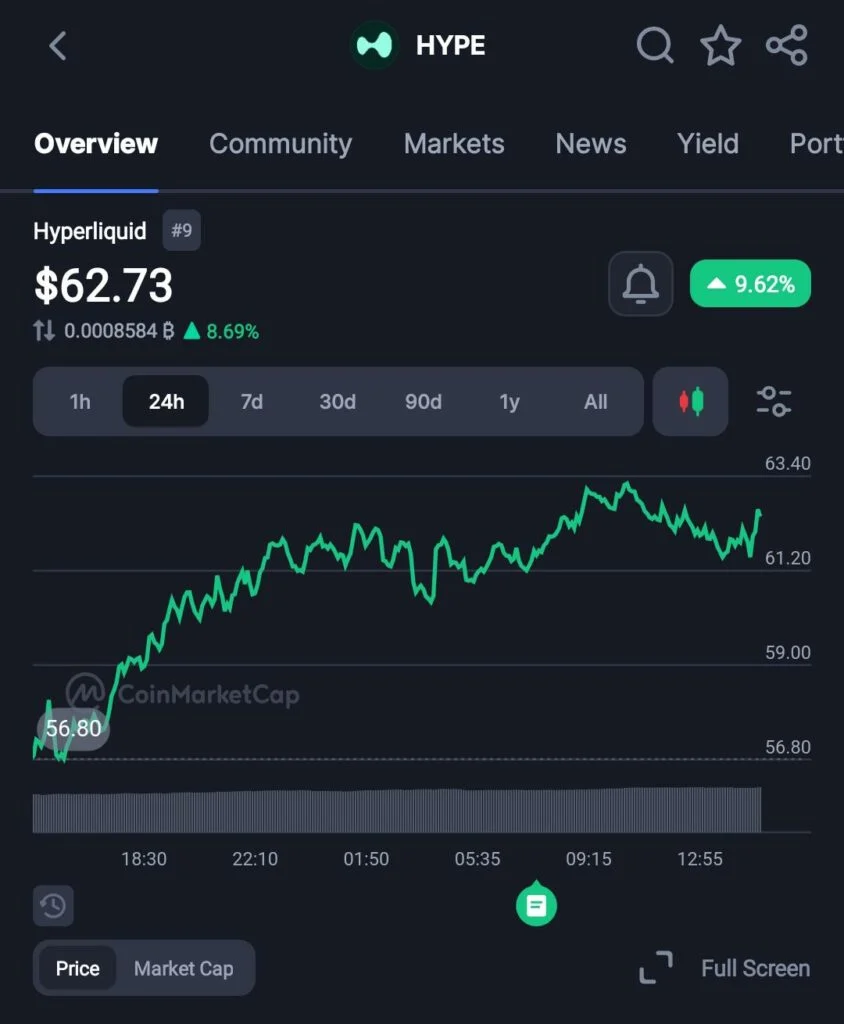
A pivotal moment in the convergence of traditional finance (TradFi) and decentralized finance (DeFi) unfolded recently, as Hyperliquid, a burgeoning decentralized exchange (DEX), received a significant endorsement from Jeff Sprecher, the venerable founder of Intercontinental Exchange (ICE) and owner of the New York Stock Exchange (NYSE). This high-profile validation, delivered at a prominent industry conference, immediately propelled Hyperliquid’s native token to a 10% surge, placing it firmly among the top-tier DEXs and signaling a profound shift in institutional perception of the DeFi landscape.
The market’s enthusiastic reaction to Sprecher’s remarks underscores the immense credibility he commands within global financial circles. Unlike the often-ephemeral hype generated within crypto social media, an endorsement from a figure of Sprecher’s stature carries substantial weight, rooted in decades of experience building and operating critical global exchange infrastructure. This affirmation arrived at a critical juncture for Hyperliquid, with its native token already hovering around all-time highs, indicating a sustained positive trajectory and robust market confidence that was further amplified by this institutional nod.
The Endorsement Heard ‘Round the Markets: Jeff Sprecher’s Pivotal Remarks
Jeff Sprecher, a titan whose vision shaped much of the modern financial trading landscape through the creation of ICE and its subsequent acquisition of the NYSE, made his impactful comments during the Bernstein conference. His assessment of Hyperliquid was not merely positive but audacious, declaring the decentralized platform "bigger than Nasdaq." This striking comparison immediately resonated across both traditional and crypto markets, highlighting the immense scale and operational prowess that Hyperliquid has achieved in a relatively short period.
Sprecher’s words are particularly significant given his history. He built ICE from scratch into a global network of exchanges and clearing houses, demonstrating an unparalleled understanding of market dynamics, technological infrastructure, and regulatory complexities. His endorsement is far from a casual observation; it represents a seasoned executive’s informed judgment on the potential and current capabilities of a cutting-edge DeFi protocol. For Hyperliquid, an entity operating at the frontier of financial innovation, receiving such an unequivocal seal of approval from a figure synonymous with established market infrastructure marks a monumental step towards mainstream acceptance and integration.
Hyperliquid’s Ascent: A Chronicle of Innovation and Market Impact
Hyperliquid has steadily built a reputation as a high-performance decentralized perpetuals exchange, offering users the ability to trade a wide range of assets with high leverage and low fees. Its architecture, designed for speed and efficiency, has attracted a growing user base, contributing to its token’s strong performance even before Sprecher’s comments.
- Early 2020s: Hyperliquid’s foundational development begins, focusing on a novel architecture for on-chain derivatives trading.
- Mid-202X: Beta testing and initial mainnet launch, attracting early adopters with its promise of low-latency, high-throughput trading.
- Late 202X – Early 2026: Steady growth in trading volume and user base, leading to its token approaching all-time highs, driven by continuous product development and community engagement, including the launch of CPI outcome markets on mainnet through HIP-4 expansion.
- May 29, 2026 (or similar date implied by image date): Jeff Sprecher makes his pivotal remarks at the Bernstein conference, likening Hyperliquid’s scale to Nasdaq and calling it "the real deal for DeFi."
- Immediate Aftermath: Hyperliquid’s native token experiences a rapid 10% price surge, accompanied by increased trading volume and heightened media attention.
The platform’s design philosophy centers on an order book model, familiar to TradFi traders, but executed entirely on-chain, eliminating many of the centralization risks associated with traditional exchanges. This blend of familiarity and innovation has been a key factor in its growing appeal, positioning it as a credible alternative to centralized platforms for sophisticated traders.
"Bigger Than Nasdaq": Unpacking a Paradigm Shift
Sprecher’s assertion that Hyperliquid is "bigger than Nasdaq" goes beyond mere hyperbole; it signifies a profound shift in perspective regarding the potential and current operational scale of decentralized finance. Nasdaq, established in 1971, is one of the world’s most iconic stock exchanges, synonymous with technological innovation in equities trading. For a decentralized protocol to be mentioned in the same breath, let alone deemed to have "outpaced" it in certain operational metrics, signals a cultural sea-change in the evolution of market infrastructure.
This comparison is rooted in Hyperliquid’s ability to drive "incredible throughput and efficiency" outside the traditional system’s constraints. While Nasdaq processes millions of transactions daily with a vast array of servers, employees, and regulatory oversight, Hyperliquid achieves comparable, and in some aspects superior, performance with a significantly leaner operational footprint. This highlights a fundamental advantage of decentralized architectures: their inherent scalability and efficiency derived from distributed consensus and automated smart contracts, rather than extensive human and physical infrastructure.
Operational Efficiency: A DeFi Paradigm Shift
One of the most compelling revelations from Sprecher’s comments was the astonishing operational efficiency of Hyperliquid, which he noted runs with a lean team of only 11 people. This stark contrast with traditional exchanges, which employ thousands and maintain vast, complex physical infrastructures, underscores a fundamental benefit of the decentralized approach.
Conventional exchanges, such as the NYSE or Nasdaq, require immense operational overhead: large IT departments, cybersecurity teams, legal and compliance divisions, customer support, sales, and executive management. Their legacy systems often involve intricate, multi-layered architectures that demand constant maintenance and significant capital expenditure.
Hyperliquid, on the other hand, exemplifies how a streamlined, on-chain execution model can yield equal, if not superior, performance using dramatically fewer resources. This efficiency is a direct result of blockchain technology, where smart contracts automate many functions traditionally performed by human intermediaries and centralized systems. The protocol’s core logic is immutable and transparent, reducing the need for extensive auditing teams and manual reconciliation processes. This lean model translates into lower operational costs, which can then be passed on to users in the form of lower trading fees or higher capital efficiency. This operational paradigm is not just an advantage; it is a disruptive force, challenging the very economic models that have sustained traditional financial institutions for decades.
Bridging Traditional Finance and Decentralized Innovation: A Path to Partnership
Sprecher’s engagement extends beyond mere observation. He explicitly mentioned having met the Hyperliquid team multiple times to "debate about a possible partnership." This disclosure is perhaps the most forward-looking aspect of his remarks, suggesting a move from observation to potential collaboration between two vastly different financial ecosystems.
A partnership between a decentralized protocol like Hyperliquid and a TradFi giant like ICE could manifest in several transformative ways:
- Technology Integration: ICE could explore integrating Hyperliquid’s underlying blockchain technology for specific use cases, leveraging its efficiency for particular market segments or data processing.
- Liquidity Provision: Traditional financial institutions, through ICE’s vast network, could become liquidity providers on Hyperliquid, bringing significant capital and market depth to the DEX.
- Hybrid Products: Jointly developed financial products could emerge, combining the regulatory compliance and institutional trust of TradFi with the innovation and accessibility of DeFi.
- Regulatory Sandboxes: Collaborative efforts could pave the way for new regulatory frameworks that accommodate decentralized systems, a critical step for broader institutional adoption.
This dialogue signifies a crucial evolution in the relationship between decentralized and traditional finance—one of interaction and potential synergy, rather than outright competition. It acknowledges that each system possesses unique strengths, and that their combined forces could unlock unprecedented opportunities for market expansion and efficiency.
Expanding Market Frontiers: 24/7 Trading and New Asset Classes
Hyperliquid’s innovative approach is not confined to its operational structure. Sprecher specifically highlighted the platform’s ability to back "weekend oil trading," a feature that has garnered significant attention. The introduction of a 24/7 trading model represents a fundamental departure from traditional finance, which operates within clearly defined market hours.

Traditional financial markets typically adhere to business hours, closing during evenings, weekends, and holidays. This structure, while providing time for back-office processing and market makers to adjust, also creates gaps in liquidity and price discovery, particularly in a globally interconnected economy. Hyperliquid, by offering continuous market access, addresses this limitation directly. This always-on model is particularly advantageous for volatile assets and global markets, allowing participants to react instantly to macroeconomic news or geopolitical events, irrespective of the clock.
Furthermore, Hyperliquid is not merely replicating existing markets but actively expanding the bounds of asset classes available for trading. By leveraging its flexible infrastructure, it can facilitate trading in a diverse range of instruments, from traditional commodities like oil to novel crypto derivatives and beyond. This capability positions Hyperliquid not just as a competitor to existing exchanges but as a pioneer, creating a new frontier for pairing fundamental market elements with cutting-edge technology. This continuous access and asset diversity are powerful draws for institutional investors seeking superior capital efficiency and broader exposure.
Institutional-Premium Return from DeFi Innovation: The Maturation of a Sector
The enthusiastic reception of Hyperliquid, amplified by Sprecher’s endorsement, is indicative of a broader trend: the maturation of the decentralized financial protocol landscape. Scalability, speed, and flexibility are no longer aspirational goals but realized functionalities within leading DEXs, making them increasingly attractive alternatives to legacy systems. This evolving landscape is now actively drawing the attention of institutional players, signaling a shift from cautious observation to active engagement.
Sprecher’s recognition reinforces the narrative that traditional financial institutions are moving beyond viewing DeFi as an experimental "wild west" or a mere "guinea pig" for new technologies. Instead, they are beginning to perceive it as a legitimate and integral component of future market infrastructure. This shift is crucial for the long-term growth and stability of the DeFi sector. Institutional capital brings not only liquidity but also a demand for robust security, regulatory clarity, and enterprise-grade performance, all of which Hyperliquid appears poised to deliver.
The timing of this endorsement is particularly noteworthy. Hyperliquid already manages substantial trading volumes and is actively expanding its product suite. External validation from a figure of ICE’s stature can significantly accelerate institutional interest and engagement, potentially unlocking vast pools of capital that have historically remained on the sidelines. This newfound credibility could lead to a cascading effect, encouraging other traditional financial entities to explore and invest in the DeFi ecosystem.
A Tale of Two Realities: Hyperliquid’s Success Amidst Industry Struggles
While Hyperliquid basks in increasing attention and positive traction, the broader landscape for many Digital Asset Treasury (DAT) companies paints a starkly different picture. Recent data reveals a challenging environment, with only a fraction of crypto companies focused on treasury operations reportedly achieving profitability. This contrast highlights the critical importance of robust strategy, operational efficiency, and astute risk management in a highly volatile market.
The data indicates that out of the top ten crypto companies primarily engaged in treasury management, a mere two are currently profitable. Hyperliquid leads this cohort with an impressive +$1.1 billion in treasury assets, followed by Hyperion with +$39.6 million. Beyond these two outliers, the performance dramatically declines, with a majority of firms reporting substantial losses.
These widespread losses underscore the inherent risks associated with treasury-driven strategies during periods of intense market volatility. Many companies, particularly those that entered the market during bull runs, acquired digital assets at inflated cost bases. When the market experienced downturns or extended periods of consolidation, their portfolios were exposed, leading to significant unrealized and realized losses. This phenomenon, often referred to as "buying the top," is a common pitfall in speculative markets and has severely impacted the balance sheets of numerous crypto firms.
Even strategies once considered the "gold standard" for Bitcoin treasury management have suffered. Firms like Raydium and Bitmine, positioned lowest on the profitability list, incurred some of the largest losses, primarily attributed to their substantial exposures to Ether (ETH) and other altcoins, which experienced steeper drawdowns compared to Bitcoin during certain market cycles. This illustrates that even seemingly conservative treasury approaches require dynamic adjustments and rigorous risk assessments in the rapidly evolving crypto space.
Survival Depends On Volatility Management and Strategic Foresight
Hyperliquid’s exceptional performance relative to its DAT peers offers a crucial lesson: effective treasury strategies in the digital asset space are exquisitely sensitive to timing, market conditions, and sophisticated volatility management. It’s not merely about accumulating assets but about having the foresight and operational agility to navigate extreme market swings.
Hyperliquid and Hyperion have distinguished themselves not just through profitability but through their superior ability to manage and capitalize on the market environment. This success likely stems from a combination of factors: impeccable timing in asset acquisition or divestment, outstanding operational efficiency that minimizes overhead and maximizes returns, and potentially a unique risk skew that allows them to absorb volatility more effectively or even profit from it. Their strategies likely involve advanced hedging techniques, dynamic rebalancing, and a deep understanding of market microstructure.
For many other companies, the primary challenge has been sheer survival. The ability to "hodl" (hold on for dear life) assets through prolonged downturns, waiting for favorable market cycles, is a cornerstone of many DAT strategies. However, not all firms possess the financial resilience, flexible balance sheets, or sufficient liquidity to endure extended periods of underperformance. Companies that ramped up their asset holdings during exuberant bull periods often find themselves struggling to maintain solvency and operational capacity when prices decline significantly. This ongoing trend highlights the brutal reality of capital management in an emerging and often unpredictable asset class.
The Future Landscape: DeFi’s Challenge to Legacy Systems
The dichotomy presented by Hyperliquid’s success against the backdrop of broader industry struggles raises profound questions about the future of financial infrastructure. How will today’s legacy platforms manage to compete with high-performance, scalable decentralized systems that are now attracting significant institutional interest and validation? The implications are far-reaching.
DeFi protocols like Hyperliquid offer a compelling vision: lower costs, greater transparency, 24/7 accessibility, and increased capital efficiency. As these platforms mature and gain regulatory clarity, they pose a direct challenge to the established order. Traditional exchanges and financial institutions may be forced to adapt by either integrating decentralized technologies, forming partnerships, or fundamentally rethinking their operational models to remain competitive.
Hyperliquid, positioned at the nexus of these evolving trends, represents a potent force. It combines near-transparent market performance with a level of institutional validation that few DeFi projects have achieved. This dual advantage—technological superiority and endorsement from a traditional finance titan—places it at the forefront of a potential paradigm shift, where decentralized finance transitions from a niche sector to a foundational pillar of the global financial system. The coming years will undoubtedly reveal whether this endorsement marks the beginning of a profound transformation, or merely a significant step in the ongoing evolution of finance.
Disclosure: This is not trading or investment advice. Always do your research before buying any cryptocurrency or investing in any services.
Follow us on Twitter @themerklehash to stay updated with the latest Crypto, NFT, AI, Cybersecurity, and Metaverse news!














