The global cryptocurrency market has experienced a significant retreat from institutional players, as digital asset investment products saw a staggering $1.67 billion in net outflows over the past week. According to the latest "Digital Asset Fund Flows" report released by CoinShares, this massive exodus marks the third consecutive week of negative sentiment among large-scale investors and represents the second-largest weekly outflow recorded in 2024. The cumulative pressure over the last twenty-one days has resulted in a total of $4.21 billion being pulled from the market, signaling a sharp pivot toward a "risk-off" environment.
This wave of selling was spearheaded by Bitcoin, the world’s largest cryptocurrency by market capitalization, which accounted for the vast majority of the redemptions. Institutional vehicles tied to Bitcoin witnessed $1.438 billion in outflows, the highest single-week divestment for the asset this year. The severity of this movement has had a profound impact on the year-to-date (YTD) statistics; while Bitcoin started the year with record-breaking inflows following the approval of Spot ETFs in the United States, recent liquidations have compressed the total YTD net inflows to just $1.2 billion.
A Deep Dive into Regional and Asset-Specific Trends
The sell-off was heavily concentrated in the United States, which has become the primary hub for institutional crypto activity since the launch of several high-profile Exchange Traded Funds (ETFs) in January. U.S.-based products accounted for $1.63 billion of the total outflows, representing nearly 98% of the global selling pressure. This concentration highlights the sensitivity of the American institutional market to both domestic regulatory shifts and global macroeconomic instability.
Beyond the United States, other major financial hubs also reported negative flows, albeit on a smaller scale. Germany saw $25.7 million in outflows, while Sweden and Hong Kong recorded divestments of $6.6 million and $4.5 million, respectively. These figures suggest that the bearish sentiment is not localized but rather a coordinated withdrawal from digital assets across the Western and Asian institutional landscapes.
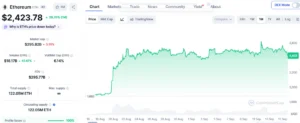
Ethereum, the second-largest digital asset, was not spared from the trend. The asset saw $257 million in outflows during the same period. Despite the recent launch of Ethereum-based spot ETFs in the U.S., investor appetite for the "world computer" remains tepid compared to previous cycles. Analysts suggest that the lack of staking rewards within current ETF structures, combined with broader market volatility, may be deterring institutional holders from maintaining long-term positions in Ethereum during periods of high uncertainty.
The Shrinking Valuation of Assets Under Management
The relentless selling pressure has taken a visible toll on the total Assets Under Management (AUM) within the crypto investment space. According to the CoinShares data, total AUM has dropped to $141 billion. This figure represents the lowest level of institutional capital committed to the sector since early April, erasing several months of growth that occurred during the mid-year rally.
The rapid decline in AUM is a combination of two factors: the physical removal of capital by investors (outflows) and the depreciating price of the underlying assets themselves. As Bitcoin and Ethereum prices dipped in response to the sell-offs, the valuation of the remaining holdings naturally followed suit, creating a compounding effect that has significantly thinned the market’s capital base.
Geopolitical Tensions and the Risk-Off Sentiment
Market analysts attribute this aggressive divestment strategy to a deteriorating geopolitical climate, specifically the escalating tensions involving Iran and the broader Middle East. Traditionally, in times of war or international conflict, institutional investors move capital away from "risk-on" assets—such as technology stocks and cryptocurrencies—and toward "safe-haven" assets like gold, the U.S. Dollar, and government bonds.
The recent military escalations have triggered a flight to safety that has overwhelmed any potential bullish catalysts. Earlier in the month, there was optimism surrounding the progress of the Clarity for Payment Stablecoins Act (CLARITY Act) in the United States. The legislation, which aims to provide a clear regulatory framework for stablecoins and integrate digital assets more formally into the financial system, was expected to boost investor confidence. However, the data suggests that the fear of a wider regional conflict in the Middle East has completely overshadowed the positive implications of regulatory progress.
A Silver Lining for Select Altcoins
While the primary market leaders suffered heavy losses, a small handful of altcoins managed to buck the trend, showing that institutional interest is becoming increasingly selective. Only five digital assets recorded weekly inflows exceeding $1 million, led by XRP.
XRP saw $20.3 million in net inflows, a movement likely driven by continued optimism regarding the legal clarity surrounding Ripple Labs and its ongoing interactions with the U.S. Securities and Exchange Commission (SEC). Following XRP was Hyperliquid, a decentralized exchange protocol, which attracted $10.8 million. Near Protocol also showed resilience with $7.6 million in inflows. These outliers suggest that while investors are fleeing the "macro" crypto narrative (Bitcoin and Ethereum), they are still willing to place strategic bets on specific ecosystems or protocols with unique value propositions or pending catalysts.
Timeline of the Three-Week Retraction
To understand the current market state, it is essential to look at the chronology of the past three weeks:
- Phase 1: The Initial Cool-off: Three weeks ago, the market saw the first signs of fatigue. Following a period of stagnation in Bitcoin’s price, institutional investors began taking profits, resulting in the first of three negative weeks.
- Phase 2: Macroeconomic Anxiety: Two weeks ago, concerns regarding the Federal Reserve’s interest rate path and fluctuating inflation data caused the outflows to accelerate. Investors began questioning the "higher for longer" narrative, leading to a $1B+ reduction in exposure.
- Phase 3: Geopolitical Escalation: The most recent week saw the situation culminate in the $1.67 billion exodus. The introduction of direct military conflict concerns acted as the "final straw," forcing large-scale funds to liquidate positions to preserve liquidity and mitigate risk.
Implications for the Remainder of the Year
The current state of institutional flows raises questions about the market’s trajectory for the final quarter of the year. Historically, the fourth quarter is often bullish for digital assets, but the massive compression of YTD Bitcoin inflows suggests a lack of conviction among the "smart money" crowd.
For Bitcoin to regain its momentum, analysts believe several conditions must be met. First, there must be a stabilization in the Middle East to de-escalate the "risk-off" trade. Second, the U.S. Federal Reserve must provide clearer signals regarding potential rate cuts, which would typically benefit non-yielding assets like Bitcoin. Finally, the market needs to see a stabilization of the AUM at the $140 billion mark to prove that the "floor" has been established.
The divergence between Bitcoin’s performance and select altcoins like XRP also suggests that the market may be entering a phase of fragmentation. Instead of a "rising tide lifts all boats" scenario, institutional capital may continue to rotate into specific projects with clear utility or regulatory advantages, while the broader market remains sensitive to global political shifts.
Expert Reactions and Market Outlook
While official statements from the major ETF providers like BlackRock or Fidelity are rare regarding weekly flow data, industry observers note that the current volatility is a test of the "institutional grade" nature of the crypto market.
James Butterfill, Head of Research at CoinShares, noted in the report that the sentiment is "deeply linked" to external shocks rather than internal crypto-native failures. Unlike the collapses of 2022 (such as FTX or Celsius), the current selling is driven by global macro-uncertainty, which is a familiar hurdle for traditional finance but a relatively new pressure point for the post-ETF crypto market.
As the industry moves forward, the focus will remain on whether the $1.2 billion YTD net inflow for Bitcoin can hold or if the market will see a complete reversal of the gains made in the first half of the year. For now, the "wait and see" approach appears to be the dominant strategy for the world’s largest financial institutions.