


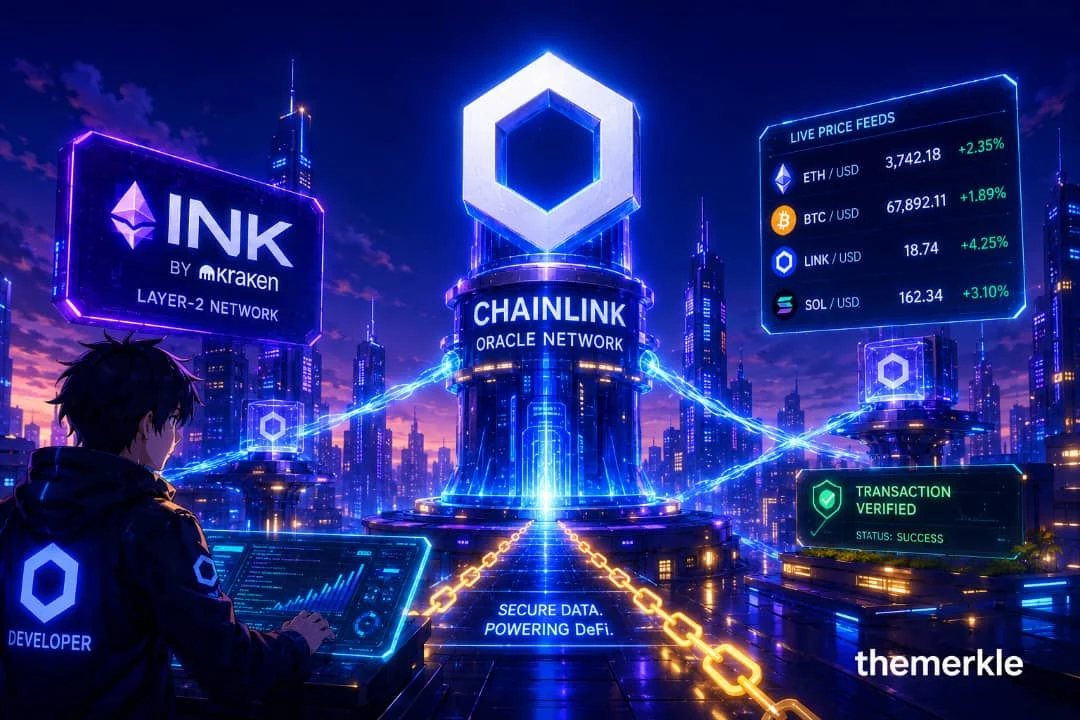
INK, the Layer-2 blockchain initiative backed by leading cryptocurrency exchange Kraken, has announced a pivotal strategic partnership, designating Chainlink as its primary oracle provider. This collaboration, made possible through Ink’s participation in the Chainlink Scale program, represents a significant leap forward in solidifying the foundation of secure decentralized finance (DeFi) infrastructure, particularly within emerging Layer-2 ecosystems. The announcement, which garnered immediate attention across the DeFi landscape, underscores the critical importance of robust oracle solutions for the sustained growth and institutional adoption of blockchain-based financial products.
The Strategic Alliance: Ink and Chainlink Scale
The core of this partnership sees Ink integrating Chainlink Data Feeds directly into its network, providing developers building on Ink with streamlined, cost-efficient access to enterprise-grade oracle services. This move eliminates the need for individual development teams to research, evaluate, and implement disparate oracle solutions, thereby simplifying the development process and enhancing overall ecosystem reliability. Chainlink Scale is an initiative designed precisely for this purpose: to empower blockchain ecosystems by subsidizing the operational costs of oracle access for developers, thereby accelerating network adoption and fostering innovation. By committing substantial capital to this program, Ink is effectively providing a foundational utility that is crucial for any sophisticated DeFi application.
This strategic alignment is particularly significant given the nature of oracle infrastructure within decentralized applications. Oracles serve as the crucial bridge between off-chain real-world data and on-chain smart contracts. Without accurate, timely, and tamper-proof external information, critical DeFi primitives such as lending platforms, derivatives exchanges, perpetual markets, and tokenized real-world assets cannot function securely or reliably. The choice of Chainlink, widely recognized as the industry standard for decentralized oracle networks, signals Ink’s commitment to establishing a high-integrity data environment from its inception.
Understanding Ink: Kraken’s Layer-2 Ambition
Ink emerges from the vision of Kraken, one of the oldest and largest cryptocurrency exchanges globally, to provide a scalable and secure environment for decentralized applications. While specific launch details and a precise timeline for Ink’s full public rollout have been gradually unfolding, its affiliation with Kraken immediately imbues it with a degree of credibility and potential for significant user adoption. Kraken’s foray into the Layer-2 space reflects a broader trend among centralized entities recognizing the long-term potential of decentralized infrastructure and seeking to influence its development. By backing Ink, Kraken is positioning itself to be a key player in the next generation of blockchain innovation, moving beyond mere asset custody and trading to fostering an entire ecosystem.
The Layer-2 landscape has become intensely competitive over the past two years, with numerous solutions vying for developers, users, and capital. Ethereum scaling solutions, in particular, have seen a proliferation of optimistic rollups, ZK-rollups, and other architectures. In this environment, differentiation is key. Ink’s strategy, as evidenced by its oracle partnership, is to prioritize institutional-grade infrastructure from the outset. Rather than focusing solely on transaction throughput or gas cost reduction, Ink is building out a comprehensive, secure, and developer-friendly stack designed for sustainable growth and the eventual onboarding of professional financial activity. This approach aligns with the growing realization that mere technical scalability is insufficient without corresponding security, reliability, and robust tooling.
The Indispensable Role of Oracle Infrastructure in DeFi
The news from Ink serves as a powerful reminder of why oracle systems constitute one of the most critical, yet often overlooked, layers in decentralized finance. Blockchain networks, by design, are deterministic and self-contained; they cannot independently access external data or events occurring outside their native environment. This inherent limitation necessitates the use of oracle providers to fetch, verify, and deliver off-chain information onto the blockchain, enabling smart contracts to react to real-world conditions.
Consider the vast array of DeFi applications:
- Lending Protocols: These platforms rely heavily on real-time asset prices to calculate collateral ratios, determine loan-to-value (LTV) thresholds, and execute liquidations. Inaccurate or delayed price feeds can lead to under-collateralized loans, systemic risk, or premature, unfair liquidations, causing significant user losses.
- Derivatives Exchanges (Perpetuals, Futures, Options): These require highly granular and frequently updated price data for asset indices, funding rates, margin calls, and trade settlements. Any discrepancy can lead to arbitrage opportunities for malicious actors or severe market instability.
- Stablecoins: Algorithmic stablecoins, in particular, often depend on external price feeds to maintain their peg to fiat currencies or other assets.
- Tokenized Real-World Assets (RWAs): Projects tokenizing assets like real estate, commodities, or equities require continuous, verifiable price data to reflect their true market value on-chain.
The history of DeFi is unfortunately replete with instances where oracle failures or manipulations have led to catastrophic outcomes. These incidents, often termed "oracle attacks" or "price manipulation exploits," have resulted in millions of dollars in losses, triggering cascading liquidations and undermining user trust. For example, some protocols have suffered when attackers exploited low-liquidity pools to manipulate spot prices on a decentralized exchange (DEX), which was then used as an oracle source for lending protocols, leading to profitable but destructive liquidations. These vulnerabilities underscore the absolute necessity of highly secure, decentralized, and robust oracle networks. Ink itself explicitly acknowledged this challenge, stating that "Onchain markets resolve down to one input: the price. If that input is… untrusted, lending markets, perpetual protocols, and trading systems stay vulnerable."
Chainlink’s Dominance and Technical Edge
Chainlink’s rise to prominence as the leading oracle provider is rooted in its multi-faceted approach to data security and reliability. Its architecture is designed to mitigate the risks inherent in single points of failure and data manipulation. Key components include:
- Decentralized Network of Node Operators: Instead of a single entity providing data, Chainlink leverages a vast, independent network of node operators that fetch data. This decentralization significantly reduces the risk of collusion or censorship.
- Multi-Source Data Aggregation: Data is not pulled from a single exchange or API. Chainlink Data Feeds aggregate price data from numerous high-quality data providers and exchanges, ensuring a robust and comprehensive data point that is resistant to manipulation on any single platform. This multi-source approach creates a more accurate and resilient average.
- Secure On-Chain Aggregation and Verification: The aggregated data is then verified and pushed on-chain, utilizing cryptographic proofs to ensure its integrity. Parameters can be set to define how frequently updates occur and what deviation thresholds trigger new updates, optimizing for both freshness and cost-efficiency.
- Reputation and Economic Security: Chainlink employs a reputation system for its node operators and mechanisms like staking (planned for the future, but concepts are already foundational) to economically secure data feeds, disincentivizing malicious behavior.
This battle-tested framework has made Chainlink an indispensable component for hundreds of DeFi protocols across various Layer-1 and Layer-2 blockchains. Its proven track record in maintaining price stability and accuracy, even during periods of extreme market volatility, is a critical factor for any ecosystem aiming for serious financial applications. Ink highlighted these advantages in its announcement, explicitly stating that Chainlink Data Feeds "leverage multi-source aggregation, independent node operators, and secure onchain parameters" to help protocols maintain steady and accurate prices.
The Chainlink Scale Program: Fueling Ecosystem Growth
The Chainlink Scale program, which Ink has joined, is a strategic initiative by Chainlink to foster broader adoption of its oracle services by making them more accessible and cost-effective for emerging blockchain ecosystems. In essence, participating chains commit capital to subsidize the on-chain operational costs associated with running Chainlink Data Feeds for the projects building within their ecosystem. This model offers several compelling benefits:
- Reduced Developer Burden: Individual projects no longer bear the full cost of fetching secure oracle data, making it easier for new dApps to integrate high-quality data feeds from day one.
- Accelerated Ecosystem Development: By lowering the barrier to entry for robust infrastructure, Scale helps attract and retain developers, accelerating the deployment of sophisticated DeFi applications.
- Enhanced Security Standards: It encourages a uniform adoption of secure, enterprise-grade oracle solutions across an entire ecosystem, raising the overall security posture and reducing fragmentation in data sourcing.
- Competitive Advantage for L2s: In a fiercely competitive Layer-2 landscape, offering subsidized access to a market-leading oracle solution like Chainlink can be a significant draw for developers who prioritize security and reliability.
This model has gained increasing appeal as new ecosystems strive to attract dapp developers from established chains. Infrastructure partnerships, particularly those involving critical security tooling, liquidity access, and integration support, have become a core piece of ecosystem growth strategies. The Chainlink Scale program directly addresses this need, positioning Chainlink not just as a technology provider but as a strategic partner in ecosystem development.
Broader Implications for Layer-2 Competition
Ink’s integration of Chainlink is indicative of a broader evolutionary trend within the Layer-2 competitive landscape. The race among Ethereum scaling solutions has moved beyond purely optimizing for transaction throughput or reducing gas fees. While these metrics remain important, the focus is increasingly shifting towards the quality, security, and completeness of a chain’s infrastructure stack.
- Infrastructure as a Differentiator: Chains that offer comprehensive, "out-of-the-box" solutions for critical components like oracles, cross-chain bridges, and identity management are better positioned to attract serious projects and institutional capital.
- Security-First Mindset: The emphasis on battle-tested and robust oracle solutions reflects a growing maturity in the blockchain space, where security is no longer an afterthought but a foundational requirement, especially when targeting institutional adoption.
- Developer Experience: Simplifying access to essential services like oracles through programs like Chainlink Scale significantly improves the developer experience, making it easier for teams to build and deploy without needing deep expertise in every infrastructural layer.
This partnership suggests that the next phase of competition among Layer-2s will heavily revolve around which ecosystems can provide the most reliable, secure, and developer-friendly environment, fostering sustainable innovation rather than just rapid, often fragile, growth.
Driving Institutional Adoption in Decentralized Finance
The ultimate goal for many Layer-2 networks, including Ink, is to bridge the gap between nascent DeFi and traditional finance, facilitating broader institutional adoption. This ambition places an even higher premium on infrastructure reliability. Institutional participants, accustomed to stringent regulatory requirements and robust risk management frameworks, have zero tolerance for unreliable data or potential exploit vectors.
- Trust and Reliability: An established, decentralized oracle network like Chainlink provides the level of trust and data integrity that institutional investors and professional trading desks demand.
- Risk Mitigation: By reducing the risk of oracle-related exploits and data manipulation, Ink makes its ecosystem more attractive for larger capital inflows and sophisticated financial products.
- Compliance Readiness: Robust data infrastructure is a prerequisite for building applications that can eventually meet regulatory standards for transparency and auditability.
Ink’s connection to Chainlink is therefore a strategic move to build an "all-in-one" self-contained financial stack capable of supporting everything from DeFi primitives to institutional-grade applications. It signals that reliable oracle systems are now seen as a fundamental, non-negotiable part of what serious liquidity providers and professional trading activity will require to engage with decentralized markets.
A New Era for Blockchain Infrastructure
This collaboration between Ink and Chainlink represents more than just a technical integration; it symbolizes a maturing ecosystem where foundational infrastructure is recognized as paramount. As Layer-2 solutions continue to evolve and compete, the focus on security tooling, data integrity, and developer support will likely become the decisive factors in attracting the next wave of DeFi applications and capital flows. For Chainlink, this partnership further cements its position as the industry-standard oracle solution across a rapidly expanding multi-chain crypto ecosystem. For Ink, it lays a crucial cornerstone for its aspiration to become a leading, secure, and scalable environment for decentralized finance, backed by the formidable reputation of Kraken. The collective impact will undoubtedly contribute to the overall maturation and resilience of the entire decentralized finance landscape.














