The U.S. Attorney’s Office for the Eastern District of Virginia, in coordination with the FBI’s Washington Field Office and a coalition of international law enforcement agencies, announced the successful court-authorized seizure of virtualine.net on October 27, 2026. The domain served as the primary digital storefront for Virtualine, a notorious "bulletproof hosting" (BPH) provider that functioned as a critical sanctuary for a vast array of global criminal activities. The operation represents a significant blow to the underlying infrastructure that allows ransomware, phishing, and illicit marketplaces to operate with perceived impunity from traditional legal and regulatory oversight.
The investigation was a multi-jurisdictional effort involving Germany’s Polizei Hessen, the Netherlands’ Politie Midden-Nederland, and the United Kingdom’s National Crime Agency (NCA). This international synergy was further bolstered by the private sector, specifically through intelligence provided by Chainalysis and OverRIPE, a specialized coalition of independent security researchers dedicated to identifying and neutralizing malicious hosting threats. By dismantling Virtualine’s primary domain, authorities have disrupted the command-and-control (C2) structures of numerous cybercriminal syndicates that relied on the provider’s "no-questions-asked" service model.
The Architecture of Bulletproof Hosting
Bulletproof hosting providers occupy a unique and predatory niche in the digital ecosystem. Unlike legitimate hosting services—such as Amazon Web Services, Google Cloud, or Microsoft Azure—which adhere to strict Terms of Service (ToS) and comply with Digital Millennium Copyright Act (DMCA) takedown notices, BPH providers like Virtualine are designed to ignore such requests. They often operate out of jurisdictions with lax cyber-regulations or utilize complex layers of proxy servers and shell companies to mask the physical location of their hardware.
By deliberately ignoring abuse complaints and law enforcement inquiries, BPH providers offer a "persistent" environment for criminal operations. This persistence is the lifeblood of modern cybercrime. When a phishing site or a ransomware C2 server is hosted on a standard platform, it is typically taken down within hours of being reported. On a bulletproof host, these assets can remain online for months, allowing criminals to maximize their return on investment. Virtualine, which operated under several aliases including Secury, Massgod, Spamhouse (not to be confused with the anti-spam organization Spamhaus), Lanedo, and Omegatech, was a market leader in this illicit sector.
A Chronology of Criminal Facilitation
The downfall of Virtualine was preceded by years of increasingly brazen activity. As early as September 2024, the provider was actively soliciting business on high-profile cybercrime forums such as Exploit.in. In one notable interaction, Virtualine representatives explicitly told a potential customer that their servers could be used for "all illegal/black hat activities," specifically listing phishing, carding, and email spam as acceptable uses. The only stated prohibitions at that time were related to child exploitation and terrorism—a claim that investigators would later prove to be a strategic falsehood.
By June 2025, Virtualine’s marketing had become even more defiant. On HackForums, a popular hub for lower-level hackers and social engineers, the provider boasted that it "ignored more abuse than your last three therapists." This rhetoric was designed to build trust within the criminal community, signaling that Virtualine was a reliable partner that would not cave to legal pressure.
In March 2026, the organization introduced its most sophisticated offering to date: an "additional protection plan." This service was specifically engineered to circumvent law enforcement intervention. Under this plan, Virtualine promised that if they received a legitimate law enforcement request or a high-level threat of seizure, they would proactively migrate the customer’s entire criminal infrastructure to a shell company unaffiliated with the Virtualine brand. This "hot-swap" capability was intended to ensure that criminal operations suffered zero downtime, even in the face of international police action.
The Breach of Public Disclaimers: The CSAM Connection
While Virtualine publicly claimed to prohibit the hosting of child sexual abuse material (CSAM) to avoid the most intense levels of international scrutiny, the U.S. Department of Justice (DOJ) revealed a darker reality. Prosecutors have accused the provider of knowingly hosting a criminal forum that specialized in the sale of sexually explicit images and videos involving both minors and adults.
Furthermore, the platform allegedly promoted "hack-for-hire" services. These services were used to illicitly gain access to the private accounts of victims to steal intimate content, which was then distributed or sold through the Virtualine-hosted forum. This revelation significantly shifted the profile of the investigation, elevating Virtualine from a facilitator of financial crime to a direct participant in the distribution of egregious and harmful content. The inclusion of CSAM hosting provided law enforcement with additional legal leverage and prioritized the takedown as a matter of urgent public safety.
Financial Forensics and On-Chain Exposure
A critical component of the Virtualine investigation involved tracing the financial flows that sustained the operation. Virtualine avoided the traditional banking system entirely, opting instead to accept direct Bitcoin payments. To further insulate themselves from the reach of financial regulators, they utilized "unhosted" or self-custodied wallets. This allowed their criminal clientele to pay for hosting services without undergoing the Know Your Customer (KYC) and Anti-Money Laundering (AML) checks required by regulated cryptocurrency exchanges.

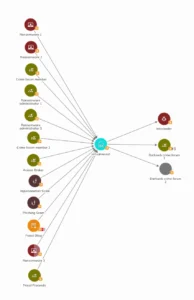
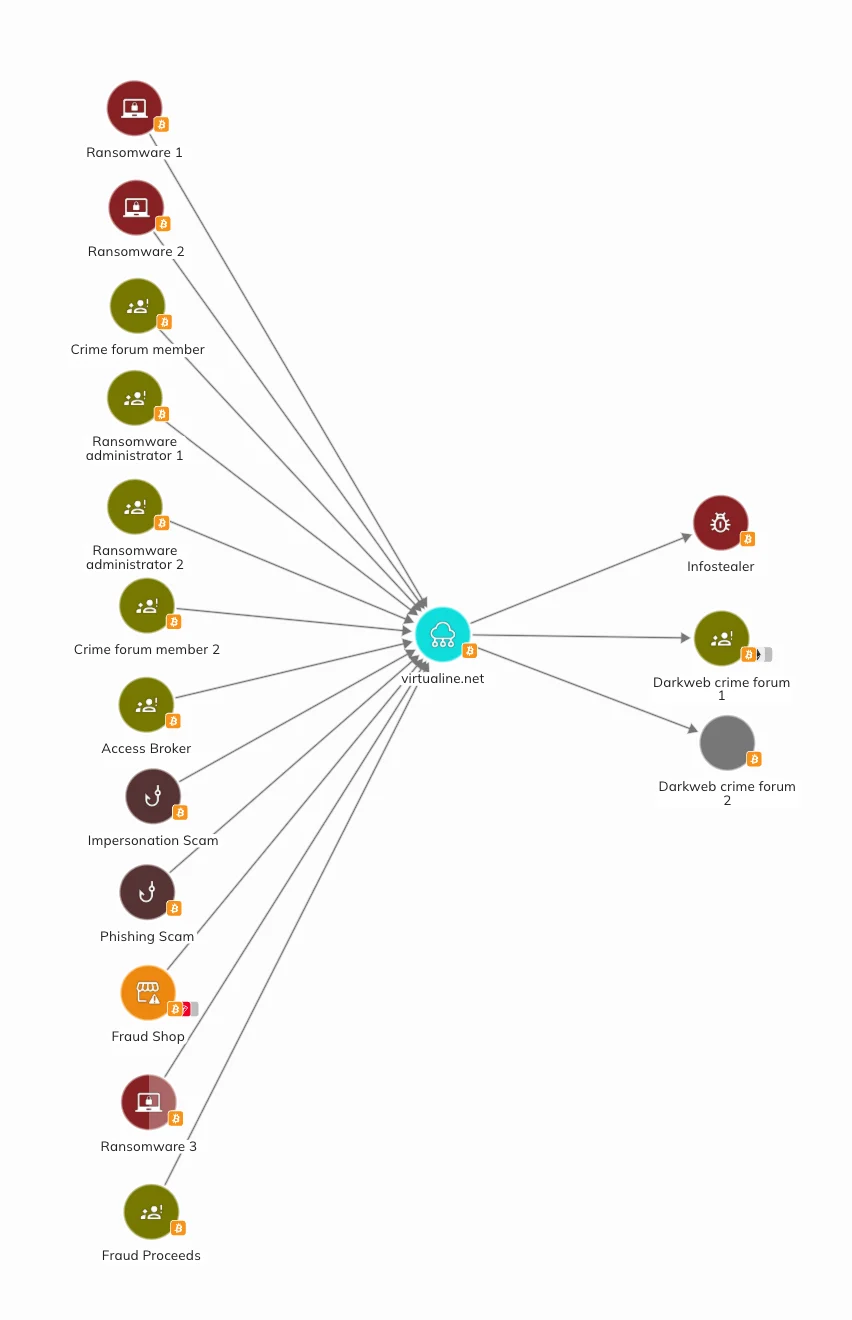
However, the transparency of the blockchain proved to be a double-edged sword for the providers. Intelligence provided by Chainalysis allowed investigators to map Virtualine’s on-chain footprint. The analysis revealed that Virtualine’s payment addresses were directly linked to a broad cross-section of the global cybercrime economy. This included:
- Ransomware Operators: Direct transfers from wallets associated with major ransomware strains, representing the "rent" paid to keep extortion servers active.
- Infostealer Infrastructure: Payments from groups deploying malware designed to harvest login credentials and financial data from unsuspecting users.
- Illicit Marketplaces: Settlement layers for shops selling stolen credit card data (carding) and "logs" from infected computers.
- Phishing Campaigns: Funding for the hosting of fraudulent login pages designed to mimic banks and government agencies.
By analyzing these flows, law enforcement was able to confirm that Virtualine was not merely a passive service provider but a central hub in the "crime-as-a-service" (CaaS) model. The proceeds from these activities were subsequently laundered through various obfuscation techniques to hide their criminal origins, a process that is now also under federal indictment.
Official Responses and Tactical Significance
The seizure of virtualine.net is being hailed by officials as a landmark case in public-private partnership. A spokesperson for the FBI’s Washington Field Office emphasized that the operation was not just about taking down a single website, but about "dismantling the sanctuary that allows cybercriminals to thrive."
"The seizure of Virtualine demonstrates that there is no such thing as ‘bulletproof’ when faced with the collective resolve of international law enforcement and the expertise of our private sector partners," the statement read. "We are committed to following the digital trail wherever it leads, and we will continue to target the infrastructure that facilitates the victimization of individuals and businesses worldwide."
The National Crime Agency (NCA) in the UK also released a statement highlighting the importance of targeting hosting providers. "By removing the foundations upon which these criminal enterprises are built, we create a ripple effect that disrupts hundreds, if not thousands, of individual criminal campaigns simultaneously. This is a highly efficient and effective way to protect the public from the multifaceted threats of the digital age."
Broader Implications for the Cybersecurity Landscape
The removal of Virtualine from the internet has immediate and long-term implications for the cybersecurity community and corporate compliance teams.
For compliance professionals in the cryptocurrency and financial sectors, the Virtualine case serves as a stark reminder of the importance of "infrastructure-level" risk monitoring. Because BPH payment addresses often touch multiple types of criminal proceeds, they serve as an early warning system. Exposure to these addresses is a high-confidence signal of downstream risk. Chainalysis has since updated its products to label all identified addresses associated with Virtualine, enabling exchanges and financial institutions to automatically flag or block suspicious transactions.
For the cybercrime ecosystem, the loss of Virtualine creates a temporary vacuum. While other BPH providers will undoubtedly attempt to absorb Virtualine’s former clients, the seizure forces criminals to undergo the risky and time-consuming process of migrating their infrastructure. This migration period is often when criminals are most vulnerable to detection and further law enforcement action.
Furthermore, the legal precedent set by this operation—particularly the use of on-chain data to prove "knowing facilitation" of crimes like CSAM and ransomware—will likely be used in future cases against other BPH providers. The message from the U.S. Attorney’s Office is clear: hosting providers can no longer hide behind the claim of being "neutral conduits" when they actively market their services to the criminal underworld and provide tools specifically designed to evade the law.
As the digital landscape evolves, the focus of law enforcement is increasingly shifting toward these "force multipliers." By targeting the servers, the domains, and the payment processors that enable cybercrime, authorities are moving toward a more proactive and systemic approach to digital policing. The seizure of Virtualine is a testament to this shift, marking a successful chapter in the ongoing effort to secure the global internet from those who seek to exploit its vulnerabilities.