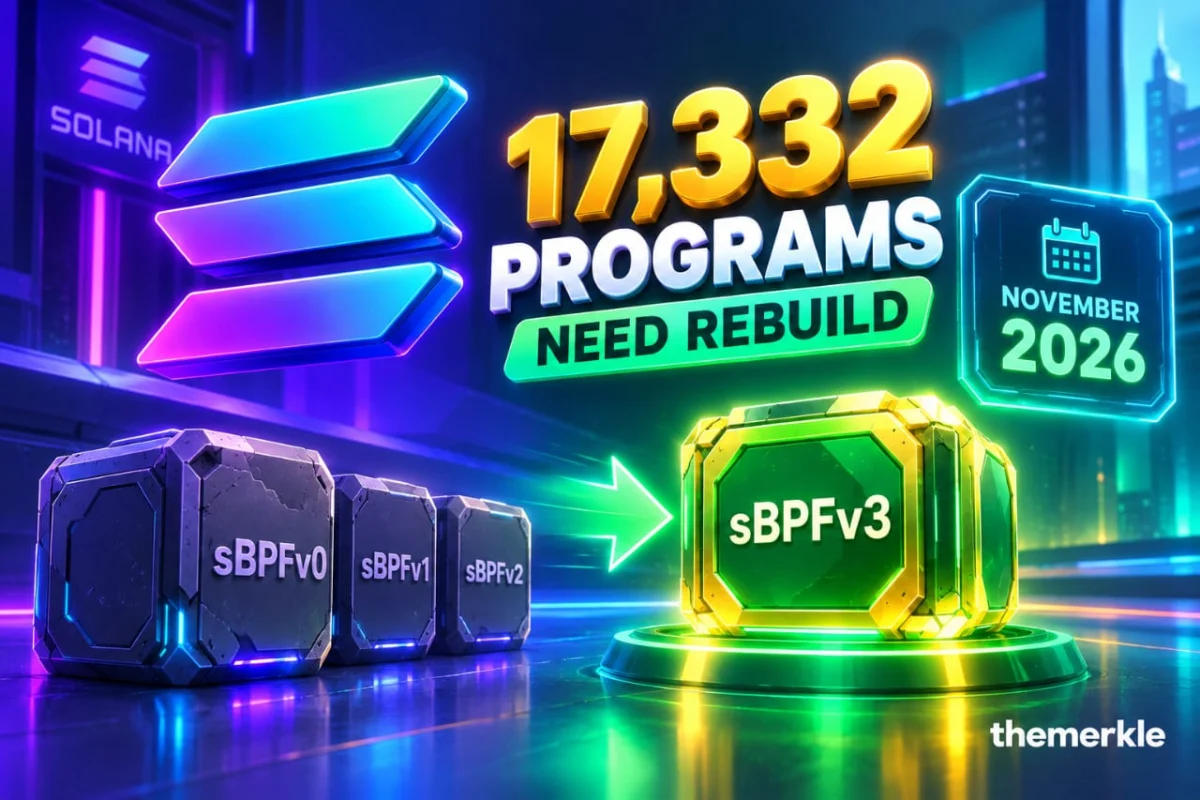
Developers building on the Solana blockchain face a crucial deadline as the network prepares to enforce a mandatory shift to the sBPFv3 program format with the Agave 4.4 release, anticipated in November 2026. This upgrade mandates that all new program deployments, upgrades, and finalizations must target sBPFv3. While existing programs already on-chain will continue to function without interruption, developers who fail to produce a v3-compliant build will be unable to deploy future fixes, updates, or new versions of their applications. The challenge is particularly acute given that the recommended Solana CLI version (v4.3.0) and a plain cargo build-sbf command currently produce programs in the older, soon-to-be-rejected v0 format unless specific flags are manually set.
The impending change marks a significant step in Solana’s ongoing evolution, aiming to enhance network efficiency, security, and developer experience. The transition underscores the dynamic nature of blockchain infrastructure and the continuous need for developers to adapt to protocol advancements. This strategic upgrade, while offering a substantial lead time until its full enforcement, necessitates proactive measures from the Solana developer community to ensure seamless operation and future adaptability of their decentralized applications (dApps).
Understanding the sBPFv3 Mandate and Its Origins
At the heart of Solana’s operational model is the Solana Bytecode Program Format (sBPF), which dictates how smart contracts (programs) are compiled and executed on the network. Like any evolving software ecosystem, Solana continuously refines its core components to improve performance, security, and introduce new capabilities. The sBPFv3 upgrade is a direct result of this ongoing development, designed to optimize program execution and pave the way for future network enhancements.
The formal proposal for this change is detailed in SIMD-0500, titled "Disable deployment of SBPF-v0, -v1 and -v2." This Solana Improvement Document outlines the technical rationale and implementation plan for deprecating older sBPF versions for deployment purposes. Once the feature gate associated with Agave 4.4 activates, Solana validators will be configured to reject specific loader-v3 operations—namely Deploy, Upgrade, and Finalize—if the target program is built using v0, v1, or v2 of the sBPF format. Other common operations like InitializeBuffer, Write, ExtendProgram, and Close will remain unaffected, as will the execution of programs already deployed on-chain. This distinction is crucial: users interacting with existing older-format programs will experience no disruption, but the maintenance and evolution of these programs will cease until they are rebuilt for v3.
The message for a blocked deployment will be explicit: "Detected sbpf_version required by the executable which are not enabled." This clear error message is intended to guide developers toward compliance. The necessary code for this feature, disable_sbpf_v0_v1_v2_deployment, is already integrated into the Agave 4.4.0 release candidate, identified by the key B8JJXCy5amZyWG9r7EnUYLwzXSXTxG7GZ1qZ1qggo83g. As of recent updates, this feature had not yet been activated on testnet, nor was a devnet activation date provided, giving developers a window to prepare.
The Scale of Impact: 17,332 Upgradable Programs Affected
The scope of this transition is substantial. According to data included in SIMD-0500, compiled using Blueshift’s program-sync tool, a significant number of programs on the Solana mainnet still utilize older sBPF formats. The critical figure stands at 17,332 upgradable programs that currently employ these older versions. Astonishingly, nearly all of them—a staggering 99.7%—are built on the oldest format, v0.
These 17,332 programs represent a diverse array of decentralized applications, protocols, and infrastructure components across the Solana ecosystem. This includes, but is not limited to, DeFi lending platforms, decentralized exchanges (DEXs), NFT marketplaces, gaming projects, identity solutions, and various utility programs. Each of these will require a v3 rebuild before its next intended upgrade. Programs that are already finalized and thus not upgradable are exempt from this requirement, as their code cannot be altered anyway.
The long-term objective articulated in SIMD-0500 extends beyond merely restricting deployments. By gradually reducing the number of old-format programs over time, Solana aims to eventually deprecate the execution of these older sBPF versions entirely. For the immediate future, however, the SIMD explicitly states that execution of v0, v1, and v2 programs will remain supported. While Agave does include a disable_sbpf_v0_execution feature from an older SIMD-0161, it currently uses only a placeholder test key in the 4.4 release, indicating that actual execution deprecation is a much later phase, likely years down the line, and will be preceded by further network-wide communication.

Chronology of the sBPF Evolution and Agave Releases
Solana’s journey to sBPFv3 has been a gradual process, reflecting a commitment to continuous improvement. The original sBPFv0 format served as the foundational program bytecode. Subsequent versions (v1, v2) introduced incremental improvements, but the leap to v3 represents a more comprehensive overhaul, focusing on areas like instruction processing, memory management, and overall security posture.
The cargo-build-sbf tool, a compiler wrapper indispensable for nearly every Solana program build, plays a central role in this transition. Its evolution directly dictates the default sBPF version produced.
- Prior to
cargo-build-sbfv4.4: The default output for a program build was sBPFv0. This meant that even if developers updated their Solana CLI, unless they explicitly added the--arch v3flag, their builds would still be in the older format. This creates a significant "readiness gap," as highlighted in the initial warning: a developer following Solana’s migration guide (which might recommend CLI v4.3.0) and running a plaincargo build-sbfwould inadvertently produce a v0 program. cargo-build-sbfv4.4 and Beyond: With the release of Agave 4.4.0-rc.1 on October 26, the default build target withincargo-build-sbfwas finally shifted to sBPFv3. This change is critical, as it aligns the default behavior with the network’s future requirements. However, until this specific toolchain becomes stable and is widely adopted, the onus remains on developers to explicitly specify--arch v3to ensure compliance.
The Agave client, developed by Anza (formerly Solana Labs), is the primary software implementation that validators run to participate in the Solana network. Network upgrades are typically rolled out through new Agave releases, which activate features via "feature gates" on a predefined schedule. The "Agave 4.4, expected November 2026" date listed on Solana’s network upgrade tracker signifies the target timeframe for the sBPFv3 deployment enforcement feature gate to activate on mainnet. This extended timeline offers developers ample opportunity to integrate the necessary changes into their development workflows without immediate panic, but it also underscores the importance of strategic planning and early adoption.
Toolchain Readiness and Framework-Specific Guidance
While the core cargo-build-sbf toolchain has evolved, the readiness of various development frameworks built on Solana varies. Developers must be aware of their specific framework’s requirements to ensure sBPFv3 compliance. Solana’s official sBPFv3 page provides minimum version requirements for several key tools and frameworks:
-
Anchor: This popular framework for developing Solana programs is notably well-prepared. Anchor 1.2.0, released on September 4, introduced
--archand--tools-versionflags to theanchor buildcommand. Crucially, its CLI now setsDEFAULT_BUILD_ARCHto "v3," making it the most ready among major frameworks. This means projects using Anchor 1.2.0 or newer will likely produce v3 programs by default, reducing the manual burden. Additionally, Anchor released maintenance versions 0.30.2, 0.31.2, and 0.32.2 on September 14, enabling projects on older major versions to still achieve compliance. Anchor 2.0 is also in release candidate, with rc.2 tagged on October 12, further solidifying its forward-looking approach. -
Pinocchio: For Pinocchio-based projects, the minimum required version is v0.10, released on January 5. Developers considering an upgrade to v0.11 (released April 8) should note that this version "changed the entrypoint signature," which may necessitate code modifications beyond just a rebuild. Like many other tools, Pinocchio builds on the 4.3 toolchain still require the explicit
--arch v3flag. -
Native Rust: Projects using native Rust for Solana program development need
solana-program2.3.0 or later. Critically, these projects also require the explicit--arch v3flag during compilation to target the correct sBPF version. -
Quasar: Quasar projects need version v0.1.0 or later. Similar to native Rust, builds must include the
--arch v3flag. -
solana-verify: The
solana-verifiable-buildtool shipped v0.5.2 on September 21, incorporating "agave 4.2/4.3 Dockerfiles and SBPFv3 toolchain pins." Its latest build image is Agave 4.3.0. However, for verified builds, the--arch v3flag still needs to be explicitly passed through as--cargo-build-sbf-args="--arch v3". Furthermore, projects not directly dependent onsolana-program(such as Pinocchio programs) must declare their CLI version inCargo.tomlto ensure the tool selects the appropriate Docker image for the build. Discrepancies between local build settings and verification build settings can lead to hash mismatches, invalidating the verifiable build process.
In summary, while the frameworks themselves offer the necessary capabilities, the primary risk lies in configuration. Except for recent Anchor versions, most build pipelines will only target sBPFv3 if developers proactively set the required flags. This highlights a potential pitfall where developers might assume their updated CLI or framework is sufficient, only to discover a deployment failure much later.
Implications of Non-Compliance: What Happens After the Deadline?
For end-users interacting with Solana dApps, the sBPFv3 transition introduces no immediate disruption. Programs already deployed on-chain will continue to execute as before, and all associated accounts, tokens, and integrations will remain fully functional. The network’s robust design ensures backward compatibility for execution, safeguarding the existing user experience.
The impact of non-compliance falls squarely on the development teams maintaining these programs. After the Agave 4.4 feature gate activates in November 2026, any upgradable program that has not been rebuilt for sBPFv3 will face significant limitations. Specifically, it cannot be upgraded and cannot be finalized. While the program’s upgrade authority will still exist, and buffer operations like writing and closing will continue to function, the network will outright reject any attempt to initiate an actual program upgrade.
This scenario poses a critical operational risk. Imagine a team discovering a severe bug or security vulnerability in their dApp after November 2026. Without a v3-compliant build, they would be unable to deploy a fix. This could lead to prolonged service outages, financial losses, or compromised user funds, severely damaging the project’s reputation and viability. For teams relying on older framework versions, such an incident would force them to not only address the bug but also undertake a potentially complex dependency upgrade and sBPFv3 migration simultaneously, all under the pressure of an active incident.
Beyond deployment, SIMD-0500 also flags a less visible, but equally important, implication for testing environments. Testing frameworks and local mocks that are used to simulate Solana network behavior "will have to be adapted to either deactivate this feature or bypass the entire deployment" if they are used to test older sBPF formats. This means that teams running local test environments should anticipate updates to their testing infrastructure to correctly reflect the new network behavior.
Solana’s Broader Vision and Future Implications
The sBPFv3 upgrade is not an isolated event but a strategic component of Solana’s long-term vision for a high-performance, secure, and scalable blockchain. By standardizing on a more optimized bytecode format, Solana aims to:
- Enhance Performance: sBPFv3 can facilitate more efficient execution of smart contracts, leading to lower transaction costs and faster processing times, which are critical for Solana’s ambitious throughput goals.
- Improve Security: Newer bytecode versions often incorporate security enhancements, patching potential vulnerabilities found in older formats and making the network more resilient against exploits.
- Streamline Development: A unified, modern bytecode format simplifies the development landscape, allowing toolchain developers to focus on optimizing for a single target, leading to better tooling and a more consistent developer experience.
- Future-Proofing: By deprecating older, less efficient formats, Solana clears the path for future innovations and optimizations at the protocol level, ensuring the network can continue to evolve and meet the demands of emerging Web3 applications.
This proactive approach to infrastructure upgrades is characteristic of a rapidly innovating blockchain ecosystem. While it places a burden on developers to adapt, it ultimately contributes to a more robust and capable platform for everyone. The long lead time until November 2026 is a testament to Solana’s commitment to providing developers with ample opportunity to prepare, minimizing disruption while maximizing the benefits of the upgrade.
A Comprehensive Checklist for Developers
To ensure a smooth transition and avoid potential deployment roadblocks, Solana developers should proactively address the sBPFv3 mandate. Based on official guides from Solana and Anza, the following checklist is recommended:
- Update Solana CLI: Ensure your local Solana Command Line Interface (CLI) is updated to at least v4.3.0. While v4.4.0 will eventually default to v3 builds, v4.3.0 is the current recommended stable version that supports v3 builds with the explicit flag.
- Review Framework Versions: Check the specific versions of your development frameworks (Anchor, Pinocchio, Native Rust, Quasar, etc.) against Solana’s official sBPFv3 page for minimum requirements.
- Modify Build Scripts: For most frameworks (excluding recent Anchor versions), explicitly add the
--arch v3flag to yourcargo build-sbfcommands. Forsolana-verifybuilds, use--cargo-build-sbf-args="--arch v3". - Update
Cargo.toml(if applicable): If your project doesn’t directly depend onsolana-programand usessolana-verify, ensure yourCargo.tomldeclares your CLI version to help the verifiable build tool select the correct image. - Test Thoroughly: After rebuilding your program for v3, rigorously test it in local environments, devnet, and testnet to ensure full functionality and compatibility. This includes unit tests, integration tests, and user acceptance testing.
- Verify Deployments: Practice deploying and upgrading your v3-built program on testnet to confirm that the network accepts the new format without issues.
- Consult Migration Guides: Refer to official documentation such as the Anza migration guide for sBPFv3, which covers these steps in more detail and provides additional context.
The most prudent approach is to perform this v3 rebuild and testing before an urgent upgrade is necessary. Proactive migration mitigates the risk of being caught off guard by a critical bug or security vulnerability, ensuring that development teams can respond swiftly and effectively to future needs. The Solana ecosystem thrives on innovation and robust infrastructure, and the sBPFv3 upgrade is a testament to this commitment, requiring a collective effort from its developer community to realize its full potential.