


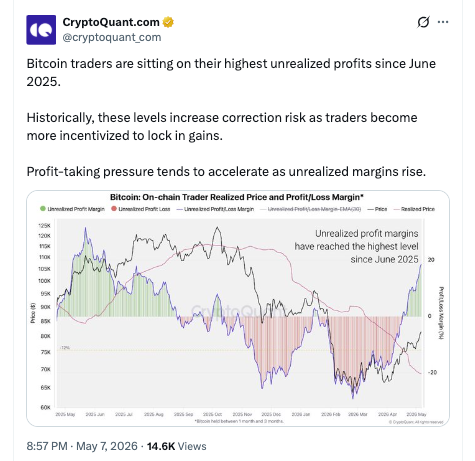
Bitcoin holders are currently experiencing the highest levels of unrealized profit since mid-2025, according to an analysis by CryptoQuant. This significant surge in profitability, however, may cast a shadow over further bullish aspirations, as a segment of analysts had already been forecasting a potential bull trap. As Bitcoin continues its sustained presence above the $80,000 price level, growing indicators suggest that the cryptocurrency could face renewed selling pressure in the near future.
CryptoQuant, a prominent blockchain analytics firm, shared its findings via a post on X (formerly Twitter) on [Insert Date of Article Publication]. The accompanying graph, derived from on-chain data, illustrated a sharp uptick in Bitcoin’s unrealized profit over the preceding 30 days. This dramatic rise mirrors the market conditions observed in June 2025, a period when the cryptocurrency was navigating the height of a major bull market. Historically, such periods of rapid profit accumulation have often preceded significant market corrections. Following this peak in mid-2025, Bitcoin experienced a substantial downturn in the final quarter of 2025 and the first quarter of 2026, with its price plummeting as low as $60,000.
The Dynamics of Rising Unrealized Profits and Potential Sell-Off Risks
The recent dip to around $60,000 presented a strategic buying opportunity for astute investors, allowing them to accumulate Bitcoin at more favorable prices. Since then, the cryptocurrency has rebounded by over 35% from this local bottom. Unrealized profits represent the difference between the current market price of an asset and its average acquisition cost for holders. When this divergence between current market value and acquisition cost becomes substantial, it creates a powerful incentive for short-term holders to realize their gains by selling. This behavior, in turn, can trigger a cascade of selling, increasing the risk of a broader market sell-off, as CryptoQuant has cautioned.
Historical data provides a compelling precedent for this scenario. Periods where unrealized profits have reached approximately +35%, as is currently being observed, have often coincided with capitulation events among short-term holders. These instances have frequently marked local tops in the market, subsequently followed by corrective price dips. The pattern suggests that as more investors see significant paper gains, the temptation to lock in profits becomes overwhelming, leading to increased selling pressure.

The current market sentiment is further complicated by a narrative that has emerged, albeit anecdotally, of an investor regretting a significant real estate purchase made instead of investing in Bitcoin. While the specifics of such a personal financial decision are not directly quantifiable in market analysis, the underlying sentiment reflects the broader discussion around opportunity cost in the volatile digital asset space. The image accompanying this narrative, depicting a million-dollar property battered by storms, serves as a stark visual metaphor for the potential risks and downsides associated with ill-timed or misplaced investments, especially when contrasted with the significant gains some have realized in Bitcoin. This anecdotal evidence, while not a direct market indicator, taps into a prevalent sentiment of "what if" that often accompanies periods of rapid asset appreciation.
Analyzing the Future Trajectory of Bitcoin
While the current environment suggests a possibility of short-term selling pressure, there is no definitive evidence to indicate an impending major price squeeze that would drive Bitcoin towards new multi-year lows below the $60,000 mark. Instead, analysts suggest that the market might experience a cooling-off period, with the price potentially consolidating around the $70,000 level before making its next significant move. This phase could allow the market to digest the recent gains and re-evaluate its next direction.
Despite the potential for short-term corrections, the broader market outlook remains cautiously optimistic for many. The increasing adoption of Bitcoin by institutional investors, coupled with strong accumulation trends observed on-chain, provides a robust foundation that could act as a cushion against severe downturns. Major financial institutions, including asset managers and corporations, have continued to allocate capital towards Bitcoin, signaling a growing conviction in its long-term value proposition. This institutional inflow often signifies a more stable demand, less susceptible to the speculative whims of retail traders.
Furthermore, the halving events, which reduce the rate at which new Bitcoins are created, have historically been followed by significant bull runs. The most recent halving, which occurred in April 2024, is still in its early stages of impacting market dynamics, and its full effects may yet to be realized. The reduction in supply, combined with sustained or increasing demand, is a fundamental economic principle that often leads to price appreciation over time.
However, the market remains susceptible to broader macroeconomic factors and regulatory developments. Geopolitical tensions, shifts in monetary policy by central banks, and evolving regulatory frameworks for cryptocurrencies can all introduce volatility and uncertainty. For instance, any significant changes in interest rate policies by major economies could influence investor appetite for riskier assets like Bitcoin. Similarly, stringent regulatory actions in key jurisdictions could create headwinds for market growth.
Divergent Analyst Outlooks and Potential Market Scenarios
While the prevailing analysis from CryptoQuant points towards a potential consolidation or moderate dip, a segment of analysts on platforms like X (formerly Twitter) have voiced concerns about a more substantial market downturn. Some have posited scenarios where Bitcoin could retrace significantly, potentially falling to $50,000 or even lower. These predictions are often based on historical patterns of boom and bust cycles within the cryptocurrency market, particularly given the volatile first four months of 2026.
The volatility experienced in the early part of 2026, characterized by sharp price swings and rapid shifts in sentiment, does lend some credence to these more bearish outlooks. The rapid ascent in price over a relatively short period can sometimes be followed by a sharp correction as early investors take profits and market sentiment shifts.
Conversely, the increasing institutional buying and robust accumulation statistics offer a counter-narrative, suggesting that the market may possess a stronger underlying support structure than in previous cycles. This sustained institutional interest could provide a stabilizing force, preventing a complete collapse of prices even during periods of heightened uncertainty. The conviction of large-scale investors, often backed by extensive research and long-term investment horizons, can significantly influence market stability.
Another potential scenario is a further upward surge towards the $90,000 price level before any significant selling pressure from short-term traders can materialize. Such a move would indicate a continuation of the bullish momentum, potentially driven by renewed retail interest or further positive news catalysts. However, a resumption of the prolonged, uninterrupted bull market that characterized earlier phases is considered less likely in the immediate term, given the current levels of unrealized profits and the historical tendency for markets to undergo corrections after substantial rallies.
The long-term outlook for Bitcoin remains a subject of ongoing debate and analysis. Factors such as its increasing integration into the global financial system, its role as a potential hedge against inflation, and its growing adoption as a medium of exchange continue to underpin its fundamental value proposition. Yet, the inherent volatility and speculative nature of the cryptocurrency market mean that investors must remain vigilant and aware of the potential risks involved. The current juncture, with high unrealized profits and mixed analyst outlooks, presents a critical period for market participants to assess their strategies and risk exposure. The interplay between profit-taking, institutional demand, and broader market sentiment will ultimately shape Bitcoin’s price action in the coming weeks and months.














