While many crypto disputes often recede from public consciousness after initial outrage, the protracted case involving Gate.io user @jheioff has defied this trend, escalating over several weeks before culminating in a public, six-figure bounty offer. This significant development follows a substantial $1.7 million theft claim against the cryptocurrency exchange, bringing renewed scrutiny to the platform’s security protocols and its handling of high-value user disputes. This week, driven by persistent frustration and perceived inaction from the exchange, Jheioff personally offered $100,000 for actionable intelligence, explicitly stating that Gate.io has ceased communication on the matter entirely.
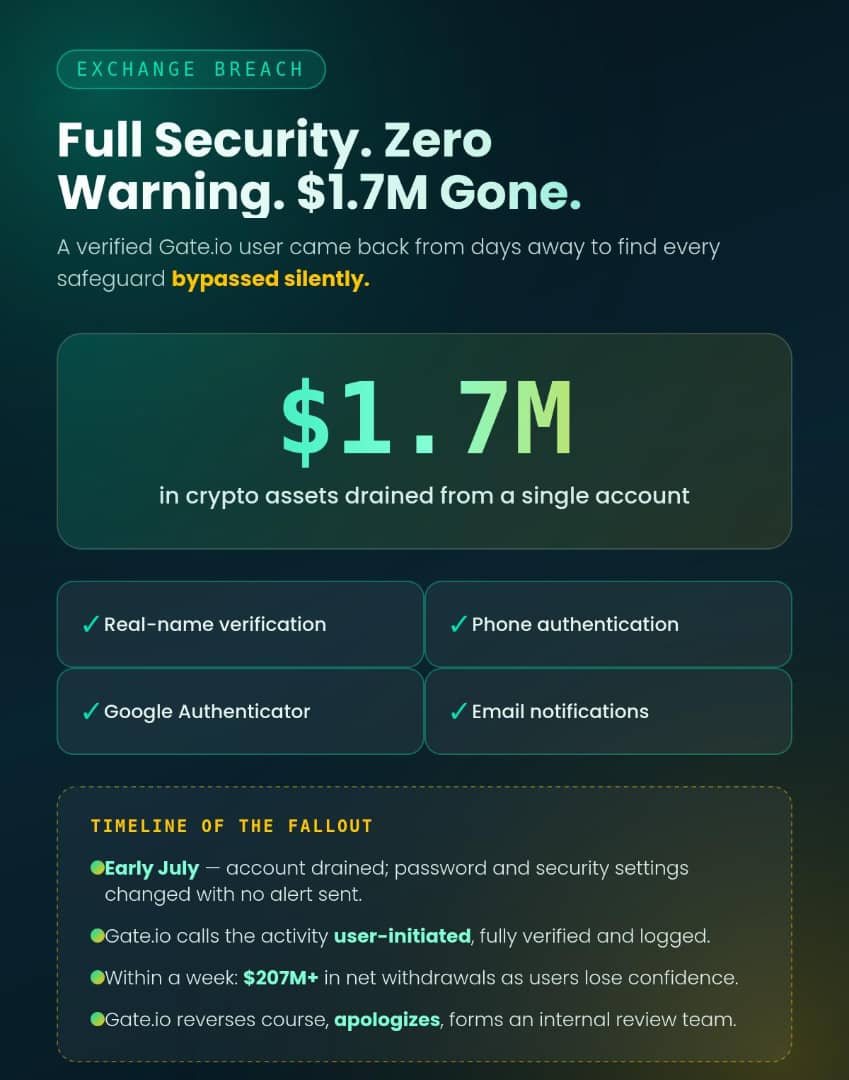
The genesis of this complex dispute traces back to early July, when Jheioff, a verified user on the global cryptocurrency exchange Gate.io, logged into their account after a period of inactivity. To their dismay, the account was found to be completely drained of its digital assets, amounting to approximately $1.7 million. What immediately distinguished this incident from typical phishing attempts or less sophisticated hacks was the robust security posture of Jheioff’s account. According to Jheioff, every available security layer offered by Gate.io had been activated, including real-name verification (KYC), phone authentication, Google Authenticator (a form of two-factor authentication, or 2FA), and email notifications. Despite these comprehensive safeguards, Jheioff reported receiving no alerts or notifications as the account’s password and crucial security settings were allegedly altered without authorization, raising profound questions about the integrity of the exchange’s security infrastructure or the processes governing account recovery and access changes.

Gate.io’s initial response to the reported theft only served to exacerbate the situation and ignite widespread criticism within the crypto community. The exchange publicly asserted that the actions taken on Jheioff’s account appeared to be user-initiated, fully verified, and properly recorded within its backend systems. This stance effectively suggested that Jheioff bore responsibility for their own losses, a position that triggered immediate and intense backlash across various crypto social media platforms. The community’s reaction was swift and impactful; within a single week following Gate.io’s initial statement, the exchange recorded over $207 million in net withdrawals. This significant outflow of capital underscored a growing sense of apprehension among users regarding the platform’s security robustness and its transparency in addressing serious allegations of theft. Such a rapid and substantial withdrawal figure is a critical indicator of eroding user trust and can pose liquidity challenges for any exchange, highlighting the tangible financial consequences of perceived security vulnerabilities and inadequate customer support.
Facing mounting public pressure and the visible exodus of user funds, Gate.io eventually reversed its initial position. The exchange issued a public apology, acknowledging the concerns raised by its user base and the broader crypto community. As part of this pivot, Gate.io announced its commitment to forming an internal team dedicated to reinvestigating Jheioff’s claim, signaling a potential shift towards greater accountability and a more thorough examination of the incident. This reversal, while welcomed by many, also served as an implicit acknowledgment of the initial misjudgment and the power of collective user sentiment in influencing exchange policies and responses.
However, this public apology and promise of reinvestigation, according to Jheioff, did not translate into a swift or satisfactory resolution. The subsequent weeks saw the process of cooperating with law enforcement devolve into a drawn-out and complex back-and-forth. Jheioff alleges that once police formally opened a case and initiated an investigation, all requested documentation was promptly provided to Gate.io. This included the official case filing decision, the identification details of the investigating officers, and a judicial evidence request letter, which is a standard legal instrument for obtaining information from entities like exchanges. Despite this, Jheioff claims Gate.io repeatedly introduced new procedural hurdles. These included requests for documents in different file formats, citing concerns about potential viruses—a claim that Jheioff found to be an unnecessary complication. Further, the exchange allegedly questioned the authenticity of the submitted materials, suggesting they might be falsified, or even implied that the police officers involved could be impersonators. Ultimately, Gate.io reportedly demanded video verification of the officers’ identities, a request Jheioff stated the police could only facilitate via voice call at that specific time, creating a verifiable impasse. While Gate.io has publicly denied intentionally withholding evidence or deliberately delaying the investigation, the ongoing dispute over these procedural requirements has undeniably overshadowed any progress towards resolving the underlying $1.7 million theft claim, leaving Jheioff in a prolonged state of limbo.
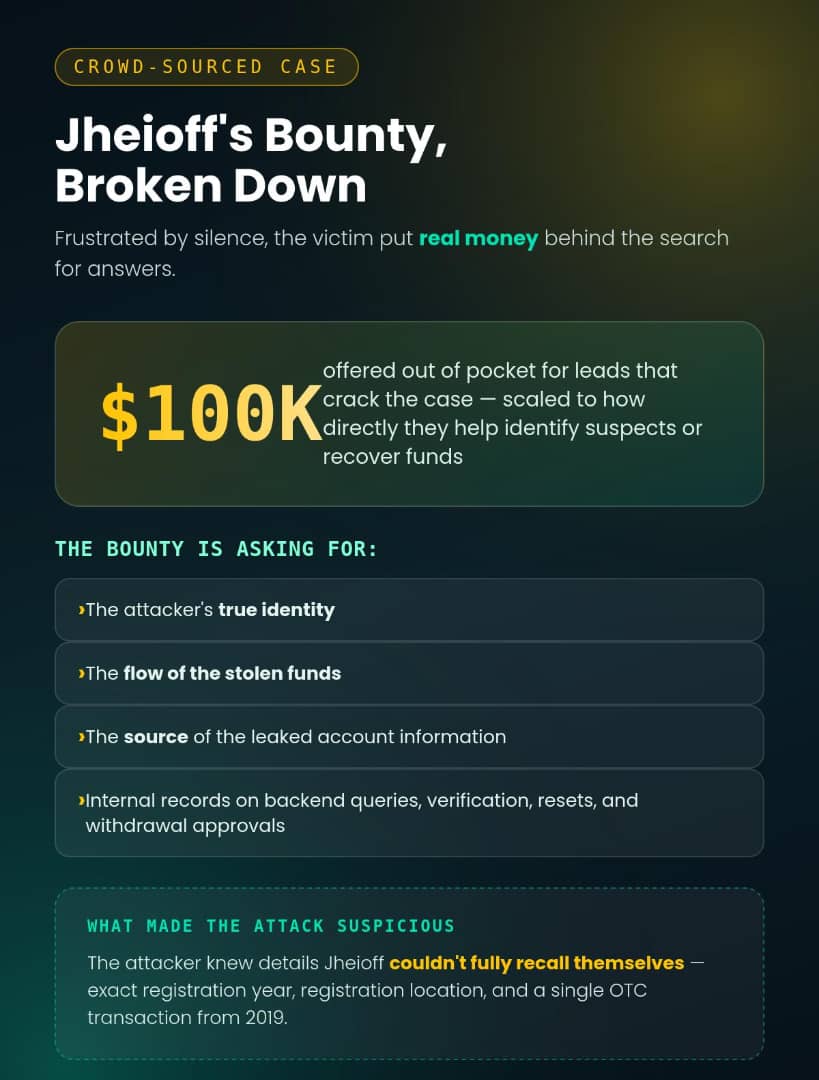
The protracted stalemate and the perceived lack of progress ultimately compelled Jheioff to take the extraordinary step of offering a public bounty this week. In a detailed post outlining the offer, Jheioff highlighted a critical piece of evidence that informed this decision: the attacker’s apparent access to highly specific user information that even Jheioff themselves struggled to recall. This included the exact year of account registration, the original registration location, and precise details of a single Over-the-Counter (OTC) transaction dating back to 2019. This level of granular, obscure information, Jheioff contended, strongly suggested a more sophisticated form of compromise than a typical external phishing attack. Instead, it pointed towards troubling possibilities such as internal data breaches within Gate.io, unauthorized internal queries into user data, abuse of backend access privileges by internal personnel, or the deliberate leakage of sensitive information by someone directly connected to the exchange’s operations.
The $100,000 bounty is meticulously structured to solicit specific types of information. Jheioff is primarily seeking the true identity of the attacker, a detailed flow of the stolen funds to aid in recovery efforts, and crucially, the source of the leaked internal information. Furthermore, the bounty specifically requests internal records pertaining to backend queries, identity verification processes, liveness detection results, security reset logs, withdrawal approval chains, and all internal communications related to Jheioff’s case. The offer extends an invitation to current or former Gate.io employees, partner service providers, or any other informed individuals to come forward. Jheioff assured that all leads would be rigorously verified by legal counsel and law enforcement, with rewards scaled proportionally to their direct contribution in identifying suspects or facilitating the recovery of funds, up to the full $100,000. A particularly poignant and pointed line in Jheioff’s public announcement underscored the current state of affairs: that Gate.io "no longer dares" to respond to their public appeals, but emphasized that the facts of the case would not simply disappear because the exchange had chosen to remain silent.
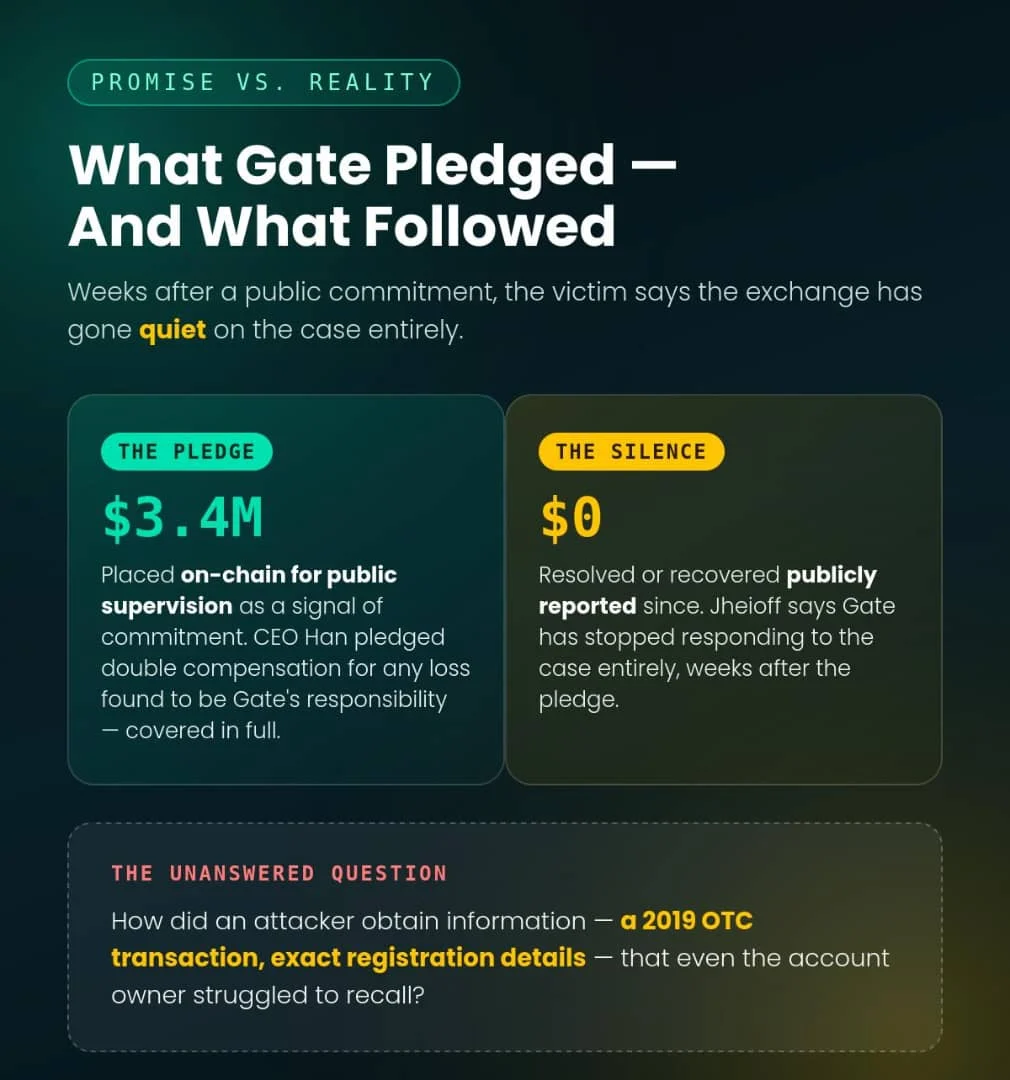
This bounty announcement stands in stark contrast to the public commitments made by Gate.io’s CEO, Han, just weeks prior. In a statement posted on the social media platform X (formerly Twitter), Han had explicitly committed to taking full responsibility for the matter. He assured the public that legal teams were fully engaged and that the exchange was actively cooperating with police to thoroughly investigate the truth of the incident. Going further, Han pledged that for any portion of the case officially determined to be Gate.io’s responsibility, the exchange would compensate the user double the lost amount, unequivocally stating that Gate.io would not shirk this obligation. As a tangible demonstration of this commitment, Han publicly declared that Gate.io had placed $3.4 million on-chain, ostensibly for public supervision, framing it as a concrete signal of the exchange’s dedication to resolving the issue. He concluded his post by extending this promise to every Gate.io user, asserting that any loss proven to be caused by the platform’s own responsibility would be fully covered.
The significant tension driving this ongoing story lies precisely in the glaring gap between CEO Han’s unequivocal public commitment to transparency, responsibility, and compensation, and Jheioff’s subsequent account of total silence and procedural obstruction from the exchange. A public pledge to assume full responsibility and to place funds on-chain for supervision, while a strong public statement, does not, in isolation, address the specific and pressing questions Jheioff is now posing. These questions revolve around how an attacker could have obtained highly specific, deeply personal information that Jheioff themselves struggled to recall, and why, despite earlier promises, the exchange has reportedly ceased engaging with the case entirely. This fundamental discrepancy between rhetoric and reported reality is the core tension fueling the narrative, raising doubts not merely about whether Gate.io issued the "right" statements in July, but whether any concrete and constructive actions have genuinely materialized since.
For the immediate future, the case remains officially open, with the $1.7 million in crypto assets still unrecovered according to public reports. Jheioff’s unprecedented $100,000 bounty represents a direct, desperate attempt to inject momentum into an investigation that appears to have stalled within official channels. The outcome of this crowdsourced initiative will be pivotal. Whether the six-figure offer ultimately yields a genuine, actionable lead—potentially from within Gate.io’s own ranks or from external sources—will likely determine if this incident becomes a landmark case study in successful crowd-sourced crypto investigation and recovery. Alternatively, it risks fading into another unresolved exchange dispute, eventually supplanted by the next unfolding controversy in the fast-paced world of digital assets. Regardless of the immediate outcome, Jheioff has unequivocally signaled that this dispute will not be allowed to fade quietly. With substantial personal funds now attached to the pursuit of concrete answers, Gate.io’s reported continued silence on the matter is almost certain to attract intensified scrutiny from the media, regulators, and the broader crypto community, rather than less. The implications for user trust and the accountability of centralized exchanges hang in the balance.