


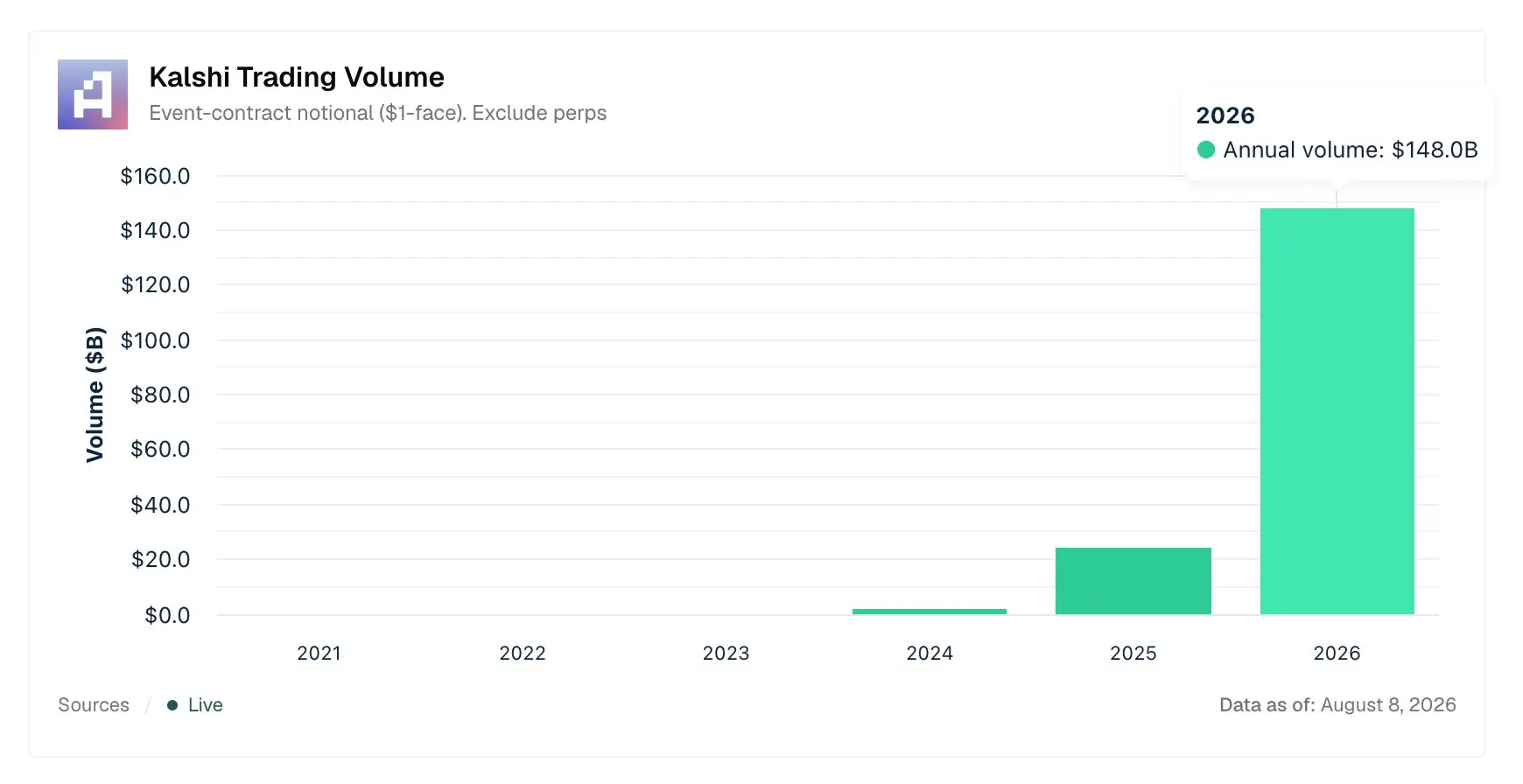
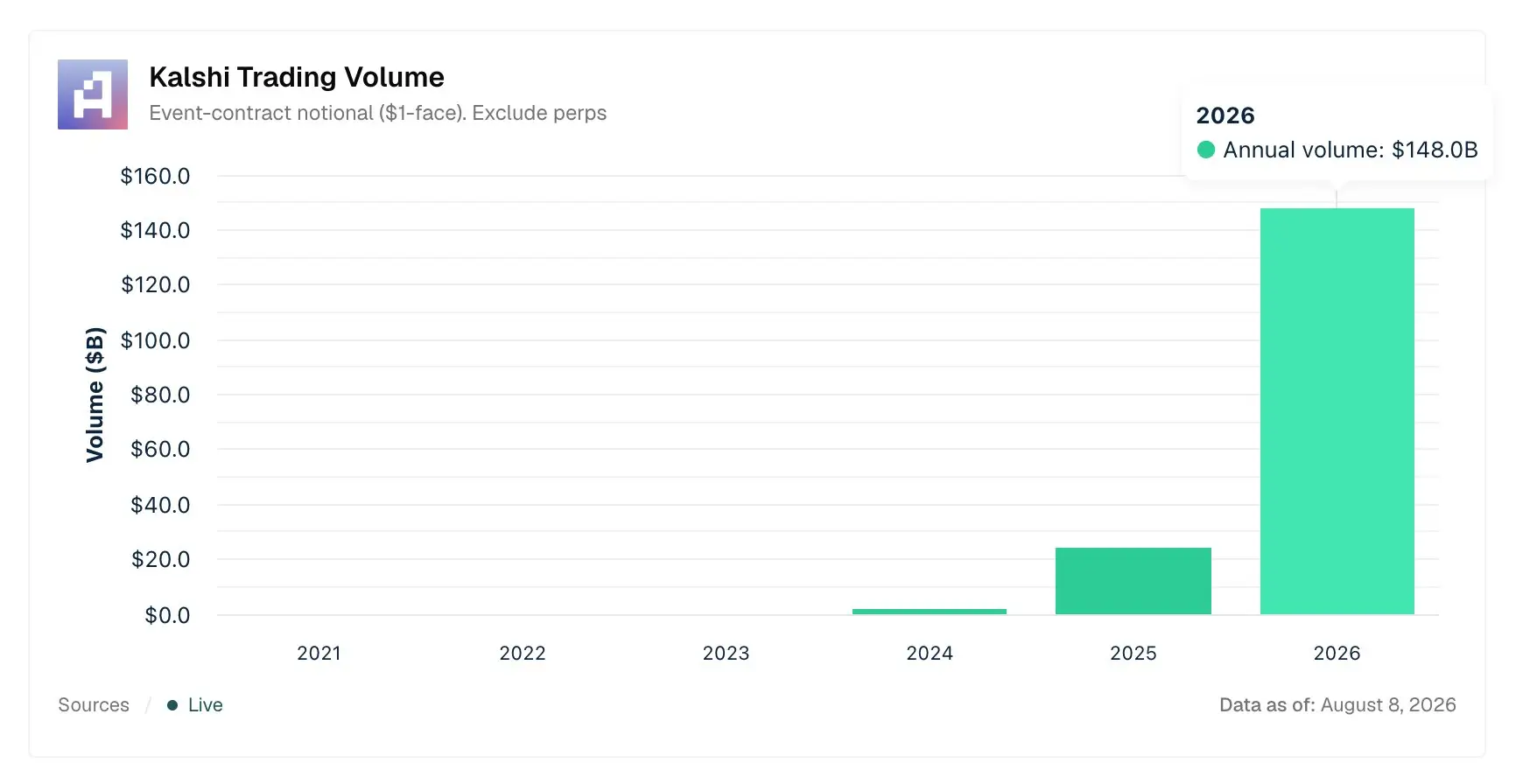
Kalshi, the pioneering prediction market platform, has reported an extraordinary surge in trading activity, generating over $148 billion in notional trading volume during 2026 alone, as of August 8. This unprecedented expansion marks the strongest growth period in the company’s history, accounting for approximately 85.5% of its cumulative event-contract trading volume, which now stands at more than $173 billion. The remarkable acceleration underscores a pivotal moment for the burgeoning prediction market industry, even as it grapples with an increasingly complex and fragmented regulatory landscape across the United States.
The data, meticulously compiled by KalshiData in collaboration with Artemis, paints a vivid picture of the platform’s meteoric rise. These figures specifically measure event-contract notional at a $1 face value, carefully excluding perpetual contracts, customer deposits, balances, and company revenue to provide a clear focus on core trading activity. The sheer concentration of lifetime activity within the first seven months of 2026 highlights a dramatic shift in market engagement and investor interest, far outpacing all previous operational periods combined.
Understanding the Mechanics of Prediction Markets and Kalshi’s Distinctive Model
To fully appreciate Kalshi’s recent success, it is essential to understand the fundamental nature of prediction markets and the unique position Kalshi occupies within this innovative financial segment. Prediction markets are platforms where participants trade contracts whose payouts are tied to the outcome of future events. Unlike traditional betting, which often involves fixed odds set by an operator, prediction markets operate more akin to financial exchanges. Traders buy and sell "event contracts" based on their beliefs about the probability of a specific future event occurring. The price of these contracts fluctuates based on supply and demand, ultimately settling at either $0 or $1 depending on whether the event occurs. This mechanism allows the market itself to aggregate collective intelligence and predict outcomes, often with surprising accuracy.
Kalshi distinguishes itself by operating as a Commodity Futures Trading Commission (CFTC)-designated contract market (DCM). This designation is crucial, as it places qualifying event contracts traded on its platform within the federal derivatives regulatory framework, typically reserved for instruments like futures and options. The company’s vision has been to democratize access to financial markets by allowing individuals and institutions to trade on "anything that can be observed and verified," ranging from economic indicators and geopolitical events to technological advancements and, increasingly, sports outcomes. This regulatory alignment, Kalshi argues, transforms event contracts from mere speculative tools into legitimate financial instruments capable of hedging risk and facilitating price discovery. The platform’s commitment to this regulated environment has been a cornerstone of its strategy, aimed at fostering trust and attracting a broader base of sophisticated traders and institutional capital.
A Deep Dive into Kalshi’s Explosive 2026 Growth
The scale of Kalshi’s 2026 performance becomes strikingly clear when juxtaposed against its prior annual records. In an official X post from January 2, 2026, KalshiData reported that the platform processed approximately $23.8 billion in notional trading volume throughout 2025. This figure, impressive in its own right, represented a staggering 1,108% year-over-year increase, or a 12.1x growth multiplier, from the preceding year. During 2025, the platform saw a monthly trading volume peak of $6.38 billion in December, a weekly high of $1.7 billion during the fourth week of December, and a daily record of $381.7 million on December 21. These statistics underscored a significant upward trajectory, signaling a nascent but rapidly accelerating interest in event-based trading.
However, the activity witnessed in 2026 has dwarfed these previous milestones with unprecedented speed and magnitude. By August 8, 2026, the year’s trading volume had already surpassed the entirety of 2025’s total by more than 6.2 times, with nearly five months of the calendar year still remaining. This means that the vast majority of Kalshi’s recorded trading history – approximately 85.5% of its cumulative $173 billion event-contract volume – has accumulated within just over seven months. To put this into further perspective, only about $25 billion of Kalshi’s total historical volume was generated prior to 2026. This year’s $148 billion total is almost six times its entire pre-2026 historical volume, unequivocally underscoring the truly exponential nature of this recent expansion.

Key Catalysts for the Unprecedented Surge
Several distinct factors have converged to fuel Kalshi’s explosive growth in 2026, pointing to a diversification of market interest and an expanding user base.
The 2026 FIFA World Cup Phenomenon: One of the most significant drivers of this year’s growth was the 2026 FIFA World Cup. During the global football tournament, Kalshi recorded an astonishing approximately $27 billion in trading volume, attracting an estimated 3 million new users to the platform. The World Cup, with its immense global viewership and unpredictable outcomes, proved to be an ideal environment for event contracts. Traders engaged in contracts related to match results, team advancements, player performance metrics, and overall tournament outcomes. The high-stakes, high-frequency nature of the games, combined with widespread public interest, created a perfect storm for rapid market engagement. This single event alone accounted for a substantial portion of the company’s year-to-date activity, demonstrating the immense potential of major global sporting events to galvanize prediction market participation. The momentum generated by the World Cup seamlessly transitioned into July, with datasets indicating monthly trading volume between approximately $37.7 billion and $41.05 billion. While variations in measurement methodologies account for the slight discrepancy, both figures unequivocally demonstrate that trading activity remained robust and elevated long after the tournament concluded, suggesting a sustained interest rather than a transient spike.
Explosion in Short-Duration Cryptocurrency Contracts: Another potent catalyst has been the remarkable expansion of short-duration cryptocurrency contracts. These contracts, often resolving within 15 minutes, saw their trading volume skyrocket from a modest $53.8 million in January to an astounding approximately $4.8 billion in July. This exponential growth reflects the inherent volatility and rapid price movements characteristic of the cryptocurrency market, which makes short-duration contracts particularly appealing to traders seeking quick turnarounds and opportunities to capitalize on immediate market shifts. The ability to trade on micro-movements of digital assets provides a novel avenue for crypto enthusiasts and professional traders alike, further cementing Kalshi’s appeal to a tech-savvy demographic. Building on this success, Kalshi subsequently expanded this popular short-duration market format to gold and silver contracts, broadening its commodity offerings and attracting interest from traditional financial market participants.
Diversification into Sports and Combination Contracts: Beyond the World Cup, other sports-related contracts and "combination contracts" contributed significantly, generating approximately $32 billion in July activity. Combination contracts allow users to trade on the interplay of multiple events or conditions, offering more complex and nuanced trading strategies. This diversification beyond single-event outcomes indicates a growing sophistication among Kalshi users and the platform’s ability to cater to a wider array of trading preferences.
Surging Institutional Participation: While retail trading activity has been a significant driver, Kalshi has also experienced a dramatic increase in institutional participation. The company reported an astounding 800% rise in institutional trading volume during the six months preceding its May financing round. This influx of institutional capital underscores a growing recognition of prediction markets as legitimate financial instruments by larger investment firms and professional traders. The validation from institutional players is critical for the long-term credibility and stability of the platform. This increased confidence culminated in a highly successful financing round in May, which raised $1 billion and valued the company at an impressive $22 billion. Such a valuation in a relatively nascent market segment speaks volumes about investor belief in Kalshi’s model, its technology, and its future potential.
The Regulatory Conundrum: A Fragmented Landscape
Kalshi’s rapid expansion has unfolded against a backdrop of increasing regulatory scrutiny and disagreements over the classification of certain event contracts in the United States. As a CFTC-designated contract market (DCM), KalshiEX operates under the federal derivatives regulatory framework, implying that eligible contracts traded on its venue fall under the CFTC’s oversight. The CFTC views these event contracts as legitimate financial derivatives, providing a mechanism for price discovery and risk management, similar to how futures contracts are used to hedge against commodity price fluctuations.
However, this federal interpretation has been met with staunch opposition from several U.S. states, which contend that sports-related event contracts, in particular, constitute a form of gambling. States like Utah and Michigan have challenged the CFTC’s jurisdiction, arguing that such contracts should remain subject to state gambling laws, which are typically designed to regulate traditional sports betting, lotteries, and casino games. The core of this dispute lies in the definitional boundary between a financial derivative and a wager. States often point to the "yes/no" nature of many event contracts, and their direct tie to specific real-world outcomes, as evidence that they resemble gambling.
This ongoing disagreement has resulted in a highly fragmented regulatory environment across the country. In a recent significant development, a federal judge allowed Utah to enforce its anti-gambling laws against the platform, adding another layer of complexity and uncertainty to the broader legal debate. This ruling highlights the legal precedent that states can, under certain circumstances, assert their authority over what they deem to be gambling activities, even if a platform operates under federal financial market regulations. For Kalshi, this means navigating a patchwork of state laws, potentially restricting its ability to offer certain types of contracts in various jurisdictions. The lack of a unified regulatory stance creates operational challenges, increases legal costs, and could impede national market expansion.
From Kalshi’s perspective, supported by the CFTC’s initial designation, event contracts offer unique economic utility. They argue that these markets can provide valuable real-time indicators for future events, aiding businesses and policymakers in decision-making, and offering individuals a tool to hedge against specific future outcomes. They differentiate their platform from traditional sportsbooks by emphasizing market-driven pricing, transparent regulatory oversight, and the absence of house odds. However, state regulators often prioritize consumer protection concerns, the potential for problem gambling, and the integrity of existing state-regulated gambling markets, seeing Kalshi’s offerings as encroaching upon their established frameworks.
Broader Implications and Future Outlook
Kalshi’s astronomical growth in 2026, coupled with the escalating regulatory disputes, sets the stage for a critical period for the prediction market industry. The rapid accumulation of trading volume and the significant institutional investment suggest a robust and growing demand for these innovative financial products. The $22 billion valuation not only validates Kalshi’s business model but also signals to the broader financial world that prediction markets are a force to be reckoned with.
For Kalshi, the immediate future involves a delicate balancing act. On one hand, capitalizing on this growth momentum by expanding contract offerings, enhancing platform features, and attracting more users is paramount. The successful expansion into short-duration gold and silver contracts demonstrates this proactive approach. On the other hand, navigating the treacherous waters of regulatory uncertainty will be crucial. The outcome of the ongoing legal battles, particularly the state-level challenges, will significantly influence where and how Kalshi can operate. A favorable resolution or a clearer federal mandate could unlock immense untapped potential, while continued fragmentation could necessitate a more localized, state-by-state strategy.
The broader prediction market industry will closely watch Kalshi’s trajectory. Its success could pave the way for other platforms, encouraging innovation and investment in this space. Conversely, if regulatory challenges prove too restrictive, it could stifle the growth of other nascent prediction market ventures. The debate over whether event contracts are financial derivatives or gambling will likely intensify, potentially leading to calls for more comprehensive federal legislation that explicitly defines and regulates these markets, thereby providing much-needed clarity for both operators and consumers.
Economically, prediction markets hold the promise of improving information efficiency and providing valuable insights into future events that traditional markets might overlook. Their role in price discovery for a vast array of outcomes, from corporate earnings to geopolitical stability, could become increasingly significant. However, to fully realize this potential, a stable and predictable regulatory environment is indispensable.
In conclusion, Kalshi’s record-breaking performance in 2026 is a testament to the surging interest in prediction markets and the platform’s innovative approach to event-based trading. The figures underscore a dramatic shift in market dynamics, driven by major global events and the appeal of rapid-fire contracts. Yet, this remarkable ascent is shadowed by a contentious regulatory landscape, where the very definition and oversight of these markets remain fiercely debated. The resolution of these regulatory challenges will ultimately determine the long-term trajectory not only for Kalshi but for the entire prediction market industry, as it seeks to solidify its place within the broader financial ecosystem.














