


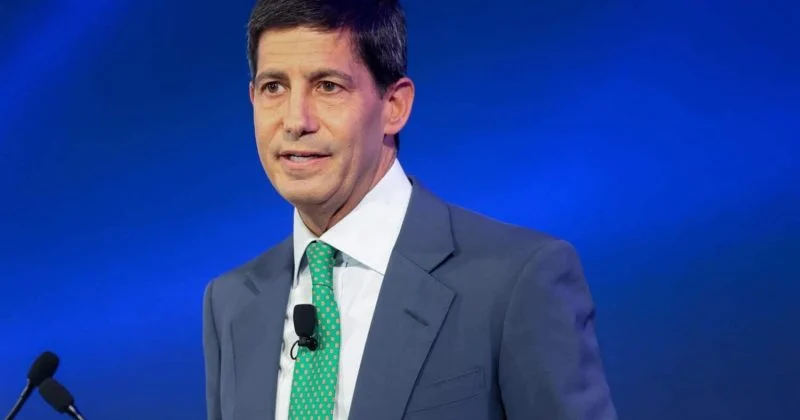
The leadership of the United States Federal Reserve will undergo a historic transition this Friday as Kevin Warsh is officially sworn in as the 11th chair of the modern era. A White House official confirmed to CNBC that President Donald Trump will administer the oath of office, signaling the formal conclusion of a selection process that has spanned nearly a year. The appointment follows a period of significant political and economic debate, culminating in a narrow Senate confirmation last week that reflected the deeply partisan atmosphere surrounding the future of the nation’s central bank. Warsh, a former Federal Reserve governor with deep ties to both Wall Street and previous administrations, steps into the role at a critical juncture for the global economy, as the Fed balances the dual mandate of price stability and maximum employment against a backdrop of shifting political expectations.
Warsh succeeds Jerome Powell, whose statutory term as chair concluded on Friday. While Powell has remained in a temporary capacity to facilitate an orderly handover, the swearing-in of Warsh represents a definitive break from the "Powell era," which was characterized by aggressive interest rate hikes to combat post-pandemic inflation. The transition comes after a nomination process that began in the summer of 2025 and faced rigorous scrutiny during Senate Banking Committee hearings. Ultimately, the Senate confirmed Warsh in a 54–45 vote, a margin that underscores the divide between lawmakers who view him as a necessary reformer and those who fear his appointment may compromise the Federal Reserve’s traditional independence from executive branch influence.
A Career Defined by Crisis and Markets
Kevin Warsh is no stranger to the inner workings of the Eccles Building. His return to the Federal Reserve is viewed by many as a homecoming for a policy expert who played a pivotal role during one of the most turbulent periods in American financial history. Originally appointed to the Board of Governors in 2006 by President George W. Bush, Warsh became the youngest person ever to hold the position at the age of 35. His tenure was defined by the 2008 financial crisis, where he served as a primary liaison between the Federal Reserve and the major financial institutions of Wall Street.
During the Great Recession, Warsh was instrumental in the design and implementation of emergency lending facilities that provided liquidity to a freezing financial system. His experience during this period is frequently cited by his supporters as evidence of his "battle-tested" credentials. However, critics from his earlier tenure often point to his initial skepticism regarding quantitative easing and his early warnings about inflation—projections that some economists argue were premature at the time. Since leaving the Fed in 2011, Warsh has spent time as a distinguished fellow at the Stanford University Hoover Institution and as a member of various corporate boards, maintaining a high profile in economic circles as a frequent commentator on monetary policy.
The Wealthiest Chair in Federal Reserve History
Beyond his policy credentials, Warsh’s appointment sets a new precedent regarding the personal finances of the Fed leadership. Based on financial disclosures filed during the confirmation process, Warsh is set to become the wealthiest individual ever to lead the central bank. This distinction is largely attributed to his successful career in the private sector, including a significant tenure at Morgan Stanley, and his marriage to Jane Lauder, an heiress to the Estée Lauder cosmetics fortune.
The scale of his personal wealth has necessitated a complex and rigorous ethics review. Under the Federal Reserve’s tightened ethics rules—strengthened in recent years following controversies involving previous regional presidents—Warsh will be required to divest a substantial portfolio of assets to avoid potential conflicts of interest. The Office of Government Ethics and the Fed’s internal counsel have overseen a plan that involves moving assets into diversified mutual funds and blind trusts. This process is intended to ensure that the Chair’s personal financial interests do not intersect with the sensitive market-moving decisions made by the Federal Open Market Committee (FOMC).
A New Stance on Digital Assets and Innovation
Perhaps the most anticipated shift under Warsh’s leadership involves the Federal Reserve’s approach to digital assets. Unlike his predecessors, who often maintained a stance of "cautious observation" regarding the crypto industry, Warsh has been vocal about his openness to integrating digital assets into the mainstream financial system. In various public forums, Warsh has stated that the rise of Bitcoin and other decentralized technologies "does not make him nervous," suggesting a departure from the more adversarial or skeptical tone often adopted by regulators in Washington.
While the Federal Reserve does not possess the direct regulatory authority over cryptocurrency exchanges held by the Securities and Exchange Commission (SEC) or the Commodity Futures Trading Commission (CFTC), the Chair’s outlook significantly influences the banking sector’s willingness to engage with the crypto ecosystem. Analysts expect that a Warsh-led Fed may provide clearer guidance for commercial banks seeking to offer custody services for digital assets or facilitate crypto-related transactions.
Furthermore, Warsh has expressed significant skepticism toward the development of a U.S. Central Bank Digital Currency (CBDC). He has argued that a government-issued digital dollar could pose risks to privacy and the existing private banking structure. Instead, he has advocated for improvements to the existing payments infrastructure and a regulatory environment that allows private-sector stablecoins to flourish under appropriate oversight. This "crypto-friendly" reputation has made his appointment a focal point for the fintech industry, which views his leadership as a potential catalyst for the "institutionalization" of digital finance.
Monetary Policy and the 2% Inflation Target
The immediate challenge facing Chair Warsh is the navigation of interest rate policy in a "post-Powell" economy. The year 2025 saw the Federal Reserve initiate three interest rate reductions as inflation began to cool from its 2022-2023 peaks. However, the path forward remains obscured by economic data that suggests a "sticky" inflationary environment. The Federal Reserve’s primary goal remains the 2% inflation target, a benchmark that has not been consistently maintained for over five years.
Market participants remain cautious, as recent data indicates a resilient labor market and consumer spending that could reignite price pressures if the Fed eases policy too quickly. President Trump has historically been a proponent of lower interest rates, frequently advocating for "cheap money" to stimulate domestic manufacturing and growth. Warsh’s appointment is widely seen as an alignment with the administration’s economic vision. The central question for Wall Street is whether Warsh will prioritize the White House’s preference for further rate cuts or adhere to the traditional data-dependent approach that has defined the Fed’s independence for decades.
Implications for Institutional Independence
The transition to Warsh’s leadership has reignited a long-standing debate over the independence of the Federal Reserve. The 54–45 Senate vote was largely split along party lines, with many opposition lawmakers expressing concern that the President is attempting to exert greater control over monetary policy. The presence of the President at the swearing-in ceremony—an event often held more quietly at the Fed’s headquarters—is seen by some as a symbolic assertion of executive influence.
Maintaining the separation between political cycles and monetary policy is considered a cornerstone of American economic stability. If the markets perceive that interest rate decisions are being made to satisfy political objectives rather than economic necessity, it could lead to increased volatility in the bond markets and a potential loss of confidence in the U.S. dollar. Warsh will need to balance his professional relationship with the President with the necessity of appearing impartial to the global financial community.
Timeline of the Transition
To understand the gravity of Friday’s ceremony, it is essential to review the chronology of events leading to this moment:
- June 2025: President Trump announces his intention to nominate a successor to Jerome Powell, citing a need for "new thinking" at the central bank.
- August 2025: Kevin Warsh emerges as the frontrunner among a shortlist of candidates that reportedly included several academic economists and Wall Street executives.
- November 2025: The formal nomination of Warsh is sent to the Senate.
- January 2026: Confirmation hearings begin before the Senate Banking Committee. Warsh faces intense questioning regarding his views on inflation, crypto regulation, and his ability to stand up to executive pressure.
- Last Week: The Senate votes 54–45 to confirm Warsh.
- This Friday: The official swearing-in ceremony at the White House.
Economic Outlook and Market Reaction
Initial market reactions to the finalization of Warsh’s appointment have been mixed. The equities markets have generally responded positively to the prospect of a Chair who is viewed as more "dovish" and open to rate cuts. However, the bond market has shown signs of nervousness, with yields on the 10-year Treasury note fluctuating as investors weigh the possibility of higher long-term inflation.
Economists are particularly focused on how Warsh will handle the Fed’s balance sheet. Following the massive expansion of the Fed’s holdings during the pandemic, the process of "quantitative tightening" (reducing the balance sheet) has been a slow and delicate operation. Warsh’s history suggests he may favor a faster normalization of the balance sheet, though this could conflict with the administration’s desire for lower borrowing costs.
The international community is also watching closely. As the leader of the world’s most influential central bank, Warsh’s policies will dictate capital flows across the globe. Central banks in Europe, Japan, and emerging markets will be forced to react to the Fed’s new direction, especially if the U.S. dollar undergoes significant valuation changes as a result of the new leadership’s approach to interest rates and digital assets.
Conclusion
As Kevin Warsh takes the helm of the Federal Reserve, he carries the weight of immense expectations. To his supporters, he is a visionary who will modernize the central bank, embrace the future of digital finance, and ensure that monetary policy supports robust economic growth. To his critics, he represents a potential shift toward a more politicized Fed, where the lines between the White House and the central bank become increasingly blurred.
Friday’s ceremony marks more than just a change in personnel; it marks a potential shift in the very philosophy of American central banking. Whether Warsh can successfully navigate the pressures of high-stakes politics while maintaining the Fed’s mandate of economic stability will be the defining narrative of his chairmanship. With the 2% inflation target still elusive and the financial world on the cusp of a digital revolution, the "Warsh era" begins at a moment where the stakes for the American economy could not be higher.














