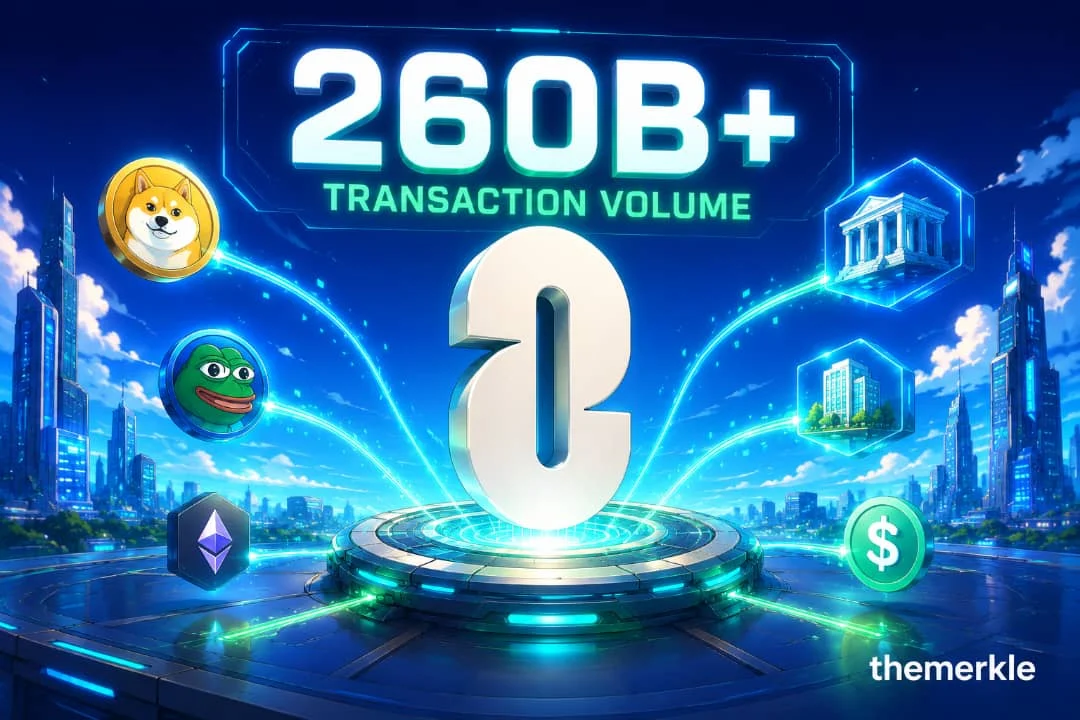
LayerZero, the omnichain interoperability protocol, has achieved a significant milestone, facilitating over $260 billion in transaction volume. This extensive activity spans more than 830 Omnichain Fungible Tokens (OFTs) deployed across upwards of 170 distinct blockchains, marking a pivotal moment in the evolution of interconnected Web3 infrastructure. From the volatile markets of speculative memecoins to the more regulated realms of institutional-grade tokenized treasuries and government-issued stable tokens, LayerZero has quietly emerged as a fundamental backbone, critically connecting an increasingly fragmented blockchain landscape. This achievement underscores the protocol’s deep integration into diverse facets of the digital asset ecosystem, demonstrating its capacity to serve a broad spectrum of use cases and users.
This substantial figure transcends typical crypto volume announcements due to the nature of its adoption and the diverse array of entities leveraging the protocol. The builders utilizing LayerZero are far from a monolithic group; they encompass everything from agile, small teams launching viral tokens to established financial institutions embedding intricate compliance logic directly into smart contracts. What distinguishes LayerZero is its ability to cater to such disparate needs, not through a rigid, one-size-fits-all solution, but via profound configurability. This adaptability allows the protocol to precisely align with each builder’s specific requirements, making it a versatile tool for various applications across the blockchain spectrum. This isn’t merely a protocol chasing transient hype; it signifies robust infrastructure maturing in real-time, with the $260 billion figure serving as the clearest indicator yet of widespread market validation and agreement on its utility and necessity.
The Imperative of Interoperability: Addressing Web3 Fragmentation
The rapid proliferation of Layer 1 (L1) and Layer 2 (L2) blockchains has undeniably spurred innovation and scalability within the Web3 ecosystem. However, this growth has simultaneously led to a highly fragmented environment. Each blockchain, while offering unique advantages in terms of throughput, security, or cost, often operates as a silo, limiting the seamless flow of assets, data, and user experience across the broader digital landscape. Users and developers frequently face challenges associated with isolated liquidity pools, complex bridging mechanisms, and disparate security models when attempting to interact with assets or applications across different chains. This fragmentation has been a significant barrier to mainstream adoption, hindering the vision of a truly interconnected and composable Web3.
Early attempts at interoperability often relied on centralized or semi-centralized bridges, which, despite their utility, frequently presented significant security vulnerabilities. Numerous high-profile hacks targeting these bridges resulted in billions of dollars in losses, eroding user trust and highlighting the critical need for more secure, decentralized, and flexible interoperability solutions. LayerZero emerged in this context, aiming to provide a foundational messaging layer that allows applications to communicate securely and efficiently across disparate blockchains without inheriting the security risks of intermediate bridge models. By focusing on a highly generalized messaging protocol, LayerZero sought to abstract away the complexities of cross-chain communication, enabling developers to build truly omnichain applications.
LayerZero’s Architectural Philosophy: A Generalizable Messaging Layer
Most observers of blockchain interoperability describe LayerZero as a protocol that connects applications across multiple blockchains. While technically accurate, this definition barely scratches the surface of the protocol’s practical capabilities and its unique architectural philosophy. At its core, LayerZero functions as a highly generalizable messaging protocol. Unlike traditional bridges that often impose a fixed model for asset transfer or data relay, LayerZero provides builders with a sophisticated toolkit to configure their own security assumptions, validation mechanisms, and deployment logic. This bespoke approach allows the protocol to precisely match the specific requirements of any given use case.
For instance, a team launching a speculative memecoin operates with entirely different priorities and risk tolerances compared to an issuer of real-world assets (RWAs), or a licensed financial institution managing regulated digital assets. LayerZero accommodates all three distinct profiles without forcing them into a restrictive, predetermined framework. The protocol achieves this flexibility through its innovative design, which separates the security of cross-chain messages into two independent components: the Oracle and the Relayer. The Oracle (e.g., Chainlink) transmits a block header, while the Relayer submits a transaction proof. A message is only considered valid if both components independently confirm it, ensuring a robust security model. Crucially, application developers can customize who acts as the Oracle and Relayer, allowing them to tailor security to their specific needs, whether it’s relying on a trusted third party or running their own Decentralized Verifier Networks (DVNs).
The outcome of this configurable architecture is a protocol that manifests differently depending on the user. For a small development team, LayerZero represents unparalleled market access and distribution capabilities. For an asset issuer, it provides robust trust infrastructure, ensuring the integrity and security of their tokens across chains. For banks and other regulated entities, it acts as essential compliance plumbing, ensuring that regulatory requirements travel seamlessly with a token wherever it moves within the omnichain environment. Understanding these nuanced distinctions is paramount to comprehending the steep and diverse adoption curve that LayerZero has experienced.
Serving a Diverse Builder Spectrum: Case Studies in Adoption
The $260 billion milestone is a testament to LayerZero’s ability to serve an incredibly diverse ecosystem of builders, each with unique needs and objectives.
Memecoin Builders: Unlocking Speed, Reach, and Unified Liquidity
For memecoin builders, speed and market reach are everything. The lifecycle of a viral token can be incredibly short, and the window to capitalize on momentum is narrow. Being confined to a single blockchain means leaving significant liquidity, potential users, and trading volume untapped. LayerZero directly addresses this critical challenge.
By deploying an Omnichain Fungible Token (OFT) using LayerZero, a memecoin team can list their asset across multiple chains almost simultaneously. This immediate multi-chain presence allows them to tap directly into the native user bases and existing liquidity pools on various blockchains, such as Ethereum, BNB Chain, Avalanche, Polygon, and others. The traditional complexities of building custom bridge infrastructure, or relying on third-party wrapped tokens that introduce additional layers of risk and management, are circumvented. Instead, the OFT moves natively across chains, and crucially, its total supply remains unified and consistent across every blockchain it reaches. This unified supply eliminates fragmentation issues and simplifies token economics for both issuers and holders.
For this segment of builders, LayerZero primarily functions as a powerful distribution tool. It dramatically reduces the friction associated with multi-chain expansion, freeing teams to concentrate on the core elements that drive memecoin success: community engagement, cultural relevance, and sustained momentum. The protocol efficiently handles the underlying mechanics of cross-chain token movement, allowing builders to focus on their strategic objectives without being bogged down by technical interoperability challenges. This capability has been instrumental in the rapid expansion of many popular memecoins, allowing them to quickly capture market share across a fragmented Web3 landscape.
Tokenized Real-World Assets (RWAs): A Traveling Security Model
The burgeoning real-world asset (RWA) sector presents a fundamentally different, and significantly more complex, set of challenges. When physical assets like treasury bills, real estate funds, commodities, or even art are tokenized, they carry substantial legal, financial, and regulatory weight that a purely digital, speculative asset does not. Any misstep in the security model for an RWA is not merely a technical glitch; it can escalate into a catastrophic regulatory violation or reputational disaster. The RWA market is projected to grow significantly, with institutions increasingly exploring the tokenization of trillions of dollars in assets. Ensuring the integrity and compliance of these tokenized assets across multiple chains is paramount.
LayerZero provides RWA issuers with the critical ability to define their own trust assumptions and embed them directly into the token’s configuration. This level of granular control is transformative. Builders can deploy and manage their own Decentralized Verifier Networks (DVNs), establish custom signing thresholds for cross-chain transactions, and precisely dictate the validation logic that governs every message their token sends across networks. The crucial innovation here is that these parameters are not static or chain-dependent; they follow the token wherever it goes. The intricate security model, therefore, does not remain confined to the originating chain when the asset moves to a new blockchain environment.
This feature holds immense significance for institutional adoption. Asset managers, custodians, and other financial entities evaluating tokenized products demand absolute assurance that the rules, governance, and enforceability governing their assets are consistent and robust across every blockchain those assets might touch. LayerZero’s configurable security model provides this assurance, mitigating the risks associated with varying security standards across different chains and paving the way for greater institutional confidence in the tokenized RWA market.
Financial Institutions: Omnichain Compliance Infrastructure
For regulated financial institutions, cross-chain interoperability is not just a technical challenge; it is fundamentally a compliance imperative. The movement of assets across different blockchains necessitates the consistent application of Know Your Customer (KYC), Anti-Money Laundering (AML) requirements, transaction monitoring obligations, and jurisdictional restrictions. These requirements must be upheld even in blockchain environments that were not inherently designed with such strict regulatory frameworks in mind. This poses a significant problem if the underlying interoperability infrastructure fails to account for these crucial compliance dimensions.
LayerZero approaches this issue with a distinct philosophy. Instead of treating compliance as an afterthought, something to be retroactively bolted on after a token’s deployment, institutions can configure the protocol to enforce compliance logic directly at the messaging layer. This means that every transfer, every cross-chain message involving their token, is automatically routed through and subjected to whatever policy checks and rules the institution has rigorously defined. For example, an institution could configure an OFT so that only whitelisted addresses can receive it on a new chain, or that specific transaction amounts trigger enhanced scrutiny.
This capability represents a significant unlock for banks and asset managers looking to enter the on-chain space without compromising their regulatory obligations. It enables them to harness the efficiency and transparency benefits of blockchain technology while simultaneously adhering to their stringent compliance mandates. As the trend towards tokenized treasuries, institutional digital assets, and central bank digital currencies (CBDCs) continues to accelerate, the ability to seamlessly carry robust compliance infrastructure across diverse blockchain environments will transition from a mere differentiator to an absolute baseline requirement for participation in the digital asset economy. LayerZero positions itself as a critical enabler for this future, providing the necessary plumbing for compliant cross-chain financial operations.
Broader Implications: Maturing Infrastructure and Web3’s Future
The $260 billion transaction volume milestone is not merely a quantitative achievement; it signals a profound maturation of core Web3 infrastructure and has far-reaching implications for the entire ecosystem.
Market Validation and Trust
The sheer volume and the diverse types of assets and builders using LayerZero provide undeniable market validation. It demonstrates that the protocol has successfully addressed critical pain points in cross-chain communication and security, earning the trust of a wide array of participants from grassroots developers to highly regulated entities. This trust is built on LayerZero’s flexible architecture, which allows for customized security, rather than a monolithic, potentially vulnerable, universal bridge. The market’s embrace of this configurable security model suggests a paradigm shift in how interoperability is approached and valued.
Driving Innovation and Composability
A robust and secure interoperability layer like LayerZero is a fundamental prerequisite for truly innovative omnichain applications. By abstracting away the complexities of cross-chain communication, developers are empowered to focus on building novel user experiences and functionalities that leverage the strengths of multiple blockchains simultaneously. This fosters greater composability within Web3, allowing different components and applications across various chains to interact seamlessly, unlocking new possibilities for decentralized finance (DeFi), gaming, NFTs, and other emerging sectors. The ability to deploy a single, unified token across many chains simplifies liquidity management and expands market reach for dApps.
Enhancing Capital Efficiency and Liquidity
Blockchain fragmentation often leads to siloed liquidity, where capital is trapped on individual chains, reducing overall market efficiency. LayerZero’s OFT standard, by unifying token supply across chains, allows for more efficient capital allocation and deeper liquidity pools. This means assets can move more freely to where they are most needed, reducing arbitrage opportunities stemming from fragmented markets and potentially lowering transaction costs for users. Greater liquidity across chains is crucial for the growth and stability of the entire digital asset market.
A Path Towards Mass Adoption
For Web3 to achieve mainstream adoption, the underlying technical complexities must become invisible to the end-user. Seamless cross-chain interactions are paramount for this. LayerZero contributes significantly to this vision by making the movement of assets and data across blockchains as simple and secure as possible for developers, which in turn translates to a more fluid and intuitive experience for users. The protocol is helping to dismantle the technical barriers that have historically intimidated new users and institutions, paving a clearer path for broader engagement with decentralized technologies.
Challenges and the Evolving Landscape
While LayerZero has achieved remarkable success, the interoperability landscape remains dynamic and replete with ongoing challenges. The fundamental security risks associated with any cross-chain mechanism persist, and while LayerZero’s configurable security model aims to mitigate these through decentralization and customization, vigilance and continuous innovation are essential. The protocol must continually adapt to the rapid pace of blockchain development, the emergence of new L1s and L2s, and evolving security threats. Furthermore, the regulatory landscape for digital assets, particularly for RWAs and institutional applications, is still taking shape, requiring interoperability solutions to remain flexible and compliant with new frameworks. The journey towards a fully interconnected and secure omnichain future is ongoing, and protocols like LayerZero are at the forefront of this evolution.
In conclusion, LayerZero’s achievement of $260 billion in omnichain transaction volume marks a critical juncture for the Web3 ecosystem. It underscores the protocol’s indispensable role in bridging the gaps created by blockchain fragmentation, providing a highly configurable and secure foundation for a diverse range of applications. From facilitating the rapid expansion of memecoins to enabling compliant, secure tokenized real-world assets for financial institutions, LayerZero is proving to be a foundational layer for the future of a truly interconnected, efficient, and resilient decentralized internet. Its continued growth and adoption will be a key indicator of Web3’s overall trajectory toward broader utility and mainstream integration.