Meta has officially entered the increasingly crowded field of AI-powered coding agents with the release of Muse Code (beta), a sophisticated terminal-based tool designed to tackle complex software engineering tasks across large repositories. This strategic move, powered by their newest foundational model, Muse Spark 1.2, positions Meta directly against leading AI behemoths like Anthropic and OpenAI, underscoring the tech giant’s accelerated ambition in the artificial intelligence frontier. The company’s announcement highlighted its commitment to pushing the boundaries of AI, stating, "We’re excited to release Muse Code (beta), a terminal coding agent powered by Muse Spark 1.2, our newest model. This marks our next step toward the frontier, with larger and much more capable models on the way."
The introduction of Muse Code signals a significant escalation in the race to develop autonomous AI agents capable of augmenting or even automating substantial portions of the software development lifecycle. Unlike earlier generations of AI coding assistants primarily focused on code completion or basic debugging, agentic tools like Muse Code are engineered to handle end-to-end software engineering workflows, from initial planning to code generation, testing, and validation. This shift represents a pivotal moment, moving beyond mere assistance to genuine partnership in complex development environments.
The Genesis of Muse Code: Meta’s Expanding AI Ecosystem
Meta’s journey into advanced AI development has been marked by a series of significant investments and strategic releases. While perhaps best known for its Llama series of open-source large language models (LLMs), which have democratized access to powerful AI, the company has simultaneously been developing specialized models and applications. The Muse line of models, including Muse Spark, represents Meta’s dedicated effort in specific domains, with Muse Spark 1.2 specifically tailored and "significantly scaled up training compute on coding tasks while expanding training environment diversity," according to Meta’s AI division. This focused development has yielded substantial improvements in code generation, complex debugging, and streamlining end-to-end developer workflows, forming the intelligent backbone for Muse Code.
The development of Muse Code didn’t happen in a vacuum. The broader industry trend has seen an explosion of interest and investment in AI for software development. Early innovators like GitHub Copilot (powered by OpenAI’s Codex) demonstrated the immediate utility of AI in accelerating coding. However, the vision for AI agents goes much further: to create intelligent entities that can understand high-level objectives, break them down into actionable steps, execute code, debug autonomously, and even learn from interactions. Meta’s entry with Muse Code, therefore, is not just about releasing a new product but about claiming a stake in this rapidly evolving and highly competitive segment of the AI market.
Unpacking Muse Code’s Core Functionality and Differentiators
As an agentic coding tool, Muse Code is purpose-built for the intricacies of modern software development, particularly within large, complex codebases. Its design emphasizes autonomy and capability, allowing it to "take on complex software engineering tasks across large repositories: planning changes, writing code, and validating the results." A key architectural innovation is its ability to "coordinate multiple persistent subagents for each task, solving difficult problems faster, more accurately, and with less intervention." This multi-agent approach suggests a division of labor where specialized AI modules can concurrently address different aspects of a problem, leading to more efficient and robust solutions.
However, the most compelling and potentially game-changing feature of Muse Code lies in its runtime architecture. Meta has engineered Muse Code to log every model call, tool run, approval, and edit to a local event log, establishing this log as a "single source of truth." This meticulous record-keeping underpins a critical capability: the runtime is "replay-exact and restart-safe." This means that should the agent encounter a crash, system interruption, or require a pause, it can resume its operations precisely where it left off, without loss of context or progress.
For developers working on long-running, complex jobs – which are common in large-scale software projects – this feature is paramount. Raw speed, while valuable, often takes a backseat to reliability and persistence in scenarios spanning hours or even days. The ability to guarantee continuity and recover seamlessly from unforeseen interruptions is a significant advantage that, as Meta points out, competitors have not yet leveraged as a primary selling point. This feature addresses a fundamental challenge in autonomous agent development: ensuring robustness and dependability over extended periods.
Muse Code also ships with a set of default skills accessible via intuitive terminal commands, designed to streamline developer interaction and workflow. The /plan command allows the agent to transform a high-level task into an approval-gated plan, providing transparency and control to the human developer. The /grill command enables stress-testing of that plan, ensuring its robustness and identifying potential flaws before execution. Finally, the /goal command directs the agent towards the successful completion of an objective, akin to how other advanced agents like Hermes operate. The synergy between Muse Code and its underlying language model, Muse Spark 1.2, is further enhanced by their co-training, ensuring the core LLM and the agent work in concert to achieve optimal performance.
Performance Benchmarks and Competitive Positioning
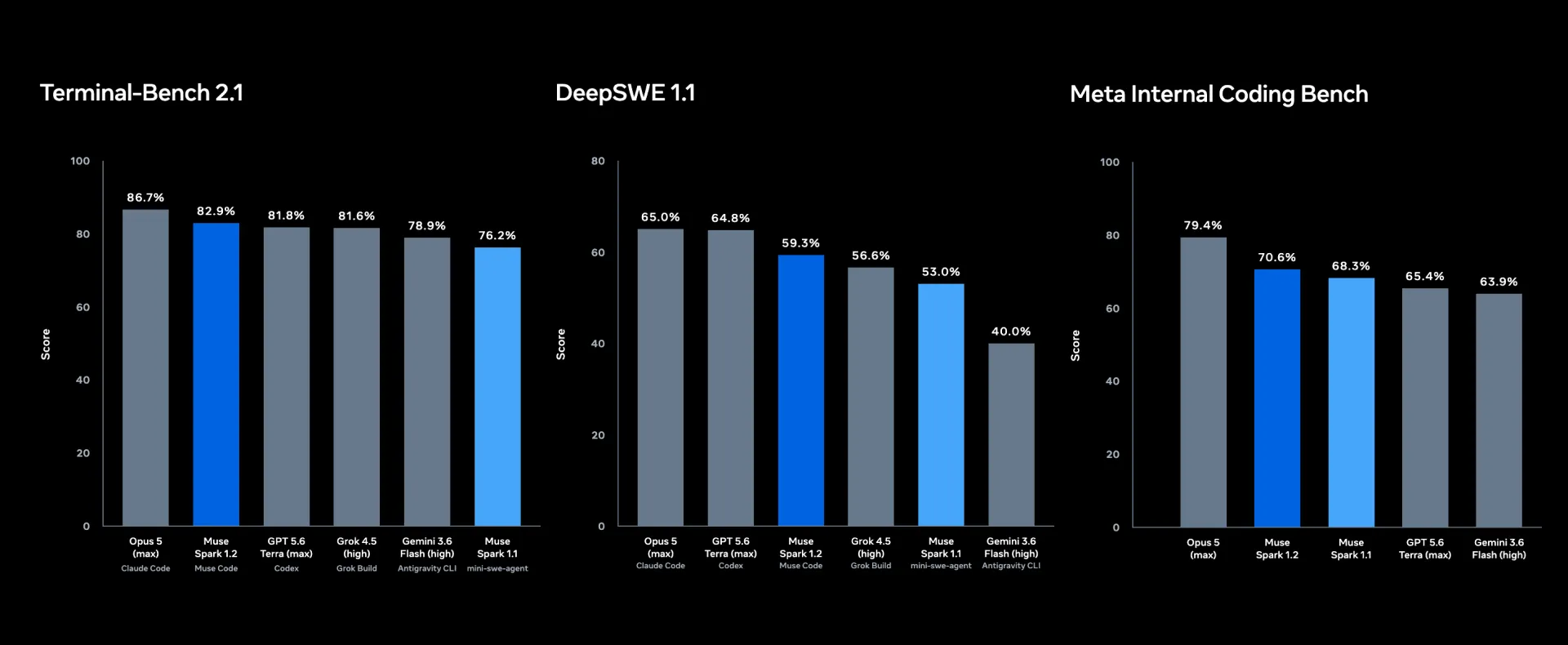
To validate Muse Code’s capabilities, Meta subjected it and Muse Spark 1.2 to rigorous benchmarking against established industry leaders. Muse Spark 1.2, as a coding-focused update to its predecessor, demonstrated notable improvements across the board. On Terminal-Bench 2.1, a widely recognized benchmark for evaluating coding agents, Muse Spark 1.2 with Muse Code achieved a score of 82.9%. While this placed it slightly behind Anthropic’s Claude Code on Opus 5, which scored 86.7%, it notably outperformed OpenAI’s GPT-5.6 Terra on Codex (81.8%) and Grok Build (81.6%). This indicates strong foundational performance, establishing Muse Code as a top-tier contender in code generation and problem-solving within a terminal environment.
However, when evaluating agentic coding capabilities specifically, as measured by DeepSWE 1.1, the landscape showed a different picture. Here, Muse Code scored 59.3%, trailing behind Opus 5 (65.0%) and Codex (64.8%). Similarly, on Meta’s internal coding benchmark, Muse Code achieved 70.6% compared to Opus 5’s 79.4%. These results suggest that while Muse Spark 1.2 is a highly capable underlying model for code generation, the agentic orchestration and problem-solving capabilities of Muse Code, at its beta stage, still have room to grow to match the very best in the industry.
Meta, however, highlights a different angle: the long-term performance and improvement of its agent. Speedup charts, which measure performance gains over accumulating tool calls, reveal an interesting dynamic. Over 1,000-plus tool calls, Opus 5 posted the biggest gain versus baseline (approximately 74-75%), while Muse Spark 1.2 was mid-pack at roughly 61-69% depending on the run. Meta’s crucial insight here is that Muse Code’s performance improves as tool calls accumulate. This behavior is precisely what is desired from a long-horizon coder, where the agent is expected to learn, adapt, and refine its approach over extended periods, making it more effective for complex, multi-stage projects. This emphasizes Meta’s focus on endurance and continuous improvement over raw, immediate benchmark supremacy.
Innovative Demos: Long-Horizon and Multimodal Prowess
Beyond numerical benchmarks, Meta showcased Muse Code’s capabilities through impressive demonstrations, particularly in long-horizon tasks and multimodal applications. In stress testing, Muse Code "iteratively optimized GPU kernels over 1,000+ tool calls (up to 24 hours) on Nvidia Hopper GPUs." This demo is highly significant as it illustrates the agent’s ability to engage in prolonged, complex optimization tasks, learning and refining its approach over an extended period. Optimizing GPU kernels is a notoriously challenging task, requiring deep understanding of hardware architecture and performance profiling, making this a strong testament to Muse Code’s analytical and iterative problem-solving abilities.
Even more striking is the multimodal visual coding demonstration. In one scenario, a user inputs a fly-through video of a house (in mp4 format) directly into the terminal. Muse Code then "interprets the video and produces a visually rich website with booking capabilities." This showcases a remarkable leap in AI functionality, where the agent can not only understand complex visual information but also translate that understanding into a functional, interactive web application. This capability aligns perfectly with Meta’s broader "Muse line" strategy, which has consistently emphasized multimodal AI as a key area of innovation, bridging the gap between diverse data types and practical applications. The ability to go from raw video to a deployable web application highlights the transformative potential of such agents.
The Crowded Arena: Meta’s Strategic Entry and Future Outlook
Meta’s entry into the AI coding agent market comes at a time when the field is already intensely competitive and rapidly evolving. OpenAI’s Codex, which powers tools like GitHub Copilot, has been a foundational player, demonstrating the potential of AI in code generation and running parallel cloud agents. DeepSeek has emerged with its own rival to Claude Code, further diversifying the market. Specialized agentic tools like Hermes and OpenClaw also offer advanced capabilities, providing developers with a range of powerful substitutes. This competitive landscape means that simply releasing a competent tool is no longer enough; differentiation is key.
In this crowded arena, Muse Code’s primary competitive advantages are its crash-safe runtime and sophisticated subagent design, enabling robust and reliable operation for long-duration, complex projects. While it may not currently boast benchmark supremacy across all metrics, its focus on persistence, recovery, and continuous improvement over time provides a unique value proposition. Meta is making a calculated bet that developers working on mission-critical, large-scale projects will prioritize these stability and reliability features over marginal gains in initial benchmark scores.
The release also brings to the forefront the inherent risks associated with highly autonomous AI agents. An agent capable of resuming after a crash and continuously calling tools for 24 hours is immensely powerful but also inherently unpredictable. This raises important questions about human oversight, error propagation, and the potential for unintended consequences. Meta’s decision to ship Muse Code now, even in beta, suggests a confidence in its control mechanisms and a belief that developers are ready to embrace this level of autonomy, albeit with appropriate safeguards and human approval points built into the workflow.
Muse Code is currently available for testing, with Meta providing a straightforward installation command: curl -fsSL https://dev.meta.ai/install.sh | bash. This accessibility indicates Meta’s intention to encourage broad adoption and gather crucial feedback from the developer community during its beta phase. The broader implications of Muse Code’s arrival are significant. For software developers, it promises to automate tedious tasks, accelerate prototyping, and potentially allow them to focus on higher-level architectural and creative challenges. For the AI industry, it signifies Meta’s unwavering commitment to developing advanced, practical AI solutions that directly impact productivity and innovation. As Meta continues to promise "larger and much more capable models on the way," the trajectory of AI in software engineering is set for even more profound transformations, with Muse Code representing a crucial step in that evolution.