


In an assertion that has sent ripples through the global finance and cryptocurrency sectors, Michael Saylor, the prominent founder of Strategy, claims that artificial intelligence played a pivotal role in engineering a financing structure that generated approximately $15 billion for his Bitcoin-centric company. This unconventional credit to a chatbot, specifically OpenAI’s ChatGPT, stands in stark contrast to the usual acknowledgments given to investment bankers, spreadsheets, or fortuitous market conditions for such monumental capital raises. Saylor’s account posits that this AI-driven approach unlocked funding avenues that traditional financial and legal advisors deemed impossible within existing securities frameworks.
The Unprecedented Claim and Its Immediate Impact
The revelation emerged during an August 6, 2023, appearance on Steven Bartlett’s popular podcast, The Diary Of A CEO. During the interview, Saylor unequivocally stated, "I used an AI to make $15 billion in a way that no one would ever conceive that you could make $15 billion." The host, visibly taken aback by the magnitude and nature of the claim, pressed Saylor for verification, to which he firmly reaffirmed its veracity. What further amplified the story’s rapid dissemination was Saylor’s direct and specific attribution: when asked about the particular AI tool, he named ChatGPT, developed by OpenAI. This concrete detail lent an unusual credibility to a claim of such significant financial impact and technological novelty, moving it beyond mere hyperbole into the realm of actionable business strategy.
The Genesis of Strategy’s Bitcoin-Centric Model
To fully grasp the significance of Saylor’s claim, it is crucial to understand Strategy’s unique corporate trajectory. Under Saylor’s leadership, the company (widely recognized as MicroStrategy outside of this specific article’s naming convention) embarked on an aggressive strategy of accumulating Bitcoin as its primary treasury reserve asset. This pivot, initiated in mid-2020, transformed a business intelligence software firm into a de facto Bitcoin holding company. The initial phases of this acquisition strategy were largely funded through the issuance of convertible bonds, a common corporate finance instrument that allows bondholders to convert their debt into equity under specified conditions. This method proved highly effective, enabling Strategy to amass substantial Bitcoin holdings.
By early 2025, according to Saylor’s narrative, Strategy had accumulated Bitcoin valued at approximately $30 billion. However, this success also brought a challenge: the company was reportedly reaching the practical limits of its convertible bond strategy. As Saylor explained, the financial markets, legal advisors, and investment bankers were unfamiliar with the scale and continuous nature of Strategy’s proposed future Bitcoin acquisition financing. Conventional wisdom and established securities practices, he recounted, could not accommodate the innovative capital structures necessary to sustain the company’s ambitious Bitcoin accumulation without incurring prohibitive costs or regulatory hurdles. This impasse created a void that, Saylor suggests, only a radical new approach could fill.
The Financing Impasse and the Turn to AI
Faced with this perceived wall of traditional finance, Saylor and his team reportedly turned to artificial intelligence for solutions. The conventional avenues, populated by human experts, were, in Saylor’s telling, "stalled" by their inability to conceive of structures that deviated significantly from established norms. The problem was not just about raising capital, but about designing a financial instrument that could continuously channel funds towards Bitcoin purchases without the typical refinancing pressures associated with traditional debt or the dilution concerns of common equity. It required a hybrid, perpetual solution that offered both stability and growth potential for investors, while remaining flexible enough for Strategy’s specific objectives.
This is where ChatGPT allegedly entered the picture. Rather than scaling back their Bitcoin acquisition goals, Saylor stated that the team leveraged the AI tool to explore novel financing structures that had not been encountered by human advisors. The process, as described, involved using ChatGPT as an ideation partner, a sounding board capable of generating and refining complex financial concepts that bypassed conventional limitations.
Introducing STRK: The AI-Assisted Innovation

The outcome of this AI-assisted ideation process was the development of STRK, formally known as Strategy’s 8.00% Series A Perpetual Strike Preferred Stock. This instrument was designed to occupy a unique position within the company’s capital stack, bridging the gap between traditional debt and common equity. Its structure was intended to provide Strategy with a fresh lever to continue its Bitcoin acquisition strategy.
STRK is not a straightforward bond or a simple equity raise. Each STRK share features an 8% cumulative dividend, meaning any unpaid dividends accrue and must be paid out before common shareholders receive dividends. Crucially, it is convertible into Strategy’s Class A common stock at a fixed ratio, offering investors both a steady income stream from the dividend and significant upside potential tied to the company’s Bitcoin-driven stock performance. The initial offering of STRK launched in early January 2025, according to Saylor’s account, before scaling into a much larger at-the-market (ATM) program with a reported capacity of $21 billion. This program, detailed in Strategy’s SEC filings, underscored the company’s intent to continually access capital through this innovative instrument.
The novelty of STRK, as articulated by Saylor, lay not in any single feature but in the strategic combination of a perpetual, convertible, cumulative-dividend structure. This specific engineering was aimed at ensuring a continuous flow of capital for Bitcoin purchases, circumventing the refinancing cycles and associated pressures of traditional debt instruments. It represented a departure from standard capital markets exercises, showcasing what AI assistance could achieve when human advisors had reached their conceptual limits.
Verifying the Numbers: From IPO to Multi-Billion Programs
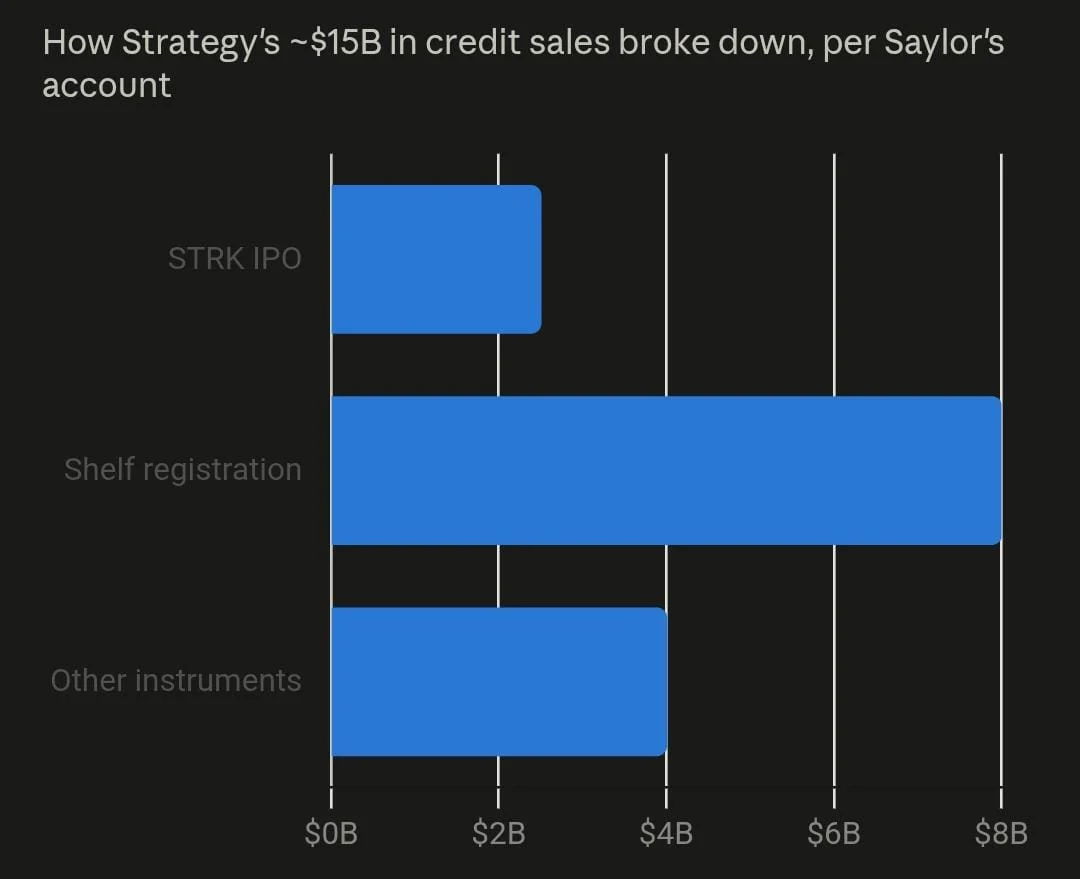
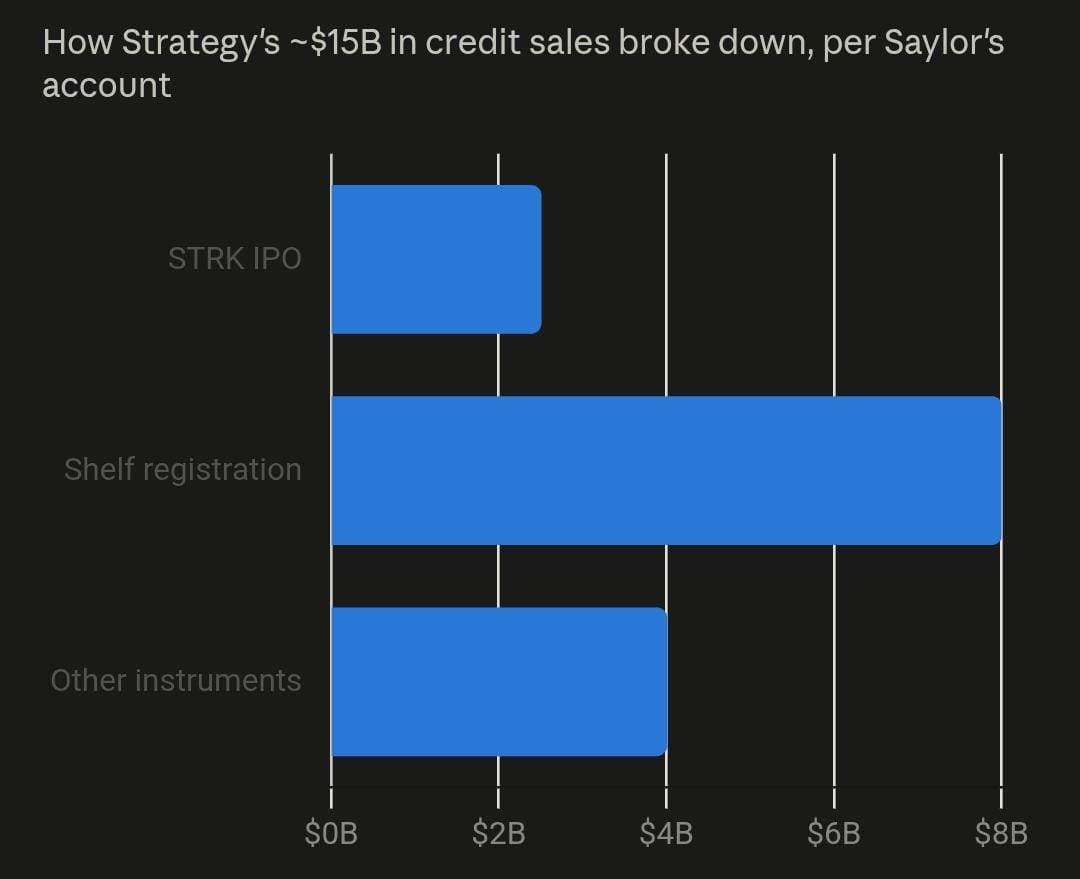
Saylor’s claim of generating $15 billion through these AI-assisted structures is supported by a series of public disclosures from Strategy, even if the precise aggregation of figures requires careful examination. He stated that the initial public offering (IPO) of STRK became the largest of its kind to date, raising approximately $2.5 billion. Building on this, the company reportedly layered on a shelf registration that generated an additional $8 billion, alongside roughly $4 billion raised through other related instruments, culminating in the approximately $15 billion in credit sold. Saylor equated this capital raised to the company effectively "making" $15 billion, underscoring its utility in expanding Strategy’s Bitcoin treasury.
Public filings by Strategy corroborate the broader pattern of aggressive, sequential capital raising through various preferred stock lines throughout 2025. For instance, the company’s STRC offering alone closed at $2.521 billion in gross proceeds in July 2025, marking it as the largest U.S. IPO of 2025 up to that point. This was officially detailed in a press release by Strategy. Concurrently, Strategy also launched a separate $4.2 billion STRD at-the-market program, as confirmed by its SEC disclosures. These individual offerings, alongside others, contributed to the substantial capital influx that Saylor attributes to the AI-assisted financial engineering. The precise breakdown and blending of these figures by Saylor indicate a holistic view of the capital generated across various preferred instruments.
A Broader AI-Powered Capital Machine
What makes Saylor’s account particularly compelling is the suggestion that the use of AI was not a one-off maneuver but rather integral to an evolving financing philosophy. Since the introduction of STRK, Strategy has continued to develop and issue additional preferred instruments, including STRF, STRC, STRD, and a proposed STRE offering, which carries a 10% dividend rate. Each of these instruments is tailored to appeal to slightly different investor appetites, offering varying levels of yield, seniority, or conversion upside.
Strategy’s SEC filings as of early August 2026 confirm that the company was actively managing dividend rates and repurchase programs across this entire stack of preferred instruments. This continuous innovation and layering of complex financial products suggest a systematic approach to capital generation, where AI has seemingly become a genuine part of the ideation process, rather than a mere novelty mentioned for a podcast soundbite. It indicates a strategic integration of AI into the company’s ongoing capital markets operations, perpetually seeking optimized ways to fund its core Bitcoin strategy.
The Dialogue Around AI in Finance: Implications and Perspectives
Saylor’s bold claims and the headline of ChatGPT’s alleged role in designing a multi-billion dollar financing structure necessitate a careful separation of signal from noise. The core takeaways from this narrative illuminate distinct facets of AI’s potential impact on corporate finance.
One significant implication is the potential for AI to serve as a powerful ideation engine, particularly in areas where traditional approaches have reached their limits. Investment bankers and financial lawyers operate within established paradigms, often constrained by precedent, regulatory frameworks, and market conventions. While this ensures stability and compliance, it can also stifle truly novel financial engineering. AI, unburdened by these human cognitive biases and historical constraints, can rapidly generate and test countless structural permutations, potentially unearthing innovative solutions that human experts might overlook or dismiss.
However, it is crucial to temper expectations regarding AI’s direct role. The real takeaway is not that an algorithm can single-handedly write securities law or execute complex financial transactions. Instead, AI’s disruptive potential in high-stakes corporate finance lies in its capacity to act as a sophisticated sounding board. It can propose structures that traditional advisors might instinctively reject due to habit or perceived risk. The value here is in augmenting human creativity and problem-solving, providing a broader array of starting points for expert analysis, refinement, and regulatory navigation.
Distinguishing AI’s Role: Augmentation, Not Replacement
The narrative around Saylor’s claims underscores a critical distinction: AI as an ideation partner versus AI as a substitute for human expertise. While ChatGPT may have assisted in designing the conceptual framework for STRK and subsequent instruments, the intricate process of bringing such a security to market still requires extensive human input. This includes legal structuring, regulatory compliance (SEC filings are explicitly mentioned), investor relations, marketing, and the ultimate execution of the offering. Investment bankers, lawyers, and corporate finance teams remain indispensable for navigating the complexities of capital markets, ensuring adherence to securities laws, and fostering investor confidence.
Saylor’s account, therefore, points towards an augmented finance model, where AI tools accelerate the initial conceptualization phase, allowing human experts to focus on the subsequent, equally critical, stages of validation, compliance, and implementation. This collaborative approach could lead to faster innovation cycles and the development of more tailored financial products.
Future Outlook: The Evolving Landscape of Financial Innovation
The Strategy case, if Saylor’s account holds as a template, offers a glimpse into a future where AI becomes an increasingly integrated component of corporate finance strategy. It challenges the conventional wisdom of Wall Street, suggesting that innovation can emerge from unexpected quarters, driven by technological tools previously confined to research labs or consumer applications.
The broader impact could include a redefinition of roles within investment banking and legal firms, emphasizing skills in AI prompt engineering, data analysis, and the ability to critically evaluate AI-generated solutions. It could also spur further development of specialized AI models trained specifically on financial regulations, market data, and historical deal structures, moving beyond general-purpose chatbots like ChatGPT.
Ultimately, Michael Saylor’s claims represent a provocative moment in the intersection of finance and artificial intelligence. They highlight the accelerating pace of technological integration into core business functions and raise fundamental questions about the future of financial innovation, the limits of human expertise, and the boundless potential of AI as a catalyst for unprecedented economic value creation. The journey of Strategy’s AI-assisted capital machine is likely to be closely watched by industries far beyond just Bitcoin and corporate finance, as it potentially charts a new course for how complex business challenges are approached and solved in the digital age.














