Moonshot AI, a rapidly emerging force in the global artificial intelligence landscape, has unveiled Kimi K3, a colossal 2.8-trillion-parameter open-weight model that is fundamentally altering perceptions of where the global AI frontier truly resides. This release is not merely another entry in the increasingly crowded field of large language models; it represents a significant leap, backed by robust third-party benchmark data, demonstrating genuine, frontier-level reasoning capabilities that challenge the dominance of established Western counterparts like Anthropic’s Claude Fable 5 and OpenAI’s GPT-5.6. The immediate aftermath of its launch has sent ripples through both the domestic Chinese AI market and the broader international tech community, signaling a pivotal moment in the ongoing race for AI supremacy.
Moonshot AI’s Ascent: A New Frontier in AI Development
Moonshot AI, a Beijing-based startup founded by former Google and Meta AI researcher Yang Zhilin, has quickly positioned itself as a key player in China’s ambitious drive for AI leadership. The company gained significant attention with its earlier Kimi Chat assistant, known for its extensive context window, and Kimi K2.6, which already demonstrated competitive performance. The introduction of Kimi K3 yesterday marks a dramatic escalation of its capabilities. At its core, Kimi K3 employs a sophisticated Mixture-of-Experts (MoE) architecture, which allows it to scale to an unprecedented 2.8 trillion total parameters, making it the largest open-weight model released to date globally. This architectural choice is crucial for handling complex tasks efficiently by activating only relevant "experts" for specific queries, thereby optimizing computational resources while maintaining vast knowledge.
A standout feature of Kimi K3 is its staggering 1 million-token context window. This capacity allows the model to process and understand vast amounts of information in a single prompt—equivalent to digesting entire codebases, multiple full-length books, or comprehensive research papers. Such a massive context window is critical for applications requiring deep contextual understanding and long-range coherence, moving beyond the limitations of earlier models that struggled with even moderately lengthy inputs. This capability alone positions Kimi K3 as a formidable tool for developers, researchers, and content creators alike, promising a new era of AI-assisted productivity and insight generation.
Dominating the Frontend Code Arena: A Benchmark Shift
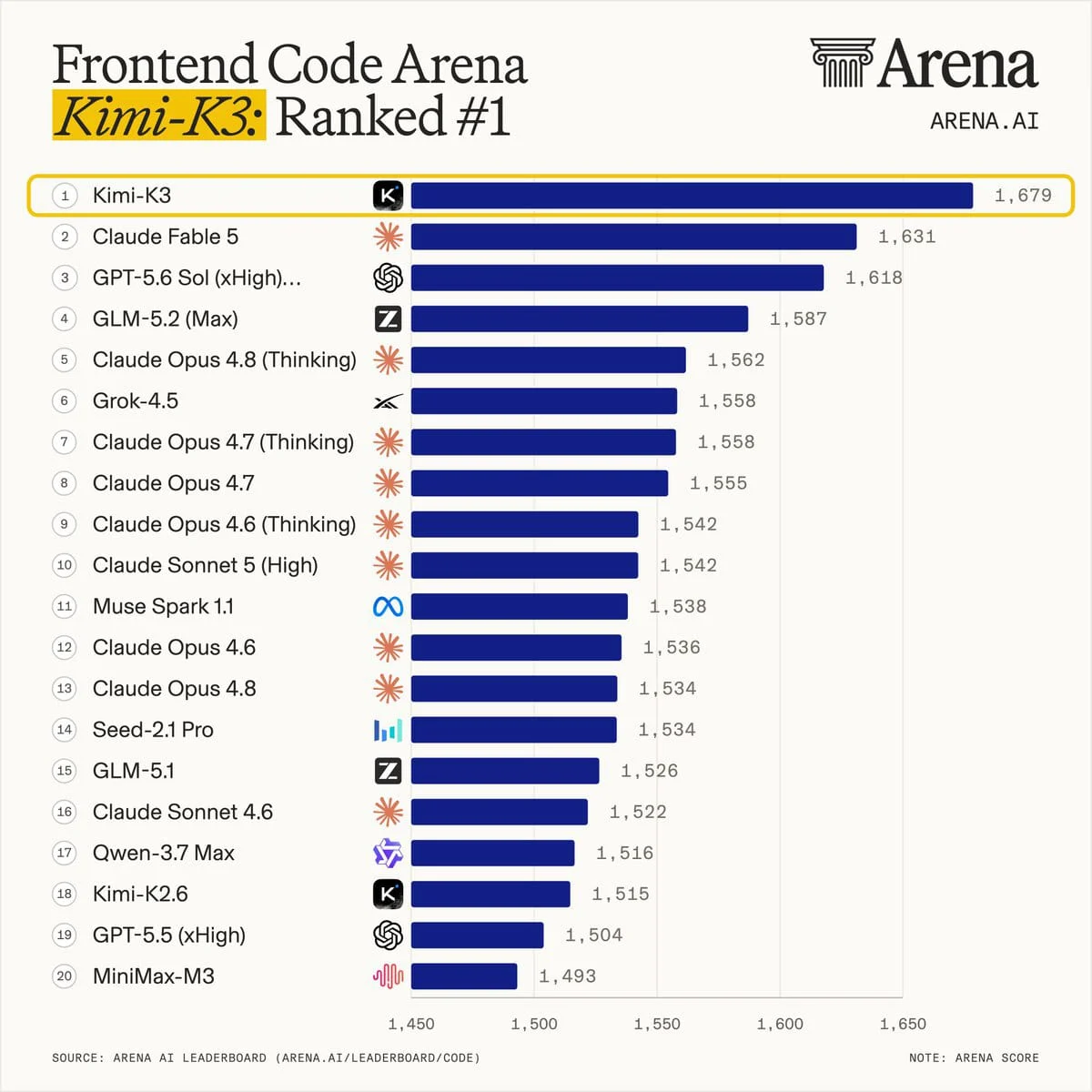
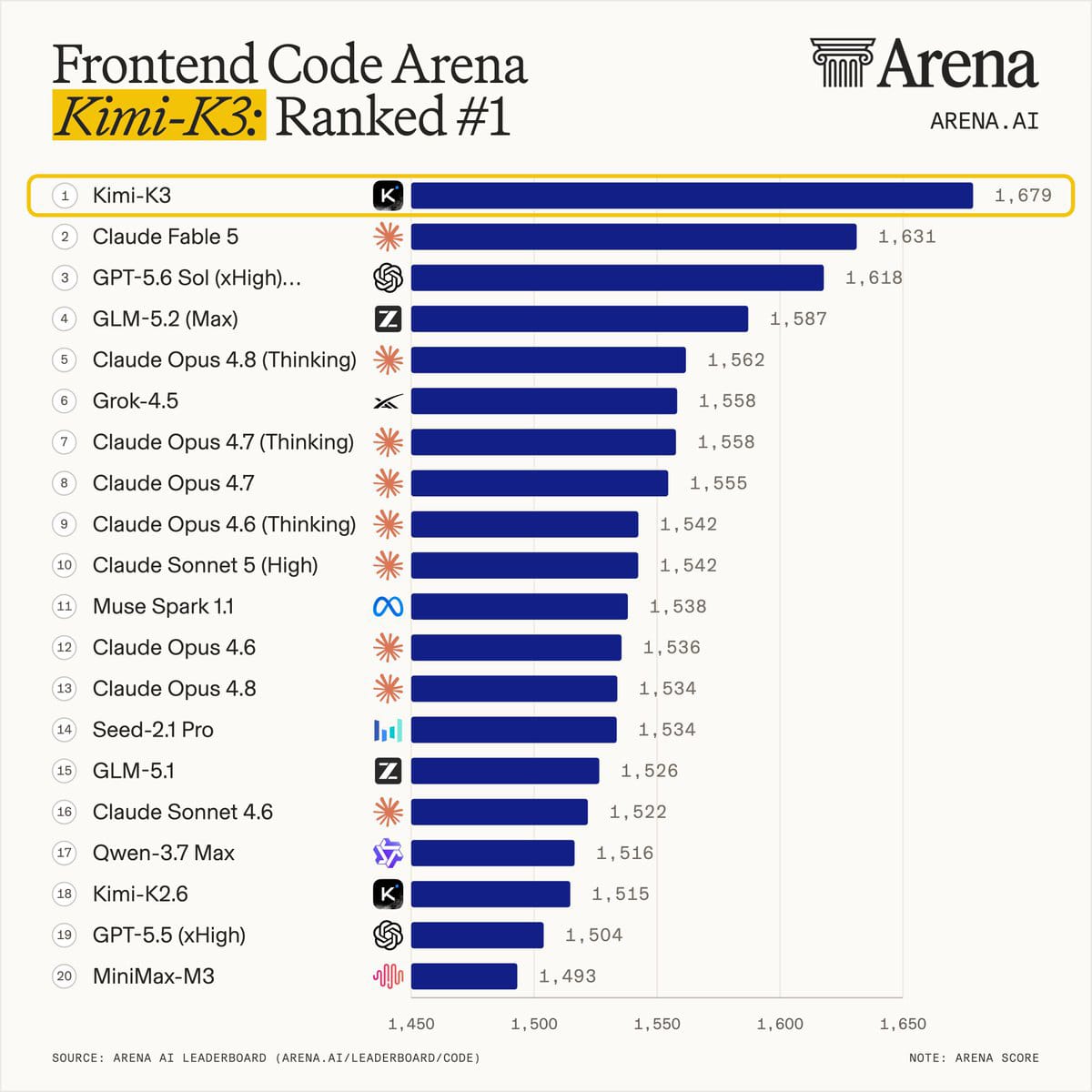
Perhaps the most startling revelation from Kimi K3’s launch is its performance in the demanding Frontend Code Arena. This benchmark, widely regarded as a crucial proxy for real-world usefulness in software development, saw Kimi K3 secure the number one position with an impressive 1679 points. This represents an extraordinary leap from its predecessor, Kimi K2.6, which languished in 18th place. The significance of this jump cannot be overstated; it indicates not just incremental improvement but a fundamental shift in the model’s understanding and generation of complex code.
The Frontend Code Arena evaluates models across various critical domains, and Kimi K3 demonstrated overwhelming superiority by ranking first in six out of seven categories. These include brand and marketing, reference-based design, data and analytics, consumer products, simulations, and content creation tools. Its only concession was in the gaming category, where Anthropic’s Fable 5 still holds a narrow lead. The ability to consistently outperform competitors across such a diverse range of frontend development tasks underscores Kimi K3’s profound grasp of modern web technologies, UI/UX principles, and intricate design patterns. This capability holds immense implications for accelerating software development cycles, enabling more sophisticated and responsive user interfaces, and potentially automating significant portions of the coding process for various industries. For developers, a model that can reliably generate and debug frontend code is a game-changer, promising increased efficiency and reduced time-to-market for new applications and digital experiences.
Agentic Intelligence: Narrowing the Gap with Western Leaders
Beyond its coding prowess, Kimi K3 also demonstrated significant advancements in agentic performance, an area critical for developing autonomous AI systems capable of complex problem-solving and decision-making over extended periods. On the GDPval v2 agentic benchmark, Kimi K3 achieved an Elo rating of 1668, marking a substantial increase from K2.6’s 1190. This score allowed it to surpass several established models, including GLM-5.2 (1514), OpenAI’s GPT-5.5 (1494), and even Anthropic’s Claude Opus 4.8 (1600). While it still trails Fable 5’s leading score of 1760, the gap has narrowed considerably, indicating that Kimi K3 is now operating within the same tier of agentic intelligence as the very best Western models.
Further solidifying its agentic capabilities, Kimi K3 also excelled in AA-Briefcase, a private evaluation designed to assess long-horizon agentic knowledge work. Here, K3 posted an overall Elo score of 1547, an astonishing 732-point improvement over K2.6, again securing second place only behind Fable 5. Qualitative assessments revealed that Kimi K3’s rubric scoring and analytical quality are remarkably close to Fable 5’s, suggesting a high degree of sophisticated reasoning and task comprehension. While GPT-5.6 Sol still maintains a lead in presentation quality specifically, Kimi K3’s overall agentic performance signals a paradigm shift. The ability of Kimi K3 to autonomously execute multi-step tasks, synthesize information, and reason through complex scenarios means it can be deployed in advanced applications ranging from automated research assistants and strategic planning tools to sophisticated enterprise solutions, potentially revolutionizing how businesses approach complex knowledge work.
Strategic Pricing: Competing at the Frontier, Not Just Open-Weight
Moonshot AI’s pricing strategy for Kimi K3 reveals a clear intention to compete directly with frontier-tier models, rather than positioning itself solely as a budget-friendly open-weight alternative. At $0.94 per task, Kimi K3 is competitively priced, landing close to OpenAI’s GPT-5.6 Sol ($1.04) and significantly undercutting Anthropic’s Claude Opus 4.8 ($1.80), which costs almost twice as much. This pricing structure presents a meaningful commercial advantage for enterprises and developers running high-volume agentic workloads, where cumulative costs can quickly become a barrier.
However, it is important to note that Moonshot AI has also significantly raised its own pricing compared to K2.6. Output tokens for K3 have jumped to $15 per million from $4 previously. The first-party API pricing for Kimi K3 stands at $3.00 per million input tokens and $15.00 per million output tokens. A substantial 90% discount on cached input tokens brings that specific cost down to $0.30 per million. This premium pricing structure signals Moonshot AI’s confidence in K3’s capabilities and its positioning as a top-tier offering. When compared to other open-weight models, Kimi K3’s pricing reveals its strategic intent: GLM-5.2 is priced at $0.32 per task, and DeepSeek V4 Pro at an even lower $0.04. This stark difference indicates that Kimi K3, despite its "open-weight" designation (with weights slated for release), is being monetized like a proprietary, cutting-edge solution, appealing to users who prioritize top-tier performance over rock-bottom costs. This strategy underscores a growing trend where performance and capability dictate pricing, even within the open-source ecosystem, blurring the traditional lines between proprietary and open models in terms of market value.
Efficiency and Future Roadmap: Token Optimization and Open-Weight Ambitions
Beyond raw performance, Kimi K3 also demonstrates significant technical advancements in efficiency, a crucial factor for the scalability and sustainability of large language models. One detail that received less initial attention but is profoundly important is its token efficiency. Kimi K3 utilized approximately 132 million output tokens to complete all nine evaluations on the Artificial Analysis Intelligence Index. This represents a remarkable 21% reduction from Kimi K2.6, which required about 166 million tokens for the same evaluations, all while K3 achieved higher scores across the board. This improvement in efficiency means Kimi K3 can deliver superior results with fewer computational resources and lower operational costs, making it more environmentally friendly and economically viable for large-scale deployments.
The model also ships with native multimodal input capabilities, meaning it can process both text and images. While the current output remains text-only, the foundation for full multimodal interaction is clearly being laid, promising richer and more versatile applications in the future. The ability to interpret visual information alongside textual prompts opens up new avenues for AI in areas like image analysis, visual content generation, and multimodal data synthesis.
Moonshot AI has also confirmed a highly anticipated plan: the full 2.8 trillion parameter weights of Kimi K3 are slated for release by July 27. This move would be a game-changer for the open-source AI community. If realized, Kimi K3 would become the undisputed leading open-weight model by a significant margin, far surpassing current contenders like GLM-5.2 (753 billion parameters) and DeepSeek V4 Pro (1.6 trillion parameters). Releasing such a massive and capable model as open-weight could democratize access to frontier AI capabilities, foster innovation, and accelerate research globally, potentially disrupting the current landscape where proprietary models hold much of the cutting-edge.
Domestic Market Tremors: Chinese Competitors Feel the Heat
The launch of Kimi K3 has not been met with universal celebration within China’s domestic AI industry. The immediate market reaction saw significant downturns for other prominent Chinese AI companies, illustrating the fierce competitive dynamics at play. Zhipu AI, another leading Chinese AI startup, experienced a sharp 28% crash in its valuation, while MiniMax, another major player, saw its value fall by 16%. This dramatic market response is a telling indicator; it suggests that investors and the market at large are perceiving Kimi K3 not merely as a marketing exercise or incremental update, but as a genuine, formidable competitive threat that could reshape the domestic landscape.
The financial fallout for Zhipu and MiniMax underscores the high stakes in the Chinese AI market, where companies are vying for dominance in a rapidly expanding sector with significant government backing. Such substantial drops in valuation, occurring in a single day following a competitor’s launch, are far from "noise." They reflect a tangible fear of market share erosion, a shift in investor confidence towards Moonshot AI, and the potential for a "winner-take-most" dynamic in key AI segments. This internal competition is likely to accelerate innovation within China, pushing all players to develop more capable and efficient models to maintain relevance and secure investment.
Global Implications: Reshaping the US-China AI Narrative
Kimi K3’s emergence represents a critical inflection point in the broader US-China AI race. For the first time, a Chinese model has decisively claimed the top spot on a globally recognized benchmark like the Frontend Code Arena, while simultaneously demonstrating near-frontier performance across several other crucial benchmarks. This is not an isolated incident but a clear signal of China’s rapidly advancing capabilities in artificial intelligence.
The prevailing narrative in some circles suggests that while Chinese firms like Moonshot are rapidly developing and deploying frontier-competitive models on aggressive timelines, American policymakers are increasingly focused on imposing stringent regulations, including bans on data centers and restrictions on advanced AI chips. This framing highlights a potential divergence in approaches: China’s "move fast and break things" innovation ethos versus a more cautious, safety-first stance in the West. While this perspective holds some validity, it is crucial to acknowledge the complexity of the debate. Many argue that guardrails and thoughtful regulation are essential precisely because the stakes of getting AI safety wrong at this scale are profoundly asymmetric, posing risks far greater than those encountered during the early internet era.
Regardless of one’s stance on regulatory approaches, Kimi K3’s results are undeniably real and impactful. Its performance unequivocally demonstrates that China is not merely catching up but actively setting new benchmarks in certain critical areas of AI development. This development will undoubtedly intensify the geopolitical competition in AI, prompting renewed discussions in the United States and Europe about maintaining technological leadership. Whether the appropriate response is fewer regulations to accelerate innovation or smarter, more adaptable ones to ensure safety and ethical deployment, Kimi K3’s launch has irrevocably altered the landscape of the global AI race, making the debate more urgent and the stakes higher than ever before. The model’s success will likely fuel further investment and strategic focus on AI within China, while simultaneously serving as a powerful call to action for Western nations to re-evaluate their own strategies for maintaining competitiveness and leadership in this transformative technology.