In a significant development signaling a paradigm shift in the global acceptance of Bitcoin, on-chain analyst Willy Woo has highlighted a surprising trend: nation-states are adopting the flagship cryptocurrency at a rate that significantly outpaces individual adoption. This observation, shared via a recent tweet, challenges the conventional understanding of cryptocurrency’s grassroots origins and suggests a potential redefinition of Bitcoin’s core investor base, driven by a growing need for inflation hedges among sovereign entities.
Willy Woo’s analysis, disseminated through his widely followed X (formerly Twitter) account, points to a divergence between stated policy and actual acquisition of Bitcoin by countries. He noted that while approximately 8% of countries have articulated policies to hold or acquire Bitcoin, a larger percentage, around 12%, are demonstrably doing so. This discrepancy, Woo suggests, is likely attributable to a substantial portion of state-held Bitcoin originating from law enforcement seizures. Such assets often enter state treasuries and remain there for extended periods pending legal resolutions, effectively increasing sovereign holdings without explicit policy announcements.
The Unfolding Narrative: Governments as Early Adopters
The implications of this trend are profound, suggesting that governments are not merely observing the cryptocurrency revolution but are actively positioning themselves within it, often ahead of their own citizens. This proactive stance by nation-states can be attributed to a confluence of factors, chief among them being Bitcoin’s perceived role as a potent hedge against inflation and a tool for financial sovereignty.
Woo’s commentary implicitly suggests a growing recognition among governments that Bitcoin offers a unique value proposition in an era of economic uncertainty. Traditional assets, while familiar, may not provide the same level of protection against the erosion of fiat currency values. Bitcoin, with its fixed supply and decentralized nature, presents an alternative that is increasingly appealing to policymakers seeking to safeguard national reserves and ensure economic stability.
The list of nations actively involved in Bitcoin acquisition, as alluded to by Woo, includes prominent global players. While specific figures and the exact chronological order of these acquisitions are not detailed in the initial observation, the inclusion of major economies such as the United States, the United Kingdom, China, Brazil, Russia, Saudi Arabia, Ukraine, and Argentina underscores the broad geographical and political spectrum of this trend. This widespread adoption, particularly among developed nations, indicates a strategic foresight regarding Bitcoin’s potential future as a reserve asset.
Bitcoin’s Evolution: From Fringe Speculation to National Strategy
This state-level embrace is injecting a new layer of legitimacy and stability into the digital asset ecosystem. What was once dismissed by many as a fringe, speculative vehicle is now being integrated into national economic strategies. This evolution is not merely symbolic; it has tangible implications for Bitcoin’s market dynamics, demand, and perceived value.
The increasing institutional and governmental interest in Bitcoin has a historical precedent. While the early days of Bitcoin were characterized by a small group of tech-savvy individuals and cypherpunks, its journey has been marked by successive waves of adoption. The emergence of exchanges, the development of institutional-grade custody solutions, and the growing clarity around regulatory frameworks have all paved the way for larger entities to enter the market.
The period between 2017 and 2021, for instance, witnessed a significant surge in institutional interest, with companies like MicroStrategy and Tesla making substantial Bitcoin purchases. This was followed by the approval of Bitcoin futures ETFs in the United States, further signaling a growing acceptance within traditional financial circles. Woo’s current observation suggests that this trend has now permeated the highest levels of global governance.
The Mechanics of State Accumulation: Beyond Policy Declarations
The observation that more countries actually hold Bitcoin than have declared policies to do so is particularly noteworthy. This discrepancy offers a window into the often opaque processes of sovereign wealth management and the practical realities of digital asset acquisition.
As mentioned, law enforcement seizures represent a significant, albeit indirect, channel through which states acquire Bitcoin. When illicit actors are apprehended, their digital assets are often confiscated. The process of liquidating or holding these assets can be complex, and in many cases, governments opt to retain them, recognizing their potential value. This has led to the accumulation of substantial Bitcoin reserves by various state agencies, sometimes without a clear public mandate.
Beyond seizures, other motivations for state acquisition likely include:
- Diversification of Reserves: In an increasingly uncertain global economic landscape, countries are seeking to diversify their foreign exchange reserves beyond traditional currencies and assets. Bitcoin’s uncorrelated nature to traditional markets makes it an attractive candidate for such diversification strategies.
- Technological Advancement and Innovation: Some nations may be acquiring Bitcoin and other digital assets to foster innovation in their domestic blockchain and cryptocurrency sectors, aiming to become leaders in the digital economy.
- Geopolitical Considerations: In a world where financial sanctions can be used as a geopolitical tool, some countries might view Bitcoin as a means to circumvent potential restrictions or to ensure financial autonomy.
The Future Landscape: State Dominance and Decentralization’s Defense
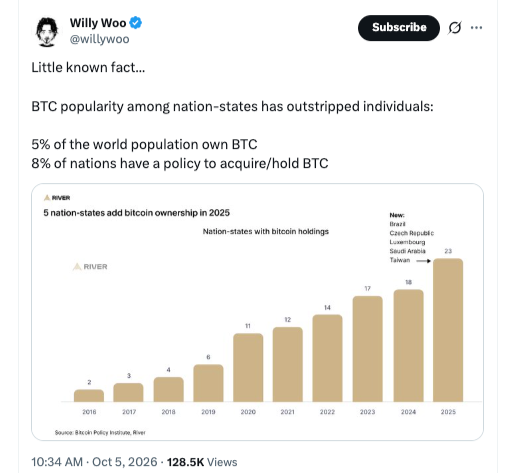
The widening gap between individual and government Bitcoin holdings, as predicted by Woo, presents a complex future for the cryptocurrency. If nation-states indeed become the dominant stakeholders in the Bitcoin ecosystem, it could lead to significant price appreciation. However, it also raises critical questions about the future of decentralization and the influence these powerful entities could wield over the crypto economy.
Bitcoin’s core tenet is decentralization – a system designed to operate without central control. Nation-states, by their very nature, thrive on control and regulation. This inherent tension could lead to future conflicts or attempts by governments to exert influence over Bitcoin’s development and operation. The desire for control over supply and price, a natural inclination for any sovereign entity seeking to manage its economy, could manifest in various ways, from advocating for specific mining regulations to influencing protocol development.
The potential for negative ramifications of excessive state control necessitates a counter-balance. Woo suggests that increasing individual ownership of Bitcoin is the most effective way to mitigate the risks associated with state accumulation. A broad base of individual holders can act as a bulwark against concentrated power, ensuring that Bitcoin remains a truly decentralized asset. The younger generation, often more receptive to technological innovation and digital ownership, is expected to play a crucial role in accelerating this process, thereby helping to bridge the gap and maintain the decentralized ethos of Bitcoin.
Broader Implications for the Global Financial System
The increasing involvement of nation-states in Bitcoin adoption signifies a maturing of the digital asset class and its integration into the global financial architecture. This trend could:
- Enhance Bitcoin’s Legitimacy: State backing, even if indirect, lends significant credibility to Bitcoin, potentially attracting further institutional and retail investment.
- Influence Monetary Policy: As more countries hold Bitcoin, it could subtly influence their monetary policy decisions and their approach to inflation management.
- Spur Regulatory Development: The growing state involvement will undoubtedly accelerate the development of comprehensive regulatory frameworks for cryptocurrencies worldwide. This could lead to greater clarity for investors but also potentially introduce more stringent controls.
- Create New Geopolitical Dynamics: The control and management of significant Bitcoin reserves could become a new factor in international relations and geopolitical strategy.
In conclusion, Willy Woo’s observation that nation-states are outpacing individual adoption of Bitcoin is a critical development that reframes the narrative surrounding cryptocurrency’s future. It highlights a strategic shift by governments seeking financial resilience and sovereignty, while also posing fundamental questions about the balance of power and the enduring principles of decentralization within the digital asset space. The coming years will likely see these dynamics play out, shaping both the future of Bitcoin and the broader global financial landscape.