


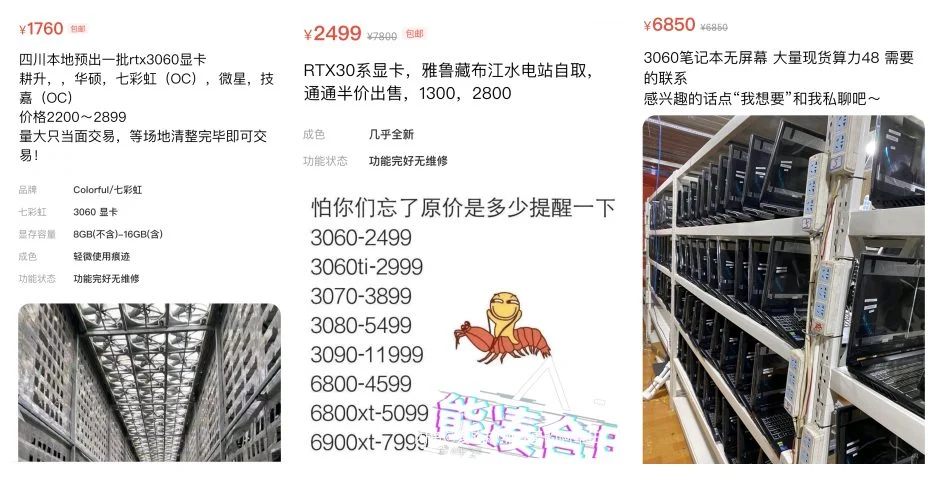
The secondary market for high-performance graphics processing units (GPUs) in China is currently experiencing an unprecedented influx of inventory as cryptocurrency miners move to liquidate their hardware holdings. Following a series of escalating regulatory interventions by the Chinese government aimed at dismantling the domestic digital asset mining industry, popular graphics cards, including the Nvidia GeForce RTX 3060, are being listed for as low as $270. This massive sell-off represents a significant shift in the global hardware landscape, marking the end of an era where Chinese mining farms dominated the global hashrate and dictated the availability of consumer-grade PC components.
The liquidation is not limited to entry-level cards. Reports from various Chinese e-commerce platforms and secondary marketplaces indicate that mid-to-high-end models such as the RTX 3070 and RTX 3060 Ti are also being offloaded in vast quantities. These units are frequently priced between $350 and $400, a stark contrast to the inflated manufacturer suggested retail prices (MSRP) and scalper-driven valuations that characterized the market throughout late 2020 and early 2021. However, these low prices come with a significant caveat: most sellers are refusing to sell individual units, instead requiring buyers to purchase in bulk lots ranging from 100 to 200 cards per transaction. This wholesale approach underscores the desperation of industrial-scale mining operations to recoup capital as they face the total cessation of their domestic business activities.
The Catalyst: China’s Multi-Pronged Regulatory Offensive
The sudden availability of these GPUs is the direct result of a coordinated campaign by Chinese authorities to eliminate cryptocurrency mining and trading within the country’s borders. The crackdown began in earnest in the spring of 2021, when the State Council’s Financial Stability and Development Committee, led by Vice Premier Liu He, announced that the government would "crack down on Bitcoin mining and trading behavior" to prevent financial risks from spreading to the broader economy.
This high-level directive was followed by localized enforcement in regions that were previously mining hubs due to their cheap electricity. Inner Mongolia was among the first to implement a "clean-up" of mining projects, followed closely by Qinghai and Xinjiang. The most significant blow came when Sichuan province—a region that accounted for a massive portion of the global Bitcoin hashrate during the rainy season due to its abundant hydroelectric power—ordered the immediate shutdown of all mining facilities. By mid-2021, the People’s Bank of China (PBoC) had further intensified the pressure by instructing major banks and payment platforms, such as Alipay, to cease all services related to cryptocurrency transactions. This systemic exclusion from the financial grid has left Chinese miners with few options other than to relocate their operations overseas or liquidate their hardware assets entirely.
Market Saturation and the Variety of Hardware
The current glut of hardware in the Chinese market is diverse, spanning multiple generations of GPU architecture. While the latest Ampere (Nvidia) and RDNA2 (AMD) architectures are the most sought-after, the second-hand market is also seeing a resurgence of older Pascal and Polaris cards. These older models, such as the GTX 10-series and RX 500-series, were the workhorses of the 2017 mining boom and had remained in service due to the extreme profitability of Ethereum mining over the past year.
In a particularly unusual development, the liquidation has extended beyond traditional desktop components. Some industrial miners had turned to gaming laptops equipped with RTX 3060 mobile chips when desktop cards became unavailable due to supply chain shortages. These laptops are now appearing on used markets for approximately $1,000 per unit. Despite the apparent value, these mobile units are often in poor physical condition, having been stacked in racks with inadequate cooling to maximize mining efficiency.
Technical Risks and Buyer Hesitation
Despite the attractive price points, the "great mining dump" has not resulted in the immediate sell-out that some analysts expected. A primary deterrent for both gamers and commercial distributors is the physical condition of the hardware. Mining GPUs are typically operated 24 hours a day, seven days a week, often in environments that are not as clean or climate-controlled as a standard home PC. To maximize profit, miners frequently overclock the video RAM (VRAM) while undervolting the core clock, a practice that puts significant thermal stress on the memory modules and power delivery phases.

Potential buyers are wary of "silicon degradation," a phenomenon where prolonged exposure to high heat and electrical current can lead to instability, artifacting, or total component failure. Furthermore, the mechanical components of these cards—specifically the cooling fans—are often near the end of their operational lifespan after months of continuous high-speed rotation. Because these cards were sold to mining operations in bulk, they often lack individual warranties, leaving the secondary buyer with no recourse if the hardware fails shortly after purchase.
Broader Implications for the Global GPU Market
The events in China are reverberating through the global supply chain, offering a glimmer of hope for consumers who have been priced out of the market for nearly two years. For the first time since the launch of the RTX 30-series, there are signs that the "GPU drought" is easing. In European markets, specifically Germany and Austria, retail prices for new graphics cards have reportedly dropped by as much as 40% in recent months, moving closer to their original MSRPs.
This price correction is driven by a "perfect storm" of factors:
- Reduced Demand from Miners: With the Chinese market effectively closed and the profitability of GPU mining declining as network difficulty rises, the massive industrial demand that previously swallowed up retail inventory has evaporated.
- The Ethereum Transition: The impending shift of the Ethereum network from Proof-of-Work (PoW) to Proof-of-Stake (PoS)—commonly referred to as "The Merge"—will render GPU mining for the world’s most profitable altcoin obsolete. Nvidia CEO Jensen Huang has acknowledged this transition, noting in various industry forums that the company is preparing for a market where gamers, rather than miners, are the primary drivers of demand.
- LHR Technology: Nvidia’s introduction of "Lite Hash Rate" (LHR) versions of their cards, which hardware-limit the mining performance of the GPU, has further discouraged miners from competing with gamers for new retail stock.
Chronology of the Decline
The timeline of the Chinese mining collapse illustrates the speed at which the industry was dismantled:

- May 2021: Inner Mongolia announces a dedicated hotline for citizens to report crypto mining activities.
- June 2021: Sichuan authorities issue a formal notice to power companies to stop supplying electricity to known mining farms. The global Bitcoin hashrate experiences its largest single-day drop in history.
- July 2021: Massive shipments of used GPUs begin appearing on platforms like Xianyu (Alibaba’s second-hand market). RTX 3060 prices begin their descent from over $800 to the sub-$300 range.
- Late 2021 (Projected): Analysts expect a "Great Migration" as large-scale miners move their remaining hardware to "pro-crypto" jurisdictions such as Texas in the United States, Kazakhstan, and parts of Northern Europe.
China’s Strategic Pivot to the Digital Yuan
The vacuum left by the removal of private cryptocurrencies is being systematically filled by the Chinese state. As the government chases off Bitcoin miners, it has accelerated the testing and deployment of the Digital Yuan (e-CNY). This Central Bank Digital Currency (CBDC) is designed to provide the state with greater visibility into financial transactions and to modernize the domestic payment system without the decentralized and "uncontrollable" nature of Bitcoin. By removing the competition of decentralized assets and the energy-intensive mining industry, China is positioning the Digital Yuan as the primary pillar of its future digital economy.
Financial Market Context and Bitcoin Price Stability
While the hardware market is in a state of upheaval, the underlying asset, Bitcoin, continues to exhibit significant volatility. At the time of this report, Bitcoin is trading at approximately $33,000, representing a modest 2% gain over a 24-hour period but remaining down nearly 1% on the weekly chart. The digital asset has struggled to reclaim the $35,000 resistance level, a psychological barrier that has proven difficult to break since the mid-summer crash.
The "hashrate migration"—the process of miners moving their equipment out of China and setting up elsewhere—is expected to stabilize the network in the long term. However, in the short term, the uncertainty surrounding the liquidation of assets and the potential for "forced selling" by distressed miners has kept the market in a range-bound state. Analysts suggest that until the hardware liquidation phase is complete and the hashrate is fully redistributed to Western jurisdictions, Bitcoin may continue to face headwinds.
The flood of cheap GPUs in China is a landmark event in the history of the semiconductor and cryptocurrency industries. It serves as a stark reminder of the power of state regulation to reshape global markets overnight. For the gaming community, the collapse of Chinese mining represents a long-awaited opportunity to upgrade their systems, provided they are willing to gamble on the longevity of hardware that has spent its life in the digital salt mines of Sichuan and Xinjiang. For the cryptocurrency industry, it marks the definitive end of China’s dominance and the beginning of a more geographically distributed, and perhaps more resilient, mining ecosystem.














