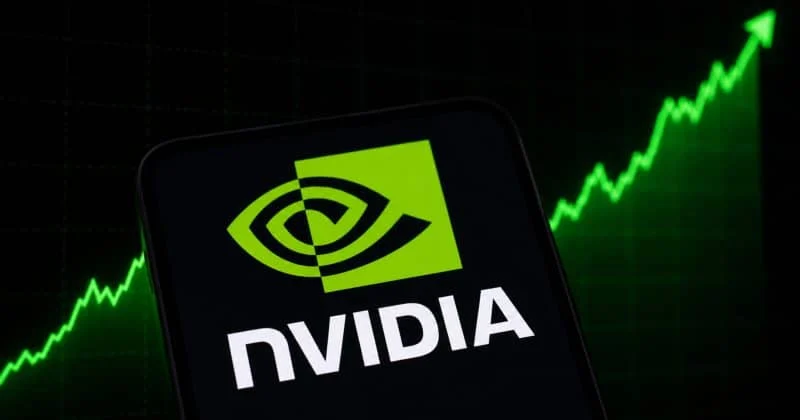
Nvidia Corporation witnessed a historic surge in its market valuation on Thursday, with shares climbing to an unprecedented all-time high following reports that the United States government has authorized the sale of advanced H200 artificial intelligence chips to approximately 10 prominent Chinese technology entities. This regulatory pivot marks a significant shift in the high-stakes geopolitical landscape of semiconductor trade, potentially reopening a multi-billion-dollar revenue stream in one of the world’s most critical markets for artificial intelligence development.
The stock climbed nearly 4% during Thursday’s trading session, hovering near the $234 mark at the time of writing. This momentum propelled Nvidia’s total market capitalization to approximately $5.7 trillion, reinforcing its position as the world’s most valuable company. The rally coincided with a broader surge in the technology sector, which saw both the S&P 500 and the Nasdaq Composite reach record intraday highs. This latest milestone follows a period of intense growth for the Santa Clara-based chipmaker, which only earlier this week surpassed the $5.5 trillion market cap threshold.
The Scope of the Licensing Agreements
The US Commerce Department’s decision to grant export licenses represents a nuanced adjustment to the stringent trade barriers that have defined the US-China tech relationship over the last three years. According to reports, the list of approved purchasers includes the "Big Four" of the Chinese internet sector: Alibaba Group Holding, Tencent Holdings, ByteDance (the parent company of TikTok), and JD.com. These companies are currently at the forefront of China’s domestic push to develop Large Language Models (LLMs) and generative AI applications that can compete with Western counterparts like OpenAI’s GPT-4.
In addition to the primary end-users, the Commerce Department has extended approvals to key hardware distributors and integrators. Lenovo Group and Foxconn (Hon Hai Precision Industry Co.) have reportedly received the necessary clearances to facilitate the movement of these high-performance components. Under the specific terms of the licensing agreements, each approved customer is permitted to purchase up to 75,000 H200 chips. Given the estimated market price of these units—which can range from $25,000 to $40,000 depending on volume and configuration—the total value of these potential transactions could exceed $20 billion for Nvidia.
Technical Significance of the H200 Architecture
The H200 Tensor Core GPU is Nvidia’s second-most powerful AI processor, built on the "Hopper" architecture. It serves as a critical bridge between the industry-standard H100 and the next-generation "Blackwell" architecture. The primary advantage of the H200 over its predecessor lies in its memory capacity and bandwidth. It is the first GPU to feature HBM3e (High Bandwidth Memory 3e), offering 141GB of memory at 4.8 terabytes per second.
For Chinese tech giants, access to the H200 is vital for "inference"—the process of running trained AI models—and for the training of increasingly complex neural networks. Previously, export restrictions had forced Chinese firms to rely on slowed-down versions of Nvidia chips, such as the H20, which were specifically designed to fall under the performance thresholds set by US regulators. The approval of the H200 suggests a recalibration of what the US deems "nationally sensitive" versus "commercially viable" technology in the context of international competition.
A Timeline of Semiconductor Export Controls
The road to this week’s announcement has been marked by a series of escalating restrictions and diplomatic negotiations. Understanding the current breakthrough requires a look at the chronology of the "Chip War":
- October 2022: The US Bureau of Industry and Security (BIS) implemented sweeping export controls aimed at preventing China from acquiring advanced semiconductors and chip-making equipment. This effectively banned the sale of Nvidia’s A100 and H100 chips to Chinese entities.
- Late 2022 – Early 2023: Nvidia developed "China-spec" chips, the A800 and H800, which met the technical limits of the October 2022 rules while providing significant compute power.
- October 2023: The US tightened regulations further, closing loopholes and banning the A800 and H800. This led Nvidia to develop the even more restricted H20, L20, and L2 chips for the Chinese market.
- 2024-2025: Chinese firms accelerated the development of domestic alternatives, such as Huawei’s Ascend 910B/C and Biren Technology’s solutions, creating pressure on US firms who feared losing the Chinese market permanently.
- Mid-2026 (Current Event): Reports emerge of the US Commerce Department clearing the H200 for select sales, coinciding with high-level diplomatic engagement.
Diplomatic Context: The Trump-Xi Summit in Beijing
The timing of these approvals is closely linked to a significant diplomatic mission. Nvidia CEO Jensen Huang is currently in Beijing as part of a high-level US business delegation. His presence comes at the invitation of President Donald Trump, who is participating in a summit with Chinese President Xi Jinping.
Market analysts suggest that the inclusion of tech leaders like Huang in the official delegation is a strategic move intended to use American technological superiority as a bargaining chip in broader trade negotiations. While the Commerce Department has granted the licenses, no physical deliveries of H200 chips have been reported yet. This "limbo" status suggests that the deliveries may be contingent on the outcome of the ongoing talks between the two world leaders.
The delay in actual shipping reflects the persistent friction between Washington’s desire to maintain a technological lead and Beijing’s aggressive push for "self-reliance." China has invested billions into its "Big Fund" to subsidize domestic semiconductor manufacturing, and some Chinese officials remain wary of re-entering a dependency cycle with US-based suppliers.
Market Reaction and Analyst Insights
Wall Street’s reaction to the news has been overwhelmingly positive. The potential for Nvidia to recapture a significant portion of its Chinese revenue—which historically accounted for 20% to 25% of its data center business—has led several analysts to revise their price targets upward.
"The reopening of the China market for the H200 is a major de-risking event for Nvidia," noted one senior equity analyst at a major investment bank. "While the Blackwell cycle remains the primary driver of growth in the West, the ability to sell H200s in China provides a massive buffer and utilizes existing Hopper-based production capacity."
Investors are also looking ahead to Nvidia’s upcoming quarterly earnings report. The consensus among institutional investors is that the demand for AI infrastructure shows no signs of slowing. Beyond the China news, Nvidia continues to benefit from massive capital expenditure (CapEx) from "Hyperscalers" like Microsoft, Meta, and Amazon, who are in a race to build out global AI data centers.
Broader Implications for Global AI Leadership
The approval of H200 sales to China carries implications that extend far beyond Nvidia’s balance sheet. It touches on the fundamental balance of power in the age of artificial intelligence.
1. The Strategic Buffer: By allowing the sale of H200s but perhaps withholding the more advanced Blackwell chips, the US maintains a "sliding scale" of technological superiority. This allows US firms to remain profitable and dominant in the global market while ensuring that the most cutting-edge capabilities remain restricted.
2. Impact on Chinese Domestic Innovation: The availability of Nvidia’s H200 may inadvertently slow the adoption of domestic Chinese AI chips. If companies like Alibaba and Tencent can buy the gold-standard Nvidia hardware, they may be less inclined to pivot entirely to unproven domestic architectures, thereby maintaining the global ecosystem’s reliance on US-designed software stacks like Nvidia’s CUDA.
3. Supply Chain Stability: The involvement of Lenovo and Foxconn as approved distributors suggests a desire to stabilize the global electronics supply chain. These companies operate massive assembly hubs that are integral to the global economy; providing them with clear regulatory pathways reduces the risk of sudden disruptions.
Official Responses and Remaining Uncertainties
While Nvidia has not released an official statement regarding the specific license approvals, the company has consistently maintained that it complies with all US government regulations while striving to serve its global customer base. The US Commerce Department has also remained tight-lipped about the specific criteria used to select the 10 approved companies, though national security vetting is assumed to be the primary filter.
The central uncertainty remains the "execution" phase of these licenses. With the H200 deliveries currently stalled, the tech industry is watching Beijing for a reciprocal gesture. Whether this involves a reduction in tariffs on other US goods or a commitment to intellectual property protections remains to be seen.
As the broader tech rally continues to push indices to new heights, Nvidia stands as the primary beneficiary of the AI era. The potential reintegration into the Chinese market, combined with the upcoming rollout of the Blackwell architecture, positions the company at the center of the next phase of global industrial transformation. For now, the $5.7 trillion valuation reflects a market that believes Nvidia is not just a chipmaker, but the essential utility provider for the future of computation.