


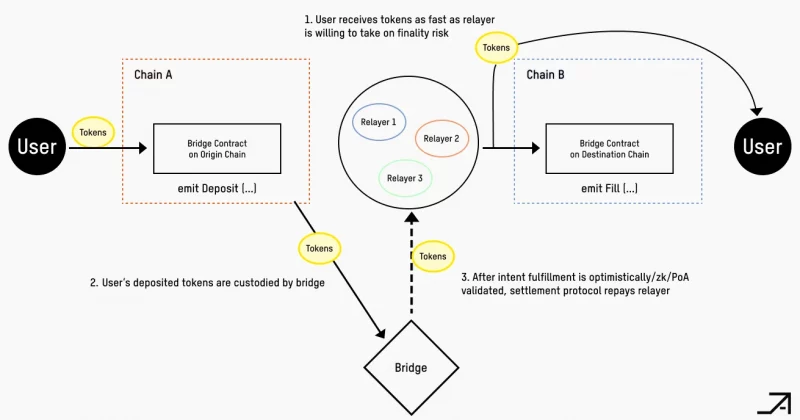
The Open Intents Framework (OIF), a groundbreaking initiative launched in February 2025 by the Ethereum Foundation in collaboration with Hyperlane and Bootnode, is rapidly establishing itself as the foundational infrastructure for building and executing cross-chain intents. This ambitious project has garnered substantial momentum, securing the backing of over 30 prominent teams, including major players in the blockchain ecosystem such as Arbitrum, Optimism, Polygon, ZKsync, and Starknet. The OIF’s strategic positioning as a neutral, open-source standard, rather than a proprietary product, is a key factor in its burgeoning adoption and signifies a significant step towards more seamless and decentralized interoperability within the burgeoning multi-chain landscape.
The core objective of the Open Intents Framework is to democratize and standardize the process of executing complex transactions across disparate blockchain networks. Historically, cross-chain interactions have been hampered by a fragmented landscape of bespoke bridges and interoperability solutions, often leading to security vulnerabilities, high fees, and a poor user experience. The OIF aims to address these challenges by providing a comprehensive, permissionless toolkit that empowers developers to build and deploy cross-chain functionalities without requiring explicit approval from any single entity.
Unpacking the Technical Architecture of the Open Intents Framework
At its heart, the OIF offers a robust suite of tools designed to facilitate the seamless operation of cross-chain intents across multiple blockchain networks. This toolkit comprises essential components, including smart contracts that govern the logic of intent execution, open-source solvers that compete to fulfill these intents, aggregators that can bundle multiple intents, and a Software Development Kit (SDK) that developers can readily integrate into their applications. The framework’s architectural elegance is built upon three fundamental contract types: InputSettler, OutputSettler, and Oracle contracts. These core components are intricately linked by the interoperability SDK, creating a cohesive and functional system for cross-chain communication.
The OIF’s design is deeply rooted in the principles of standardization, specifically building upon the ERC-7683 standard. This established standard provides a clear and concise definition for the structure and submission of cross-chain intents. When a user expresses an intent – for instance, a desire to swap tokens from one blockchain to another – the OIF orchestrates a competitive environment where multiple independent solvers vie to execute that request with maximum efficiency and minimal cost. This competitive dynamic is a cornerstone of the framework’s philosophy, ensuring that users benefit from optimal execution pathways.
Early deployments of the OIF have already been successfully implemented on several prominent testnets, including Ethereum Sepolia and Optimism Sepolia, demonstrating its practical applicability. Under ideal network conditions, the framework has shown the capability to complete solver-filled intent orders within a remarkably short timeframe, typically ranging from 10 to 60 seconds. This speed is a critical factor for applications requiring near real-time cross-chain transactions, such as decentralized finance (DeFi) protocols and gaming platforms.
Coinbase Payments Throws Its Weight Behind the OIF
A significant catalyst for the OIF’s growing influence arrived in September 2025 with the announcement that Coinbase Payments, the payments division of the globally recognized cryptocurrency exchange Coinbase, had become a core contributor to the project. This strategic endorsement from a major industry player underscores the perceived value and future potential of the OIF. Coinbase Payments’ involvement is primarily focused on leveraging the framework to help standardize and streamline cross-chain asset transfers, a crucial element for the broader adoption of digital assets and decentralized applications.
The OIF’s inherent modularity and permissionless nature are key design principles that resonate with industry leaders like Coinbase. This approach signifies that any development team, regardless of size or affiliation, can deploy and extend the framework’s smart contracts without the need for centralized approval. This open ecosystem fosters innovation and prevents the emergence of gatekeepers, aligning with the decentralized ethos of blockchain technology. Crucially, the OIF has deliberately eschewed the creation of a native governance token. This absence of a token serves to reinforce its identity as neutral infrastructure, free from the complexities of tokenomics, staking requirements, or fluctuating fee structures dictated by token holder votes.
This "no token" strategy is a deliberate design choice with profound implications. While it eliminates the need for developers to navigate intricate token-based economic models, it also presents a unique challenge: how to incentivize participation and growth within the network without a direct financial reward mechanism. The OIF addresses this by relying on the inherent competitive dynamics among solvers. Solvers are motivated to operate efficiently and cost-effectively because their profitability is directly tied to their ability to successfully fulfill user intents. This creates a self-sustaining ecosystem where performance and efficiency are the primary drivers of success.
The Strategic Advantage of a Tokenless Framework
The decision to launch the Open Intents Framework without a dedicated token is a departure from the common practice in many blockchain projects, which often use tokens to bootstrap networks and incentivize participation. However, this tokenless approach is a deliberate strategy to position the OIF as a foundational, neutral piece of infrastructure, akin to an internet protocol rather than a specific application or service.
For developers building on the OIF, this means a simplified development experience. They are not burdened by the need to understand or integrate complex tokenomics, manage staking mechanisms, or account for potential changes in protocol fees that could be influenced by token holder governance. This focus on pure utility and standardization allows developers to concentrate on building innovative applications that leverage cross-chain capabilities.
The absence of a token also means that the OIF does not rely on a direct financial incentive mechanism to attract and retain solvers and other network participants. Instead, the framework is designed to foster competition among solvers. These solvers are independent entities that operate to fulfill user intents, earning revenue from the efficiency and speed with which they execute these requests. This competitive landscape is expected to drive innovation in solver technology and execution strategies, ultimately benefiting the end-users by ensuring that their cross-chain transactions are processed reliably and cost-effectively.
The OIF team has acknowledged that building and maintaining a robust network of solvers without a token presents unique challenges. However, they believe that the inherent value proposition of providing a standardized, secure, and efficient cross-chain intent execution layer will be sufficient to attract and retain participants. The focus on open-source development and the framework’s neutrality are intended to foster trust and encourage broad adoption.
Timeline and Key Milestones in the OIF’s Development
The journey of the Open Intents Framework began in February 2025 with its official launch, a collaborative effort spearheaded by the Ethereum Foundation, Hyperlane, and Bootnode. This initial phase was marked by the foundational development of the core smart contracts, the interoperability SDK, and the establishment of the ERC-7683 standard as the bedrock for intent structuring.
Following the launch, the project immediately focused on real-world testing and validation. Deployments on key Ethereum testnets, including Sepolia, and on the Optimism Sepolia testnet, were among the first tangible steps, allowing developers and the wider community to experiment with the framework. This period was crucial for gathering feedback and identifying areas for optimization.
A significant turning point in the OIF’s trajectory occurred in September 2025 with the formal integration of Coinbase Payments as a core contributor. This marked a critical endorsement from a major industry entity and signaled a growing commitment from established players in the blockchain space to embrace and contribute to the OIF’s development. Coinbase’s involvement is expected to accelerate the standardization of cross-chain asset transfers and introduce the framework to a broader audience of businesses and users.
Looking ahead, the OIF roadmap includes ongoing audits of its production contracts, which are already deployed across various testnets and are being prepared for wider mainnet adoption. Furthermore, the framework anticipates significant advancements in solver development throughout the latter half of 2025. This includes the development of more sophisticated solvers, enhanced performance optimizations, and potentially the expansion of supported intent types beyond simple token swaps. The continued evolution of the solver ecosystem is paramount to the OIF’s long-term success and its ability to handle increasingly complex cross-chain operations.
Supporting Data and Industry Context
The rise of the Open Intents Framework is occurring against a backdrop of exponential growth in the blockchain industry and a burgeoning demand for seamless cross-chain communication. As of late 2025, the total value locked (TVL) across all DeFi protocols has surpassed $1.5 trillion, with a significant portion of this value distributed across multiple blockchain networks. This multi-chain reality necessitates robust interoperability solutions.
The number of active blockchain networks has also proliferated, with hundreds of Layer 1 and Layer 2 solutions vying for user adoption. While this innovation has fostered a diverse ecosystem, it has also created significant fragmentation, making it challenging for users and developers to navigate and interact across different chains. Bridges, while essential, have historically been a source of security concerns, with numerous high-profile exploits resulting in billions of dollars in stolen assets. The OIF’s focus on a standardized, permissionless, and competitive execution model aims to mitigate these risks.
The backing of major Layer 2 scaling solutions like Arbitrum, Optimism, ZKsync, and Starknet is particularly noteworthy. These networks are at the forefront of blockchain scalability and are actively seeking ways to improve the user experience and developer accessibility. Their commitment to the OIF suggests a shared vision for a more interconnected and efficient blockchain future.
The inclusion of Polygon, a prominent multi-chain scaling solution, further solidifies the OIF’s broad appeal. Polygon’s own efforts in bridging and interoperability will likely benefit from the standardized approach offered by the OIF. The involvement of over 30 teams indicates a significant consensus within the developer community regarding the need for a universal framework for cross-chain intents.
Broader Impact and Future Implications
The Open Intents Framework has the potential to fundamentally reshape how users and applications interact within the blockchain ecosystem. By establishing a neutral, open-source standard, the OIF aims to:
- Enhance User Experience: Simplify complex cross-chain transactions, making them as intuitive as single-chain operations. This could involve seamless token swaps, asset transfers, and even cross-chain smart contract interactions, all executed with greater reliability and speed.
- Reduce Security Risks: By promoting a standardized and auditable execution layer, the OIF can help mitigate the vulnerabilities associated with proprietary or ad-hoc bridging solutions. The competitive nature of solvers incentivizes them to maintain secure and efficient operations.
- Foster Innovation: The permissionless nature of the OIF allows developers to build novel applications and services that leverage cross-chain capabilities without facing artificial barriers. This could lead to the creation of entirely new categories of decentralized applications.
- Promote Decentralization: The framework’s commitment to neutrality and its lack of a governance token prevent any single entity from controlling or monopolizing cross-chain intent execution. This aligns with the core principles of decentralization that underpin blockchain technology.
- Lower Development Costs: By providing a standardized toolkit and SDK, the OIF can significantly reduce the development effort and cost associated with building cross-chain functionalities, making it more accessible for a wider range of projects.
The strategic decision to forgo a token also has long-term implications for the OIF’s governance and evolution. Without a token, decisions regarding protocol upgrades and future development will likely be driven by technical merit and community consensus, rather than the economic interests of token holders. This could lead to a more stable and predictable development path.
The collaboration with Coinbase Payments, in particular, signals a growing convergence between the decentralized finance (DeFi) and traditional finance (TradFi) worlds. As more institutional players explore the potential of blockchain technology, standardized and secure interoperability solutions like the OIF will become increasingly crucial. Coinbase’s involvement suggests a recognition of the OIF as a potential backbone for future cross-chain financial services.
In conclusion, the Open Intents Framework represents a significant leap forward in the quest for true blockchain interoperability. Its open-source nature, robust technical design, and broad industry support, including key endorsements from major players like Coinbase, position it as a leading candidate to become the de facto standard for building and executing cross-chain intents. As the blockchain landscape continues to evolve and expand, the OIF’s neutral and permissionless approach is poised to play a pivotal role in shaping a more connected, secure, and innovative decentralized future. The ongoing development and adoption of the framework will be closely watched by developers, users, and institutions alike as it strives to unlock the full potential of a multi-chain world.














