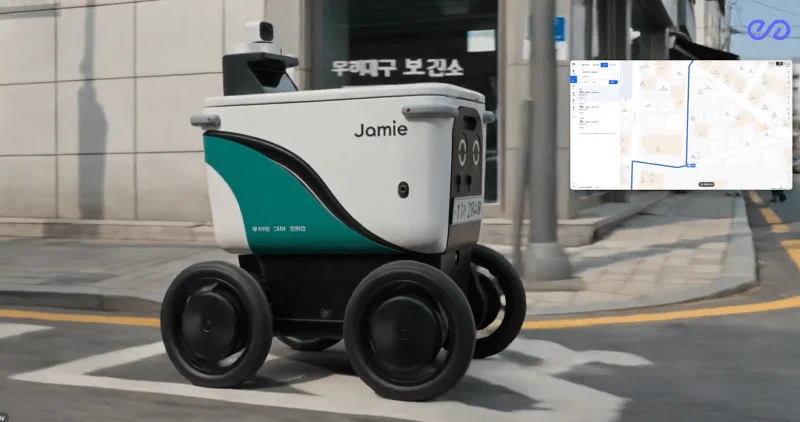
Peaq has unveiled a groundbreaking simulated robotic delivery system that showcases the potential for autonomous machines to process onchain payments, marking a significant advancement in the convergence of robotics, decentralized finance (DePIN), and real-world asset tokenization. The demonstration, powered by robotic.sh, a marketplace operating on peaqOS, illustrates a future where machines can independently access and pay for digital services, facilitating seamless, human-free transactions.
Autonomous Navigation and Payment Settlement
The core of peaq’s demonstration involved a simulated workflow for a delivery robot, specifically a Serve Robotics unit, navigating the bustling streets of Seoul. Utilizing NAVER Maps, a leading digital mapping service in South Korea, the robot was depicted not only charting its course but also autonomously settling payments for services rendered. This onchain transaction was facilitated through Tether (USDT), a stablecoin pegged to the U.S. dollar, leveraging the Solana blockchain and Tether’s robust Wallet Development Kit (WDK).
This integration signifies a paradigm shift in how machines can interact with the digital economy. The simulated workflow allows the robot to access a digital mapping service, make real-time navigation decisions based on traffic, road conditions, and delivery priorities, and then execute a blockchain-based payment without any human intervention. This "no-human-in-the-loop" approach underscores the potential for increased efficiency and automation in logistics and delivery services.
According to peaq, the transparency and verifiability inherent in blockchain technology are crucial to this system. Transaction records, digital wallets, and settlement activities are all recorded and auditable on the blockchain, providing a high degree of trust and security for all parties involved, even if those parties are machines.
Robotic.sh: A Decentralized Marketplace for Machine Services
The NAVER Maps integration, a key component of this demonstration, is now accessible to machines running peaqOS through robotic.sh. This marketplace, which launched this week, offers a suite of machine-accessible services designed to empower autonomous agents. Beyond mapping and navigation, robotic.sh currently supports a diverse range of services including AI inference tools, specialized search and data platforms, cloud-based analytics, CAPTCHA solving (a common task for verifying human interaction but here utilized by machines for data processing), and decentralized storage solutions.
The significance of robotic.sh lies in its open architecture. Peaq emphasizes that any mobile robot, autonomous vehicle, drone, or even humanoid robot operating on the peaqOS platform can seamlessly access these services. Crucially, this accessibility is not limited by the underlying blockchain network the machine might be utilizing for other operations. This interoperability is a cornerstone of peaq’s vision for a decentralized machine economy, fostering an ecosystem where diverse robotic agents can collaborate and leverage shared digital infrastructure.
The Broader Context: DePIN and the Future of Machine Economies
Peaq has been steadily establishing itself as a leading layer 1 network specifically engineered for Decentralized Physical Infrastructure Networks (DePIN). DePIN refers to a burgeoning sector that utilizes blockchain technology to incentivize the collective building and maintenance of real-world physical infrastructure, such as wireless networks, storage, and computing power. By aligning economic incentives with the deployment of hardware and services, DePIN aims to create more efficient, resilient, and community-governed infrastructure.
With over 60 applications already integrated and spanning more than 20 distinct industries, peaq has demonstrated significant traction in the DePIN space. The network’s ability to support millions of machines and devices highlights its scalability and the growing demand for a decentralized infrastructure layer that can accommodate the increasing number of connected and autonomous systems.
This latest demonstration by peaq is a potent illustration of how DePIN principles can extend beyond simple infrastructure provision to enable complex autonomous operations. By providing the foundational layer for machines to access services, manage their digital identities, and conduct financial transactions, peaq is paving the way for a new era of machine-to-machine (M2M) commerce.
Chronology of Developments
While the exact timeline leading to this specific demonstration is not fully detailed, the underlying technologies and concepts have been under development by peaq and its partners for some time.
- Early 2023: Peaq began to gain significant recognition as a prominent layer 1 blockchain focused on DePIN. Partnerships and integrations with various hardware providers and application developers started to emerge, laying the groundwork for a robust machine economy.
- Mid-2023 to Late 2023: Development efforts likely intensified on core peaqOS functionalities, including secure machine identity management, decentralized storage access, and basic onchain interaction capabilities for autonomous agents. The concept of a machine-accessible service marketplace would have been a key strategic focus.
- Early 2024: Preparations for the launch of robotic.sh would have been underway, involving the onboarding of service providers and the testing of various machine-to-service integrations. The partnership with Serve Robotics, a known player in autonomous delivery, likely solidified during this period, providing a tangible use case for the demonstration.
- May 2026 (Simulated Future Date): The specific demonstration as presented in the tweet likely represents a forward-looking simulation or a projected milestone. The tweet itself, dated May 22, 2026, describes a simulated workflow, indicating that the technology is either in advanced development or a proof-of-concept stage, with this simulated future date highlighting the envisioned capabilities. The actual launch and public availability of such a fully integrated system would be a subsequent event.
Supporting Data and Industry Trends
The global market for autonomous delivery robots is experiencing rapid growth. Industry analysts project that the market size will expand significantly in the coming years, driven by increasing e-commerce penetration, labor shortages, and advancements in AI and robotics.
- Market Growth Projections: Reports from firms like MarketsandMarkets estimate the global autonomous last-mile delivery robot market to grow from $0.5 billion in 2023 to $2.5 billion by 2028, at a Compound Annual Growth Rate (CAGR) of 37.9%. This indicates a strong demand for the very solutions peaq is enabling.
- DePIN Sector Expansion: The DePIN sector itself has seen substantial investment and growth. Projects are increasingly focusing on real-world applications, with infrastructure for autonomous systems being a prime area of development. The number of active DePIN projects and their total value locked (TVL) has seen a steady upward trend.
- Blockchain Adoption in Logistics: While still nascent, the adoption of blockchain technology in logistics and supply chain management is gaining momentum. Use cases range from enhanced transparency and traceability to automated payments and smart contract-based agreements. Peaq’s approach accelerates this by directly integrating blockchain capabilities into the machines themselves.
Official Responses and Inferred Reactions
While direct quotes from all involved parties are not provided in the initial announcement, we can infer potential reactions and the strategic significance for each participant.
- Peaq: The demonstration serves as a powerful validation of peaq’s vision for a decentralized machine economy. It showcases the practical application of its peaqOS and robotic.sh marketplace, attracting developers, machine manufacturers, and service providers to its ecosystem. The company’s emphasis on verifiable onchain activity underscores its commitment to building a trustworthy and transparent decentralized infrastructure.
- Serve Robotics: For Serve Robotics, this integration represents a significant step towards achieving fully autonomous operations. The ability for their robots to independently manage service access and payments reduces operational overhead and unlocks new business models. This partnership demonstrates their forward-thinking approach to leveraging cutting-edge technologies.
- NAVER Maps: While NAVER Maps is a service provider in this scenario, its integration signifies a growing openness among traditional technology companies to engage with decentralized ecosystems. By making its mapping data accessible via APIs that can be consumed by machines on platforms like peaqOS, NAVER is positioning itself to be a key player in the future of autonomous navigation services.
- Tether (USDT) and Solana: The use of USDT on Solana highlights the growing utility of stablecoins and high-performance blockchains in facilitating real-world transactions. For Tether, it demonstrates the expanding use cases for USDT beyond traditional finance, into the realm of machine-to-machine payments. For Solana, it showcases its capability to handle high-throughput, low-cost transactions essential for micro-payments and automated settlement by autonomous agents.
Broader Impact and Implications
The implications of peaq’s demonstrated robotic payment system are far-reaching, extending across multiple industries and technological domains.
Enhanced Efficiency and Reduced Costs
By eliminating human intervention in payment processing and service access, the system promises significant gains in operational efficiency and cost reduction. Delivery robots can operate more autonomously, responding to dynamic demands and managing their own resource needs without constant human oversight. This is particularly impactful in logistics, where last-mile delivery is often the most expensive and complex part of the supply chain.
New Business Models and Revenue Streams
The ability for machines to transact autonomously opens up entirely new business models. Service providers can offer their capabilities on a pay-per-use basis to machines, creating a more granular and flexible market for digital services. This could lead to the proliferation of specialized machine-centric services, from data processing to charging infrastructure access.
Democratization of Autonomous Systems
Peaq’s platform aims to democratize access to advanced services for autonomous systems. By providing a standardized marketplace and interoperable infrastructure, it lowers the barrier to entry for smaller robotics companies or those developing specialized autonomous agents. This fosters innovation and competition within the rapidly evolving robotics landscape.
The Rise of Machine Economies
This development is a crucial step towards the realization of robust machine economies, where machines not only perform tasks but also participate in economic activities. The concept of "digital assets" and "digital services" for machines becomes tangible, moving beyond theoretical discussions to practical implementation. This could eventually lead to machines earning, saving, and investing their own "digital income" within a decentralized framework.
Trust and Transparency in Automation
The reliance on blockchain technology ensures that all transactions and service interactions are transparent and verifiable. This is critical for building trust in autonomous systems, especially as they become more integrated into critical infrastructure and public spaces. The onchain audit trail provides accountability and can help resolve disputes, even between autonomous agents.
Challenges and Future Outlook
Despite the promising demonstration, several challenges remain. The scalability of blockchain networks to handle the potentially massive volume of machine transactions needs to be continuously addressed. Security remains paramount, with robust measures required to protect machine identities and digital assets from unauthorized access or manipulation. Furthermore, regulatory frameworks will need to evolve to accommodate autonomous economic agents.
However, peaq’s initiative represents a significant leap forward. By bridging the gap between the physical world of robotics and the digital world of decentralized finance, peaq is not just building infrastructure; it is architecting the future of how autonomous machines will operate, interact, and transact in an increasingly connected and automated world. The successful simulation of autonomous onchain payments for robotic deliveries is a clear indicator that the era of truly intelligent and self-sufficient machines is rapidly approaching.