


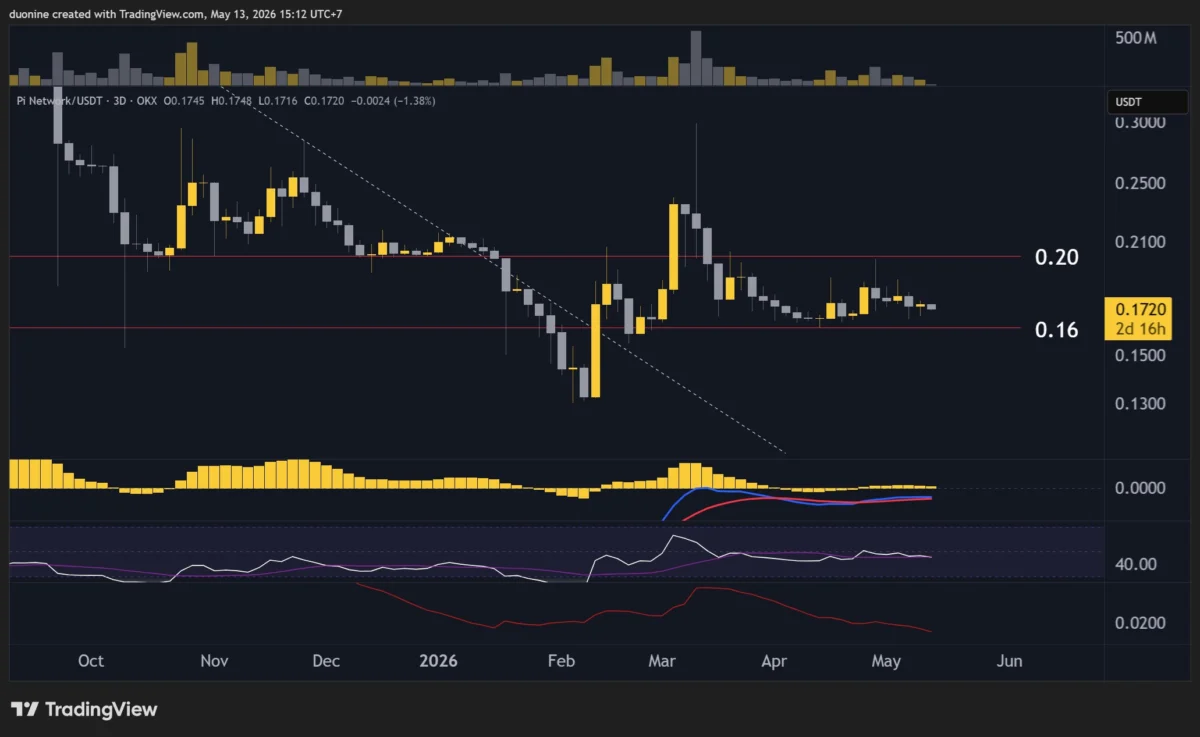
The price of PI Network (PI) has been consolidating within a distinct horizontal channel, leaving investors and observers questioning when a significant price movement, either upwards or downwards, will occur. Current technical indicators suggest a period of stagnation, with the PI price hovering around the 17-cent mark for the past week. While buyers attempted to breach the $0.20 resistance level in late April, these efforts were met with resistance, leading to a subsequent decline in trading volume. This lack of sustained upward momentum has confined PI to its current trading range, sparking discussions about its potential future trajectory.
Key Technical Levels to Watch
Market analysts have identified crucial price levels that will likely dictate the short-to-medium term performance of PI Network. The key support level is firmly established at $0.16. This signifies a price floor below which buying pressure is expected to increase, potentially halting further declines. Conversely, the key resistance levels are situated at $0.20 and a more significant hurdle at $0.28. Breaching these resistance points would indicate a shift in market sentiment and potentially initiate an upward trend.
PI Remains Stuck in a Channel: A Technical Overview
The recent price action of PI Network has been characterized by a distinct lack of volatility, a common phenomenon during periods of market consolidation. For the past week, the cryptocurrency has been trading sideways, predominantly above the $0.17 mark. This sideways movement, often referred to as a "flat channel" or "consolidation phase," suggests a balance between buying and selling pressure. Neither bulls nor bears have been able to exert enough dominance to drive the price decisively in one direction.
The failed attempt to break through the $0.20 resistance in late April is a notable event within this consolidation period. This rejection by sellers indicates that there is significant supply concentrated around this price point, requiring a substantial increase in buying demand to overcome. Since this failed breakout, trading volume has seen a noticeable decline. This often accompanies periods of sideways price action, as traders may be adopting a "wait-and-see" approach, anticipating a clearer signal before committing to new positions.
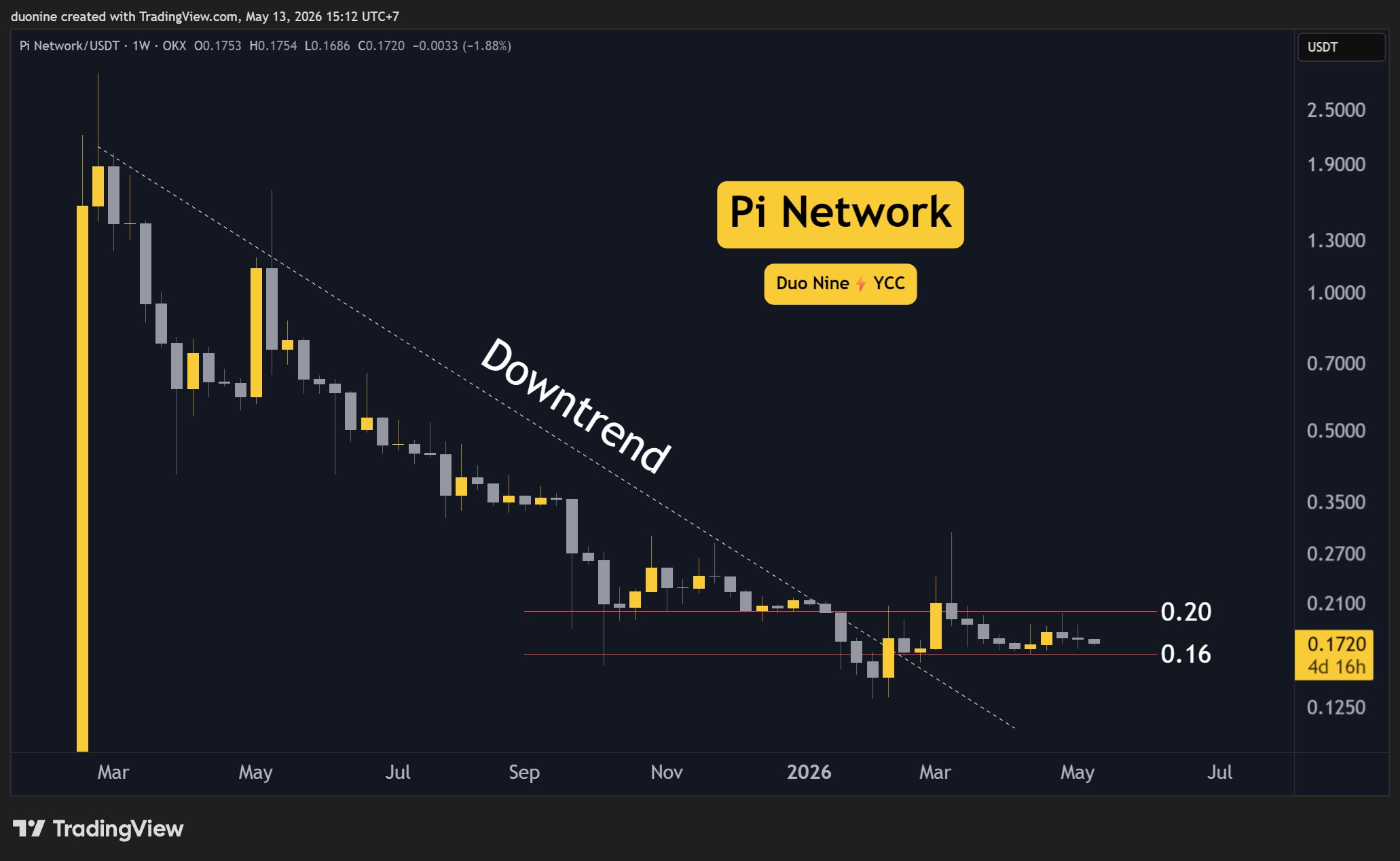
Despite the lack of immediate upward momentum, the consolidation itself can be viewed as a positive development by some market participants. Crucially, the price has stopped making lower lows. This implies that the downward trend that may have preceded this period of stability has potentially been arrested. The formation of higher lows, even within a tight trading range, can build confidence among investors that the asset has found a bottom and is preparing for a potential recovery. This psychological shift can be a precursor to more significant price movements.
Low Momentum, but Higher Lows: A Bullish Undercurrent?
At the time of this analysis, both price and momentum indicators do not exhibit strong signals for an imminent breakout. Indicators that measure the speed and strength of price movements are suggesting a period of low activity. However, a closer examination of the price chart reveals a more nuanced picture. Since reaching a low point of approximately $0.13, the PI price has been consistently making higher lows. This pattern is a classic indicator of a potential bullish reversal or the accumulation phase preceding a significant upward move.
This formation of higher lows is a crucial observation. It suggests that with each subsequent dip, buyers are stepping in at progressively higher price levels, indicating increasing demand and a potential shift in market sentiment. If this trend continues and is accompanied by a decisive move above the $0.20 resistance, it would be a strong confirmation of a bullish outlook. However, for such a breakout to occur, a substantial increase in buying volume will be necessary. The current trend of falling volume in May is a counteracting factor, suggesting that the market is not yet fully convinced of a sustained recovery.
Flat Volume Keeps the Price Stuck: The Need for Increased Activity
Volume is a critical indicator in technical analysis, often considered as important as the price itself. It represents the total number of units traded over a specific period and can provide insights into the strength and conviction behind price movements. Since the beginning of April, PI Network’s trading volume has remained consistently low, with only minor fluctuations. This sustained low volume has directly contributed to the price being unable to break out of its current range, effectively trapped between the $0.16 support and the $0.20 resistance.
For PI to escape this sideways channel and embark on a significant upward trajectory, a notable increase in trading volume is essential. Higher highs on the volume profile would signal increased participation and conviction from traders, suggesting that a larger number of market participants are actively buying the asset. While the current volume is subdued, it is important to remember that PI Network is often categorized as a "momentum coin." This means that once a trend begins, it can accelerate rapidly, driven by increased trading activity.
Until such a surge in volume occurs, patience appears to be the prevailing strategy for investors. The current "grind" of slow, incremental price movements within a tight range suggests that the market is in a state of equilibrium, awaiting a catalyst for change. Traders and investors are likely to remain on the sidelines, observing price action and volume trends for any indication of a shift in market dynamics.
Background Context: The PI Network Ecosystem
The PI Network project aims to be a cryptocurrency accessible to everyone, allowing users to mine PI coins on their mobile phones without significant energy consumption. Launched with the promise of a user-friendly interface and a focus on community building, PI Network has garnered a substantial user base since its inception. The project’s development roadmap has included stages of development, enclosed mainnet, and eventually, the open mainnet. The current price action is occurring within the context of these developmental phases.
The project’s decentralized nature and its emphasis on accessibility have contributed to its unique position in the cryptocurrency market. Unlike many other cryptocurrencies that require specialized hardware for mining, PI Network’s mobile-first approach has democratized participation. However, this accessibility has also led to discussions about the token’s valuation and its eventual listing on major cryptocurrency exchanges, which typically drives liquidity and price discovery.
Timeline of Key Developments (Inferred from general crypto market trends and project phases)
While specific daily price charts are proprietary to trading platforms, the general market sentiment and PI Network’s developmental milestones can be pieced together to understand the context of its current price action.
- Early Development & Mining Phase: During its initial stages, the focus was on user acquisition and mobile mining. The value of PI was largely theoretical, as it was not yet listed on open exchanges.
- Enclosed Mainnet Phase: This phase allowed for peer-to-peer transactions within the PI ecosystem but limited external trading. Price discovery was still nascent and primarily occurred through internal marketplaces or unofficial channels.
- Late April Attempts at Resistance Breach: This period likely saw increased speculative interest or news-driven sentiment, leading to attempts to break through the $0.20 level. The failure to sustain this breakout suggests that the market was not yet ready for a significant upward revaluation.
- May Consolidation & Declining Volume: The current phase, characterized by sideways trading and low volume, indicates a period of market digestion and indecision. Investors are likely awaiting clearer signals regarding the project’s future utility and exchange listings.
Supporting Data: Volume and Price Correlation
The relationship between price and volume is a fundamental concept in financial markets. Generally, a rising price accompanied by rising volume is considered a strong bullish signal, indicating conviction behind the upward move. Conversely, a rising price with declining volume can suggest a weakening trend, potentially leading to a reversal. The current scenario for PI Network exhibits a lack of correlation that would typically drive a breakout.
- Low Volume: The consistently low trading volume observed since April suggests that a large number of market participants are not actively engaging with PI at current price levels. This can be due to a variety of factors, including uncertainty about future price movements, waiting for exchange listings, or a general lack of broader market interest in the asset at this specific time.
- Sideways Price Action: The absence of significant price swings further reinforces the notion of a market in equilibrium. Without strong buying or selling pressure, the price tends to remain within a defined range.
Broader Impact and Implications for Investors
The current consolidation phase for PI Network presents both challenges and opportunities for investors.
- Opportunity for Accumulation: For investors who believe in the long-term potential of PI Network, the current low price and sideways trading could represent an opportune time to accumulate holdings at a relatively stable price point. The formation of higher lows provides a degree of confidence that the asset may be undervalued.
- Risk of Stagnation: Conversely, the extended period of consolidation could lead to investor fatigue and a loss of interest if a breakout does not materialize in the near future. Impatience could lead some investors to exit their positions, potentially putting downward pressure on the price.
- Catalyst Dependence: The future price movement of PI Network is heavily reliant on external catalysts. The most anticipated catalyst remains its listing on major cryptocurrency exchanges. Such listings typically increase liquidity, market visibility, and accessibility, which can significantly impact price discovery and volatility. Furthermore, the continued development and adoption of PI’s ecosystem and use cases will play a crucial role in its long-term valuation.
Conclusion: Patience and Observation are Key
The PI Network (PI) price is currently navigating a period of consolidation within a defined trading channel. While the absence of strong momentum and declining volume suggest a lack of immediate upward pressure, the formation of higher lows offers a glimmer of optimism for potential future gains. Key resistance levels at $0.20 and $0.28 will be critical to watch for any signs of a breakout. Investors are advised to remain patient and closely monitor trading volume for any indications of increased market participation. The eventual listing on major exchanges remains a significant anticipated event that could dramatically alter the current price dynamics. Until then, a cautious and observant approach is recommended for all stakeholders in the PI Network ecosystem.














