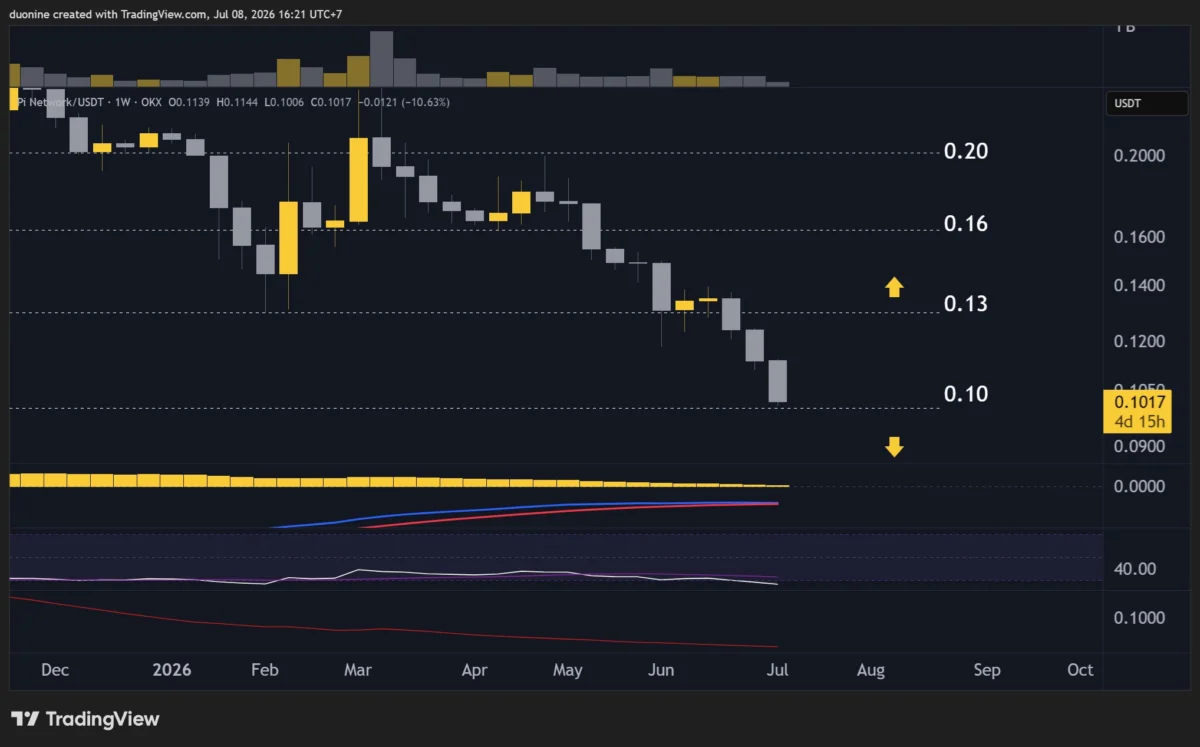
The price of PI Network (PI) has experienced a significant downturn, shedding 12% of its value over the past week and is now hovering precariously close to the $0.10 mark. This critical psychological support level is now being tested, prompting questions about whether a buyer resurgence is imminent or if further declines are on the horizon. Technical indicators suggest a challenging period for PI, with sellers currently dominating the market sentiment.
PI Network Faces Crucial Support at $0.10
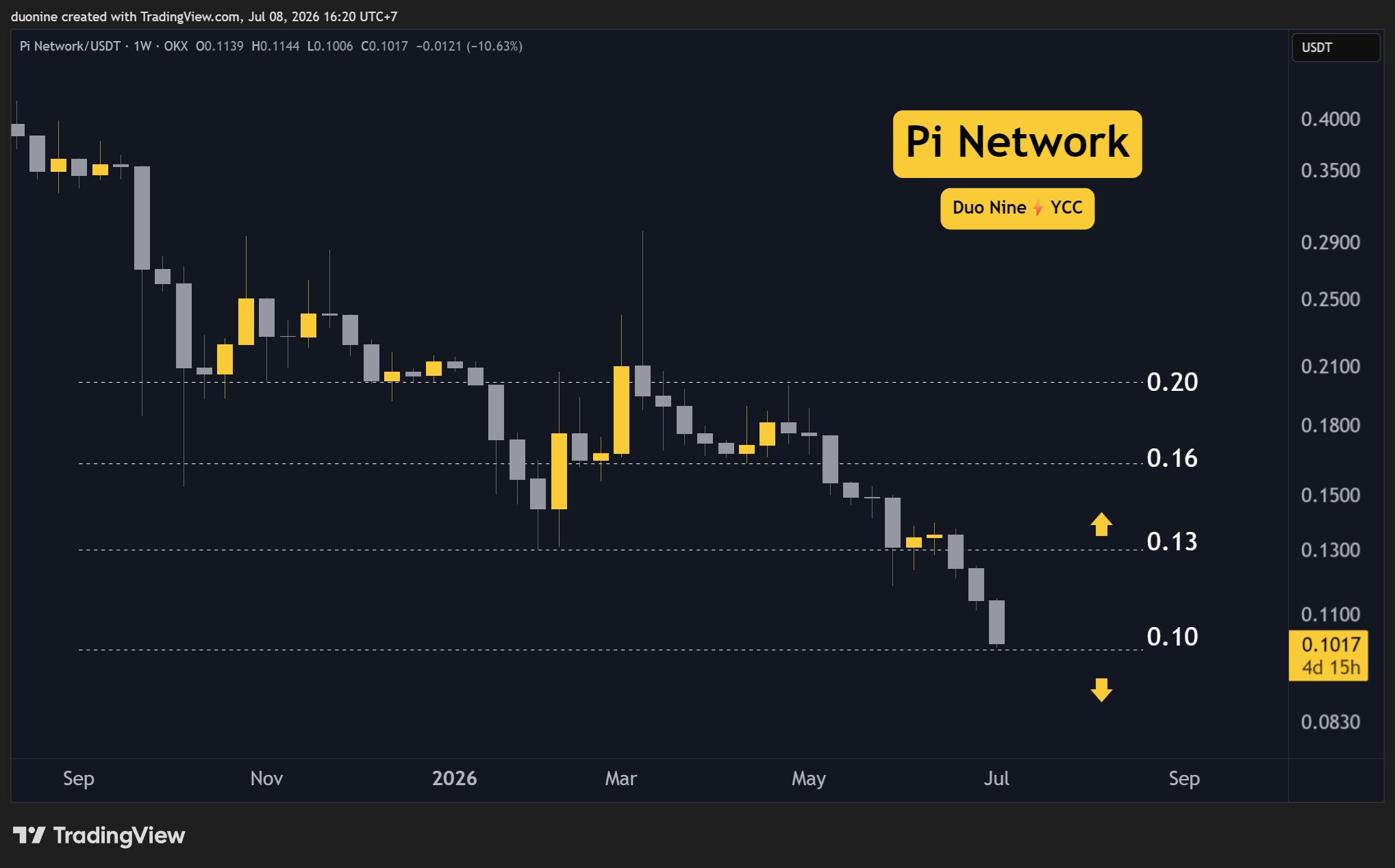
As anticipated by market observers, the price of PI Network has indeed descended to the $0.10 support level, a threshold that holds considerable psychological weight within the cryptocurrency trading community. Thus far, the prevailing sentiment indicates that sellers have maintained a firm grip on the market, evidenced by the substantial 12% price drop recorded over the last seven days.
For potential buyers looking to re-enter the market, this juncture represents a pivotal moment. The ability of buyers to defend the $0.10 level will be a key determinant of PI’s short-term trajectory. A successful defense could initiate a rebound, potentially pushing the price upwards. However, significant upward momentum would require breaking through the immediate resistance found at $0.13, a level that must be convincingly surpassed to signal a sustainable rally.
Key Support Levels: $0.10, $0.085
Key Resistance Levels: $0.13, $0.16
A Decisive Moment for PI Network’s Price Action
With the critical $0.10 support level under intense pressure, PI Network finds itself at a significant crossroads. A successful defense of this level could provide a much-needed reprieve for investors, allowing for the recovery of some of the recent losses. Conversely, a failure to hold this floor could precipitate further price depreciation, potentially pushing PI into single-digit territory.
An examination of momentum indicators offers a less optimistic outlook for buyers in the immediate term. The daily Relative Strength Index (RSI) has dipped below the 30 mark, a reading that typically signifies oversold conditions, but in the current bearish trend, it can also indicate strong downward momentum. Furthermore, the Moving Average Convergence Divergence (MACD) has been charting lower lows since a bearish crossover occurred in late June, reinforcing the bearish sentiment in the market.
Momentum Indicators Signal Bearish Trend
The current technical landscape for PI Network paints a picture of persistent selling pressure. The daily RSI’s descent below 30 suggests that the asset has been oversold. However, within a strong downtrend, this condition does not automatically guarantee a reversal. Instead, it can highlight the extent of the selling pressure. Traders often look for divergences or other confirming signals before anticipating a bounce from such levels.
The MACD indicator further corroborates the bearish narrative. The recent bearish crossover, followed by a series of lower lows, indicates that the momentum is firmly in favor of sellers. This suggests that downward price action is likely to continue unless there is a significant shift in market dynamics or a substantial influx of buying interest.
Surge in Sell Volume Indicates Dominance of Sellers
Since the middle of June, a notable trend has emerged: the volume of PI Network tokens being sold has been consistently making higher highs. This is a clear bearish signal in technical analysis, suggesting that conviction among sellers is increasing, and they are actively offloading their holdings at progressively higher volumes. This trend offers little immediate hope for a reversal in the near future. The most prudent course of action for market participants appears to be observing the reaction at the $0.10 support level, should it materialize into a demonstrable bounce.
If the current momentum remains unchanged, it is highly probable that sellers will continue to exert their dominance over the market. This could lead to PI being pushed towards new record lows, with the $0.085 level identified as the next significant target for further price descent.
Understanding the Implications of Increased Sell Volume
The escalating sell volume is a critical indicator for traders and investors. It signifies an increase in the number of tokens being sold, often at decreasing prices, as sellers attempt to exit their positions. When accompanied by higher highs in sell volume, it suggests a growing number of participants are actively participating in selling pressure, potentially overwhelming any attempts by buyers to absorb the supply.
In the context of PI Network’s price action, this surge in sell volume amplifies the bearish outlook. It implies that despite the price approaching a key support level, the underlying selling pressure remains strong. This makes a sustained bounce less likely without a significant catalyst or a fundamental shift in market sentiment.
Background and Context: PI Network’s Journey
PI Network is a cryptocurrency project that aims to make cryptocurrency mining accessible to everyday users through mobile devices. Launched in 2019, it has garnered a substantial user base due to its low barrier to entry. However, the network has faced scrutiny and skepticism due to its prolonged development phase and the fact that its native token, PI, has not yet been officially listed on major cryptocurrency exchanges, meaning its publicly traded price is largely determined by over-the-counter (OTC) markets and derivative trading platforms.
The current price action reflects the speculative nature of PI’s valuation, which is not backed by a fully functional, decentralized mainnet with open trading capabilities. The project’s roadmap has been subject to delays, and the community eagerly awaits key milestones such as the official mainnet launch and widespread exchange listings, which are expected to bring greater liquidity and a more established market price.
The PI Network Ecosystem and Its Valuation Challenges
The PI Network operates on a unique model where users can "mine" PI tokens through a mobile application by simply checking in daily. This approach has fostered a large community of users who have accumulated PI tokens without significant financial investment. However, the lack of an open, regulated market for PI has led to a situation where its "price" is often derived from unofficial channels.
This disconnect between the perceived value by its community and its lack of official market integration presents a significant challenge for price analysis. The current price movements, while appearing like typical cryptocurrency market fluctuations, are occurring in a less transparent and regulated environment. This makes it difficult to ascertain true market demand and supply dynamics.
Timeline of Recent Price Action
- Late June: A bearish crossover occurred on the MACD indicator, signaling a potential shift in momentum towards sellers.
- Early July to Present: PI Network’s price has experienced a consistent decline, culminating in a 12% drop over the past week.
- Current Observation: The price is testing the critical $0.10 support level, a key psychological and technical threshold.
This recent timeline highlights a period of increasing bearish pressure, with technical indicators aligning to suggest a continuation of the downward trend. The approach to $0.10 represents a crucial test of this bearish sentiment.
Analyzing Key Resistance and Support Levels
The identification of key support and resistance levels is fundamental to technical analysis. In the case of PI Network:
-
Support Levels:
- $0.10: This is the immediate and most critical support level. A failure to hold here could lead to a sharp decline. Its significance is amplified by its psychological impact.
- $0.085: This represents the next potential floor should the $0.10 level break. It is a more substantial support zone that would indicate further significant losses.
-
Resistance Levels:
- $0.13: This is the initial hurdle that buyers must overcome to initiate any meaningful recovery. Breaking this level would signal a potential shift in sentiment.
- $0.16: This represents a more significant resistance zone, a break of which would be necessary for a sustained bullish trend to emerge.
These levels provide a framework for understanding potential price movements and identifying critical points where market sentiment might shift.
Broader Impact and Implications
The current price action of PI Network has several implications for its ecosystem and the broader cryptocurrency market:
- Investor Sentiment: The continued decline in price can negatively impact investor sentiment, potentially deterring new investors and causing existing holders to reconsider their positions.
- Project Development: While the price of a cryptocurrency is not the sole determinant of a project’s success, sustained negative price action can sometimes reflect underlying concerns about development progress or market adoption. PI Network’s ongoing development and eventual mainnet launch will be critical factors in shaping its future valuation.
- Speculative Markets: The volatile nature of PI’s price, especially given its OTC and derivative market valuation, underscores the speculative aspect of certain digital assets. This highlights the importance of due diligence and risk management for investors participating in such markets.
The trajectory of PI Network remains closely watched by its large community, with the upcoming developments and the ability to defend key price levels being paramount in determining its short-to-medium term outlook. The market will be keenly observing whether buyers can step in at the $0.10 level, or if sellers will continue to drive the price lower towards subsequent support zones.
Disclaimer: This article provides an analysis of the PI Network’s price action based on available technical indicators and market sentiment. It is important to note that the cryptocurrency market is highly volatile, and information provided herein should not be considered financial advice. Investors are strongly advised to conduct their own thorough research and consult with qualified financial professionals before making any investment decisions. The author and publisher are not responsible for any losses incurred as a result of actions taken based on the information presented in this article.