


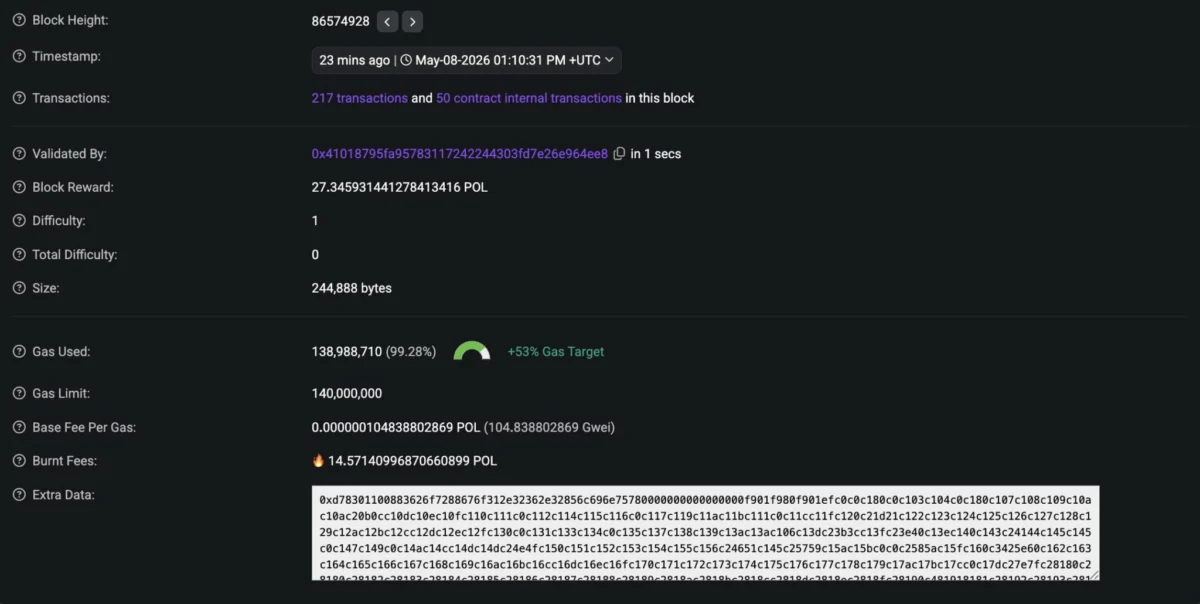
Polygon, a leading Layer 2 scaling solution for Ethereum, has significantly advanced its mission to become a cornerstone of global payments infrastructure by deploying a major network upgrade earlier today. This pivotal enhancement, known as the Giugliano hardfork, is engineered to dramatically increase the network’s throughput and overall chain capacity, solidifying Polygon’s competitive edge in the rapidly evolving blockchain landscape. The core of this upgrade lies in raising the network’s gas limit to an unprecedented 140 million, a move designed to fundamentally transform Polygon’s ability to process transactions at scale and support a new generation of high-demand decentralized applications and financial services.
This substantial increase in the gas limit directly translates into a remarkable boost in transaction processing capabilities, with Polygon now capable of achieving a maximum throughput exceeding 3,800 transactions per second (TPS). For context, many established blockchain networks struggle to consistently maintain even a fraction of this speed, often leading to congestion and prohibitively high transaction fees, particularly during periods of peak demand. Polygon’s strategic enhancement marks a significant step towards its overarching goal of powering mass-market financial activities—ranging from high-volume retail payments and intricate institutional settlements to sophisticated high-frequency decentralized applications (dApps)—all while maintaining cost-efficiency, a critical factor for widespread adoption.
Understanding the Giugliano Hardfork and its Technical Foundations
The Giugliano hardfork represents a critical inflection point in Polygon’s developmental roadmap. At its heart is the adjustment of the network’s gas limit, a fundamental parameter in blockchain operations. In blockchain networks, "gas" is a unit of measurement for the computational effort required to execute operations or transactions. The "gas limit" defines the maximum amount of gas that can be consumed within a single block. By increasing this limit to 140 million, Polygon’s network can now accommodate a significantly larger volume of computations within each block. This means that not only can more individual transactions be processed simultaneously, but also more complex smart contracts, which inherently demand more computational resources, can be executed efficiently without clogging the network.
Before this upgrade, Polygon’s gas limit, while already higher than Ethereum’s mainnet, still presented potential bottlenecks as the ecosystem grew. The previous capacity, while robust for many existing applications, was seen as insufficient to meet the projected demands of truly global, enterprise-grade blockchain adoption. The Giugliano hardfork addresses this directly, enabling Polygon to handle far greater bandwidth for large-scale payment processing, robust decentralized finance (DeFi) activities, and the increasingly complex operations of Web3 gaming and metaverse platforms. This technical leap is not merely an incremental improvement; it is a re-architecting of the network’s capacity to prepare for an exponential increase in usage.
Polygon’s Strategic Vision: Beyond Scaling Ethereum
Polygon’s journey began as the Matic Network, primarily focused on providing a Layer 2 scaling solution for Ethereum, aiming to alleviate its well-documented issues of high gas fees and network congestion. Over the years, it evolved into a comprehensive platform for building and connecting Ethereum-compatible blockchain networks, encompassing a Proof-of-Stake (PoS) sidechain, Polygon Supernets, and advanced zero-knowledge (ZK) scaling solutions like Polygon zkEVM. The Giugliano hardfork on its main PoS chain is a testament to Polygon’s commitment to maintaining and enhancing its foundational infrastructure while simultaneously innovating with cutting-edge ZK technology.
The timing of this upgrade is particularly strategic. The crypto market has matured beyond speculative narratives, with an increasing focus on real-world utility and the development of serviceable systems that can facilitate genuine economic activity. This shift has placed immense pressure on blockchain networks to demonstrate operational scale, reliability, and cost-efficiency—qualities traditionally associated with established financial systems. Polygon’s stated ambition is to compete directly with traditional finance infrastructure by offering an always-on, blockchain-based settlement system that operates 24/7, unconstrained by banking hours or reliance on third-party orchestrators. This latest upgrade positions Polygon as a formidable contender in this pursuit, ready to attract payment processors, banks, and consumer applications that demand instant settlement and minimal transaction costs.
Reactions from the Ecosystem and Broader Implications
The news of the Giugliano hardfork quickly resonated throughout the crypto ecosystem. Polygon’s official announcement on X (formerly Twitter) highlighted that the increased capacity is specifically intended to "enable higher demand for on-chain payments and more general blockchain usage," underscoring the strategic focus on practical utility. Developers, traders, and infrastructure providers, who are constantly seeking robust and scalable networks capable of supporting large-scale financial activity without the historical bottlenecks of early blockchain iterations, reacted with significant interest.
The upgrade has also generated considerable buzz within the community. One humorous, yet indicative, community post speculated that if Polygon’s throughput were to increase by 32% every 48 hours, it could hypothetically achieve one trillion TPS within approximately 140 days. While highly hyperbolic, this sentiment reflects the underlying optimism and excitement surrounding Polygon’s dedication to relentless scalability improvements. It signals a belief that Polygon is not merely reacting to current demands but proactively building for a future where blockchain underpins a significant portion of global commerce.
The Intensifying Race for Blockchain Infrastructure Supremacy
The year 2026 continues to underscore scalability as the dominant theme in crypto infrastructure development. As institutional adoption matures and decentralized finance expands its reach, blockchain networks are locked in an intense competition to offer the most compelling solutions based on transaction times, settlement efficiency, and operational reliability. This competitive landscape sees Layer 1 blockchains (like Solana, Avalanche, and others) and Layer 2 solutions (such as Arbitrum, Optimism, and Polygon’s own ZK rollups) vying for market share.
With the global proliferation of stablecoins, the increasing tokenization of real-world assets (RWAs), and the emergence of various blockchain-based payment systems, scalability has unequivocally become the key battleground. Networks that fail to adapt and scale risk being sidelined as the industry pushes towards mainstream integration. Polygon’s Giugliano hardfork is a direct response to this intensifying race, bolstering its main chain’s capabilities to handle the immense transaction volumes required by these burgeoning sectors. The ability to process over 3,800 TPS places Polygon among the top-tier networks in terms of raw transaction capacity, making it an attractive proposition for businesses and institutions that require robust performance.
Enabling Mass Adoption: Retail, Institutional, and DeFi
The enhanced capacity brought by the Giugliano hardfork has far-reaching implications across multiple sectors:
- Retail Payments: For everyday consumers and businesses, the upgrade means significantly faster and cheaper transactions. Imagine micro-payments, loyalty programs, or in-game purchases settling almost instantly with negligible fees. This addresses a major barrier to blockchain adoption for casual users who are accustomed to the seamless experience of traditional digital payment platforms.
- Institutional Settlements: Financial institutions exploring blockchain for interbank settlements, cross-border payments, or corporate treasury management require systems that can handle massive transaction volumes with utmost reliability and security. Polygon’s improved throughput makes it a more viable candidate for these high-stakes applications, reducing the time and cost associated with traditional settlement systems that often involve multiple intermediaries and delayed processing.
- Decentralized Finance (DeFi): DeFi protocols, including decentralized exchanges (DEXs), lending platforms, and complex derivatives, rely heavily on network speed and low transaction costs. Higher gas limits and TPS mean less congestion, faster trade execution, and a more responsive user experience, thereby attracting more liquidity and users to Polygon’s DeFi ecosystem.
- Stablecoins and Tokenized Assets: Polygon has already emerged as a significant hub for stablecoins and the tokenization of assets. The upgrade further solidifies this role by providing the necessary infrastructure to support the explosive growth in these areas. As more businesses and governments explore central bank digital currencies (CBDCs) and enterprise-grade stablecoin solutions, networks like Polygon that can offer high-volume, cost-effective settlements will be indispensable. The ability to process a larger number of transactions per block also means more efficient batching of stablecoin transfers, further optimizing costs.
On-Chain Payments: The Road to Mainstream Finance
Blockchain-based payments represent one of the most rapidly expanding areas within the broader crypto economy. What began as a niche instrument for early adopters has evolved into essential financial infrastructure for a diverse range of applications, including remittances, payroll, supply chain finance, and cross-border transactions. This evolution is driven by the inherent advantages of blockchain: 24/7 availability, transparency, immutability, and the potential for significantly lower transaction costs compared to legacy systems.
Traditional financial systems, like Visa or Mastercard, boast theoretical transaction processing capacities far exceeding current blockchain capabilities, with Visa often cited as handling tens of thousands of TPS. While practical throughput for traditional systems is often lower than theoretical maximums, the comparison highlights the imperative for blockchain infrastructure to dramatically scale up. Polygon’s move to 3,800+ TPS is a significant stride in closing this gap, demonstrating that blockchain can indeed offer operational scale for mass adoption. This performance benchmark is crucial for attracting the payment processors, banks, and consumer applications that require instant settlement with minimal transaction costs.
Polygon explicitly acknowledges this future, emphasizing both retail and institutional settlements as key beneficiaries of the improved network capacity. For financial firms considering blockchain settlement systems, stability, cost-efficiency, and the ability to process large transaction volumes are paramount. Upgrades like the Giugliano hardfork directly strengthen Polygon’s proposition in these high-level discussions, making it a more compelling choice for enterprise integration. Similarly, developers building consumer-facing applications—from gaming platforms to decentralized social networks—require infrastructure that can scale to support millions of users without succumbing to congestion, a common pitfall of earlier blockchain generations.
The broader market focus is indeed shifting from purely speculative narratives towards the development of truly serviceable systems that facilitate economic activity. The "long-term investment conversations" now revolve around robust stablecoin infrastructure, liquid tokenized asset markets, efficient settlement rails, and highly scalable execution environments. Polygon’s expansion strategy aligns perfectly with this trend, positioning itself not merely as another smart contract platform but as a critical piece of global, mass-market payment infrastructure.
A New Epoch in Blockchain Scalability
The Giugliano hardfork signals the arrival of a new phase in blockchain maturity, where networks are actively engineering for widespread, global adoption rather than niche use cases. While increasing gas limits and improving throughput might appear to be highly technical adjustments, their real-world implications extend far beyond developer benchmarks. Higher throughput directly translates into expanded capacity for payment systems, robust DeFi applications, liquid tokenized markets, and real-time blockchain settlements, all operating with best-in-class efficiency, minimal congestion, and significantly reduced transaction fees.
Achieving a sustained throughput of over 3,800 TPS is a landmark accomplishment for Polygon, reinforcing its commitment to building a blockchain network that caters not only to crypto-native users but also to the demanding requirements of large-scale global financial activity. As stablecoins, tokenized assets, and on-chain payments continue their inexorable growth, the performance of underlying infrastructure will become an increasingly decisive factor for the entire crypto industry. The next wave of blockchain adoption will undoubtedly be spearheaded by networks that master the critical balance of speed, cost, security, and interoperability.
For now, Polygon’s latest upgrade sends an unambiguous message to the industry: the race to scalable on-chain payments is intensifying, and the battle for supremacy in providing robust, high-performance blockchain infrastructure is being fought with strategic and significant technical advancements. This hardfork represents a powerful statement of intent, positioning Polygon at the forefront of this crucial evolution.














