


The landscape of cryptocurrency mining underwent a seismic shift following the successful execution of the Ethereum Merge, an event that marked the end of an era for GPU-based mining on the world’s second-largest blockchain. As the Ethereum network transitioned from a Proof-of-Work (PoW) consensus mechanism to Proof-of-Stake (PoS), the massive computational force previously dedicated to securing Ethereum was suddenly displaced. This "Great Migration" of miners has resulted in a catastrophic collapse in profitability for nearly all alternative PoW cryptocurrencies, as a tidal wave of hashrate overwhelmed smaller networks, driving mining difficulty to unprecedented levels while rewards remained stagnant or declined.
The Mechanics of the Post-Merge Migration
For years, Ethereum was the primary destination for miners utilizing Graphics Processing Units (GPUs). Unlike Bitcoin, which is mined using specialized Application-Specific Integrated Circuit (ASIC) hardware, Ethereum’s Ethash algorithm allowed for decentralized participation through consumer-grade hardware. At its peak, the Ethereum network commanded a hashrate exceeding 1,000 Terahashes per second (TH/s).
When the Merge occurred on September 15, 2022, the need for these miners vanished instantly. Proof-of-Stake relies on "validators" who lock up (stake) their ETH to secure the network, consuming 99.9% less energy than the previous system. This left hundreds of thousands of miners with a binary choice: liquidate their expensive hardware or point their rigs toward other PoW coins such as Ethereum Classic (ETC), Ravencoin (RVN), Ergo (ERG), or Flux.
The result was an immediate and overwhelming surge in the hashrate of these alternative networks. For example, Ethereum Classic saw its hashrate skyrocket from approximately 30 TH/s to over 300 TH/s in the days following the Merge. While a higher hashrate generally increases network security, it also triggers the network’s difficulty adjustment algorithm. These algorithms are designed to ensure that blocks are produced at a constant rate; as more miners compete for the same limited number of rewards, the "difficulty" of finding a block increases, effectively diluting the earnings of every individual participant.
Quantifying the Profitability Crisis
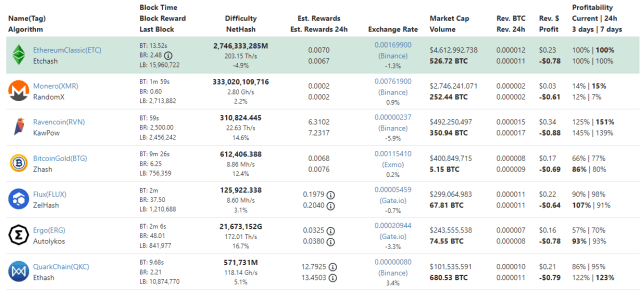
Data from industry-standard mining calculators, such as WhatToMine, illustrates a grim reality for the mining community. As of the latest market assessments, mining profits for the most popular PoW coins have entered deep negative territory when factoring in operational costs.

Using a baseline electricity cost of $0.10 per kilowatt-hour (kWh)—a rate often considered the threshold for industrial viability—a standard mining rig equipped with three AMD RX 480 graphics cards currently yields a net profit of approximately -$0.78 per hour when mining Ethereum Classic. Even those utilizing high-end, top-tier hardware like the NVIDIA GeForce RTX 3090 Ti are seeing losses. A single 3090 Ti, which represents the pinnacle of consumer GPU technology, currently nets a profit of roughly -$0.50 per hour.
These figures indicate that miners are essentially paying for the privilege of securing these networks, losing more money in electricity and cooling costs than they earn in crypto rewards. For many, the only way to remain "profitable" is to have access to near-zero electricity costs or to speculate that the coins they are mining will see massive price appreciation in the future—a strategy often referred to as "speculative mining."
Chronology of the Ethereum Transition
The path to this mining crisis was paved over several years of development and testing. Understanding the timeline of the Ethereum Merge provides context for why the current mining surplus exists:
- 2015: Ethereum launches with a long-term roadmap that includes an eventual transition to Proof-of-Stake to improve scalability and energy efficiency.
- December 2020: The Beacon Chain is launched, creating the foundational PoS layer that would eventually merge with the Ethereum Mainnet.
- April 2022: The "Shadow Forks" begin, testing the transition in simulated environments to ensure network stability.
- June – August 2022: Major testnets, including Ropsten, Sepolia, and Goerli, successfully complete their merges, signaling that the Mainnet transition is imminent.
- September 15, 2022: The official Merge is triggered by the Total Terminal Difficulty (TTD). The PoW chain is retired, and the network begins producing blocks via PoS.
- Post-Merge (Present): The immediate "hashrate explosion" on alternative chains leads to the current profitability collapse.
Impact on Alternative Networks
The influx of hashrate has not been distributed equally, and the impact on smaller networks has been profound.
Ethereum Classic (ETC): As the direct legacy of the original Ethereum chain, ETC was the most logical destination for displaced miners. However, its market capitalization and daily issuance of new coins are insufficient to support the massive volume of hardware that migrated from ETH. The difficulty spike has made it nearly impossible for small-scale "home miners" to break even.
Ravencoin (RVN): Popular for its ASIC-resistant algorithm, Ravencoin saw a significant jump in activity. However, because RVN mining is more power-intensive than Ethash-based mining, the electricity costs have proven prohibitive for many users in regions with high energy prices.

Ergo (ERG) and Flux: These networks cater to a more technical subset of the mining community. While they experienced growth in hashrate, their relatively low trading volumes mean that large-scale miners selling their rewards to cover electricity costs can put significant downward pressure on the token prices, creating a "death spiral" of declining value and increasing difficulty.
The Secondary Market and Hardware Devaluation
The lack of profitability has triggered a mass exodus of miners from the market. This is most visible in the secondary hardware market, where platforms like eBay and Craigslist have been flooded with used GPUs. During the 2021 bull run, GPUs were selling for two to three times their Manufacturer’s Suggested Retail Price (MSRP). Today, prices have plummeted as miners look to recoup whatever capital they can from their idle rigs.
Analysts at major financial institutions had previously warned of this "GPU glut." The sudden availability of thousands of used cards has also impacted the bottom lines of hardware manufacturers like NVIDIA and AMD, who have reported a significant cooling in their gaming and data center divisions as the "crypto-demand" evaporated overnight.
Institutional and Industry Reactions
The shift has drawn mixed reactions from across the crypto ecosystem. Proponents of the Ethereum Merge, including Ethereum co-founder Vitalik Buterin, have championed the move as a necessary step for the environmental sustainability of blockchain technology. The 99.9% reduction in energy consumption has made Ethereum more attractive to institutional investors who are bound by Environmental, Social, and Governance (ESG) mandates.
Conversely, some "PoW maximalists" argue that the transition sacrifices decentralization and security for efficiency. This sentiment led to the creation of EthereumPoW (ETHW), a fork of the network that attempted to maintain the PoW consensus. However, ETHW has struggled to gain significant traction, with its token price falling sharply and its hashrate failing to reach the heights once held by the original Ethereum chain.
Mining pool operators have also been forced to adapt. Large pools like Ethermine and F2Pool, which once derived a majority of their revenue from ETH, have diversified into staking services or shifted their focus to Bitcoin mining, which remains the only PoW network with enough scale to support massive industrial operations.
Future Outlook: Is GPU Mining Dead?
The current state of negative profitability raises a fundamental question: Is there a future for GPU mining?
In the short term, the outlook is bleak. The "difficulty-to-price" ratio on alternative coins is fundamentally broken for most miners. For GPU mining to become profitable again, one of two things must happen: either the market price of alternative PoW coins must increase by several hundred percent, or a significant portion of the global hashrate must permanently go offline, allowing difficulty to drop to a level that reflects current energy costs.
There is also the possibility of a "pivot" in the utility of GPU hardware. Some former miners are exploring high-performance computing (HPC) tasks, such as rendering for the film industry, providing computational power for Artificial Intelligence (AI) training, or participating in decentralized cloud computing networks like Render or Akash. These applications offer a different revenue model that is not tied to the volatility of PoW difficulty.
In conclusion, the Ethereum Merge has acted as a "cleansing fire" for the mining industry. While it has achieved the goal of making Ethereum a more sustainable and efficient network, it has left the GPU mining sector in a state of existential crisis. As profits remain in the red, the industry is witnessing a consolidation where only those with the most efficient hardware and the lowest energy costs can hope to survive, marking the definitive end of the "hobbyist" mining era that characterized the early years of the cryptocurrency revolution.














