



The long-anticipated transition of the Ethereum network from a Proof-of-Work (PoW) consensus mechanism to Proof-of-Stake (PoS), a milestone known as "the Merge," has fundamentally altered the landscape of the global cryptocurrency mining industry. While the event marked a triumph for Ethereum’s sustainability goals, it has simultaneously triggered a financial crisis for the millions of miners who previously secured the network. As these miners migrate their massive computing power to alternative blockchains, the resulting surge in mining difficulty has rendered the mining of once-profitable altcoins economically unviable. Current data indicates that for many operators, the cost of electricity now exceeds the value of the rewards earned, leading to a state of "negative profitability" across the most popular remaining PoW networks.
The Mechanical Shift: From Validation to Migration
For nearly seven years, Ethereum functioned as the primary ecosystem for GPU-based mining. Unlike Bitcoin, which transitioned to specialized ASIC (Application-Specific Integrated Circuit) hardware years ago, Ethereum remained accessible to miners using high-end graphics cards (GPUs). At its peak, the Ethereum network commanded a hashrate—the total computational power used to process transactions—of approximately 900 Terahashes per second (TH/s). When the Merge occurred, this massive infrastructure was rendered obsolete on the Ethereum mainnet overnight.
Faced with the choice of selling their hardware at a loss or seeking new revenue streams, a significant portion of the mining community shifted their rigs to "ASIC-resistant" or GPU-friendly PoW chains. The primary beneficiaries—in terms of hashrate, if not profitability—were Ethereum Classic (ETC), Ravencoin (RVN), Ergo (ERG), and Flux (FLUX). However, the influx of miners was so sudden and of such a magnitude that these smaller networks were unable to absorb the capacity without severe economic repercussions.
The Logic of Mining Difficulty and the Profitability Crater
The fundamental problem facing the mining industry is the automatic adjustment of mining difficulty. Most PoW blockchains are programmed to maintain a consistent block time—the interval at which new blocks are added to the ledger. To achieve this, the network monitors the total hashrate. When more miners join the network and the hashrate rises, the "difficulty" of the mathematical puzzles required to mine a block increases proportionally.

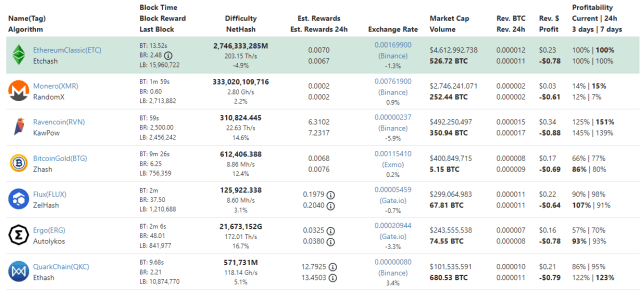
Before the Merge, Ethereum Classic had a hashrate hovering between 20 and 30 TH/s. Within days of the Merge, this figure skyrocketed to over 200 TH/s. While this makes the network more secure, it also means that the same fixed reward of ETC coins is now being split among roughly ten times as many miners.
According to real-time data from mining profitability calculators such as WhatToMine, the economic reality for these miners is stark. Using a standard baseline of $0.10 per kilowatt-hour (kWh) for electricity, almost every major PoW coin is currently yielding a daily loss. For instance, a miner utilizing three AMD RX 480 graphics cards—a once-reliable workhorse for mid-range operations—currently faces a net profit of approximately -$0.78 per hour when mining Ethereum Classic. Even high-tier professional hardware, such as the NVIDIA GeForce RTX 3090 Ti, fails to reach break-even levels, with estimated hourly losses sitting near -$0.50.
A Chronology of the Transition
The road to this profitability collapse was paved over several years of development and multiple delays. Understanding the current crisis requires a look at the timeline that led to the mining exodus:
- December 2020: The launch of the Beacon Chain introduced the Proof-of-Stake layer to Ethereum, running in parallel with the original Proof-of-Work chain. This gave miners a clear signal that their days on the network were numbered.
- August 2021: London Hard Fork (EIP-1559). This update began burning a portion of transaction fees, reducing the overall revenue for miners and signaling a shift in the network’s economic priorities.
- June 2022: The "Difficulty Bomb" was delayed, providing a final window for miners to maximize profits before the transition.
- September 15, 2022: The Merge is finalized. Ethereum officially ceases PoW operations. Within minutes, the hashrate of Ethereum Classic, Ravencoin, and Ergo began to climb vertically.
- September 16–20, 2022: Mining difficulty on alternative chains reaches all-time highs. Profitability for the average home miner drops below zero for the first time in several years.
Market Reactions and Industry Sentiment
The immediate reaction from the mining community has been a mixture of pragmatism and frustration. Large-scale mining farms, particularly those with institutional backing, had already begun diversifying their operations months in advance. Some transitioned to high-performance computing (HPC) or providing rendering power for AI applications, which utilizes GPUs for tasks other than blockchain validation.
However, the "retail" miner—the individual operating from a home office or small garage—has been hit the hardest. Social media forums and mining communities have seen a surge in listings for used GPUs as miners attempt to recoup capital before hardware prices plummet further. The secondary market for graphics cards, which was already cooling due to a global slowdown in PC demand, has been flooded with "ex-mining" cards, leading to a price drop of 30% to 50% for certain models compared to their 2021 highs.

Official responses from the developers of alternative chains have been cautiously optimistic, despite the price pain for miners. Representatives from the Ethereum Classic community have noted that the increased hashrate makes their network "the most secure PoW smart contract platform in existence." While they acknowledge the current lack of profitability, they argue that the long-term security of the chain will eventually attract more decentralized applications (dApps), which could drive up the price of the native token and restore mining incentives.
Broader Implications for the Crypto Ecosystem
The current state of mining profitability raises serious questions about the future of Proof-of-Work outside of Bitcoin. If mining remains unprofitable for an extended period, it could lead to a dangerous centralization of hashrate. Only those with access to nearly free electricity—such as those utilizing stranded energy or government-subsidized power—will be able to keep their machines running. This narrows the pool of validators, potentially making these smaller networks more susceptible to 51% attacks if a single entity can dominate the now-reduced mining landscape.
Furthermore, the environmental narrative has shifted. One of the primary arguments for the Ethereum Merge was the 99.9% reduction in the network’s energy consumption. By migrating to other PoW chains, miners have not necessarily reduced their carbon footprint; they have simply moved it to different ledgers. However, the economic pressure of negative profits may achieve what environmental advocacy could not: the forced retirement of older, less efficient mining hardware.
Analysis of the Ethereum Price Action
Parallel to the mining crisis, the price of Ether (ETH) itself has faced significant volatility. At the time of writing, ETH is trading at approximately $1,400, representing a decline of roughly 6% over the week following the Merge. This "sell the news" event was predicted by many market analysts, who suggested that the successful technical execution of the Merge was already priced in.
The disconnect between the network’s technical success and its market price has added to the gloom for miners who held their rewards in ETH. With the asset’s value tumbling and the alternative coins they are now mining also suffering from broader market bearishness, the "mining winter" appears to be in full effect.
Conclusion: The End of an Era?
The transition of Ethereum to Proof-of-Stake represents more than just a software update; it is the end of the "GPU mining era" that defined the 2017 and 2021 bull markets. For years, the ability for an average person to buy a graphics card and participate in the security of a major global network was a cornerstone of crypto-decentralization.
As it stands, the math for GPU mining no longer adds up. Unless there is a massive rally in the price of altcoins like ETC or RVN, or a significant portion of the global hashrate goes offline permanently to lower the difficulty, the industry faces a period of consolidation. The "gold rush" has concluded, leaving behind a professionalized, highly competitive landscape where only the most efficient operators can survive. For the rest, the once-lucrative hum of mining rigs has become a costly reminder of a rapidly evolving digital economy.














