



Bitcoin (BTC) experienced a notable rebound, crossing the $77,000 threshold on Monday. This surge coincided with positive sentiment emanating from global markets, particularly following statements by U.S. President Donald Trump regarding a potential peace agreement with Iran. Trump indicated a "50/50" chance of reaching such an accord, a development that appeared to buoy investor optimism across various asset classes, including cryptocurrencies.
The broader cryptocurrency market capitalization saw an uptick of approximately 1.35% in the preceding 24 hours, reflecting a general increase in appetite for risk assets driven by improving geopolitical sentiment. However, this upward momentum faced headwinds as significant volumes of Bitcoin were moved by large holders, commonly referred to as "whales." Data from Santiment indicated that over the past 96 hours, approximately 18,447 BTC, valued at roughly $1.42 billion, was either sold or redistributed, raising concerns about potential selling pressure.
This dichotomy of market sentiment—optimism from geopolitical developments versus caution stemming from whale activity—has led to a divided outlook among cryptocurrency analysts regarding Bitcoin’s immediate future. While some foresee an impending rally, others caution that the current recovery may be fragile.
Geopolitical Catalysts and Market Reactions
The optimistic outlook for Bitcoin’s price action appears to be intricately linked to the evolving geopolitical landscape. President Trump’s comments on the potential for a peace agreement between the U.S. and Iran, if realized, could signal a de-escalation of tensions in a critical global region. Historically, periods of reduced geopolitical uncertainty tend to foster a more favorable environment for risk-sensitive assets like cryptocurrencies. Investors often view such periods as opportunities to allocate capital towards assets perceived to offer higher growth potential, away from traditional safe havens.
The impact of these geopolitical developments on the broader financial markets was palpable. A calmer international environment often translates to lower volatility in traditional markets, which can, in turn, encourage capital to flow into alternative investments. For Bitcoin, this could mean increased demand as investors seek diversification and potential for significant returns. The initial rebound above $77,000 demonstrated this correlation, as the positive news narrative provided a crucial psychological boost.
Divergent Analyst Perspectives on Bitcoin’s Trajectory
Despite the initial positive market reaction, a nuanced analysis of Bitcoin’s price action reveals a more complex picture, with analysts offering a spectrum of predictions.

Kamile Uray’s Technical Analysis: A Tightrope Walk Above Key Levels
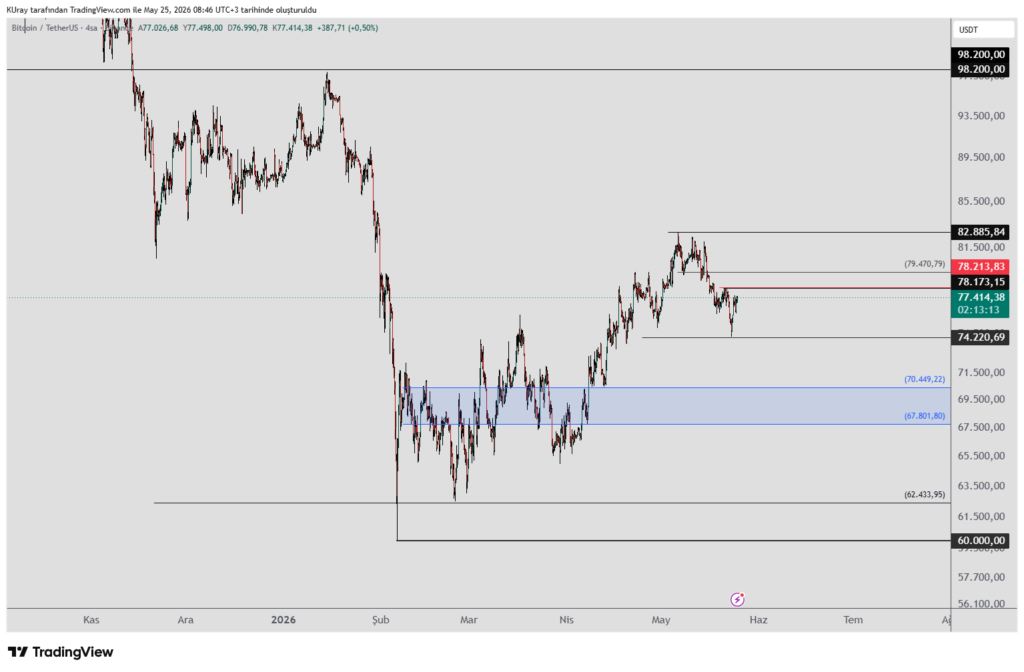
Kamile Uray, a prominent Turkish economist, has articulated a view that, while the peace talks provided a temporary lift, they did not fundamentally alter the underlying structural uncertainties observed in Bitcoin’s charts. Uray’s analysis hinges on key technical indicators and price levels that are crucial for determining Bitcoin’s short-to-medium term direction.
According to Uray, the $78,213 mark represents a critical breakout point. A sustained move above this level, she posits, would serve to reinforce the bullish structure of the market and significantly diminish the probability of a bearish reversal. She further identified the 0.618 Fibonacci retracement level, situated near $79,470, as a vital resistance zone. Successfully breaching this level would provide stronger confirmation of a continued upward trend.
Conversely, Uray outlined a bearish scenario should Bitcoin fail to maintain its current support structures. In this eventuality, she anticipates the first significant downside target to emerge around $74,220. A more pronounced correction could potentially drive prices down to the $71,000 area. However, she suggested that at these lower levels, substantial buying interest might emerge, potentially acting as a floor for the price. "This region is a Fibonacci support level and an area where buyers could step in," Uray stated. "If buyers strengthen, there could be a rise again."
Looking further ahead, Uray’s upside targets are positioned between $98,000 and $107,000, representing areas of significant resistance. She noted that the $107,000-$109,000 range could present a formidable barrier if Bitcoin regains strong bullish momentum. However, she cautioned that failure to decisively break above the previous all-time high, estimated to be near $126,199, could trigger a sharp and rapid decline.
Michaël van de Poppe’s Optimistic Outlook: A Summer Rally on the Horizon?

In contrast to Uray’s more cautious approach, analyst Michaël van de Poppe has expressed a more bullish sentiment, suggesting that Bitcoin might be on the cusp of another significant upward movement. Van de Poppe’s optimism is largely predicated on the potential for a favorable macroeconomic environment to emerge from a resolution in the Middle East.
He posits that a peace agreement could lead to a cascade of positive economic developments, including a potential decrease in oil prices and a reduction in bond yields. Such conditions, he argues, are typically conducive to increased investment in risk assets, with Bitcoin and other cryptocurrencies poised to benefit from renewed capital inflows.
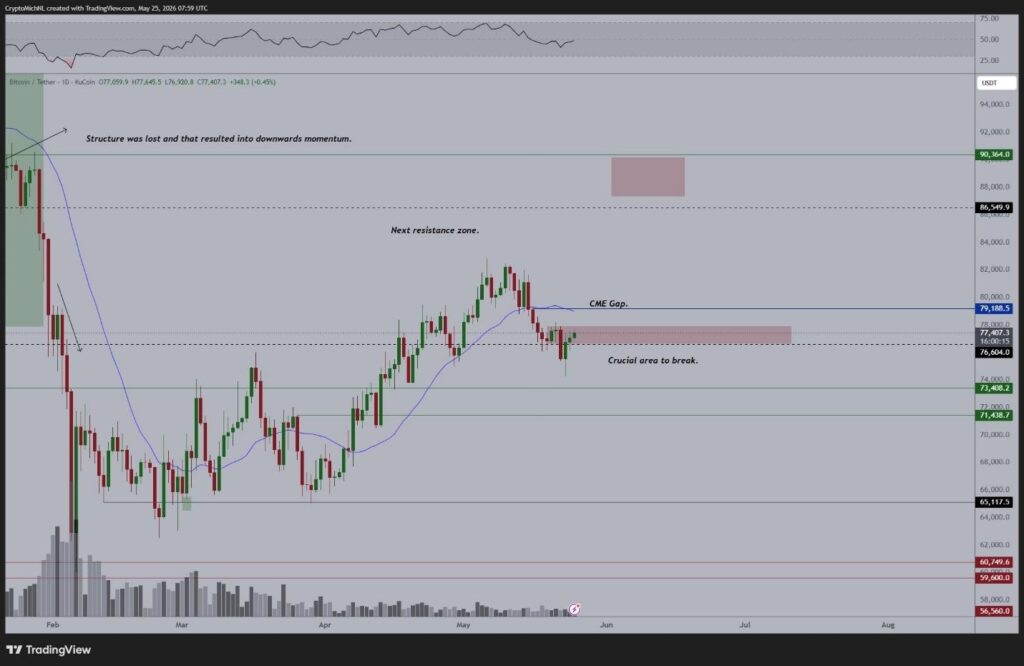
Van de Poppe had previously voiced concerns regarding Bitcoin’s ability to reclaim and sustain levels above the $77,000 resistance. However, recent price action has led him to believe that bulls are gradually asserting control. He anticipates that a decisive break above the $80,000 mark could rapidly accelerate momentum, pushing the price towards $90,000, where another significant resistance zone awaits.
Furthermore, van de Poppe suggested that an improvement in overall market conditions, particularly if Bitcoin can stabilize above key resistance levels, could trigger a robust altcoin rally throughout the summer months. This optimistic outlook suggests a potential period of broad-based growth across the cryptocurrency market.
Byzantine General’s Cautious Stance: Signs of Exhaustion?
Adding another layer of complexity to the market outlook, the analyst known as Byzantine General has adopted a decidedly cautious stance. This perspective suggests that Bitcoin may have temporarily exhausted its upward momentum in the immediate short term.
Byzantine General warned that any attempt by Bitcoin to rally back towards recent highs could invite renewed selling pressure from short-sellers looking to capitalize on potential downward price movements. The $74,000 level, in their view, might offer only temporary support, potentially failing to halt a more significant downtrend.
According to this analyst’s assessment, a stronger wave of selling pressure could ultimately drive Bitcoin prices down towards the higher end of the $60,000 range. Such a decline would signify a deeper corrective phase for the broader cryptocurrency market, potentially impacting altcoins more severely.
Whale Activity and its Implications
The substantial movement of Bitcoin by large holders, as reported by Santiment, warrants closer examination. Historically, significant outflows from wallets associated with "whales" have often preceded periods of price decline, as these entities may be liquidating their positions. The redistribution of 18,447 BTC, valued at approximately $1.42 billion, over a 96-hour period, represents a considerable volume of assets changing hands.
The motivations behind such large-scale movements can vary. Whales might be rebalancing their portfolios, taking profits after a period of appreciation, or anticipating a market downturn and seeking to de-risk. Alternatively, these movements could be part of sophisticated trading strategies or preparations for future market events.
The immediate impact of such large transactions can create short-term volatility. If these movements represent selling pressure, they can overwhelm buying demand, leading to price drops. Conversely, if the Bitcoin is being moved to cold storage or to different exchange accounts for strategic reasons, the impact might be less direct. The market is closely watching these whale movements as a potential indicator of future price direction, especially in conjunction with macroeconomic and geopolitical news.
Bitcoin’s Current Standing and Future Resistance/Support Levels
At the time of reporting, Bitcoin was trading at approximately $75,750, reflecting a 2.36% decrease over the preceding 24 hours. This price action indicates that the market is currently grappling with the conflicting signals of geopolitical optimism and the potential overhang of whale selling.
Key Resistance Levels to Watch:
- $78,213: Identified by Kamile Uray as a critical breakout point. A sustained move above this level is seen as a precursor to further bullish momentum.
- $79,470: The 0.618 Fibonacci level, which acts as a significant resistance zone for trend confirmation.
- $80,000: A psychological and technical level noted by Michaël van de Poppe, a break above which could accelerate upward movement.
- $90,000: A significant resistance zone as per van de Poppe’s analysis.
- $98,000 – $107,000: Uray’s identified upper resistance band, with $107,000-$109,000 being a major barrier.
- $126,199: The previous all-time high, a critical level whose failure to be surpassed could trigger a sharp correction.
Key Support Levels to Watch:
- $74,220: The first downside target identified by Uray if current structures fail.
- $71,000: A deeper correction level where Uray expects significant buying interest.
- $60,000s (high range): Byzantine General’s projection for a more substantial corrective phase.
The interplay between these support and resistance levels, influenced by both on-chain data and macroeconomic factors, will dictate Bitcoin’s path in the coming days and weeks. The market’s ability to digest the large whale outflows while maintaining positive sentiment from geopolitical developments will be crucial.
Broader Market Implications and Future Outlook
The performance of Bitcoin often acts as a bellwether for the broader cryptocurrency market. If Bitcoin successfully navigates the current resistance levels and embarks on a sustained upward trend, it could indeed trigger the anticipated altcoin rally throughout the summer. This would signify a return of speculative interest and capital into the altcoin space, which has often lagged behind Bitcoin’s performance.
However, a failure to maintain upward momentum and a subsequent drop below key support levels could lead to a broader market downturn. In such a scenario, altcoins, which are generally more volatile than Bitcoin, would likely experience even steeper declines.
The current market environment highlights the dynamic and interconnected nature of cryptocurrency investments. Geopolitical stability, macroeconomic indicators, and on-chain whale activity all play significant roles in shaping price action. Investors are faced with a landscape of competing narratives, necessitating careful analysis and risk management. The coming weeks will likely provide more clarity on whether Bitcoin is indeed poised for an explosive rally or if a more protracted period of consolidation and potential correction lies ahead. The market’s response to the $78,000-$80,000 price range will be particularly telling.














