Raydium, the preeminent decentralized exchange (DEX) on the Solana blockchain, has recently reported its most robust weekly performance in over a year, marking a significant reversal of fortune after an extended period of subdued activity. This remarkable resurgence is attributed to a confluence of strategic initiatives and burgeoning market trends, most notably a drastic reduction in token launch costs, the pivotal integration of the StonkFun launchpad, and the accelerating adoption of tokenized traditional equities within the Solana ecosystem. The confluence of these factors propelled Raydium’s weekly revenue to levels unseen since July 2025, culminating in a substantial increase in "holders revenue" and a notable rally for its native token, RAY.
Raydium’s Resurgence: A Deep Dive into the Numbers
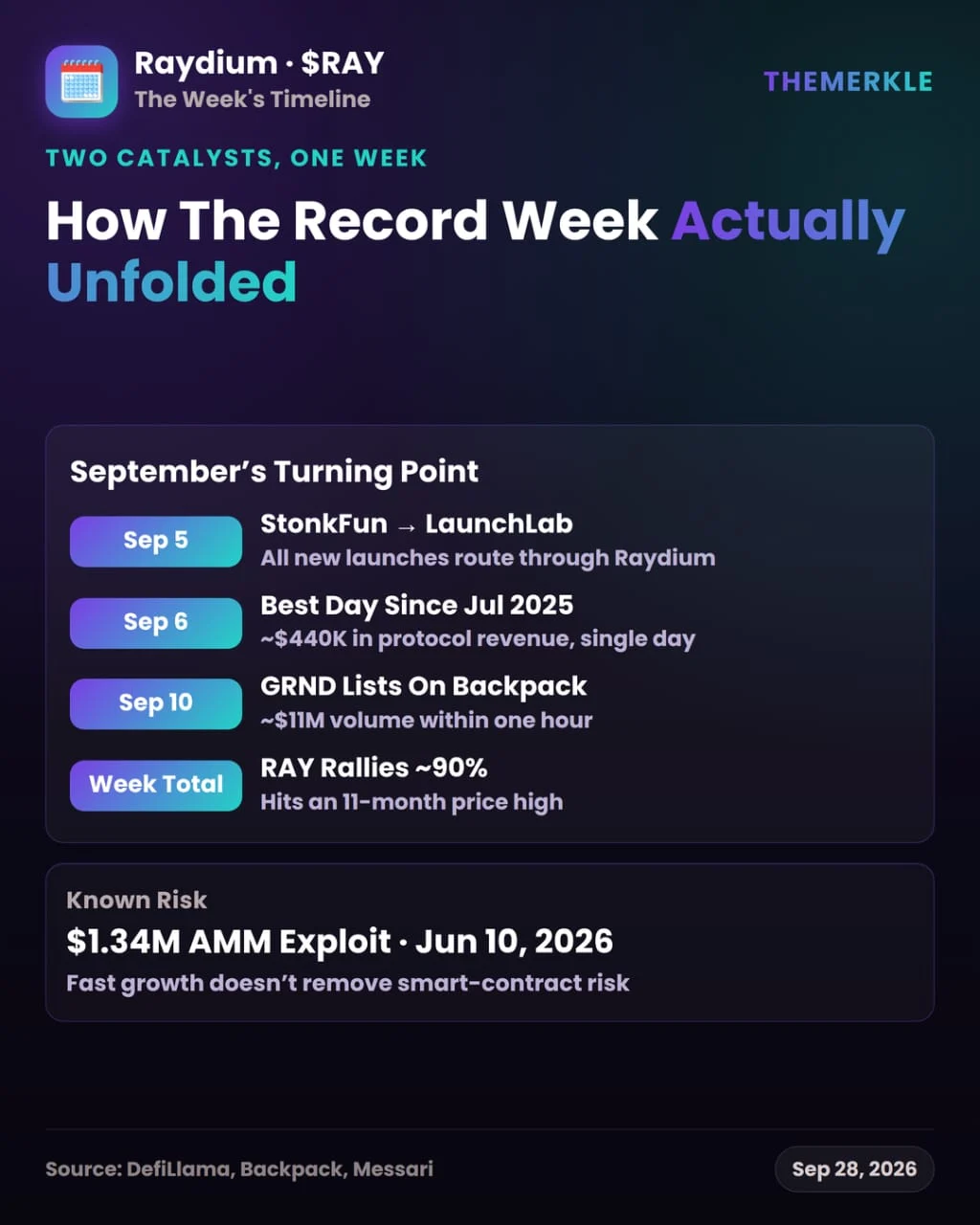
The financial metrics underpinning Raydium’s turnaround are compelling. According to data aggregated by DeFiLlama, a leading analytics platform for decentralized finance protocols, Raydium recorded $4.43 million in holders revenue over the past 30 days. This figure represents the portion of protocol fees specifically allocated to the buyback and burning of RAY tokens, directly benefiting token holders and contributing to deflationary pressure. The immediate impact of the recent surge was particularly evident on September 6, which saw an impressive $440,000 in protocol revenue generated in a single day—a peak not witnessed since July 2025. This stands in stark contrast to the protocol’s performance throughout much of 2026, a period characterized by a significant slump. Quarterly gross protocol revenue had plummeted to $16.99 million in Q2 2026, a steep decline from the $114.34 million recorded in Q3 2025. This record-breaking week, therefore, signals a dramatic shift in momentum and investor sentiment surrounding the protocol.
Understanding the nuances of Raydium’s revenue streams is crucial to appreciating the significance of these figures. DeFiLlama meticulously differentiates between "fees," "revenue," and "holders revenue." "Fees" are the charges paid by traders for executing transactions on the platform. "Revenue" represents the portion of these fees retained by the Raydium protocol itself for operational costs and development. "Holders revenue," the figure most directly impacting the RAY token, is the segment of protocol earnings specifically earmarked for token buybacks. On Raydium’s Automated Market Maker (AMM), 12% of fees across all pool types are allocated to this purpose. For its LaunchLab platform, a more substantial 25% of the protocol fee is dedicated to buying back and subsequently burning RAY tokens, enhancing their scarcity and potential value. These buyback mechanisms form a critical link between the platform’s operational success and the value proposition for its token holders, transforming raw trading volume into direct token appreciation potential.

The Strategic Play: Lowering Launch Costs and Bolstering LaunchLab
A cornerstone of Raydium’s recent success was a decisive strategic move to significantly reduce the cost of deploying new tokens on its LaunchLab platform. The cost for launching a token was slashed by approximately 90%, from 0.29 SOL to a mere 0.03 SOL. This dramatic reduction has lowered the barrier to entry for aspiring projects, making token launches considerably more accessible and economically attractive. In the highly competitive landscape of decentralized finance, where transaction costs and deployment fees can deter innovation, this cost-cutting measure served as a powerful incentive, encouraging a higher volume of projects to utilize Raydium’s infrastructure. The underlying principle is straightforward: by making it cheaper and easier to launch, Raydium aimed to stimulate a greater influx of new tokens and, consequently, a higher volume of trading activity and fee generation through its pools.
Raydium’s LaunchLab has a proven track record as a successful launchpad for new projects within the Solana ecosystem. In Q3 2025, for instance, LaunchLab was a formidable revenue generator, contributing $12.8 million to the protocol’s coffers, accounting for over half of Raydium’s total revenue during that period. This historical performance underscores the platform’s capacity to attract and facilitate significant capital deployment for new tokens. The recent cost reduction appears to be a calculated maneuver to rekindle this past success, positioning LaunchLab as the go-to platform for new projects seeking efficient and cost-effective deployment on Solana. Each bonding-curve trade facilitated through LaunchLab pays a fee, directly contributing to the protocol’s overall revenue and, by extension, the holders revenue through the aforementioned buyback mechanism.
StonkFun’s Pivotal Role: Bridging Traditional Assets to DeFi
The most significant immediate catalyst for Raydium’s revitalized activity was the integration of StonkFun, a specialized launchpad focused on tokenizing traditional stocks and commodities. On September 5, StonkFun began routing all new token launches through Raydium’s LaunchLab. This strategic partnership meant that every trade associated with these newly tokenized assets would settle through Raydium’s liquidity pools, thereby generating substantial fees for the protocol. StonkFun’s innovative approach aims to bring the vast liquidity and established assets of traditional finance into the decentralized realm, offering users exposure to conventional markets through a blockchain-native interface.

The impact of this integration was instantaneous and profound. StonkFun’s native token, STONK, experienced an impressive surge of over 250% on the day of the announcement, pushing its market capitalization to approximately $140 million. Even before the full integration, StonkFun had already demonstrated its potential, having generated over $1.21 million in revenue and facilitated approximately $219 million in trading volume through Raydium’s infrastructure. With every subsequent launch from StonkFun now flowing through LaunchLab by default, this partnership creates a continuous and robust stream of new assets and trading volume for Raydium. This collaboration highlights a growing trend within DeFi to bridge the gap with traditional financial markets, leveraging the efficiency and transparency of blockchain technology to offer novel investment opportunities. Representatives from StonkFun, while not explicitly quoted in the original report, would likely emphasize the synergistic benefits of this partnership, touting Raydium’s robust infrastructure and liquidity as ideal for supporting their vision of democratizing access to tokenized traditional assets.
The Rise of Tokenized Equities: A New User Frontier
Beyond the direct impact of StonkFun, the broader proliferation of tokenized US stocks emerged as a critical secondary catalyst. During the same period, more than 15 tokenized US equities, including major companies like Boeing, Costco, Lululemon, Reddit, and Roblox, went live through platforms such as Backpack and Sunrise. This development introduced a fundamentally new class of assets to the Solana ecosystem, attracting a diverse cohort of traders who might not typically engage with speculative cryptocurrencies or meme coins. A notable example of this trend was the listing of Grindr’s GRND token on Backpack on September 10, which swiftly garnered approximately $11 million in trading volume within its first hour.
The significance of tokenized equities extends beyond mere trading volume. These assets offer several advantages that appeal to a wider audience: 24/7 trading capabilities, fractional ownership, and the inherent transparency and efficiency of blockchain settlements. By attracting traders interested in traditional assets, Raydium and the broader Solana ecosystem are tapping into a much larger market segment, potentially diversifying their user base beyond crypto-native participants. This influx of "TradFi" users represents a crucial step towards mainstream adoption of decentralized finance. A week where both speculative meme coin activity and more fundamentally driven tokenized stock trading overlap creates a powerful dual-fuel source, precisely the kind of dynamic needed to overcome a prolonged revenue drought and establish a more sustainable growth trajectory. This diversification of trading activity helps to insulate the protocol from the inherent volatility and often fleeting nature of purely speculative crypto trends.
RAY Token’s Remarkable Rally: The Mechanics of Value Accrual

The surge in protocol activity and revenue directly translated into a remarkable rally for RAY, Raydium’s native utility and governance token. The mechanism for this value accrual lies in the "holders revenue" model, where a portion of generated fees is used to buy back RAY tokens from the open market. As fees jump, so too do the buybacks, creating a direct link between platform utility and token value. During this period of heightened activity, Raydium executed significant buybacks, including a single-day purchase of $640,788 worth of RAY – the largest daily buyback since February 2025. These buybacks reduce the circulating supply of RAY tokens, creating deflationary pressure and, theoretically, increasing the value of the remaining tokens.
The market responded decisively to these developments. RAY hit an 11-month high, experiencing a weekly rally of approximately 90%. Over the past 30 days, its price surged by an impressive 160.7%, reaching around $2.01 with a market capitalization of $542.86 million. This strong performance stands in stark contrast to most of 2026, when buyback activity remained flat and unremarkable. The acceleration of buybacks, starting in August and intensifying in the first week of September, perfectly coincided with the climb in protocol revenue, clearly illustrating the effectiveness of Raydium’s value accrual mechanism for its token holders. This symbiotic relationship between platform activity and token performance is a cornerstone of well-designed DeFi protocols, rewarding participants who hold and stake the native asset.
Broader Ecosystem Impact and Solana’s Resilience
Raydium’s impressive turnaround is not merely an isolated success story; it reflects positively on the broader Solana ecosystem. As a leading DEX on Solana, Raydium’s enhanced performance underscores the network’s capabilities for high-throughput, low-cost transactions, which are essential for facilitating the kind of rapid and diverse trading activity witnessed recently. Solana has often been lauded for its technical prowess, but it has also faced challenges, including network outages and concerns about centralization. Raydium’s resurgence, particularly with the influx of tokenized traditional assets, demonstrates Solana’s growing maturity and its potential to attract a wider range of financial applications beyond its initial reputation for high-speed meme coin trading.
The ability to seamlessly integrate platforms like StonkFun and support the trading of tokenized stocks from Backpack and Sunrise highlights Solana’s robust infrastructure. This development could serve as a blueprint for other blockchain networks aiming to bridge the gap between traditional finance and decentralized ecosystems. The increased activity on Raydium contributes to overall network usage, potentially boosting transaction fees for validators and further decentralizing the network over time as more participants are incentivized to secure it. This positive feedback loop is crucial for the long-term health and growth of any blockchain ecosystem.

Navigating Future Challenges: Sustainability and Risk Mitigation
While the recent surge in Raydium’s activity and revenue is undoubtedly a cause for optimism, it is imperative to approach the future with a degree of caution. The current momentum leans heavily on a narrow set of drivers, particularly the speculative nature of new token launches and the initial excitement surrounding tokenized equities. History suggests that speculative launch activity can cool quickly, leading to periods of reduced volume and revenue. Messari, a prominent crypto research firm, highlighted a similar vulnerability in 2025, noting that LaunchLab’s growth was heavily reliant on a single platform at the time. StonkFun could potentially play a similar role now, and over-reliance on any single partner or asset class introduces a degree of systemic risk.
Furthermore, the decentralized finance space remains susceptible to smart-contract vulnerabilities and exploits. Raydium itself experienced a significant $1.34 million exploit on its AMM on June 10, 2026, serving as a stark reminder that rapid growth does not eliminate inherent security risks. Maintaining robust security protocols, undergoing regular audits, and implementing comprehensive risk management strategies are paramount for sustained success. The sustainability of this growth hinges on several factors: whether tokenized stocks can consistently attract and retain new traders, if LaunchLab can continue to be a cost-effective and attractive platform for diverse projects, and if Raydium can diversify its revenue streams beyond its current key drivers.
The crucial question remains: was this recent surge a temporary peak driven by speculative fervor, or does it represent a genuine reset and the beginning of a sustained recovery for Raydium? For the coming weeks and months, market observers and stakeholders will closely monitor weekly revenue lines and daily buyback figures. Consistent performance in these metrics will be the strongest indicator of whether Raydium has indeed found a new, stable trajectory for growth, or if it will eventually drift back towards its Q2 2026 levels. Raydium’s team, while needing to balance innovation with prudence, would likely articulate a vision focused on continued platform enhancements, fostering a diverse ecosystem of token launches, and bolstering security measures to protect user assets and build long-term trust. This period represents a critical juncture for Raydium, with the potential to solidify its position as a leading DeFi protocol on Solana, provided it can skillfully navigate the inherent volatilities and risks of the crypto market.