Ondo Finance, a prominent player in the burgeoning real-world asset (RWA) tokenization space, announced a significant milestone: its newly launched Intelligent Portfolios have accumulated over $20 million in Total Value Locked (TVL) within less than a month of their introduction. This rapid accumulation of assets underscores growing investor interest in tokenized traditional financial products, particularly those backed by established financial institutions. However, a deeper examination of on-chain data for one of its flagship offerings, the BlackRock-branded Ondo High Income Powered by BlackRock (BLKHIon) token, reveals a highly concentrated distribution among a few large wallets, prompting a more nuanced understanding of "adoption" in the decentralized finance (DeFi) context.
Ondo Finance: Bridging Traditional and Decentralized Finance
Ondo Finance has positioned itself at the forefront of the RWA tokenization movement, aiming to connect institutional-grade investment products with the efficiency and transparency of blockchain technology. Their core offering revolves around creating tokenized versions of traditional assets, making them accessible to a broader, albeit often regulated, investor base within the DeFi ecosystem. The company’s vision aligns with a broader industry trend where blockchain is increasingly seen as a robust infrastructure for fractionalizing, trading, and managing real-world assets like bonds, equities, and real estate. This bridge between traditional finance (TradFi) and DeFi promises enhanced liquidity, reduced settlement times, and increased transparency, appealing to a new generation of investors and institutions alike.
The Genesis of Intelligent Portfolios
The introduction of Ondo’s Intelligent Portfolios on September 24 marked a pivotal expansion of its product suite. These portfolios are designed as curated investment strategies, each packaged as a single, easily transferable on-chain token. The initial launch featured three distinct portfolios, all prominently branded as "Powered by BlackRock," signaling a strategic collaboration with one of the world’s largest asset managers. These inaugural offerings included:
- Ondo High Income Powered by BlackRock (BLKHIon): A bond-focused strategy.
- Ondo Total Return Powered by BlackRock (BLKTRon): A diversified total return strategy.
- Ondo Equity & Income Powered by BlackRock (BLKEIon): A hybrid strategy combining equity and income generation.
These initial products aimed to leverage BlackRock’s expertise in asset allocation and portfolio construction, providing investors with familiar, institutionally-designed strategies in a novel, tokenized format.
Expanding the Horizon: A Broader Range of Strategies
Building on the initial momentum, Ondo swiftly expanded its lineup of Intelligent Portfolios on October 1, introducing four additional offerings designed by Ondo itself. This expansion demonstrated Ondo’s ambition to cater to a wider array of investor preferences and market trends. The new portfolios included:
- MAG7Xon: A portfolio focused on the "Magnificent 7" tech stocks, augmented with exposure to cryptocurrencies, reflecting a blend of traditional high-growth equities and digital assets.
- BRAINon: An AI leaders portfolio, targeting companies at the forefront of artificial intelligence development, capitalizing on one of the most significant technological trends.
- YLD5on: A targeted income portfolio aiming for a 5% annual yield.
- YLD8on: Another targeted income portfolio, designed for investors seeking a higher 8% annual yield.
This diversified suite of products, ranging from BlackRock-designed core strategies to Ondo’s thematic and yield-focused portfolios, illustrates a comprehensive approach to attracting both conservative and growth-oriented investors to the tokenized asset space.
The $20 Million Milestone: A Closer Examination of TVL
On October 20, Ondo officially announced that its Intelligent Portfolios had collectively surpassed $20 million in TVL, a notable achievement for a product line barely a month old. This figure represents the total value of assets currently locked within these tokenized portfolios across various blockchain networks, including Ethereum and BNB Chain, with Solana slated for future integration.
While TVL is a commonly cited metric in the DeFi sector to gauge the size and perceived success of a protocol, it doesn’t always paint a complete picture of broad market adoption or investor distribution. As the analysis of BLKHIon reveals, a high TVL can sometimes mask a concentration of assets among a small number of large holders, rather than indicating widespread participation from a diverse investor base. This distinction is crucial for understanding the true penetration and decentralization (or lack thereof) of a tokenized product.
Dissecting "Powered by BlackRock": A Nuanced Collaboration
The "Powered by BlackRock" branding, while a powerful marketing tool, warrants closer scrutiny to understand the exact nature of BlackRock’s involvement. Ondo’s disclosures clarify that BlackRock’s role is specifically limited to the design of the asset allocation strategy for these particular portfolios. This means BlackRock provides the investment framework and underlying asset selection philosophy.
However, Ondo Finance is responsible for all operational aspects, including:
- Custody of the underlying assets: Ondo manages the actual holdings.
- Issuance of the tokenized "on" versions: Ondo Global Markets issues these tokens.
- Management of the portfolio tokens: Ondo creates and manages the Intelligent Portfolio tokens themselves.
- Regulatory compliance: Ondo ensures the products meet necessary legal and compliance standards, such as KYC (Know Your Customer) requirements for minting and redeeming.
- Liability: Crucially, holding BLKHIon or any other "Powered by BlackRock" token gives investors a claim on Ondo Finance, not directly on BlackRock or the underlying iShares funds.
Essentially, BlackRock acts as an intellectual partner for strategy design, lending its brand prestige and investment acumen, while Ondo handles the blockchain-specific implementation, asset management, and regulatory compliance. This distinction is vital for investors to understand the true risk profile and counterparty exposure associated with these tokenized products.
What’s Inside the BlackRock-Branded Tokens? The BLKHIon Example

To illustrate the composition of these portfolios, Ondo’s Intelligent Portfolios page provides a detailed breakdown for BLKHIon. This portfolio is designed as a BlackRock bond strategy, constructed entirely from iShares Exchange Traded Funds (ETFs). However, these aren’t direct holdings of iShares ETFs; rather, they are tokenized "on" versions issued through Ondo Global Markets. The specific holdings include:
- iShares Core U.S. Aggregate Bond ETF (AGGon): Representing a broad exposure to investment-grade U.S. bonds.
- iShares iBoxx $ High Yield Corporate Bond ETF (HYGon): Focusing on higher-yielding, but also higher-risk, corporate bonds.
- iShares U.S. Credit Bond ETF (CREDITon): Targeting U.S. dollar-denominated investment-grade corporate bonds.
- iShares Core Total USD Bond Market ETF (IUSBion): Providing broad exposure to the total U.S. dollar-denominated bond market.
- iShares Core U.S. Treasury Bond ETF (GOVTon): Investing in U.S. Treasury bonds across various maturities.
- iShares 1-3 Year Treasury Bond ETF (SHYTon): Short-duration U.S. Treasury bonds.
- iShares 7-10 Year Treasury Bond ETF (IEFon): Mid-duration U.S. Treasury bonds.
- iShares 20+ Year Treasury Bond ETF (TLTon): Long-duration U.S. Treasury bonds, sensitive to interest rate changes.
- iShares TIPS Bond ETF (TIPon): Treasury Inflation-Protected Securities, offering protection against inflation.
Categorically, this translates to an allocation of approximately 32% in aggregate bonds, 30% in high-yield bonds, 24% in credit bonds, and 14% in other bond categories. This layered approach—BlackRock’s strategy, implemented with Ondo’s tokenized iShares versions, and then wrapped into an Ondo portfolio token—showcases the complex interplay of TradFi products within a DeFi wrapper.
On-Chain Transparency: Tracing BLKHIon’s Ethereum Supply
One of the foundational promises of blockchain technology is transparency. By examining the on-chain data for BLKHIon, the only portfolio token currently indexed on an Ethereum explorer, we can gain insights into its distribution. As of October 21, the BLKHIon contract on Ethereum had a supply of approximately 792,111 tokens, each priced at $4.92. This calculates to a total value of roughly $3.9 million, representing about 19.5% of Ondo’s reported $20 million total TVL across all portfolios and chains.
The distribution of these tokens, however, is highly concentrated:
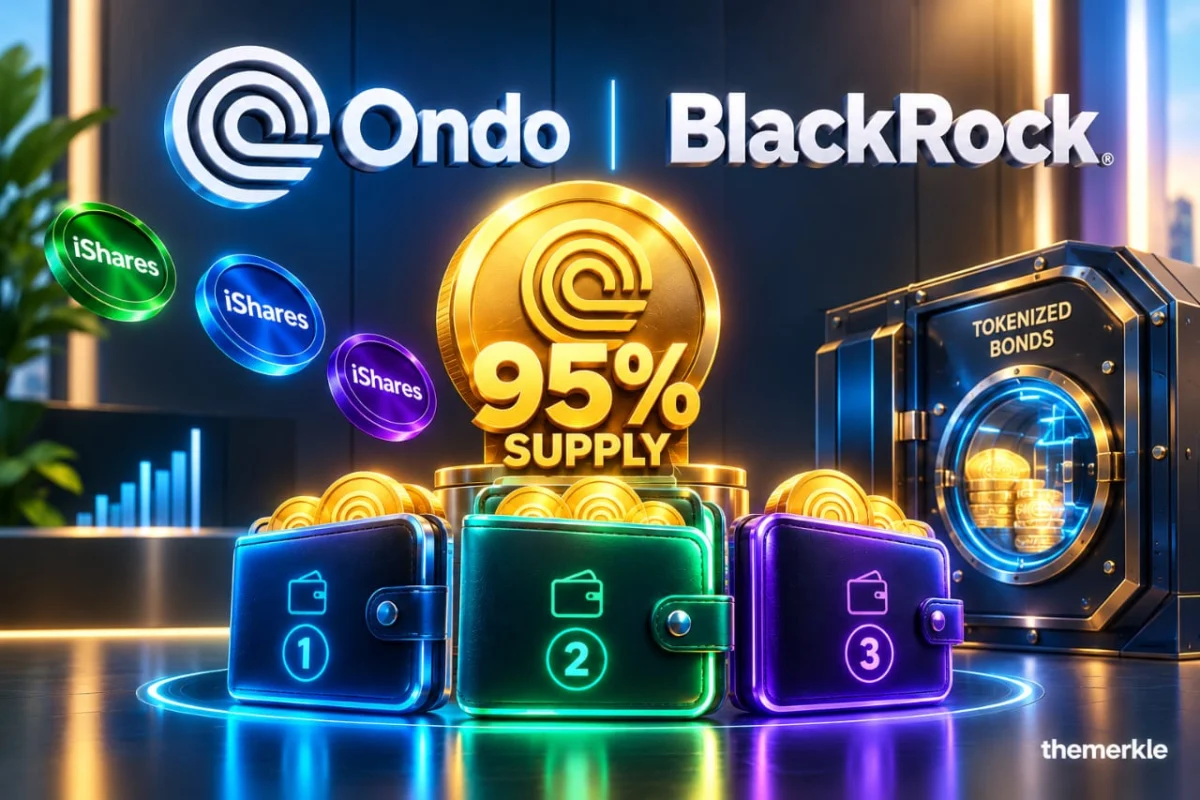
- Wallet 1: Holds approximately 325,000 tokens, accounting for about 41% of the Ethereum supply.
- Wallet 2: Holds around 129,000 tokens, representing roughly 16% of the supply.
- Wallet 3: Holds about 300,000 tokens, making up approximately 38% of the supply.
- Other Wallets: The remaining 1,500+ wallets collectively hold a mere 38,111 tokens, valued at approximately $22,000, which is about 5% of the total Ethereum supply.
This data clearly illustrates that a vast majority (95%) of the BLKHIon supply on Ethereum is held by just three entities, underscoring the early-stage nature of adoption and the significant influence of a few major investors or internal operational wallets.
Unpacking the Holder Concentration and Minting History
Further investigation into the minting history provides additional context for this concentration. Wallets 1 and 3, which together hold approximately 79% of the Ethereum supply, were both funded by the same originating address. This single address executed 25 separate minting transactions, totaling 625,804 BLKHIon tokens, and subsequently transferred them to Wallets 1 and 3. This indicates a single, significant minter responsible for the overwhelming majority of BLKHIon tokens on Ethereum.
Two notable details emerge from this minting history:
- Large, Regular Mints: The minter consistently created tokens in large batches, ranging from $120,000 to $240,000 per transaction, often several times a day between September 24 and October 5. This suggests systematic capital deployment, potentially from an institutional investor, a large fund, or an operational treasury.
- Early Dominance: By October 5, this primary minter had already established positions totaling approximately $3.08 million, representing 79% of the current Ethereum supply of BLKHIon. This early and substantial commitment highlights a foundational investment that predates wider market distribution.
Wallet 2’s position is more recent. A separate address initiated the minting of 129,860 tokens through three mintWithAttestation calls on October 16, October 20, and October 21. Notably, the October 20 mint, valued at around $265,000, coincided with the same day Ondo publicly announced the $20 million TVL milestone. All of these tokens were subsequently transferred to Wallet 2. This sequence of events suggests a targeted acquisition, potentially by another significant investor or a strategic partner, timed around the public announcement.
Regulatory Framework and Market Access
Ondo’s Intelligent Portfolios are not universally accessible. To comply with regulatory requirements, they are currently open only to eligible non-US investors. Furthermore, minting or redeeming these portfolio tokens requires adherence to Know Your Customer (KYC) protocols. This approach aligns with the broader trend of institutional-grade DeFi products that seek to balance the advantages of blockchain technology with the necessity of regulatory compliance, particularly when dealing with tokenized securities. The requirement for KYC and geographical restrictions ensures that Ondo operates within established legal frameworks, even as it innovates with blockchain-based financial instruments.
Broader Implications and the Future of Tokenized Assets
The rapid accumulation of $20 million in TVL for Ondo’s Intelligent Portfolios, despite the concentrated ownership, carries several significant implications for the evolving RWA tokenization landscape:
- Institutional Appetite: The substantial capital inflows, even from a few large wallets, underscore a clear institutional or large-investor appetite for tokenized traditional assets. These investors are willing to engage with blockchain infrastructure for the potential benefits of efficiency, transparency, and new liquidity avenues.
- Validation of the RWA Thesis: Ondo’s success, even if concentrated, validates the core thesis of RWA tokenization: that traditional financial assets can be effectively represented and managed on-chain, offering a new frontier for investment.
- Branding Power: The "Powered by BlackRock" branding clearly acts as a powerful magnet, attracting capital and lending credibility to Ondo’s offerings. This signals the increasing importance of established TradFi brands in driving adoption within the DeFi space.
- The Nuance of TVL: The BLKHIon case serves as a crucial reminder that TVL, while an important metric, must be interpreted with caution. High TVL doesn’t automatically equate to broad, decentralized adoption. Understanding holder distribution is equally important for assessing true market penetration.
- Challenges of Distribution: The concentration also highlights a challenge for RWA tokenization projects: achieving widespread, retail-level distribution. While institutional adoption is a critical first step, sustained growth and true decentralization will require broader participation.
- Future Growth: Ondo’s expansion to seven portfolios and its plans for Solana integration indicate a strategic roadmap for continued growth and diversification. As regulatory clarity improves and institutional comfort with blockchain increases, such platforms are likely to attract more diverse capital.
Conclusion: A Promising Start with Distributional Challenges
Ondo Finance’s achievement of $20 million in TVL for its Intelligent Portfolios in under a month is a commendable feat, signaling robust demand for tokenized traditional financial products. The collaboration with BlackRock for strategic allocation further solidifies the credibility and appeal of these offerings. However, the detailed on-chain analysis of BLKHIon reveals a highly concentrated distribution, with a few large wallets accounting for the vast majority of assets. This concentration is not necessarily a negative indicator for an nascent institutional product, but it does highlight the distinction between significant capital deployment and broad market adoption.
As the RWA tokenization sector matures, the focus will likely shift from merely accumulating TVL to achieving more equitable and decentralized ownership structures. For Ondo, the challenge and opportunity lie in expanding its investor base beyond the initial large players, fostering wider participation, and further democratizing access to institutional-grade investment strategies through the power of blockchain technology. The journey of bridging TradFi and DeFi is complex, marked by both rapid innovation and the need for careful consideration of market dynamics and investor distribution.