


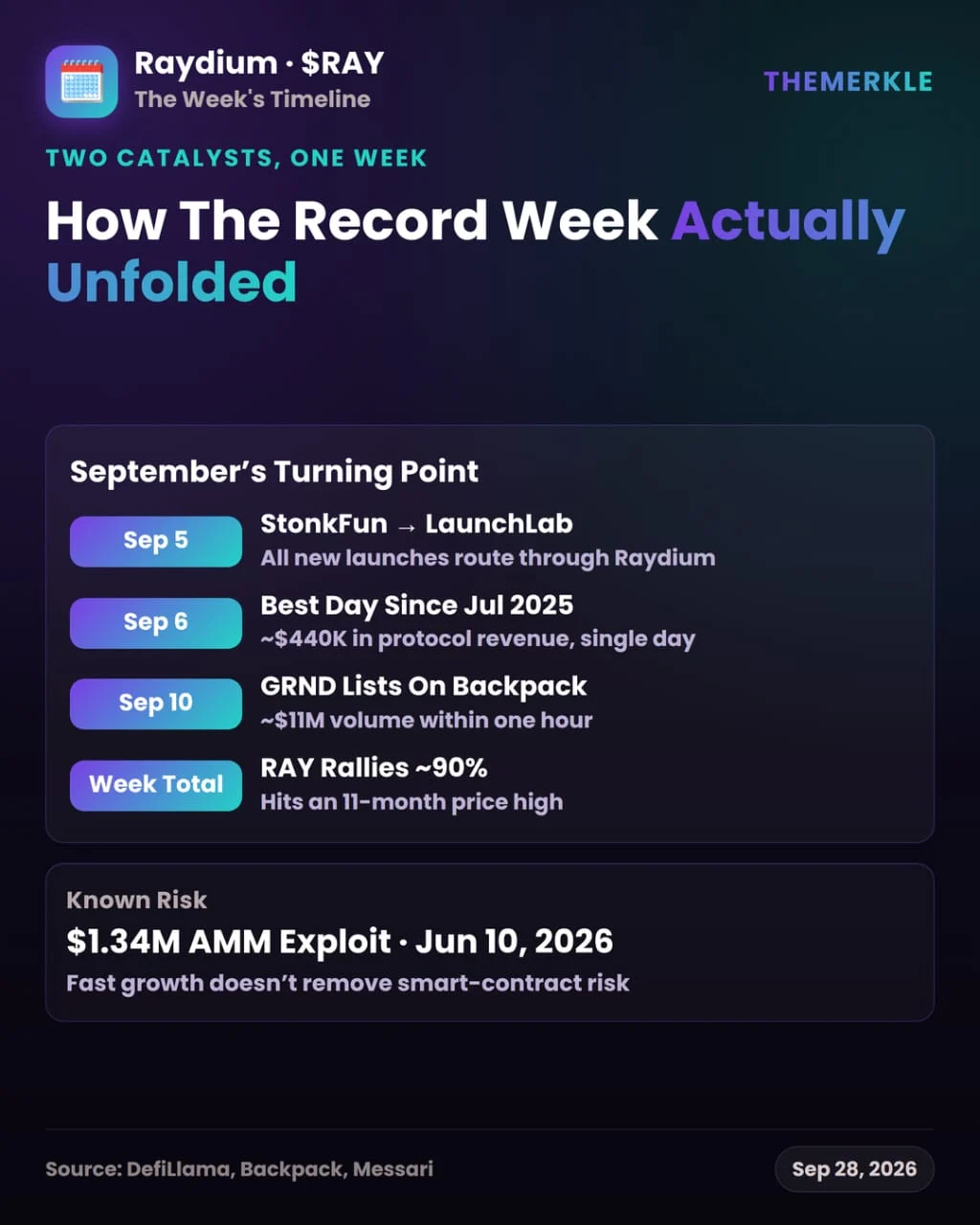
Raydium, a leading decentralized exchange (DEX) on the Solana blockchain, has recently achieved its most robust weekly performance in over a year, signaling a significant turnaround after a prolonged period of revenue contraction. This remarkable resurgence is primarily attributed to a strategic reduction in token launch costs on its LaunchLab platform, coupled with a pivotal integration with the StonkFun launchpad and the burgeoning interest in tokenized traditional assets.
The week’s exceptional activity saw Raydium report its highest weekly revenue since July 2025. According to data from DefiLlama, the protocol registered an impressive $4.43 million in holders’ revenue over the past 30 days, with a single day on September 6 generating nearly $440,000 in protocol revenue—the best daily performance since July 2025. This surge directly impacted Raydium’s native token, RAY, which rallied by approximately 90% in a single week, reaching an 11-month high. This performance marks a stark contrast to much of 2026, which saw the protocol’s quarterly gross revenue slump to $16.99 million in Q2, a significant decline from the $114.34 million recorded in Q3 2025.
Unpacking the Metrics: Holders’ Revenue and Protocol Fees
To fully appreciate Raydium’s financial rebound, it is crucial to understand the distinct revenue metrics tracked by platforms like DefiLlama. The reported $4.43 million figure specifically represents "holders’ revenue." In the decentralized finance (DeFi) ecosystem, these metrics are often segmented:
- Fees: These are the amounts paid by traders for executing transactions on the DEX.
- Revenue: This refers to the portion of the fees that the protocol retains for its operations and development.
- Holders’ Revenue: This is a specific allocation of the protocol’s revenue earmarked for the benefit of its token holders, typically through mechanisms like token buybacks and burns.
For Raydium, the holders’ revenue mechanism is integral to its tokenomics. On its Automated Market Maker (AMM) pools, 12% of all collected fees are allocated to RAY token buybacks. Furthermore, 25% of the protocol fee generated by its LaunchLab platform is dedicated to buying back and subsequently burning RAY tokens. This direct link between trading activity, protocol revenue, and token holder benefits creates a positive feedback loop, where increased volume translates directly into demand for the RAY token, contributing to its price appreciation and overall ecosystem health.

Chronology of Catalysts: A Confluence of Strategic Moves
The recent success of Raydium is not an isolated event but rather the culmination of several strategic adjustments and market developments.
Strategic Cost Reduction Ignites LaunchLab Activity:
A pivotal decision that acted as an immediate catalyst was the dramatic reduction in the cost of deploying a token on Raydium’s LaunchLab. The fee for launching a new token was slashed from 0.29 SOL to a mere 0.03 SOL. This approximately 90% cost reduction significantly lowered the barrier to entry for projects seeking to launch on Solana, making LaunchLab an exceptionally attractive platform. The rationale behind this move was to incentivize more projects to utilize the platform, thereby increasing the volume of new token launches and the associated trading fees generated through Raydium’s pools. Each bonding-curve trade associated with these launches pays a fee, directly contributing to the protocol’s revenue. Historically, LaunchLab has been a significant revenue driver for Raydium, generating $12.8 million in Q3 2025 and accounting for over half of the protocol’s total revenue during that period.
StonkFun Integration: A Game Changer for LaunchLab:
Adding to the momentum, September 5 marked a crucial integration with StonkFun, a specialized launchpad focused on tokens tied to traditional stocks and commodities. From this date, StonkFun began routing all new token launches through Raydium’s LaunchLab. This strategic partnership meant that every trade linked to these newly launched tokens would settle through Raydium’s liquidity pools, inherently generating fees for the DEX. The impact was immediate and substantial. StonkFun’s native token, STONK, surged by over 250% on the day, propelling its market capitalization to approximately $140 million. Even prior to this full integration, StonkFun had already demonstrated its potential, having generated over $1.21 million in revenue and facilitated approximately $219 million in trading volume through Raydium. The default routing of all StonkFun launches through Raydium has cemented a consistent and robust source of volume and fees for the platform.
The Rise of Tokenized Equities: Diversifying Solana’s Appeal:
Beyond the StonkFun integration, the broader emergence of tokenized US stocks played a crucial role in attracting a new demographic of traders to Solana and, by extension, to Raydium. In the same week, more than 15 tokenized US stocks, including blue-chip names like Boeing, Costco, Lululemon, Reddit, and Roblox, went live through platforms like Backpack and Sunrise. A notable example was the GRND token for Grindr, which listed on Backpack on September 10 and amassed approximately $11 million in trading volume within just one hour.
This trend is particularly significant because tokenized equities serve as a bridge between traditional financial markets and the decentralized world. They appeal to a different cohort of traders—those who might not typically engage with speculative memecoins but are interested in the benefits of blockchain technology applied to familiar assets. These tokenized stocks also offer 24/7 trading capabilities, a significant advantage over traditional market hours, potentially leading to sustained trading volume. The overlap of traditional asset interest with the existing speculative "meme flow" created a powerful synergy that was instrumental in breaking Raydium’s revenue drought.

Solana’s Resurgence: A Broader Tailwind
Raydium’s impressive performance is also set against the backdrop of a broader resurgence within the Solana ecosystem. After navigating challenging market conditions and network stability concerns in previous periods, Solana has demonstrated remarkable resilience and growth. Recent upgrades, increased developer activity, and a renewed focus on scalability and user experience have contributed to a positive sentiment surrounding the Layer 1 blockchain. Metrics such as Total Value Locked (TVL) across Solana DeFi protocols, network transaction volume, and the increasing number of active wallets have shown an upward trend. This healthier ecosystem provides a robust foundation for DEXs like Raydium, as more users and capital flow into the network, directly translating to higher trading volumes and liquidity on its platforms. Raydium, as the largest DEX on Solana, is uniquely positioned to capitalize on this renewed ecosystem vitality, acting as a primary gateway for new assets and users entering the Solana DeFi space.
RAY Token Reacts: An 11-Month High Driven by Utility and Scarcity
The direct consequence of Raydium’s surging revenue and the protocol’s tokenomics mechanism has been a substantial appreciation in the value of its native token, RAY. The holders’ revenue feeds directly back into the RAY token through buybacks, creating consistent buying pressure. The past week saw Raydium execute a daily buyback of $640,788 worth of RAY, marking the largest single-day purchase since February 2025.
This sustained buying activity, fueled by the protocol’s success, directly influences the token’s market dynamics. Increased demand from buybacks, coupled with the burning mechanism (reducing supply), creates a scenario of increasing scarcity and utility. RAY currently trades around $2.01, boasting a market capitalization of approximately $542.86 million, and has seen a remarkable 160.7% increase over the past 30 days. This performance stands in stark contrast to most of 2026, when buybacks remained flat and unremarkable. The acceleration of buyback activity in August and the first week of September directly correlated with the climb in protocol revenue, clearly illustrating the direct link between platform activity and token value. For investors, this demonstrates a tangible benefit of holding RAY, as the protocol’s success directly translates into token appreciation through a transparent and automated mechanism.
Navigating Potential Headwinds and Sustainability Challenges

While the recent surge is undoubtedly a significant positive development for Raydium, it is crucial for market observers to approach this momentum with a degree of caution. DeFi analysts and market experts often highlight the inherent volatility and speculative nature of certain segments within the crypto market, particularly those related to new token launches.
One primary concern revolves around the concentration of drivers behind this growth. The surge appears heavily reliant on the activity generated by StonkFun and the broader speculative interest in new token launches. Historically, launchpad-driven growth can be episodic and dependent on the continuous flow of highly anticipated projects. Messari, a prominent crypto research firm, previously flagged this vulnerability in 2025, noting that LaunchLab’s growth was heavily concentrated on a single platform. StonkFun could potentially play a similar role now, meaning any slowdown in its activity or a shift in its strategy could impact Raydium’s revenue.
Furthermore, the DeFi landscape is perpetually exposed to smart-contract risk. Raydium itself experienced a significant exploit on its AMM on June 10, 2026, resulting in a loss of $1.34 million. This incident serves as a stark reminder that even with rapid growth and positive market sentiment, the underlying security of smart contracts remains paramount. Sustaining user trust and activity requires continuous auditing, robust security measures, and rapid response capabilities to potential vulnerabilities.
The Path Forward: Diversification and Continued Innovation
Despite these potential headwinds, the upside case for Raydium is compelling if the current trends can be sustained and diversified. If tokenized traditional assets, particularly stocks, continue to attract new traders to Solana and LaunchLab remains an accessible and efficient platform for new project deployments, this period could indeed mark the beginning of a sustained recovery and growth phase for Raydium.
The integration of tokenized equities, in particular, represents a crucial step towards diversifying Raydium’s user base and revenue streams beyond the often-volatile memecoin market. By bridging traditional finance and DeFi, Raydium could tap into a much larger pool of capital and participants, potentially stabilizing its revenue profile. Continued innovation in expanding the types of tokenized assets available and making their trading seamless could further solidify this position.

For Raydium to maintain its momentum, it will need to ensure that LaunchLab’s appeal extends beyond single integrations like StonkFun, fostering a diverse ecosystem of launching projects. Additionally, ongoing commitment to security enhancements and risk mitigation strategies will be vital in rebuilding and maintaining investor confidence in the wake of past exploits.
The coming weeks will be critical in determining whether this record-breaking period was merely a speculative peak or a genuine reset for Raydium. Market participants and analysts will be closely monitoring key metrics, including weekly revenue lines, daily token buyback figures, and the sustained activity across both LaunchLab and AMM pools. These indicators will provide crucial insights into the longevity of the current growth trajectory and Raydium’s capacity to convert this exceptional week into a sustainable recovery and leadership position within the Solana DeFi ecosystem.














