


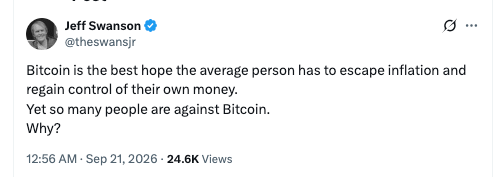
The enduring debate surrounding Bitcoin’s fundamental value proposition and its potential to serve as a hedge against inflation continues to be fueled by a spectrum of opinions, even as the cryptocurrency demonstrates robust recovery. Jeff Swanson, a prominent Bitcoin proponent, recently articulated his perspective on the persistent skepticism surrounding the digital asset, positing that for many individuals, Bitcoin remains the most viable avenue to escape inflationary pressures and reclaim financial sovereignty. His commentary surfaces at a time when Bitcoin has achieved a significant upward trajectory, trading above $86,000 at the time of this report, underscoring its market resilience and renewed investor interest.
Swanson, a vocal advocate for Bitcoin for over a decade, shared his insights via a post on the social media platform X, formerly Twitter. His personal journey, as he describes it, has been one of liberation from the traditional 9-to-5 work structure, directly attributed to his early and sustained investment in Bitcoin. He highlights how the considerable appreciation of BTC has enabled him and a cohort of early investors to achieve financial independence and a lifestyle of freedom. This personal success story prompts him to question the persistent animosity directed towards the cryptocurrency economy, especially considering its demonstrable benefits to a significant portion of its adopters.
However, Swanson acknowledges that his individual experience, while illuminating, is not universally representative. He emphasizes that a comprehensive understanding of the public’s apprehension towards cryptocurrencies necessitates a deeper exploration of the underlying issues and the imperative for more effective solutions.
The "Get-Rich-Quick" Stigma: A Barrier to Adoption
A primary driver of the general public’s negative or skeptical stance towards cryptocurrencies is the pervasive narrative that has positioned the digital currency market as a facile pathway to rapid wealth accumulation. This "get-rich-quick" perception, actively promoted by certain segments of the crypto community and media, has unfortunately overshadowed Bitcoin’s potential as a long-term store of value and inflation hedge.
While dedicated proponents like Swanson advocate for a disciplined, long-term investment strategy centered on Bitcoin, emphasizing its intrinsic properties and potential for sustained growth, other voices have amplified a more speculative and high-risk approach. These narratives often focus on leveraged trading, the allure of memecoins, and other highly volatile digital assets, which, while offering the possibility of explosive gains, carry an equally significant risk of substantial losses. The inherent volatility of these instruments has led to frequent and significant financial setbacks for many retail investors who are drawn to the promise of instant riches.
The consequence of this marketing dynamic is that a considerable segment of the public has internalized the notion of crypto as a speculative casino rather than a revolutionary financial technology. Many individuals have reportedly lost substantial capital by chasing these ephemeral opportunities, rather than adopting a more prudent investment approach. This widespread negative experience, even among those who may not have directly invested in Bitcoin itself, has contributed to a general distrust of the cryptocurrency market. Ironically, this skepticism often extends to Bitcoin, despite its fundamentally different risk profile and historical performance compared to more speculative altcoins.
One notable response to Swanson’s commentary on X, from a user named @onebillionsats, succinctly captured this sentiment: "The problem is that most people see #bitcoin not as a store of value or an inflation hedge, but as a lottery ticket. The media and influencers have pushed this narrative for years. It’s hard to shake that perception." This highlights the deep-seated challenge of recalibrating public perception away from speculative frenzy towards a more grounded understanding of Bitcoin’s utility.
Distinguishing Bitcoin: A Unique Digital Asset
The discourse surrounding cryptocurrency often suffers from a lack of differentiation, with Bitcoin frequently being conflated with the vast array of altcoins and tokens that populate the market. However, prominent figures such as Michael Saylor, CEO of MicroStrategy, and Jack Dorsey, co-founder of Twitter (now X) and Block, have consistently emphasized Bitcoin’s unique position. They argue that the flagship cryptocurrency is fundamentally distinct from all other digital assets and should be evaluated on its own merits.
Bitcoin, as the first and most established cryptocurrency, commands a market capitalization that dwarfs its competitors, often exceeding 50% of the total cryptocurrency market value. This dominance is not merely a function of its early arrival but is also a testament to its robust network effects, decentralized infrastructure, and a proven track record of resilience and strong performance over more than a decade. Unlike many newer cryptocurrencies that may rely on centralized development teams or speculative tokenomics, Bitcoin’s open-source nature and decentralized governance have fostered a level of trust and stability that is unparalleled in the digital asset space.
The narrative of Bitcoin as "digital gold" is not without merit. Its scarcity, guaranteed by a fixed supply of 21 million coins, mirrors the finite nature of precious metals like gold. This programmed scarcity is a critical component of its appeal as an inflation hedge, offering a potential safeguard against the debasement of fiat currencies, which can be printed at the discretion of central banks. Historically, Bitcoin has demonstrated a correlation with gold as a safe-haven asset during times of economic uncertainty, further reinforcing this comparison.
The Evolving Landscape: Institutional Adoption and the Future of Finance
The sustained growth and increasing adoption of Bitcoin have compelled even traditionally risk-averse institutional investors to engage with the cryptocurrency market. The advent of Bitcoin Exchange-Traded Funds (ETFs) in major financial markets, such as the United States, marks a significant milestone in this evolution. These financial instruments provide a regulated and accessible avenue for traditional investors to gain exposure to Bitcoin without the complexities of direct ownership and custody.
This institutional embrace is particularly noteworthy given that many of these entities were once vocal critics of digital assets, often dismissing them as fraudulent or speculative ventures. Their current engagement signals a profound shift in their perception of Bitcoin’s long-term viability and its potential as a legitimate asset class.
The rationale behind this shift is increasingly rooted in a growing disillusionment with traditional, politically managed fiat currencies. The history of monetary policy is replete with instances of inflation eroding purchasing power, and the ongoing debasement of currencies through quantitative easing and other expansionary measures has led many to seek alternative stores of value. In this context, Bitcoin, alongside traditional safe havens like gold, is emerging as a credible and proven asset that offers a potential hedge against the uncertainties of fiat-based financial systems.
The implications of this trend are far-reaching. As institutional capital continues to flow into Bitcoin, it can contribute to increased price stability and further legitimization of the asset class. This, in turn, could foster greater retail adoption and encourage wider integration of Bitcoin into global financial infrastructure. The increasing acceptance of Bitcoin as a digital store of value and a hedge against inflation, supported by institutional backing, challenges the narrative that it is merely a speculative fad. Instead, it suggests a fundamental re-evaluation of financial assets in an era of persistent monetary expansion and economic uncertainty.

The question of whether "physical Bitcoins" – a concept that has largely faded from prominence – could see a resurgence and challenge Bitcoin’s inflation control is largely moot in the current context. Physical Bitcoin tokens, often resembling coins or bars with a private key embedded, were an early novelty and are not representative of the digital, decentralized nature of Bitcoin. Their appeal was primarily aesthetic and symbolic, lacking the inherent technological and economic underpinnings that drive Bitcoin’s value. The true "physical" aspect of Bitcoin lies in its decentralized network, distributed ledger, and the cryptographic security that underpins its existence, not in tangible representations. Therefore, the future of Bitcoin’s inflation control is intrinsically linked to the strength and adoption of its digital network, not to a revival of physical tokens.
As the cryptocurrency market matures, the focus is increasingly shifting from speculative exuberance to the fundamental utility of digital assets. Bitcoin, with its established track record, scarcity, and growing institutional acceptance, is at the forefront of this paradigm shift, poised to continue its role as a significant player in the global financial landscape and a potential bulwark against inflationary pressures.














