San Francisco, CA – In a significant move poised to enhance the utility and accessibility of the XRP Ledger (XRPL), Ripple has officially partnered with Privy, a company backed by Stripe, to introduce embedded wallet solutions for digital payments. This collaboration, announced on October 13, arrives amidst a period of heightened interest from large-scale investors, with notable XRP whale accumulation occurring despite broader selling pressures observed across the cryptocurrency market. The integration is designed to empower developers with streamlined tools to create wallets supporting XRP, the stablecoin RLUSD, and a diverse range of other digital assets native to the XRPL, marking a crucial step towards mainstream adoption of blockchain-based financial services.
A Deep Dive into the Ripple-Privy Collaboration
The partnership between Ripple and Privy represents a strategic alignment aimed at lowering the barrier to entry for developers and users within the burgeoning Web3 ecosystem. Privy, a developer-focused infrastructure provider with robust backing from industry giants like Stripe, specializes in creating seamless authentication and embedded wallet experiences. Their core offering allows applications to manage user identities and digital assets with enhanced ease, abstracting away the complexities often associated with private key management.
Under this new integration, developers building applications on the XRP Ledger will gain access to Privy’s programmable wallet services. This infrastructure enables businesses to construct custom wallet solutions, efficiently manage various digital assets, and securely sign transactions without the laborious and resource-intensive process of developing bespoke wallet systems from scratch. The primary goal is to simplify the user experience, making interaction with digital assets as intuitive as traditional online payments.
According to Privy’s official announcement, the integration offers comprehensive support for XRP, Ripple’s native digital asset, as well as RLUSD, a stablecoin, and other assets issued on the XRPL. A key feature of this service is the ability for users to engage with these digital assets without the necessity of manually handling private keys, a common point of friction and security concern for many new users in the crypto space. Crucially, while offering this simplified experience, Privy also retains the option for users to export their credentials, ensuring they maintain ultimate sovereignty over their digital holdings.
An innovative aspect of this collaboration is its support for automated payments via the x402 standard. This forward-looking feature is designed to facilitate transactions initiated by AI agents using server-side wallets. Such capabilities are envisioned to power a new generation of digital services, enabling autonomous agents to conduct payments for various resources, including data access, cloud computing, and other programmable economic interactions, thereby expanding the potential applications of the XRPL into emerging technological frontiers like agentic commerce.

Markus Infanger, Senior Vice President at RippleX, a division of Ripple dedicated to fostering the XRPL developer ecosystem, articulated the strategic importance of this integration. He stated that Privy’s robust infrastructure would significantly assist developers in building sophisticated payment applications utilizing the XRP Ledger. Infanger highlighted the XRPL’s established credentials, citing its impressive track record of over eight million funded accounts and more than $1 trillion in cumulative value transferred, underscoring its readiness for broader enterprise and consumer adoption.
This integration is not an isolated development but rather follows a series of continuous enhancements to the XRP Ledger. Recently, the XRPL underwent a crucial security update that addressed specific token permission bugs, demonstrating Ripple’s ongoing commitment to maintaining a secure and reliable blockchain environment. Looking ahead, Privy has outlined plans to further expand its service offerings to include advanced transaction policy controls and network fee sponsorship, features that would further reduce operational overhead for developers and improve the overall user experience by abstracting away gas fees. While the partnership holds significant promise, neither company has yet disclosed specific projections regarding expected transaction volumes or the anticipated increase in XRP demand stemming directly from this collaboration.
Chronology of Key Events
- October 13: Ripple and Privy officially announce their strategic partnership to integrate embedded wallet solutions with the XRP Ledger.
- Late October/Early November: Observation period reveals growing interest among large XRP holders, with significant accumulation noted by market analysts.
- November 2-6: Approximately $529,500 in net XRP ETF outflows are recorded, indicating a period of reduced institutional demand for XRP-backed exchange-traded products.
- November 7: Crypto analyst Ali Martinez reports that whales accumulated more than 16.46 million XRP over a five-day period, signaling strong buying activity from large investors.
- November 8: XRP trades near $1.16, having retreated from approximately $1.34 in the preceding week, reflecting continued market volatility and selling pressure.
- November 30 (Projected): GraniteShares is scheduled to launch its leveraged XRP ETFs, a development that could potentially inject new institutional liquidity into the XRP market, following an earlier delay.
XRP Price Dynamics and Market Sentiment
The announcement of the Ripple-Privy partnership and the ongoing whale accumulation efforts have unfolded against a backdrop of persistent volatility in the cryptocurrency market. On November 8, XRP was trading around $1.16, a retreat from its position near $1.34 observed during the previous week. This downward price movement occurred despite consistent reports of large wallet holders actively increasing their positions.
According to data shared by prominent market analyst Ali Martinez, drawing from Santiment’s on-chain analytics, XRP whales demonstrated significant conviction by accumulating over 16.46 million XRP within a five-day window leading up to November 7. This scale of accumulation, particularly from entities often associated with institutional or high-net-worth individual investors, typically signals underlying confidence in the asset’s long-term prospects. Historically, sustained whale activity can often precede significant price movements, though it does not guarantee immediate upward momentum.
Despite this robust buying activity from whales, XRP has struggled to break free from broader downward trends and overcome key resistance levels. Previous technical analyses identified the $1.60 mark as a critical resistance barrier that XRP bulls have found challenging to surmount. A sustained break above this level is generally considered a prerequisite for any significant upward price trajectory. Martinez also highlighted the potential formation of an inverse head-and-shoulders pattern on XRP charts, a bullish reversal indicator; however, he cautioned that this pattern remained unconfirmed and would require further price action to validate.
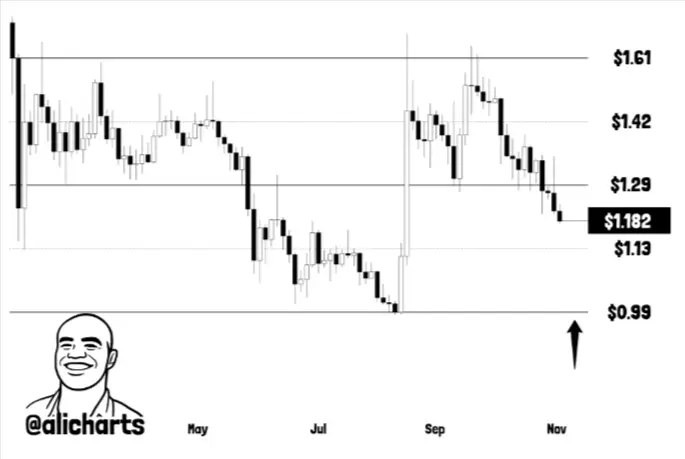
Should XRP manage to achieve a sustained recovery above $1.60, subsequent resistance levels, including the psychologically significant $2 mark, would come into focus. Reaching the $2 target from its November 8 price of $1.16 would necessitate an approximate gain of 72.4%, underscoring the substantial upward momentum required.
Conversely, market analysis has also identified crucial support zones for XRP. Recent reports pinpointed a support band between $1.04 and $1.16. Furthermore, Martinez separately identified $0.99 as the next potential support area, particularly following XRP’s breakdown below the midpoint of its established trading channel. A further decline towards this $0.99 boundary would exert additional pressure on buyers attempting to defend the crucial $1 psychological level, potentially signaling a more pronounced short-term bearish sentiment.
Adding another layer of complexity to XRP’s market picture are institutional investment product flows. Between November 2 and 6, the market recorded approximately $529,500 in net XRP ETF outflows. This weak demand from exchange-traded funds represents an additional challenge for buyers aiming to reverse the recent price declines, as institutional inflows often provide significant liquidity and validation for an asset. Compounding this, GraniteShares, a prominent asset manager, had postponed the launch of its leveraged XRP ETFs until November 30. Such delays, while potentially due to regulatory or logistical factors, can momentarily dampen institutional enthusiasm and defer potential capital injections into the XRP market.
Broader Impact and Implications
The Ripple-Privy partnership carries significant implications for the XRP Ledger ecosystem, Ripple’s strategic positioning, and the broader trajectory of Web3 adoption.
For the XRP Ledger Ecosystem:
The integration of Privy’s embedded wallets is a game-changer for developer experience on the XRPL. By abstracting the complexities of private key management and offering pre-built wallet infrastructure, Ripple is effectively lowering the technical barrier for new projects and developers. This could lead to an acceleration of decentralized application (dApp) development on the XRPL, attracting a more diverse range of innovators. The support for automated payments via the x402 standard for AI agents is particularly forward-thinking, potentially positioning XRPL as a foundational layer for the emerging "agentic economy" where AI-driven entities can autonomously conduct financial transactions. This could unlock entirely new use cases and revenue streams for the network.
For Ripple’s Strategic Vision:
Ripple has consistently positioned the XRP Ledger as a scalable, cost-effective solution for global payments and tokenized assets. The partnership with Privy aligns perfectly with this vision by making it easier for businesses to integrate XRPL into their existing financial applications. This move could significantly bolster Ripple’s enterprise adoption efforts, providing a more user-friendly interface for companies looking to leverage blockchain technology without requiring deep cryptographic expertise. It underscores Ripple’s commitment to building practical, real-world utility for its technology, moving beyond speculative trading to tangible applications in finance and commerce.

For XRP Utility and Demand:
While the companies have not disclosed projected transaction volumes, a successful and widespread adoption of Privy’s embedded wallets on the XRPL would inherently increase the utility of XRP. Every transaction on the XRP Ledger, including those facilitated by these new wallets, requires a small amount of XRP for network fees (burned, not collected), which contributes to its deflationary mechanism. Furthermore, if the x402 standard for AI agent payments gains traction, it could create a continuous, programmatic demand for XRP to power these autonomous transactions. This enhanced utility, if realized at scale, could serve as a fundamental driver for XRP’s long-term value, moving its price correlation beyond pure market sentiment to tangible network usage.
For the Broader Web3 and Embedded Finance Landscape:
The collaboration between Ripple and a Stripe-backed entity like Privy highlights a growing trend towards embedded finance within the Web3 space. As blockchain technology matures, the industry is increasingly focused on making digital assets and decentralized applications more accessible and less intimidating for mainstream users. Embedded wallets, which seamlessly integrate into existing applications, are a crucial component of this evolution. This partnership could serve as a blueprint for how traditional financial infrastructure providers (like Stripe, through its backing of Privy) can bridge the gap between legacy systems and decentralized networks, fostering greater interoperability and ultimately accelerating the adoption of Web3 technologies in everyday commerce.
Challenges and Outlook
Despite the positive developments, challenges persist. The lack of disclosed transaction volume projections from the partnership means the immediate impact on XRP demand remains an open question. Furthermore, the broader cryptocurrency market remains subject to macroeconomic headwinds, regulatory uncertainties, and investor sentiment, all of which can influence XRP’s price performance regardless of underlying utility improvements. The ongoing struggle to break key resistance levels and the observed ETF outflows indicate that while whale accumulation is a bullish sign, it alone may not be sufficient to reverse entrenched bearish trends in the short term.
However, the strategic importance of the Ripple-Privy partnership cannot be overstated. By focusing on developer experience and simplifying user interaction with digital assets, Ripple is laying critical groundwork for the XRPL to become a more integral part of the future digital economy. If these efforts lead to a significant increase in dApp development and user adoption, the long-term outlook for XRP’s utility and value could be substantially enhanced, positioning it favorably for future market cycles. The coming months will be crucial in observing how developers leverage these new tools and how the market responds to the enhanced capabilities of the XRP Ledger.