


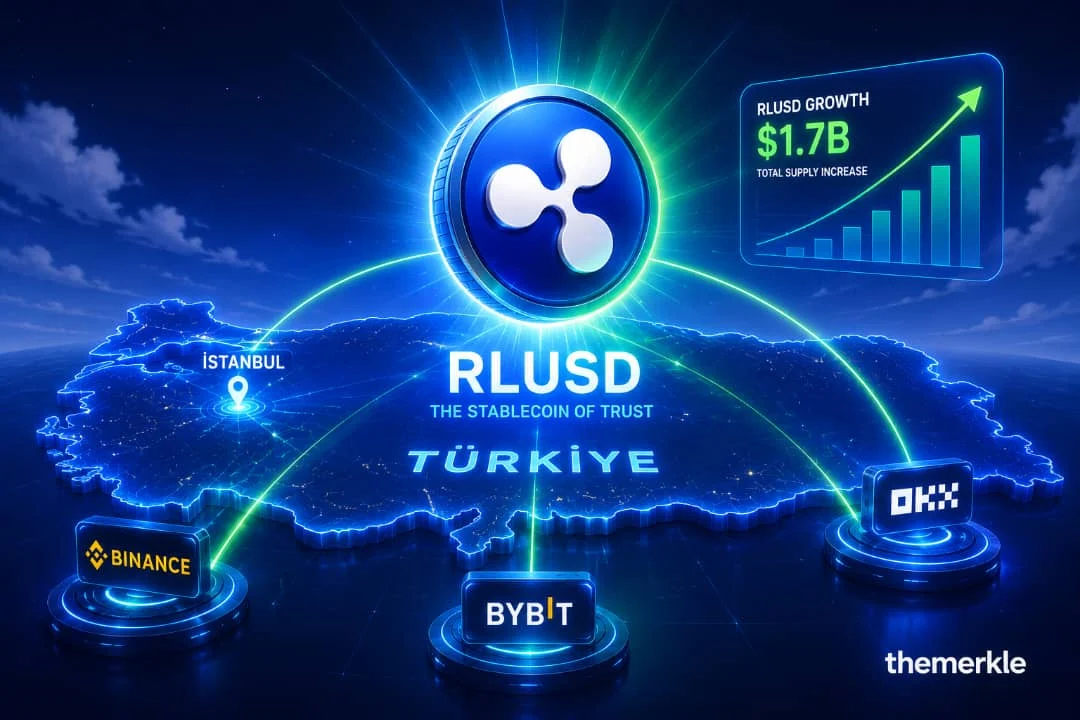
Blockchain payments company Ripple has officially launched its dollar-pegged stablecoin, RLUSD, in the Turkish market, establishing partnerships with three prominent local cryptocurrency exchanges: BiLira, Bitexen, and Bitlo. This strategic expansion marks a significant milestone for RLUSD, which has rapidly surpassed a $1.7 billion market capitalization since its inception less than a year ago, underscoring Ripple’s aggressive global outreach and its commitment to regulated financial products in key emerging economies. The move is not merely an addition to Ripple’s growing list of operational countries but represents a calculated entry into one of the world’s most dynamic and crypto-active populations, signaling a deepening engagement with both commercial and academic sectors within Turkey.
Turkey: A Hotbed for Crypto Adoption
Turkey’s economic landscape, characterized by a $1.3 trillion economy and an annual crypto trading volume nearing $200 billion, presents a compelling case for the introduction of a dollar-pegged stablecoin like RLUSD. The Turkish Lira has experienced considerable volatility and depreciation against major global currencies, particularly the U.S. dollar, over recent years. For instance, Turkey’s annual inflation rate soared to nearly 70% in 2024, following years of high single-digit and double-digit inflation. This persistent economic instability has driven a significant portion of the Turkish populace towards alternative assets, with cryptocurrencies emerging as a favored hedge against inflation and a means of preserving wealth. For many Turkish citizens, digital assets are not merely speculative investments but integral tools for financial survival and savings in an unpredictable economic environment.
The high adoption rate of cryptocurrencies in Turkey is well-documented. Surveys consistently rank Turkey among the top countries globally for crypto ownership, with a substantial percentage of its adult population holding digital assets. This widespread engagement extends beyond speculative trading, encompassing remittances, cross-border payments, and a growing integration into daily economic activities. Ripple’s decision to target Turkey, therefore, is not arbitrary but a direct response to a deeply ingrained market need for stable, reliable digital alternatives to the local fiat currency. The demand for dollar-pebacked stablecoins, in particular, is exceptionally strong in such environments, providing a much-needed sanctuary from domestic currency fluctuations.
RLUSD’s Rapid Ascent and Strategic Positioning
RLUSD’s impressive growth to over $1.7 billion in market capitalization within its inaugural year is a testament to Ripple’s robust distribution network and a clear indication of evolving market preferences. The stablecoin market has historically been dominated by established players like Tether (USDT) and Circle (USDC), which have built formidable infrastructure, liquidity, and institutional relationships over many years. For a newcomer to achieve such rapid scale speaks volumes about the current appetite for new, well-regulated stablecoin offerings.
Launched with an explicit focus on regulatory compliance and enterprise-grade utility, RLUSD differentiates itself from some of its older counterparts. Unlike stablecoins that might have originated in less regulated environments, RLUSD was designed from its inception to operate within stringent regulatory frameworks. This approach is particularly appealing to institutional investors, banks, and large payment companies that face rigorous compliance requirements. Integrating stablecoins like USDT, which has faced scrutiny over its reserve composition and regulatory adherence, into traditional treasury operations often raises significant red flags in compliance meetings. RLUSD, by contrast, is positioned as a "clean" alternative, carrying the imprimatur of Ripple, a company that has actively engaged with and navigated complex regulatory landscapes, notably through its protracted legal battle with the U.S. Securities and Exchange Commission (SEC). This experience, while challenging, has arguably equipped Ripple with a deeper understanding of regulatory expectations and the importance of clear, verifiable compliance.
The timing of RLUSD’s market entry also plays a crucial role in its success. Global regulators are rapidly developing and implementing comprehensive frameworks for stablecoins. Regions like the European Union, with its Markets in Crypto-Assets (MiCA) regulation, are setting precedents for how digital assets, particularly stablecoins, must be issued, governed, and backed. This tightening regulatory environment is creating a clear bifurcation in the market: it increasingly marginalizes loosely structured stablecoins lacking transparent reserves and robust compliance mechanisms, while simultaneously rewarding those that have proactively embraced regulatory best practices. RLUSD, firmly entrenched in the latter category, is well-positioned to capitalize on this global shift, appealing to institutions that have previously remained on the sidelines but are now seeking compliant digital asset solutions. The $1.7 billion market cap is not just a numerical achievement; it’s a strong signal of growing institutional confidence and the market’s demand for regulatory clarity in the stablecoin sector.
Strategic Local Partnerships: A Foundation for Growth
Ripple’s selection of BiLira, Bitexen, and Bitlo as its initial exchange partners in Turkey reflects a sophisticated understanding of the local market dynamics and a commitment to a partner-centric expansion model. These are not arbitrary choices but established entities deeply embedded within the Turkish crypto ecosystem.
- BiLira: This platform is particularly noteworthy as it operates its own stablecoin pegged to the Turkish Lira. This experience means BiLira and its user base are already intimately familiar with the concept and practical utility of pegged digital assets. The transition to a dollar-backed stablecoin like RLUSD, offering a different form of stability, is therefore a natural progression for its users rather than an entirely new or foreign concept. BiLira’s existing infrastructure for managing fiat-backed tokens provides a robust foundation for integrating RLUSD seamlessly.
- Bitexen and Bitlo: Both Bitexen and Bitlo are well-established trading platforms with significant retail and, increasingly, institutional user bases across Turkey. They possess existing regulatory compliance frameworks, robust security protocols, and proven track records of operational reliability. These are not nascent startups attempting to build credibility but known and trusted names within the Turkish digital asset space. Their extensive user networks and established fiat on/off ramps are critical for providing liquidity and accessibility for RLUSD.
Ripple’s approach, opting for collaboration with these local stalwarts rather than attempting a direct-to-consumer launch, underscores a mature and pragmatic market entry strategy. This method acknowledges the importance of local trust, cultural familiarity, and existing infrastructure. In a market as nuanced as Turkey’s, leveraging the established user bases and regulatory understanding of local partners is far more effective than launching an unfamiliar foreign application. This strategy not only accelerates adoption but also mitigates potential regulatory and operational hurdles, reflecting a long-term vision for market integration.
Investing in the Future: Istanbul Technical University Partnership
Beyond the immediate commercial partnerships, a crucial detail in Ripple’s Turkish expansion is its collaboration with Istanbul Technical University (ITU). Ripple is extending its XRP Ledger education and research presence through ITU, one of Turkey’s premier engineering and technology institutions. This academic partnership, while less immediately visible than exchange listings, holds profound long-term implications for the sustainability and evolution of Ripple’s ecosystem in the region.
Ripple has historically engaged in similar academic initiatives globally, recognizing that while commercial partnerships drive liquidity and trading volume, university collaborations cultivate the essential developer pipeline that fuels a blockchain ecosystem’s innovation and growth over decades. Istanbul Technical University, with its distinguished reputation for producing top-tier engineers and computer scientists, is an ideal partner. This collaboration could involve curriculum development, research grants, hackathons, and mentorship programs, integrating the XRP Ledger into the academic fabric of the university.
The strategic foresight behind such an initiative is clear: students and researchers emerging from ITU in five to ten years will have grown up with the XRP Ledger as a known, studied, and deeply understood blockchain platform. This organic integration into the educational system ensures a continuous supply of skilled developers and innovators who can build applications, contribute to the core protocol, and drive the adoption of XRP Ledger-based solutions. This kind of investment fundamentally alters the talent and innovation landscape, creating a self-sustaining ecosystem that is difficult to quantify in immediate financial terms but yields immense strategic value over time.
Furthermore, the ITU partnership signals a deeper level of commitment from Ripple than commercial deals alone. Companies merely "passing through" a market typically focus on short-term gains, signing exchange agreements, collecting trading volumes, and moving on. Ripple, by contrast, is actively putting down roots, investing in the intellectual infrastructure and future talent pool of Turkey. This distinction highlights Ripple’s intent to be a long-term player in the Turkish market, demonstrating a commitment that extends beyond immediate financial returns to include educational and technological development. It tells a story of genuine market integration and a belief in the long-term potential of Turkey as a hub for blockchain innovation.
The Global Stablecoin Landscape and Ripple’s Trajectory
Turkey is the latest, but certainly not the last, stop on RLUSD’s rapid global expansion tour. Ripple’s consistent strategy involves identifying regulated, credible local partners, meticulously ensuring compliance with regional regulations, and then facilitating market entry. This disciplined, compounding expansion strategy is designed for sustainable growth rather than fleeting surges.
The broader global stablecoin market is undeniably shifting in Ripple’s favor. The increasing momentum behind global regulatory frameworks, exemplified by MiCA in Europe, the ongoing discussions in the United States, and similar initiatives in Asia, is creating a more defined playing field. This regulatory tightening acts as a dual-edged sword: it effectively squeezes out stablecoin issuers who neglected regulatory buy-in, lacked transparency in their reserves, or operated in a legal grey area. Simultaneously, it significantly rewards those, like Ripple with RLUSD, who have proactively embraced compliance and built their products with regulatory clarity as a foundational principle.
RLUSD’s positioning as a fully compliant, enterprise-grade stablecoin allows it to thrive in this evolving environment. Every new market entry, particularly those with a clear regulatory pathway and strong local partners like Turkey, strengthens RLUSD’s global standing and reinforces Ripple’s narrative as a leader in providing compliant blockchain solutions for the financial industry.
With RLUSD now live in Turkey through its partnerships with BiLira, Bitexen, and Bitlo, and with the foundational academic infrastructure being laid through Istanbul Technical University, Ripple is constructing a robust, long-term presence in this strategically vital market. The $1.7 billion market cap of RLUSD was a powerful headline, indicative of early success. However, the real narrative—the story of sustained growth, deep market integration, and strategic ecosystem development—is now unfolding in markets like Turkey, poised to redefine the future of stablecoins and digital finance on a global scale.














