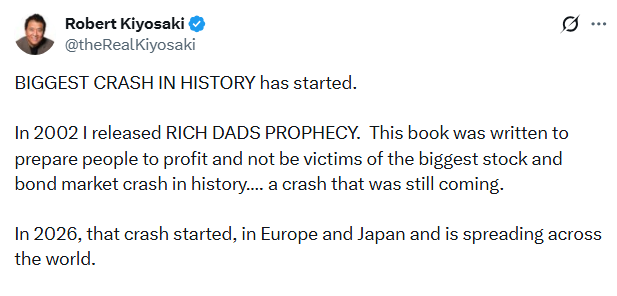
Renowned personal finance expert and author Robert Kiyosaki has issued a stark warning to global investors, predicting an imminent and severe crash in the bond and stock markets. In a recent tweet, Kiyosaki, best known for his seminal work "Rich Dad Poor Dad," asserted that the economic downturn has already begun and its repercussions will likely unfold significantly over the next year. This forecast arrives at a time when U.S. Spot Bitcoin Exchange-Traded Funds (ETFs) are experiencing a surge in investor interest, a trend Kiyosaki suggests may be a consequence of the very economic instability he foresees.
Kiyosaki’s pronouncements paint a grim picture of the global financial landscape. He pointed to a confluence of factors he believes are contributing to this impending crisis. Among these are the speculative frenzy surrounding Artificial Intelligence (AI), escalating geopolitical tensions in the Middle East, the burgeoning burden of government debt worldwide, and the demographic shift of the Baby Boomer generation entering retirement. These elements, he contends, are creating a perfect storm that threatens to destabilize established financial markets.
A Looming Economic Meltdown: Historical Parallels and Contributing Factors
The financial expert’s latest warnings echo sentiments he expressed in his 2002 book, "Rich Dad’s Prophecy," where he presciently cautioned about a severe slump in stock and bond markets. His recent assertion is that these dire scenarios are now materializing in 2026 and have the potential to spread globally. Kiyosaki specifically highlighted that financial markets in Japan and Europe are already exhibiting signs of a wider recession that is gradually permeating the global economy.
The impact of such a downturn, Kiyosaki fears, could be devastating for individuals holding retirement savings in accounts such as 401(k)s, Individual Retirement Arrangements (IRAs), Superannuation in Australia, and Registered Retirement Savings Plans (RRSPs) in Canada. He drew a chilling parallel to the Great Depression, a catastrophic economic period that spanned from 1929 to 1954. During that era, the U.S. stock market crash had a devastating ripple effect across the global economy, plunging millions into financial hardship.
However, Kiyosaki also noted a crucial historical lesson from the Great Depression: even amidst widespread devastation, astute and prepared individuals managed to significantly increase their wealth. He cited prominent figures like the Kennedy family, Walter Chrysler, and William Boeing as examples of those who capitalized on the market crash to build their fortunes. This historical perspective suggests that while the impending crisis poses immense risks, it also presents opportunities for those who are strategically positioned.
The Role of Bitcoin Amidst Economic Uncertainty
In light of his grim economic outlook, Kiyosaki has consistently advocated for specific asset classes as a means of protection against economic downturns. His preferred hedges against recession include tangible assets like gold and silver, along with real estate that generates profitable income and private businesses. Crucially, he also names Bitcoin as a key component of his wealth preservation strategy.
This emphasis on Bitcoin comes at a pivotal moment for the cryptocurrency. U.S. Spot Bitcoin ETFs have recently extended their winning streak, marking a significant period of sustained investor inflows. Data from financial analytics firms indicates that these ETFs have garnered substantial traction, suggesting they have become a vital instrument for a growing segment of ETF investors. This renewed interest in Bitcoin, channeled through regulated financial products, underscores its increasing integration into mainstream investment portfolios.
Market analysts attribute this growing trend to a phenomenon often referred to as the "debasement trade." This occurs when governments resort to printing money to finance their deficits, a practice that inherently erodes the purchasing power of fiat currencies. In such an environment, investors naturally seek alternative assets that can act as a store of value and a hedge against currency devaluation. Gold and Bitcoin, due to their perceived scarcity and decentralized nature respectively, are often seen as prime candidates for this role.
Bitcoin ETFs: A Catalyst for Mainstream Adoption?
The approval and subsequent performance of Spot Bitcoin ETFs in the United States represent a watershed moment for the cryptocurrency industry. Prior to their inception, gaining exposure to Bitcoin for many traditional investors involved navigating the complexities of cryptocurrency exchanges, managing private keys, and understanding the inherent volatility of the digital asset market. Bitcoin ETFs have significantly lowered this barrier to entry.
These ETFs allow investors to purchase shares through their regular brokerage accounts, much like they would invest in traditional stocks or other commodity-backed ETFs. The underlying Bitcoin is held by a custodian, thereby removing the direct responsibility of storage and security from the individual investor. This increased accessibility and familiarity have undoubtedly contributed to the robust demand observed in recent weeks.
The sustained inflows into these ETFs suggest a growing institutional acceptance and a belief among a significant portion of the investment community that Bitcoin has a role to play in a diversified investment portfolio, particularly as a hedge against macroeconomic uncertainty. The "debasement trade" narrative gains further credence when considering the ongoing global economic challenges, including high inflation rates in many developed economies and the continued expansion of central bank balance sheets.
Broader Market Reactions and Implications
While Kiyosaki’s pronouncements are often characterized by their bearish outlook, they resonate with a broader sentiment of caution prevalent in financial circles. Several economic indicators have pointed towards potential headwinds for the global economy. For instance, global debt levels have reached unprecedented highs, raising concerns about sovereign solvency and the capacity of governments to manage their financial obligations. Geopolitical instability, as highlighted by Kiyosaki, adds another layer of uncertainty, potentially disrupting supply chains and impacting global trade.
The AI craze, while driving innovation and growth in certain sectors, also carries speculative risks. Rapid valuations in AI-related companies, often detached from immediate profitability, could signal an asset bubble that may eventually burst, impacting broader market sentiment. Furthermore, the demographic shift of a large cohort entering retirement can lead to shifts in investment patterns, potentially impacting asset prices as retirees rebalance their portfolios.
The implications of Kiyosaki’s warning are far-reaching. For individual investors, it underscores the importance of reassessing their risk tolerance and portfolio allocation. Diversification across different asset classes, including those that have historically performed well during periods of economic distress, becomes paramount. The inclusion of assets like gold, real estate, and potentially Bitcoin, as suggested by Kiyosaki, could offer a buffer against the potential erosion of value in traditional financial assets.
For financial institutions and policymakers, Kiyosaki’s pronouncements serve as a reminder of the fragility of the global financial system. The increasing interconnectedness of markets means that a crisis in one region can quickly spread. This necessitates robust regulatory frameworks, prudent fiscal policies, and proactive measures to mitigate systemic risks. The growing popularity of Bitcoin ETFs also presents a new challenge and opportunity for regulators, who must balance investor protection with fostering innovation in the evolving financial landscape.
The Long-Term Outlook and Investor Preparedness
Kiyosaki’s consistent advocacy for assets like Bitcoin, gold, and silver as hedges against inflation and economic collapse suggests a long-term perspective on the potential devaluation of fiat currencies and the instability of traditional financial systems. His message is not merely one of impending doom but also a call to action for investors to prepare and potentially benefit from periods of market turmoil.
The narrative surrounding Bitcoin as "digital gold" or a hedge against inflation has gained significant traction in recent years. While its volatility remains a concern for many, its fixed supply and decentralized nature differentiate it from fiat currencies, which can be subject to inflationary pressures. The increasing institutional adoption, evidenced by the success of Bitcoin ETFs, lends further credibility to this narrative, moving Bitcoin from the fringes of the financial world towards a more established asset class.
Ultimately, Robert Kiyosaki’s latest warning about an imminent global financial collapse, coupled with his endorsement of Bitcoin as a potential hedge, serves as a potent reminder of the inherent risks and opportunities within the complex world of finance. As the global economic landscape continues to evolve, investors are tasked with navigating these uncertainties with informed strategies and a keen awareness of both potential pitfalls and emerging avenues for wealth preservation and growth. The coming year, as Kiyosaki predicts, may prove to be a critical period for reassessing financial strategies and preparing for the unforeseen.