


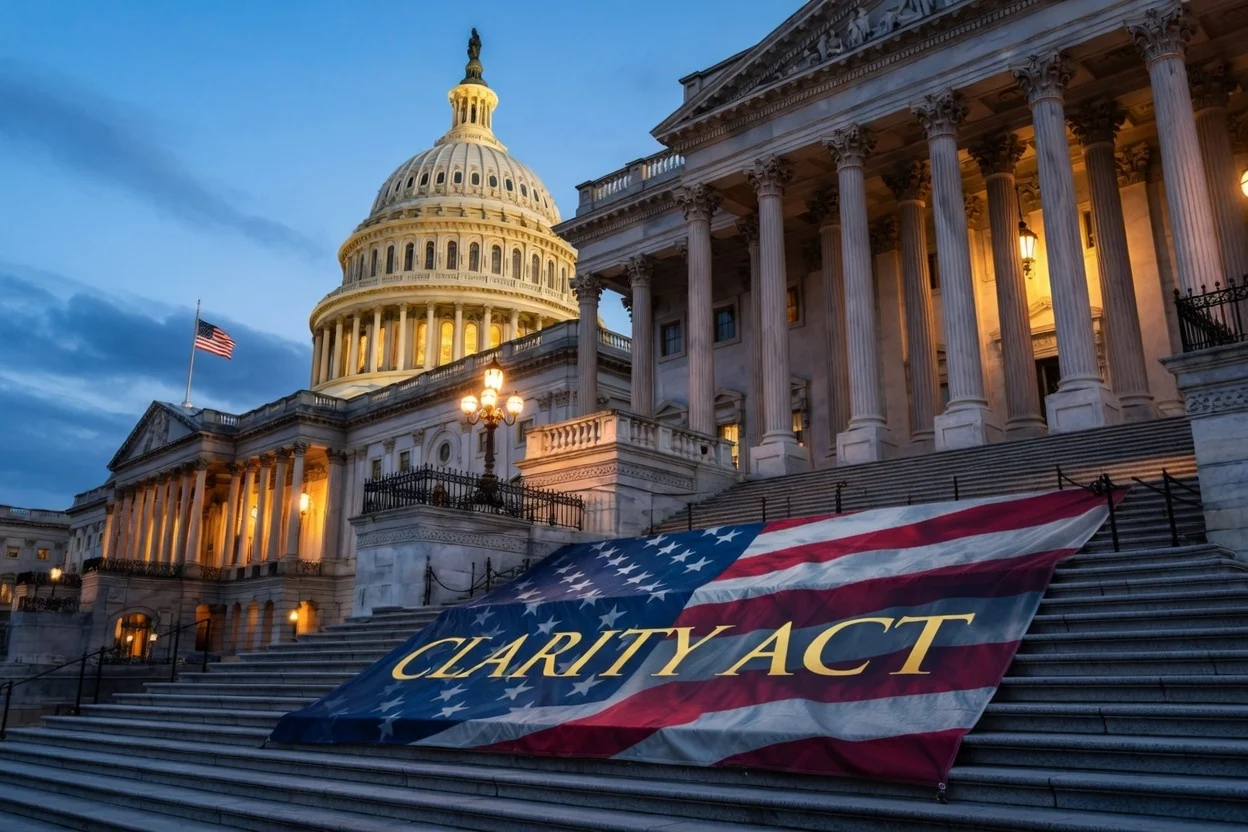
The proposed Clarity Act, a landmark piece of digital asset legislation, has hit a significant roadblock in the Senate, primarily due to an escalating ethics dispute centered on former President Donald Trump’s family’s extensive cryptocurrency interests. Democrats are demanding far more stringent ethics safeguards before they will lend their crucial support to the bill, arguing that the current proposal contains loopholes that could allow Trump and his relatives to continue profiting from various digital assets, including memecoins and holdings in World Liberty Financial. This contentious debate, as reported by Bloomberg, has drastically reduced expectations for the bill’s passage before the crucial August recess and has begun to erode market confidence in the likelihood of a deal materializing this year.
For the Clarity Act to advance through the Senate, Republicans require at least seven Democratic votes, making bipartisan consensus on key issues paramount. Negotiators from both sides now identify the ethics rules as the primary sticking point, ranking it alongside essential consumer safeguards and robust controls against illicit finance. The complexity of these interwoven issues underscores the challenging path ahead for comprehensive cryptocurrency regulation in the United States.
The Clarity Act: A Bid for Regulatory Certainty
The Clarity Act is designed to establish a clear regulatory framework for digital assets in the United States, an area currently characterized by a fragmented and often ambiguous landscape. Proponents argue that a unified federal approach is essential to foster innovation, protect investors, and prevent illicit activities in the rapidly evolving crypto market. Currently, various federal agencies, including the Securities and Exchange Commission (SEC) and the Commodity Futures Trading Commission (CFTC), assert jurisdiction over different aspects of digital assets, leading to regulatory uncertainty that industry players lament. The Act aims to provide much-needed clarity on how cryptocurrencies, stablecoins, and other digital tokens should be classified and regulated, offering a more predictable environment for businesses and investors.
The urgency for such legislation has grown with the increasing mainstream adoption of cryptocurrencies. Without clear rules, the U.S. risks falling behind other nations that have moved more decisively to regulate their digital asset markets. The bill seeks to define which digital assets are securities, which are commodities, and how stablecoins should be governed, thereby addressing some of the fundamental questions that have plagued the industry for years. However, its ambitious scope and the highly politicized nature of cryptocurrency, particularly when intertwined with high-profile political figures, have made its passage an arduous task.
The Core Ethics Dispute: Trump’s Crypto Empire
The ethics controversy gained traction when Senate Republicans released revised language for the Clarity Act this week, hoping to revive negotiations that had stalled for months. However, the updated proposal was swiftly rejected by Democrats and a coalition of watchdog groups, who contended that its ethics protections were insufficient and left significant gaps. At the heart of their concern lies the potential for former President Trump to profit from regulated crypto markets should he return to office, given his well-documented and substantial exposure to digital assets.
Donald Trump’s foray into the cryptocurrency space has been multifaceted and financially significant. Reports indicate that Trump holds exposure to World Liberty Financial through DT Marks DEFI LLC, a venture in which he reportedly owns approximately 38%. Furthermore, his involvement extends to various "memecoin" ventures and other token-related activities, which have generated considerable income. A linked report from Parameter.io indicated that Trump’s cryptocurrency earnings exceeded $1.4 billion in 2025, surpassing profits from many of his traditional businesses. This substantial financial interest in a sector directly impacted by the Clarity Act has fueled accusations of potential conflicts of interest, especially if the proposed legislation does not adequately insulate a future president from personal financial gain through policy decisions.
Critics argue that the proposed language, which allows a president to divest their stake or place assets in a blind trust but does not mandate a full sale, is insufficient. The ambiguity surrounding "officials with a direct interest in digital assets" is particularly problematic, given the complex ownership structure of Trump’s holdings. Watchdog groups contend that such a provision could be easily circumvented, allowing a president to retain significant influence over assets without technically "owning" them directly under the proposed rules.
Specific Flaws in the Proposed Ethics Framework
A major point of contention within the revised Clarity Act language is its specific limitations regarding ethics. The draft explicitly excludes the children of government officials from its purview, meaning that Donald Trump Jr. and Eric Trump could continue their extensive cryptocurrency business activities without facing restrictions under the Act. Both have been actively involved in various crypto ventures, and the inability to regulate their financial dealings related to digital assets is seen by Democrats as a significant loophole that undermines the bill’s integrity. Watchdogs argue that this exclusion weakens the bill’s capacity to address existing conflicts of interest comprehensively, as family members could potentially serve as conduits for financial influence.
Furthermore, the measure explicitly states that it would not recover income already generated from past token and memecoin ventures. This backward-looking limitation is another point of contention for critics, who believe that any robust ethics framework should address existing gains derived from potentially conflicted positions. The argument is that allowing past profits to remain untouched sets a poor precedent and fails to fully address the scope of the ethical concerns.
Another critical area of disagreement revolves around enforcement. Democrats strongly oppose giving the Justice Department primary authority over the new ethics rules, fearing that such a framework could be susceptible to political influence. They argue that blocking state attorneys general from acting as an independent enforcement channel removes a crucial layer of accountability and oversight. Senator Angela Alsobrooks (D-MD) has been particularly vocal on this issue, describing ethics as the "decisive issue" in current negotiations, indicating that her party will not compromise on the need for robust, independent enforcement mechanisms. Senators Ruben Gallego (D-AZ) and Thom Tillis (R-NC) are reportedly working to develop a potential compromise framework, suggesting the intensity of these negotiations.
Political Dynamics and Senate Negotiations
The path forward for the Clarity Act is complicated by the intricate political landscape of the Senate. Republicans, holding a slim majority, need at least seven Democratic votes to overcome potential filibusters and ensure swift passage of the legislation. This numerical reality grants Democrats significant leverage in shaping the final language of the bill. Senate Majority Leader John Thune (R-SD) has expressed skepticism regarding the bill’s prospects, stating that he does not expect the Clarity Act to pass before the August recess. This looming deadline adds immense pressure to negotiators, who must still reach consensus on consumer protection measures and illicit finance controls in addition to the ethics provisions.
The political stakes extend beyond the immediate legislative battle. The cryptocurrency industry, through powerful lobbying groups and political action committees (PACs), has become a significant force in Washington. Fairshake, a prominent crypto-aligned super PAC, along with two affiliated PACs, has reportedly raised a staggering $164 million for the upcoming midterm elections. Federal filings reveal that they have already spent $66.6 million, primarily supporting candidates perceived as crypto-friendly. This financial muscle creates a complex dilemma for Democrats: those who are seen as "crypto-friendly" risk alienating a powerful industry if talks collapse, potentially directing significant campaign spending against their candidacies. Conversely, progressive Democrats could face attacks from their base if they compromise too much on ethics, especially concerning perceived conflicts related to figures like Donald Trump.
Senator Chris Murphy (D-CT) has explicitly urged his Democratic colleagues to frame crypto corruption as a potent campaign issue, highlighting the broader political ramifications of this debate. This suggests a strategic effort to leverage the ethics controversy to galvanize voter support and potentially pressure Republicans into accepting stronger safeguards.
Broader Regulatory Divisions and Industry Concerns
Beyond the ethics dispute, the Clarity Act faces other significant obstacles, reflecting deeper divisions within the regulatory and financial sectors. One major point of contention involves stablecoin rewards, with traditional banks advocating for tighter limits. Banks fear that unregulated or lightly regulated yield-bearing crypto accounts could attract deposits away from traditional banking institutions. Such a shift could significantly reduce their lending capacity, impact liquidity, and ultimately pressure banking profits, potentially destabilizing the financial system.
To address these concerns, Senator Thom Tillis (R-NC) has discussed the possibility of introducing "circuit-breaker powers" for federal regulators like the Federal Deposit Insurance Corporation (FDIC). These powers would allow regulators to intervene if a sharp decline in traditional bank deposits were observed due to outflows into crypto accounts. However, this approach has met with strong opposition from within the Republican ranks, most notably from Senator Cynthia Lummis (R-WY), a staunch supporter of digital assets and co-sponsor of previous crypto legislation. This disagreement illustrates how the Trump crypto business controversy intersects with broader fights over market structure, banking competition, and the appropriate scope of regulatory oversight for digital assets.
Another contentious provision in the proposed Act is a sunset clause that would terminate the new ethics rules on January 20, 2029. This date precisely aligns with the inauguration of Trump’s potential successor, sparking accusations from opponents that the clause is designed to limit accountability after his term. Critics argue that such a sunset undermines the long-term integrity of the ethics framework. Republicans, however, counter that the proposal already imposes restrictions beyond those accepted by previous presidents, suggesting that the sunset clause merely brings the rules in line with historical precedents for post-presidency conduct.
Financial and Market Implications
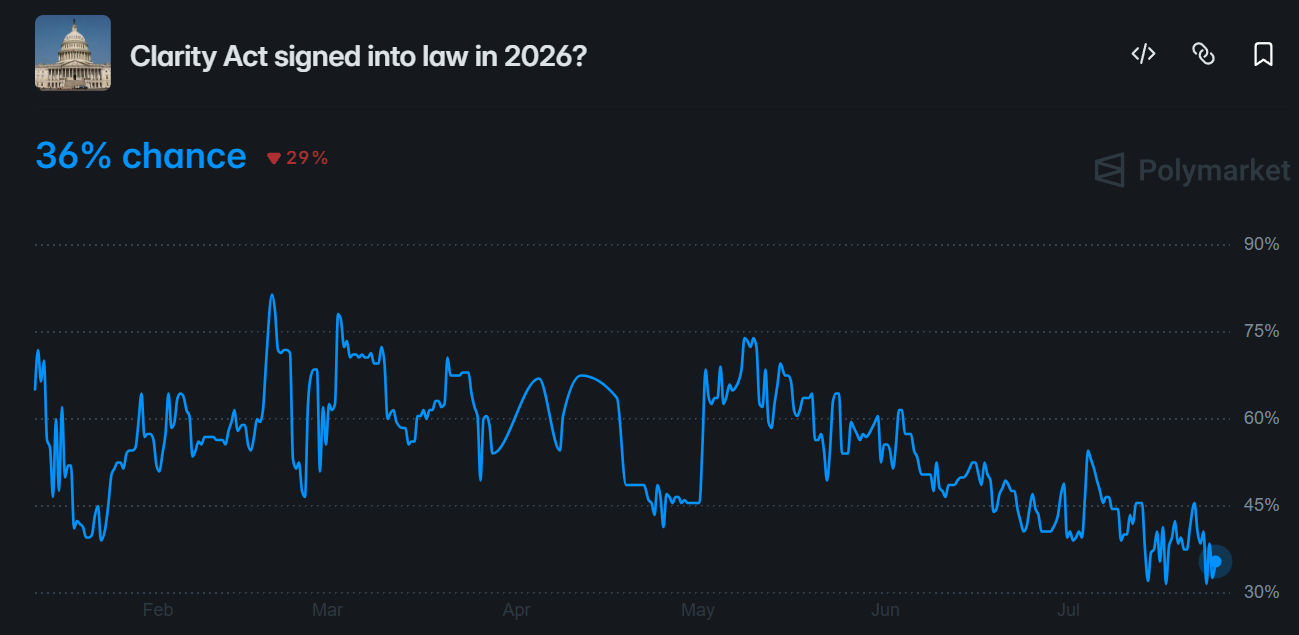
The ongoing uncertainty surrounding the Clarity Act has had tangible effects on the digital asset market. Prediction markets, often seen as indicators of informed sentiment, reflect the growing pessimism. Polymarket traders, for instance, have placed the odds of the Clarity Act passing near one in three. This figure represents a significant drop, roughly half the probability recorded after a Senate committee backed an earlier version of the bill on May 14. This declining confidence underscores the market’s sensitivity to regulatory clarity and the perception of political stability surrounding digital assets.
A failure to pass the Clarity Act would perpetuate the existing regulatory ambiguity, potentially hindering innovation and investment in the U.S. crypto sector. Companies might choose to relocate to jurisdictions with more defined rules, and institutional investors may remain hesitant to fully commit to the market without a clear legal framework. The protracted debate also signals a broader challenge in Washington’s ability to adapt to new technologies and regulate them effectively, potentially leaving the U.S. at a disadvantage in the global digital economy. The intersection of presidential ethics, financial regulation, and partisan politics has created a perfect storm, placing the future of comprehensive crypto legislation in severe jeopardy.
The Road Ahead: Navigating the Impasse
The Clarity Act stands at a critical juncture, emblematic of the complex challenges facing digital asset regulation in the United States. The ethics dispute, inextricably linked to Donald Trump’s significant crypto holdings, has become a central impediment, overshadowing other crucial aspects of the bill, such as consumer protection and illicit finance controls. Democrats, emboldened by watchdog groups and the potential political leverage of the ethics argument, are unlikely to yield on their demands for stronger, independently enforceable safeguards.
Republicans, while keen to pass landmark crypto legislation, face the delicate task of balancing their desire for regulatory clarity with the need to secure bipartisan support, potentially requiring compromises on provisions that touch upon the financial interests of a prominent figure within their party. The August recess deadline looms large, and without a breakthrough in negotiations on the ethics front, the prospects for the Clarity Act appear increasingly dim. The outcome will not only determine the future regulatory landscape for cryptocurrencies in the U.S. but also set a precedent for how Congress addresses potential conflicts of interest arising from evolving asset classes and the financial entanglements of political leaders. The current impasse underscores the high stakes involved, with implications for market stability, technological innovation, and the integrity of American political institutions.














