


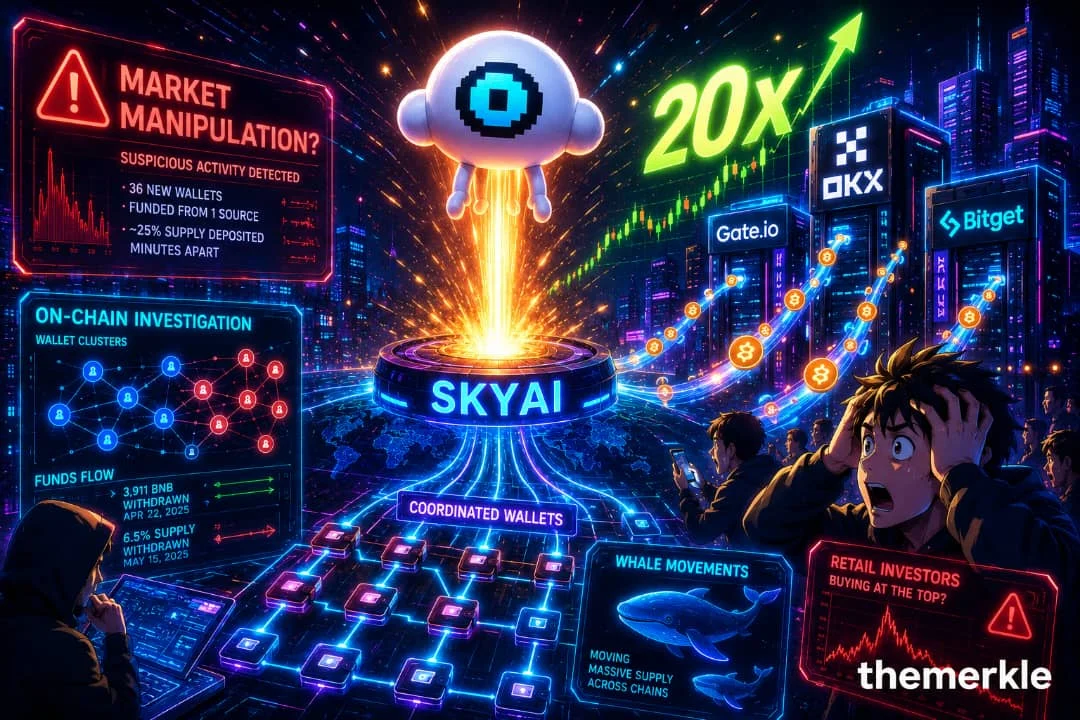
The cryptocurrency market finds itself once again under intense scrutiny, as an explosive price surge in the relatively unknown token SkyAI has triggered a cascade of alarms regarding potential transparency issues, deeply coordinated wallet activity, and suspected involvement from centralized exchanges. What initially appeared to be a meteoric breakout rally has quickly escalated into a comprehensive investigation spearheaded by prominent blockchain analytics firms and on-chain sleuths, who have meticulously identified trading patterns that strongly suggest the recent price action deviates significantly from natural market demand. With the token’s fully diluted valuation (FDV) nearing an astonishing $800 million following its rapid ascent, urgent questions are now mounting over the true forces propelling this rally and the profound risks being silently embedded into the investments of unsuspecting retail participants.
Unmasking the Parabolic Ascent: A Closer Look at SkyAI’s Rally
SkyAI, a cryptocurrency that had previously languished in relative obscurity, abruptly gained an approximate twentyfold increase in value over a short period, captivating market attention. While rapid price appreciation often signals strong investor interest and project momentum, in SkyAI’s case, this parabolic rise has instead triggered widespread suspicion across the blockchain community. The velocity and scale of the surge, particularly after a prolonged period of dormancy on trading platforms, immediately flagged it for closer examination by experts.
Blockchain analytics firm Bubblemaps was among the first to sound the alarm, asserting that the rally exhibits tell-tale signs of coordinated wallet activity and potential manipulation directly linked to centralized exchanges (CEXs). While the full extent of this alleged activity remains under active investigation, early findings have uncovered a complex and intricate web of transactions that defy straightforward explanations rooted in organic market demand. This intricacy suggests a deliberate, strategic effort rather than the spontaneous actions of diverse individual investors.
The Precursor: Suspicious Wallet Activity Before the Surge
A particularly troubling aspect of the SkyAI rally, according to on-chain data, is the highly unusual pattern of wallet activity that preceded the significant price upswing. Bubblemaps’ analysis revealed that a cohort of 36 newly created wallets collectively deposited approximately 25% of the token’s entire supply—an estimated $135 million at the then-current valuation—into the Gate.io exchange on April 30th. Crucially, these substantial deposits occurred mere minutes apart, a timing coincidence that is statistically improbable for independent actors. Further investigation into these wallets uncovered an even more concerning detail: the vast majority were funded from a singular, identifiable source. This level of correlation is exceedingly rare in legitimate market dynamics and is frequently interpreted as a hallmark of "herding behavior" or coordinated action rather than autonomous investment decisions.
Such a focused and tactically executed placement of significant token volumes across exchanges, particularly just ahead of a major price movement, possesses the inherent capacity to exert substantial market influence. These pre-surge maneuvers could serve multiple purposes, from establishing large positions discreetly to preparing for a coordinated "pump" by ensuring liquidity on target exchanges.
Beyond these pre-rally deposits, concerns extend to the initial launch phase of SkyAI, where data also indicates a "lumpy distribution" of tokens. A specific cluster of newly created wallets reportedly received approximately 4.5% of the total token supply through an airdrop, an amount valued at around $24 million at current prices. These wallets, much like those observed later, displayed a set of unique characteristics that strongly suggested a lack of true decentralization at the project’s inception. Instead, this pattern implies that a significant portion of the supply was intentionally "staged" in the hands of a few large holders, often referred to as "whales," with the probable intent of orchestrating joint movements at a future date. This initial distribution strategy lays the groundwork for potential market control, as concentrated holdings make it easier to influence price action.
Historical On-Chain Movements Bolster the Manipulation Case
Retrospective analysis of earlier on-chain movements further strengthens the argument for coordinated manipulation. A significant event occurred on April 22, 2025, when approximately 3,911 BNB coins (Binance Coin) were withdrawn from major centralized exchanges, specifically Bitget and OKX. These funds were subsequently funneled into a series of recently created wallets, which were then utilized to acquire SkyAI tokens. This sequence of actions—withdrawal of capital from established exchanges, transfer to new, anonymous wallets, and immediate deployment to purchase the target asset—is a classic pattern observed in accumulation phases by entities seeking to obscure their identities and intentions.
Roughly two weeks later, on May 15, 2025, another substantial withdrawal of SkyAI tokens took place. Approximately 6.5% of the total SkyAI supply was moved off exchanges, including HTX, Gate.io, and Bitget. While each of these events, when viewed in isolation, might not immediately raise an alarm, their combined chronology and the consistent pattern of funds flowing through newly established, interconnected wallets paint a clear and compelling picture of a concerted effort. This pattern strongly indicates a collaborative operation aimed at dominating and strategically redistributing the token supply, particularly in the critical period leading up to and immediately following the recent dramatic price surge. Such organized movements are typically characteristic of market manipulators attempting to control supply and demand dynamics to their advantage.
Echoes of Past Scandals: Analysts Warn of Recurring Patterns
Veteran on-chain investigator ZachXBT, renowned for his forensic analysis of cryptocurrency scams and illicit activities, has been vocal for months about such manipulative behaviors. He has consistently warned that centralized exchanges, wittingly or unwittingly, are either facilitating or failing to actively prevent manipulation schemes designed to artificially inflate token prices, only for them to be "dumped" on retail investors.
ZachXBT points to recent instances involving tokens like LAB, RAVE, and PIPPIN, all of which experienced similar sky-high valuations followed by precipitous drops, leaving retail investors exposed to massive downside risks. He argues that SkyAI is now treading a disturbingly similar path. The pattern identified involves extended periods of token dormancy, followed by simultaneous, large-scale purchase upswings that ignite price spikes, drawing in retail exuberance at inflated prices. This "pump-and-dump" methodology relies heavily on creating an illusion of organic demand and rapid growth, luring in less experienced investors who enter the market at the peak, only to suffer significant losses when the initial orchestrators liquidate their holdings. ZachXBT’s repeated warnings underscore a systemic issue within the crypto ecosystem, where vulnerabilities are exploited for illicit gains.
Centralized Exchanges: A Conspicuous Silence Amidst Growing Evidence
Despite the mounting evidence from blockchain analytics firms and the increasingly vocal discourse within the crypto community, the centralized exchanges implicated in the SkyAI trading patterns have largely remained silent. No comprehensive statements or official responses regarding the unfolding events have been issued by Gate.io, Bitget, OKX, or HTX. This conspicuous silence is particularly concerning given the gravity of the allegations, which suggest direct involvement or, at the very least, a failure to detect and prevent potential market manipulation on their platforms.
The fact that tokens like SkyAI, LAB, PIPPIN, and RAVE continue to be traded on these exchanges, even after analysts have publicly highlighted clear signs of manipulation, fuels whispers and speculation among market participants. Many are questioning whether exchanges are actively tracking and investigating these unusual activities or if they are simply content to benefit from the increased trading volumes that such volatile price actions inevitably generate. This opacity from key market intermediaries not only fosters an environment ripe for speculation but also severely erodes trust in centralized trading venues, which are often touted as more secure and regulated alternatives to decentralized platforms. The lack of transparency from CEXs in such critical situations poses a significant threat to the credibility and integrity of the broader cryptocurrency industry.
Late last night, the SkyAI project did issue a statement, disavowing any connection with the suspicious wallet transactions. They asserted that the accounts involved have no relation to the project itself and stated they are monitoring ongoing developments and assisting with open inquiries to identify fund movements and wallet activity. While this response is a crucial step towards addressing concerns, it only partially alleviates the larger questions surrounding the token’s initial distribution and the intricate patterns of trading activity observed on centralized platforms. It highlights the complex challenge of distinguishing official project actions from the independent, potentially manipulative, behaviors of large holders.
A Multifaceted Case with Far-Reaching Market Implications
Bubblemaps itself has characterized the SkyAI case as one of the most complex it has ever encountered, emphasizing the intricate flow of funds and the sophisticated interactions between numerous wallets. This complexity is not merely an isolated incident; it reflects a pervasive and widespread problem within the cryptocurrency ecosystem: the inherent difficulty in accurately parsing genuine market demand from deliberately coordinated manipulation, especially in an environment that still lacks firmly established and universally enforced standards of transparency.
The SkyAI saga serves as a potent cautionary tale regarding the rapid and dramatic shifts in narrative that can occur within the volatile crypto space. Only a few weeks ago, SkyAI was lauded as an emerging star, seemingly on a trajectory of organic growth and innovation. Today, it faces intense scrutiny, its legitimacy questioned, and its future clouded by allegations of market misconduct.
The lesson for investors is unequivocally clear: in a market where price movements can be influenced by hidden hands and sophisticated schemes, developing the ability to interpret on-chain data and exercising extreme caution when approaching parabolic rallies are not merely advisable but absolutely essential. Blindly chasing gains based on hype or superficial price charts can lead to devastating financial losses.
Moving forward, as investigations continue to unfold, the ramifications of the SkyAI incident are likely to extend far beyond the token itself. This case has significant implications for how the entire cryptocurrency industry manages transparency, enforces accountability, and, most critically, protects its investors from predatory practices. It will undoubtedly fuel ongoing debates about the need for clearer regulatory frameworks, enhanced oversight of centralized exchanges, and more robust mechanisms for detecting and preventing market manipulation across the digital asset landscape. The outcome of this investigation could set a precedent for how future instances of suspected manipulation are handled, potentially shaping the future trust and adoption of cryptocurrencies globally.
Disclosure: This is not trading or investment advice. Always do your research before buying any cryptocurrency or investing in any services.
Follow us on Twitter @themerklehash to stay updated with the latest Crypto, NFT, AI, Cybersecurity, and Metaverse news!














