



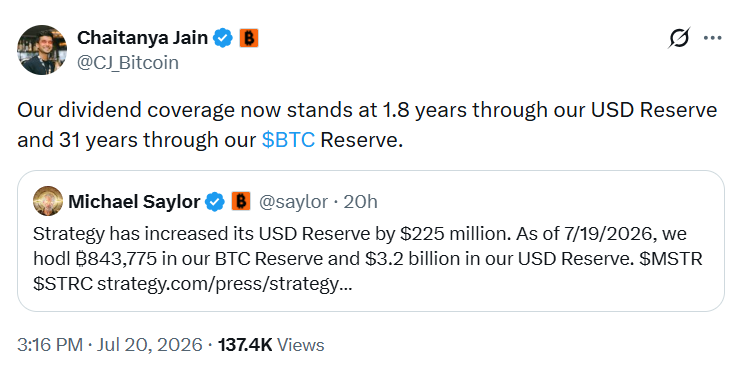
Strategy, a prominent entity in the digital asset space, has once again captured significant attention following a recent revelation by its corporate treasurer, Chaitanya Jain. The disclosure highlights the extraordinary scale of the company’s Bitcoin holdings, suggesting that its cryptocurrency treasury alone could potentially fund shareholder dividends for an impressive 31 years. This projection dramatically contrasts with the company’s traditional U.S. dollar reserves, which would only cover approximately 1.8 years of such obligations. This stark comparison underscores the increasingly pivotal role Bitcoin plays in Strategy’s long-term financial planning and balance sheet strength.
The latest update comes on the heels of a confirmation from Strategy’s founder, Michael Saylor, who has consistently championed the adoption of Bitcoin as a corporate treasury asset. As of July 19, Saylor confirmed that Strategy held a staggering 843,775 Bitcoin, solidifying its position as the world’s largest corporate holder of the digital currency. This substantial accumulation of Bitcoin, acquired at an average cost of $75,476 per coin, for a total investment of approximately $63.69 billion, represents a significant strategic pivot for the company. Notably, during the latest reporting period, Strategy did not engage in any Bitcoin transactions, neither buying nor selling, indicating a steadfast commitment to its existing holdings. Instead, the company focused on bolstering its liquidity through its at-the-market (ATM) common stock program.
Strategic Financial Maneuvering: Equity Issuance and Liquidity Enhancement
Between July 13 and July 19, Strategy successfully generated approximately $263.5 million by selling its Class A common shares. These proceeds were strategically allocated to increase the company’s U.S. dollar reserve, bringing it to roughly $3.225 billion. This infusion of capital serves a dual purpose: providing immediate liquidity for operational needs and enhancing the company’s ability to meet its financial obligations. Specifically, the cash reserve is earmarked to support preferred stock dividend payments and service interest on outstanding debt, thereby granting Strategy enhanced financial flexibility in navigating market fluctuations.

Despite the monumental role Bitcoin now plays on its balance sheet, Strategy continues to leverage equity markets as a crucial mechanism for financing its operations and reinforcing its treasury. The company’s regulatory filings indicate substantial runway within its common stock ATM program, with approximately $23.5 billion in remaining capacity. This provides Strategy with considerable room to raise additional capital should market conditions or strategic objectives necessitate it. This approach highlights a sophisticated financial strategy that integrates digital assets with traditional capital markets to achieve robust financial resilience.
The Bitcoin Thesis: Long-Term Value Preservation Over Active Trading
Strategy’s consistent accumulation and retention of Bitcoin, rather than engaging in speculative trading, reflects a core tenet of its corporate finance philosophy. The company appears committed to preserving its long-term cryptocurrency holdings, viewing them as a fundamental asset for future value appreciation and as a hedge against traditional economic uncertainties. This strategy contrasts with many other publicly traded companies that might treat their Bitcoin holdings more like volatile trading assets. Strategy’s approach suggests a belief in Bitcoin’s enduring value proposition as a store of wealth and a potential catalyst for long-term growth.
Investor Perspectives on Strategy’s Unique Financing Model
The intricate financing model employed by Strategy, particularly its reliance on both Bitcoin and equity issuance, has naturally drawn the attention of investors and financial analysts. The company’s preferred stock, in particular, has become a focal point for discussions regarding its valuation and long-term viability. Credit investor Khing Oei, in a notable commentary, posited that the market might be undervaluing Strategy’s STRC preferred shares. Oei argued that investors are often too focused on the current yield of these securities, overlooking their significant long-term cash generation potential.
Oei’s analysis draws a parallel between Strategy’s preferred shares and traditional bonds, emphasizing the company’s demonstrated ability to sustain dividend payments over extended periods. This sustained payout capacity, he suggests, inherently strengthens the long-term value proposition of the preferred stock. Furthermore, Oei highlighted that any potential appreciation in Bitcoin’s price could serve as an additional tailwind for Strategy’s financial standing, potentially leading to a more favorable valuation of its preferred securities over time. This perspective suggests that the intertwined success of Strategy’s Bitcoin holdings and its equity offerings could create a virtuous cycle of financial strength and investor confidence.
A Paradigm Shift in Corporate Treasury Management
Strategy’s latest financial disclosures paint a vivid picture of a significant and deliberate shift in its balance sheet composition. While the company continues to prudently grow its cash reserves through strategic stock issuance, its leadership consistently emphasizes the paramount importance of its Bitcoin holdings as the bedrock of its long-term financial resilience. This embrace of Bitcoin as a core treasury asset represents a bold departure from conventional corporate finance practices and positions Strategy at the forefront of companies exploring the potential of digital assets.
As Strategy continues to expand its capital-raising programs while maintaining its substantial Bitcoin exposure, the market will undoubtedly remain keen observers. The success of its unconventional treasury model hinges on its ability to consistently deliver both robust balance sheet stability and sustained long-term shareholder value. The ongoing integration of digital assets into mainstream corporate finance strategies is a developing narrative, and Strategy’s journey offers a compelling case study in navigating this evolving landscape.
At the time of reporting, Bitcoin (BTC) was trading at approximately $64,880, reflecting a modest 0.45% gain over the preceding 24 hours. This price action, while not directly indicative of Strategy’s specific holdings’ current valuation due to the time lag in reporting, provides context for the broader cryptocurrency market dynamics within which Strategy operates. The sustained upward trend in Bitcoin’s price over recent periods has undoubtedly contributed to the growing value of Strategy’s substantial holdings, reinforcing the financial prudence of its long-term accumulation strategy.
The Broader Implications: Bitcoin as a Strategic Corporate Asset
The strategic decisions made by companies like Strategy have far-reaching implications for the broader adoption of Bitcoin as a legitimate corporate asset. By demonstrating the potential for Bitcoin to serve not only as a store of value but also as a potential engine for dividend sustainability, Strategy is challenging traditional financial paradigms. This approach could encourage other corporations to re-evaluate their own treasury management strategies, potentially leading to increased institutional adoption of Bitcoin.

Furthermore, the ongoing debate surrounding the valuation of Strategy’s preferred stock, as highlighted by Khing Oei, underscores the innovative financial instruments that can emerge when companies integrate digital assets into their core operations. The potential for Bitcoin’s appreciation to bolster the value of these securities presents a novel investment thesis that merges cryptocurrency exposure with traditional equity and debt markets.
However, the inherent volatility of Bitcoin remains a key factor that investors and analysts will continue to monitor. While Strategy’s strategy appears to be one of long-term holding, significant downturns in the Bitcoin market could, in theory, impact the company’s overall financial position and investor sentiment. The company’s ability to manage this volatility through its diversified approach, which includes substantial cash reserves and ongoing equity issuance, will be critical to its sustained success.
In conclusion, Strategy’s bold embrace of Bitcoin as a central component of its corporate treasury, coupled with its sophisticated capital-raising strategies, positions it as a significant player in the evolving landscape of corporate finance. The company’s commitment to its digital asset holdings, while simultaneously strengthening its traditional financial foundations, presents a compelling narrative of adaptation and innovation in the face of a rapidly changing economic and technological environment. The long-term success of this unconventional model will be closely watched by the financial world, offering valuable insights into the future of corporate treasury management in the digital age.














