A recent investigation by prominent on-chain sleuth ZachXBT has brought to light a disturbing series of violent home invasion robberies in France, resulting in the theft of approximately $667,000 in cryptocurrency. Unlike many crypto-related crimes that begin with digital exploits or phishing scams, this case underscores a growing, physically violent dimension to cryptocurrency theft, where perpetrators target individuals directly in their homes. The unraveling of this sophisticated laundering operation, which saw funds moved across multiple blockchains and exchanges, was ultimately aided by an alleged perpetrator’s conspicuous social media activity, revealing a striking paradox of technical sophistication undermined by basic carelessness.
The Double Assault: A Chronology of Violence
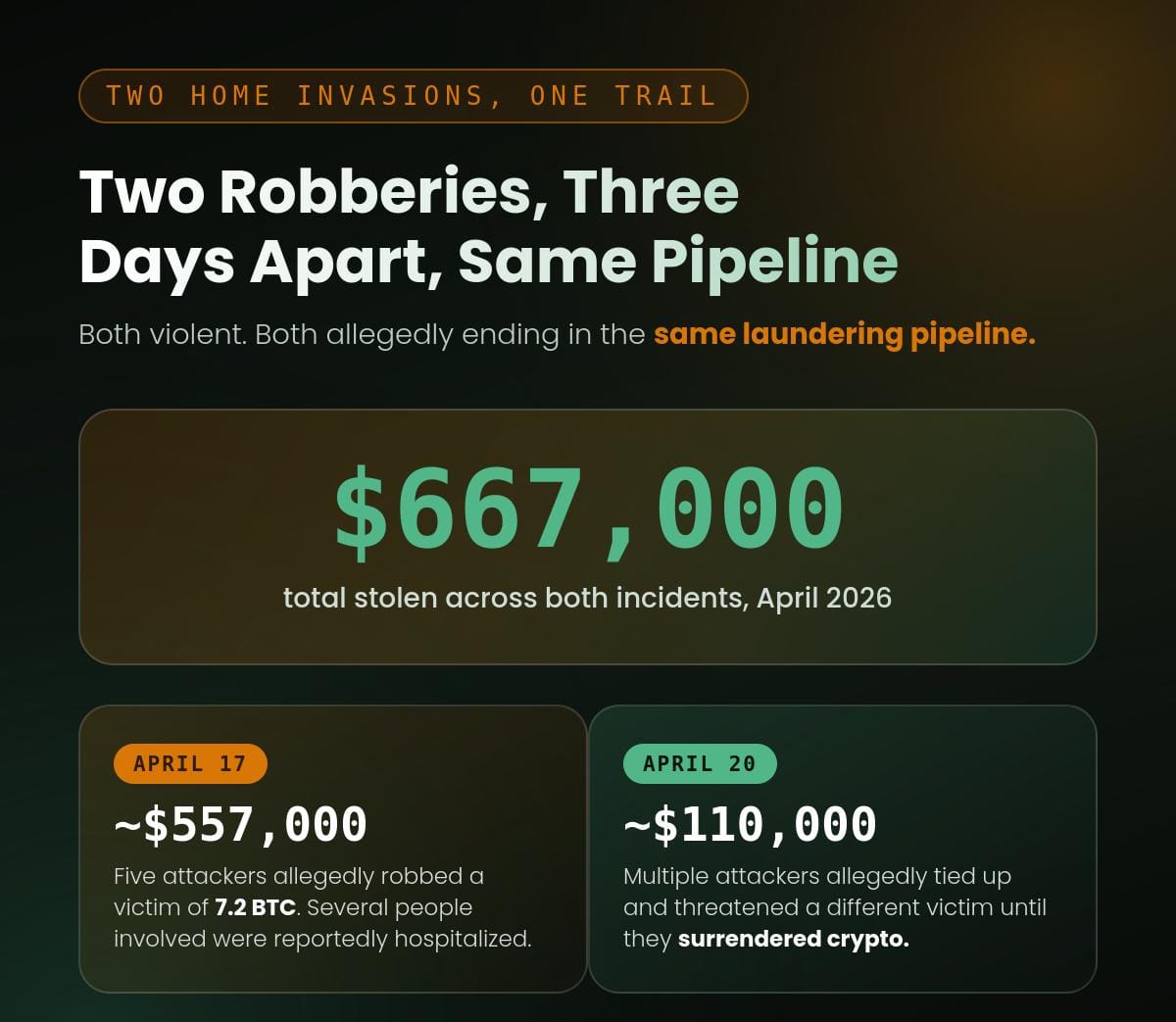
The investigation details two distinct but interconnected home invasion robberies that occurred within days of each other in April 2026, both characterized by extreme violence and a clear intent to extract cryptocurrency from the victims. Such incidents highlight a worrying trend where the high value and often irreversible nature of cryptocurrency transactions make individuals with known crypto holdings prime targets for physical assaults, moving beyond traditional cybercrime into the realm of real-world physical threats.
The first incident, reported on April 17, involved five assailants who violently broke into a victim’s home. The attackers reportedly subjected the victim to severe physical duress, ultimately coercing them into surrendering approximately 7.2 Bitcoin (BTC), which was valued at around $557,000 at the time of the theft. The brutality of the attack was such that several individuals involved, presumably the victims or those attempting to intervene, required hospitalization for their injuries. The stolen funds were subsequently traced to a wallet address beginning with bc1qrdq5acl9nw4gt3cjte2629lw9qcg9xxkf3x02k, marking the initial digital footprint of the illicit gains.
Just three days later, on April 20, a second, similarly violent home invasion unfolded in France. In this instance, multiple attackers reportedly tied up and threatened another victim, compelling them to transfer approximately $110,000 worth of various cryptocurrencies. The funds from this second robbery were moved out of an address beginning with 0x3000d2a2. The proximity of these two violent events, both geographically and chronologically, coupled with the similar modus operandi and target profile, immediately raised red flags for ZachXBT, suggesting a coordinated effort by the same criminal group and hinting at a shared laundering pipeline that would prove central to the investigation. The pattern of physical violence followed by rapid on-chain movements is a hallmark of an increasingly professionalized criminal ecosystem attempting to capitalize on the perceived anonymity and speed of cryptocurrency.

The Digital Pursuit: Unraveling the Laundering Network
The subsequent on-chain investigation by ZachXBT meticulously tracked the stolen funds, revealing a complex web of transactions designed to obscure their origin. What is particularly noteworthy is the juxtaposition of this elaborate digital obfuscation with the alleged perpetrator’s eventual, glaring oversight in their personal conduct.
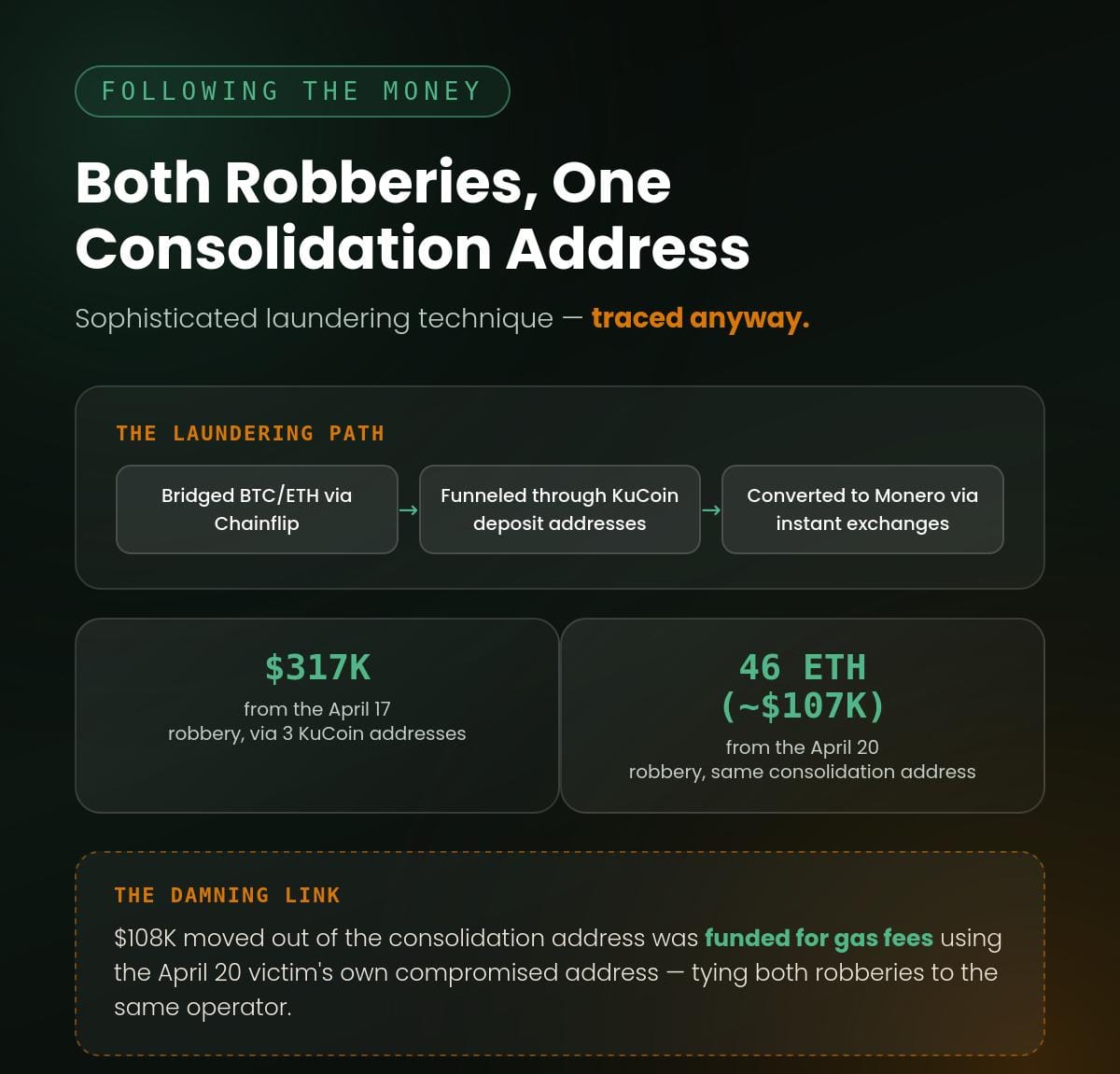
The funds stolen from the April 17 robbery were initially funneled through a cross-chain platform called Chainflip, which served as a bridge to convert the Bitcoin into Ethereum. Chainflip, like other cross-chain protocols, facilitates the movement of assets between disparate blockchain networks, a process often utilized by illicit actors to break the direct link between stolen funds and their original chain, thereby complicating tracing efforts. Following this initial conversion, a substantial portion, approximately $317,000, was then systematically funneled through three separate deposit addresses on KuCoin, a centralized cryptocurrency exchange known for its wide range of trading pairs and global accessibility. While KuCoin, like other regulated exchanges, has Know Your Customer (KYC) and Anti-Money Laundering (AML) policies, sophisticated criminals often employ various tactics, including the use of "mule" accounts or exploiting less stringent verification tiers, to bypass these controls. ZachXBT’s meticulous timing analysis of withdrawals from these KuCoin addresses ultimately linked these fragmented deposits back to a single, central consolidation address: 0xe744d8890792eb4b51ac6565e3d409076b62b302. Furthermore, another batch of the stolen funds from the April 17 incident was converted into Monero (XMR) through two instant exchanges and a platform known as Wagyu. Monero is a privacy-centric cryptocurrency specifically designed to make transactions untraceable, a feature that makes it a favored tool for money launderers seeking to fully obscure the flow of illicit funds.
The funds from the April 20 robbery followed a strikingly similar laundering trajectory. After being bridged to Ethereum, approximately 46 ETH, valued at around $107,000, was laundered through yet another KuCoin deposit address. Crucially, ZachXBT’s analysis revealed that the withdrawals from this KuCoin address also traced back to the exact same consolidation address (0xe744), firmly establishing a direct financial link between the two violent home invasions and suggesting a single orchestrating entity. From this consolidation address, a further $108,000 was moved to a separate wallet, where it was swapped from ETH to USDT (Tether). A critical piece of evidence in connecting these cases emerged from a small, yet damning, detail: the gas fees required for this ETH-to-USDT swap were reportedly funded using the April 20 victim’s own compromised cryptocurrency address. This particular detail provides a robust and direct on-chain link, effectively tying the alleged operator not just to the stolen funds, but directly to the victim’s compromised accounts, thereby strengthening the investigative findings significantly. The precision required to follow these digital breadcrumbs across multiple chains, exchanges, and transaction types underscores the advanced capabilities of modern on-chain forensic analysis.
From On-Chain to Real-World Consequences: The Freeze
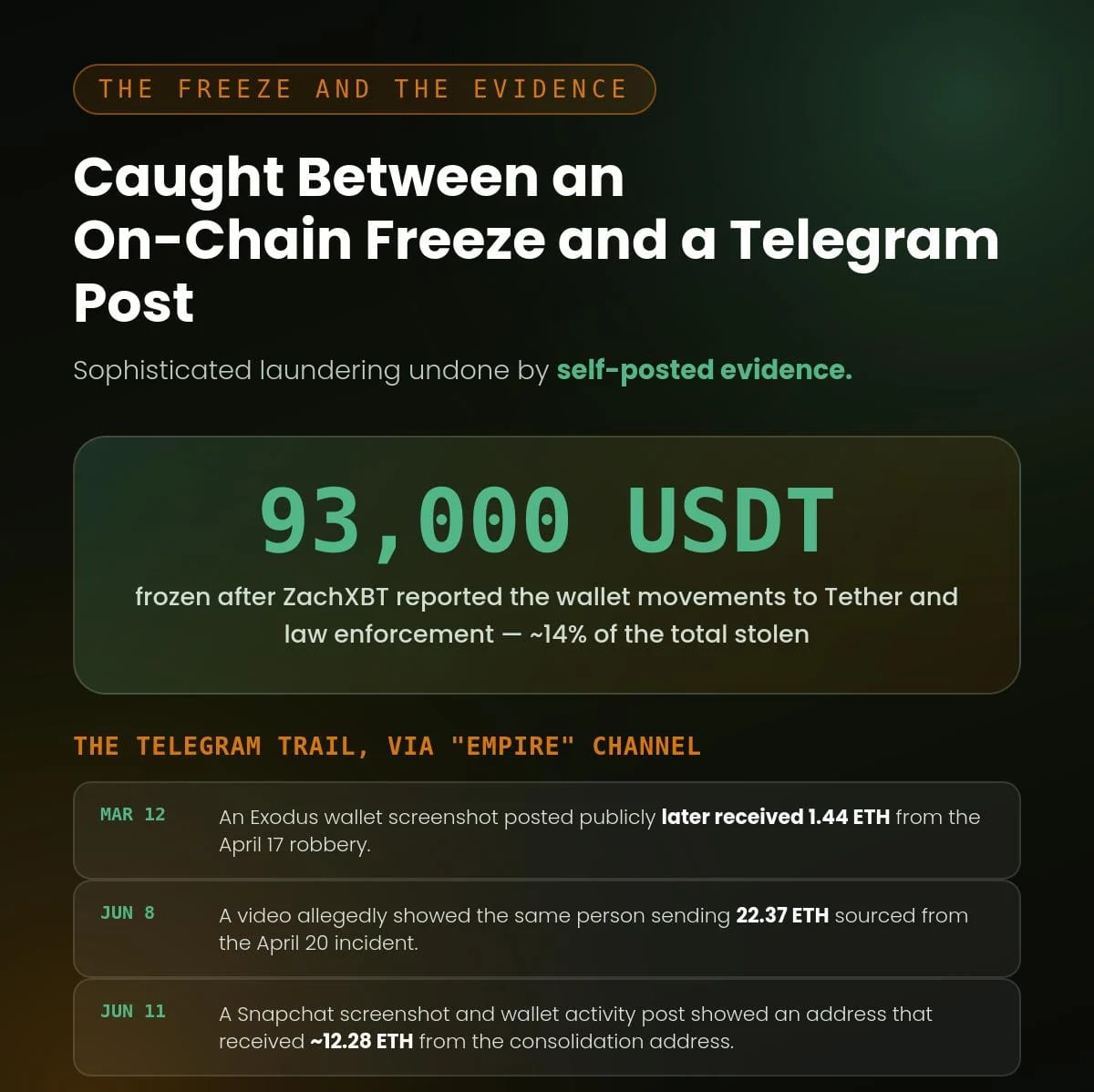
The utility of on-chain investigations extends beyond merely tracing stolen assets; it can also facilitate their recovery. In a significant development, ZachXBT acted decisively upon his findings, reporting the identified wallet movements directly to Tether, the issuer of the USDT stablecoin, and to relevant law enforcement agencies. This rapid and coordinated action yielded a tangible result: a freeze of 93,000 USDT at the address 0x47967fe27f07fb54e9f4daa2541c0f75e27ddde7.
This freeze represents a meaningful victory in the fight against crypto crime. The recovered amount constitutes approximately 14% of the combined $667,000 stolen from both robberies. In an ecosystem where the recovery rate for stolen cryptocurrencies is notoriously low, often hovering in the single digits or considered entirely unrecoverable within days of a theft, this outcome is genuinely rare and highly significant. Tether, as a centralized issuer of a stablecoin, possesses the technical capability to freeze assets linked to illicit activities, a power that is increasingly leveraged by law enforcement and on-chain investigators to claw back stolen funds. This incident highlights the critical role stablecoin issuers can play in disrupting money laundering pipelines and offers a glimmer of hope for victims of cryptocurrency theft, demonstrating that proactive engagement with both forensic experts and asset issuers can lead to concrete financial recoveries, even in cases involving complex cross-chain laundering techniques.
The Social Media Thread: Unmasking "M1llionz"
The digital trail of stolen funds, while intricate, might have remained anonymous were it not for the alleged perpetrator’s astounding lack of caution on social media. The identification piece of this extensive investigation reportedly centered on a Telegram channel named "EMPIRE," allegedly operated by an individual using the handle "M1llionz." This case provides a stark illustration of how criminals, despite employing sophisticated technical measures for obfuscation, often fall victim to their own hubris and desire for recognition, inadvertently leaving crucial breadcrumbs on public platforms.
According to ZachXBT’s findings, "M1llionz" posted multiple screenshots of Exodus wallet interfaces to the "EMPIRE" Telegram channel. These seemingly innocuous posts proved to be critical, as the wallets displayed in the screenshots were later found to have directly received approximately $84,000 traceable to the two violent home invasion incidents. Specific instances of this self-incrimination include:
- March 12: A public post by M1llionz showcased an Exodus wallet that subsequently received 1.44 ETH directly from the funds stolen in the April 17 robbery.
- June 8: A video posted by the same individual allegedly depicted them sending 22.37 ETH, which was directly sourced from the April 20 incident.
- June 11: Two further posts, one a screenshot of a Snapchat conversation and the other an Exodus wallet activity screenshot, both allegedly displayed the same address. This address reportedly received approximately 12.28 ETH on May 9, directly from the consolidation address that ZachXBT had identified as linking both robberies. The Snapchat screenshot, in particular, was critical as it allegedly confirmed M1llionz’s direct control over one of these implicated wallets.
Beyond these direct financial links, ZachXBT’s investigation painted a broader picture of "M1llionz." The alleged operator was described as openly promoting bank fraud services within the same Telegram channel, all while publicly flaunting a lavish lifestyle built around luxury hotels, private flights, high-end cars, and designer goods. A curious detail noted was his consistent practice of blurring his own face in photos posted online. While this might appear to be a measure of caution, in retrospect, it reads more like an individual acutely aware of the risks associated with their online activities, yet unwilling or unable to resist the urge to "flex" their illicit gains. Through extensive open-source research, ZachXBT was able to identify several aliases potentially tied to this persona, including names distinct from the "M1llionz" handle, alongside multiple email addresses linked to associated social media accounts, further solidifying the digital identity of the alleged perpetrator. This meticulous cross-referencing of on-chain data with public social media profiles exemplifies the power of open-source intelligence (OSINT) in modern criminal investigations, particularly in the crypto space.
Broader Implications and the Road Ahead
In the wake of ZachXBT’s detailed public exposé, "M1llionz" has reportedly gone noticeably quiet across his TikTok and Telegram channels. His TikTok account has since been set to private, a behavioral shift that, whether directly related to the investigation or not, is often interpreted as an individual realizing they are under scrutiny. This retreat from public view underscores the immediate impact such investigations can have on alleged perpetrators.
The investigation’s scope did not conclude with the two documented robberies. ZachXBT has since identified two additional attacks that sit within just two transaction hops of the alleged operator’s Over-The-Counter (OTC) addresses. This suggests that the criminal enterprise associated with "M1llionz" may be far more extensive than initially revealed, potentially involving a wider network of victims and a larger sum of stolen funds, indicating an ongoing threat that demands further law enforcement attention.
ZachXBT, reflecting on the nature of his work, emphasized the limitations and complexities inherent in such investigations. He explicitly stated that home invasion robberies are among the cases he prioritizes most, given their severe impact on victims. His track record includes successfully freezing funds across multiple seven-figure incidents spanning both the United States and the European Union, with several additional perpetrators identified in cases he hopes to eventually make public. However, he also candidly acknowledged that the sensitive nature of these investigations often precludes him from publicizing findings as quickly as he might wish. Premature disclosure can inadvertently tip off a suspect, allowing them to further obfuscate funds or flee, or complicate active law enforcement cases by interfering with ongoing operations.
Regarding the French legal system specifically, ZachXBT offered a measured assessment. He noted that French law enforcement generally demonstrates a commitment to assisting victims and solving these cases. However, he also pointed out that inefficient or outdated laws can sometimes impede the translation of investigative efforts into tangible legal outcomes, highlighting the regulatory challenges that often lag behind the rapid evolution of crypto-related crime. This calls for greater legislative agility and international cooperation to effectively combat these transnational criminal activities.
This entire saga serves as a compelling narrative of the ongoing cat-and-mouse game between crypto criminals and on-chain investigators. The underlying irony is profound: while the alleged perpetrators employed sophisticated techniques for laundering stolen funds—bridging assets across chains via platforms like Chainflip, moving them through centralized exchanges like KuCoin, and converting them to privacy coins like Monero—their undoing was ultimately a result of ordinary carelessness. The decision to post wallet screenshots to a public Telegram channel and to share a Snapchat conversation confirming control of one of these wallets represents a fundamental lapse in operational security. Such self-inflicted evidence, easily accessible through open-source intelligence, demonstrates that no amount of on-chain sophistication can compensate for basic human error and the allure of public validation, ultimately leading to the unraveling of a violent and elaborate criminal scheme. The case underscores the critical importance of persistent on-chain analysis in holding criminals accountable and providing a measure of justice to victims in the complex world of cryptocurrency.