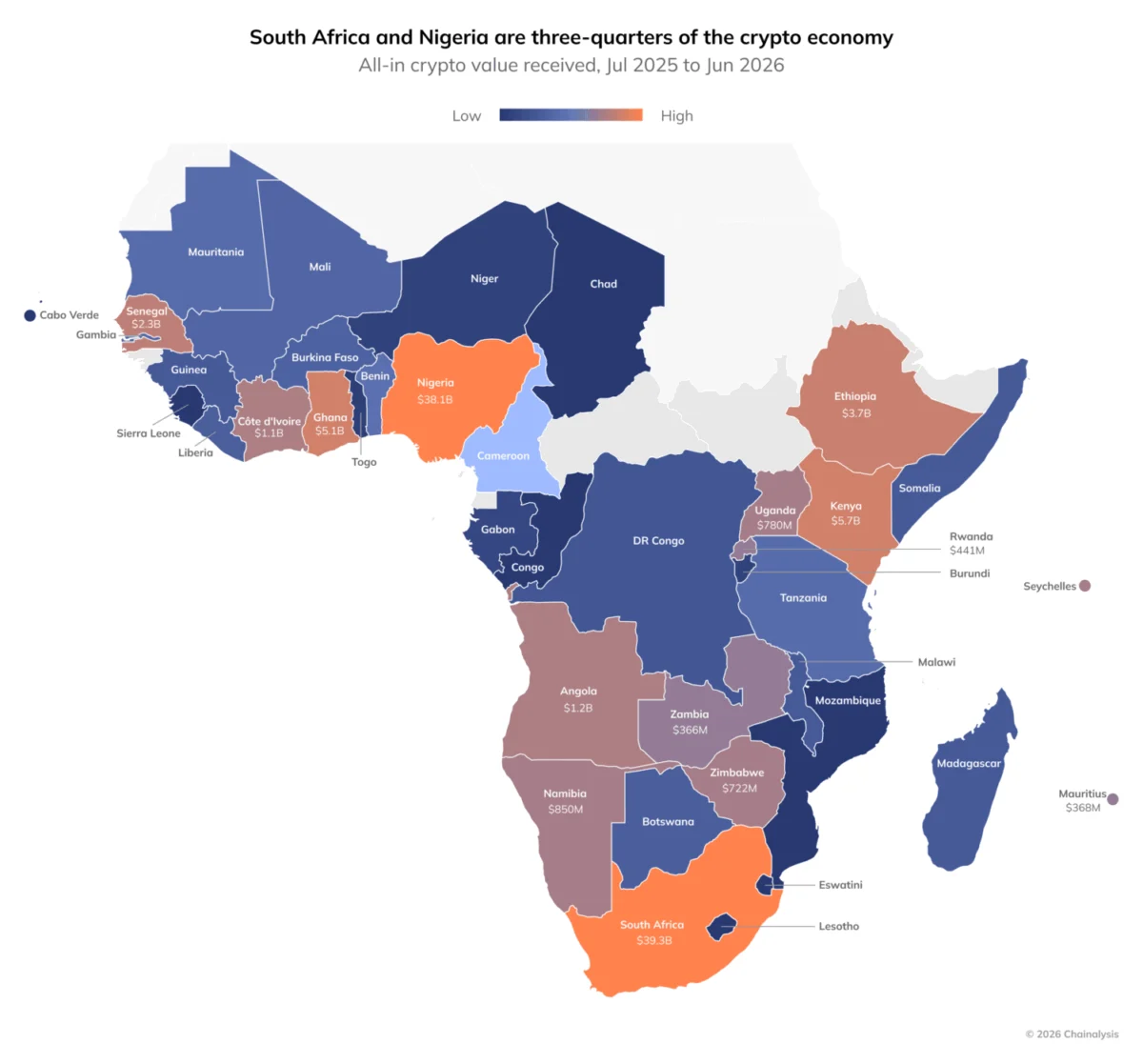
Sub-Saharan Africa has solidified its position as the world’s fastest-growing cryptocurrency region, recording a 13.4% increase in value received to reach a total of $101 billion between July 1, 2025, and June 30, 2026. Despite representing the smallest total crypto economy globally in terms of absolute dollar value, the region’s rapid expansion underscores a profound shift in how individuals and businesses navigate a fragmented and often inaccessible traditional financial landscape. Driven by the twin engines of South Africa and Nigeria, which together account for more than 75% of regional activity, the adoption of digital assets is increasingly moving away from speculative trading toward practical, everyday utility, including cross-border payments, remittances, and inflation hedging.

The surge in adoption is fundamentally linked to the limitations of the region’s legacy banking systems. For many Sub-Saharan Africans, traditional financial services remain expensive, unreliable, or entirely out of reach. This reality has created a fertile environment for decentralized technologies to solve real-world problems. As Mercy Emmanuel, Stablecoin and Blockchain Commercial Lead at the Nigerian fintech giant Flutterwave, noted, the most commercially significant innovations in the African market are those that reduce friction in existing financial activities rather than those that introduce unnecessary technological complexity.
Divergent Growth Trajectories in Regional Hubs
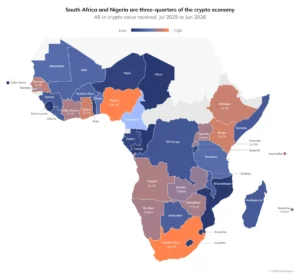
While the region as a whole is trending upward, its two primary markets—South Africa and Nigeria—are following distinct paths. South Africa has emerged as the regional leader, with its crypto economy reaching $39.3 billion during the report period. This represents a staggering 52% year-over-year growth, achieved despite a global bear market. The growth was broad-based, spanning institutional inflows and retail activity, but was particularly led by cross-border peer-to-peer (P2P) stablecoin flows.

In contrast, Nigeria’s crypto economy, valued at $38.1 billion, saw a slight contraction of 3% year-over-year. However, this headline figure masks a significant internal transformation. While decentralized exchange (DEX) activity plummeted by 45% and cross-border P2P flows dropped by 17%, centralized exchange (CEX) activity remained robust. Nigeria continues to rank third globally in grassroots adoption, reflecting a deeply embedded crypto culture among the general population. The shift in Nigeria suggests a maturing market where users are moving away from more volatile decentralized platforms toward regulated domestic services.
Smaller markets across the continent also displayed extreme volatility and rapid growth. Ghana’s crypto economy expanded by 80% to reach $5.1 billion, while Senegal witnessed an extraordinary 215% surge to $2.3 billion, primarily driven by centralized exchange growth. Conversely, Ethiopia recorded an 8% decline to $3.7 billion, largely due to a cooling of DEX activity. These contrasting figures highlight that while the region is ripe for growth, smaller markets remain sensitive to shifts in global market sentiment and local regulatory developments.

The Dominance of Self-Custody and Personal Wallets
One of the most striking characteristics of the Sub-Saharan African crypto market is the prevalence of self-custody. According to recent research, personal wallets accounted for 32.3% of the total value received in the region—the highest share of any region globally. This pattern suggests that African users prioritize direct control over their funds, often bypassing intermediaries and established exchanges.
This preference for self-custody is largely driven by a history of regulatory uncertainty and limited access to reliable custodial services. In Nigeria, for instance, a 2021 ban that prevented banks from servicing crypto exchanges (which was lifted in late 2023) forced many users to rely on P2P networks and personal wallets to manage their assets. Subsequent tensions between the Nigerian government and major international platforms have further reinforced the desire for financial sovereignty. Cross-border P2P transfers constituted 70.9% of the value received by personal wallets, illustrating that digital assets are being used as a primary tool for international value transfer outside the traditional banking system.

The Stablecoin Revolution and the Decline of Bitcoin
The most significant qualitative shift in the region is the explosive rise of stablecoins. Between 2022 and 2026, the value of stablecoins received via P2P channels in Sub-Saharan Africa grew more than sixfold, jumping from $2.3 billion to $14.6 billion. During the same period, Bitcoin’s share of the P2P market fell by 60%, dropping from $36 billion to $14.6 billion.
This shift marks a move toward utility over speculation. In a region where local currencies often face high inflation and depreciation, stablecoins pegged to the U.S. dollar provide a vital mechanism for preserving wealth and conducting business without the need for traditional foreign-currency bank accounts. Gillian Darko, Vice President of Strategy at Yellow Card, identified stablecoins as the single largest opportunity for the region in the coming year, noting their potential to bridge the gap between savings, investments, and reliable payment systems.

The Bank of Ghana and other regional regulators are taking note of this trend. Philip Kwaw Sebuabe, Head of the Virtual Assets Department at the Bank of Ghana, highlighted that stablecoins are increasingly used for remittance settlements and cross-border payments because they operate 24/7, bypassing the "banking hours" constraints that hamper traditional commerce. This has led to the exploration of local-currency stablecoins, such as cedi-backed models, which would allow users to receive value in their local currency through mobile money wallets while the underlying settlement happens via blockchain.
Expanding Crypto Corridors and Business Integration
Beyond individual use, the 2025-2026 period saw a massive expansion in intra-regional crypto corridors used for business-to-business (B2B) and consumer-to-business (C2B) payments. The number of active intra-regional corridors nearly doubled, rising from 80 to 152. Total transaction volume across these routes more than tripled, reaching $116.5 million.

This growth is a direct response to the high costs associated with intra-African financial clearing. Historically, payments between two African countries often had to be routed through correspondent banks in Europe or North America, leading to significant delays and high fees. Crypto payment channels offer a "short-circuit" to this inefficient system, allowing businesses to settle transactions faster and at a lower cost.
South Africa has positioned itself as the central hub for these flows. The country’s crypto activity mirrors its traditional Foreign Direct Investment (FDI) footprint, with significant crypto corridors established between South Africa and Nigeria, Kenya, the Democratic Republic of the Congo, and Zimbabwe. This suggests that crypto is not operating in a vacuum but is being integrated into established trade relationships.

The Growing Role of Diaspora Remittances
Sub-Saharan Africa remains the most expensive region in the world for receiving remittances, with the World Bank reporting an average cost of 7.9% for a $200 transfer. In countries like The Gambia and Lesotho, where remittances account for over 20% of GDP, these costs represent a significant drain on the local economy.
Crypto-based remittances from Western nations to Sub-Saharan Africa reached $888 million during the report period, a 36% increase year-over-year. North America led these inflows, contributing $645 million, followed by Australia and New Zealand, which saw their totals triple to $143 million. Interestingly, while Western Europe hosts a large portion of the African diaspora, its crypto remittance volume remains disproportionately low, contributing only $100 million. For example, despite France and the U.S. having similar numbers of African-born residents, the U.S. sent $223 million in crypto remittances compared to just $5.4 million from France. This disparity likely reflects the higher maturity of the crypto markets in North America and Canada, where Canada recorded the highest outflow per migrant at $736.

South Africa’s Retail Crypto Integration
In South Africa, crypto is moving rapidly into the physical retail space. The country saw $8.34 billion in "service-like" transactions—payments that resemble retail purchases—during the report period. This growth was bolstered by infrastructure projects like the partnership between Scan to Pay and MoneyBadger, which enabled consumers to spend Bitcoin at nearly 700,000 merchant locations as of August 2026.
According to Carel van Wyk, CEO of MoneyBadger, half of these payments were for amounts under $13, signaling that crypto is becoming a staple for everyday micro-transactions. This retail integration is a crucial step in moving crypto from an investment asset to a functional currency, providing a blueprint for other African nations to follow.

Regulatory Landscape and Future Outlook
The future of the region’s crypto economy will be defined by the evolving regulatory environment. Over the past year, Kenya and Ghana have passed new virtual asset laws, while Nigeria’s SEC has proposed higher capital requirements for digital asset operators to ensure market stability. South Africa is also refining its "Crypto Asset Manual for Cross-Border Activities," moving toward a system that balances capital flow management with the need for innovation.
Rob Downes, Head of Digital Assets at Absa Corporate and Investment Banking, emphasized that regulation is the "critical enabler" for the next phase of growth. As governments move from skepticism to structured oversight, institutional investment is expected to follow, potentially integrating blockchain technology into the very fabric of Africa’s financial infrastructure.

In conclusion, the 2025-2026 period has demonstrated that Sub-Saharan Africa is no longer just a frontier for crypto experimentation. It is a region where digital assets are being actively harnessed to bypass systemic financial barriers. The shift toward stablecoins, the rise of intra-regional business corridors, and the integration of crypto into retail payments all point to a future where blockchain technology plays a central role in the continent’s economic development. The challenge for the coming year will be to harmonize these grassroots innovations with formal regulatory frameworks to ensure long-term stability and continued financial inclusion.