


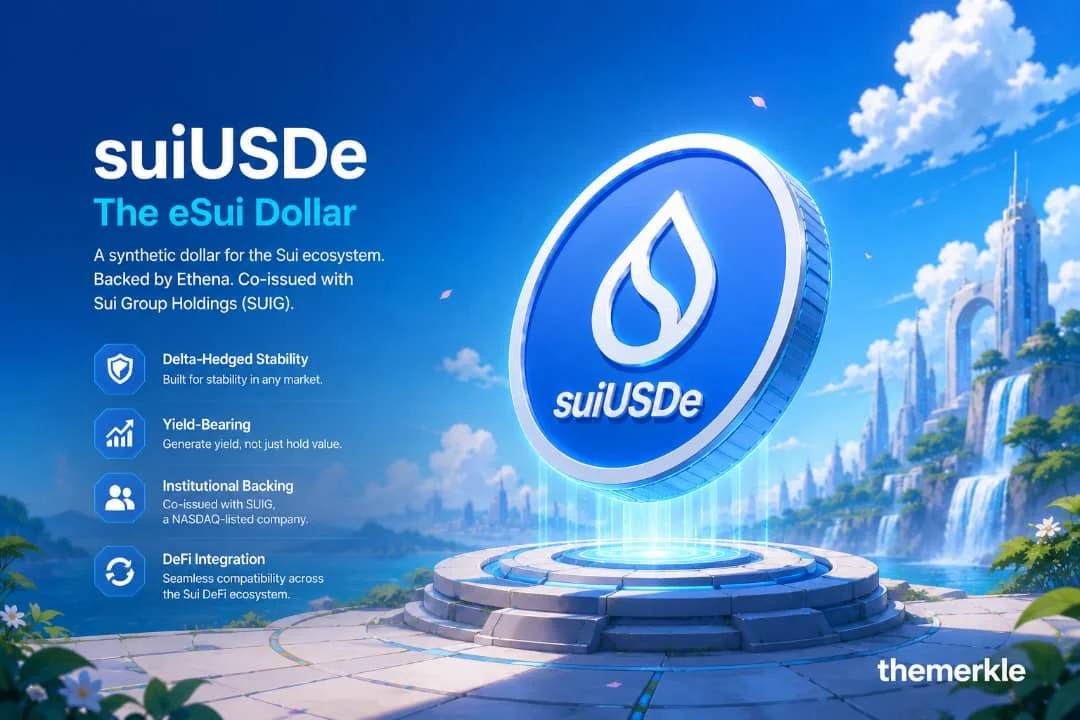
The digital asset landscape witnessed a notable development with the official launch of a dedicated landing page for suiUSDe, now formally referred to as the eSui Dollar. This initiative stems from a strategic partnership between Ethena Labs, the developer of the synthetic dollar USDe, and Sui Group Holdings, Inc. (NASDAQ: SUIG), a publicly traded entity. The introduction of suiUSDe, a yield-bearing synthetic dollar, directly integrated into various decentralized finance (DeFi) protocols across the high-performance Sui blockchain, signifies a crucial evolution in the convergence of traditional finance and the on-chain economy. Previously, comprehensive information regarding suiUSDe was fragmented across various social media announcements and technical documentation. The new centralized landing page addresses this by providing a unified, accessible resource for potential users, investors, and developers, enhancing transparency and fostering a deeper understanding of the asset’s mechanics and utility.
The Genesis of suiUSDe: A Strategic Alliance
The collaboration between Ethena and Sui Group Holdings to co-issue suiUSDe is particularly noteworthy due to the distinct profiles of the entities involved. Ethena Labs has carved out a significant niche in the DeFi sector with its USDe, a synthetic dollar designed to offer stability and yield without direct reliance on traditional fiat reserves or centralized banking infrastructure. Its model, which employs a delta-neutral hedging strategy involving staking rewards from Ethereum and funding rates from perpetual futures markets, has demonstrated resilience through various market conditions since its inception. On the other side, Sui Group Holdings, trading on the NASDAQ, represents a publicly accountable corporation operating under stringent regulatory frameworks and shareholder obligations. This pairing—a crypto-native protocol with a NASDAQ-listed firm—is an unusual yet pioneering move in the nascent world of on-chain asset issuance, signaling a maturing phase for the digital asset industry where institutional participation extends beyond mere asset holding to active product development and co-creation.
The decision to launch suiUSDe on the Sui network is not arbitrary. Sui is a Layer 1 blockchain celebrated for its high throughput, low latency, and object-centric data model, powered by the Move programming language. These architectural advantages position Sui as a robust platform for scalable DeFi applications. Despite its technical prowess and growing ecosystem, Sui has identified a significant gap: the lack of a reliable, scalable, and yield-bearing dollar-denominated asset. Ethena’s proven USDe mechanism, adapted for the Sui environment, directly addresses this need, promising to inject substantial liquidity and innovative financial primitives into the Sui DeFi ecosystem. The immediate integration of suiUSDe into existing lending markets and liquidity pools on Sui demonstrates a readiness for adoption, bypassing the typical cold-start challenges often associated with new token launches on a blockchain.
Understanding Ethena’s USDe Model: Innovation in Synthetic Assets
To fully appreciate suiUSDe, it is essential to delve into the operational mechanics of Ethena’s USDe. Unlike traditional stablecoins, which typically maintain their peg by holding equivalent reserves of fiat currency or other assets in bank accounts, USDe operates on a "synthetic dollar" model. This model relies on two primary components: liquid staked Ethereum (LSTs) as collateral and a sophisticated delta-neutral hedging strategy using short perpetual futures positions.
When users mint USDe, they typically deposit collateral such as liquid staked Ethereum. Ethena then simultaneously takes an equivalent short position on ETH perpetual futures contracts on various centralized exchanges. This dual strategy aims to create a delta-neutral exposure, meaning that the overall value of the position (long spot ETH + short ETH perpetuals) remains relatively stable regardless of ETH price fluctuations. If the price of ETH rises, the value of the spot ETH collateral increases, but the short perpetual position loses value by a corresponding amount, and vice-versa.
The yield generated by USDe, and subsequently suiUSDe, originates from two main sources: the staking rewards earned from the underlying liquid staked Ethereum (e.g., from validator operations) and the funding rates collected from the short perpetual futures positions. Funding rates are periodic payments exchanged between traders holding long and short positions in perpetual futures markets. When the market is predominantly bullish (long positions outweigh short positions), short positions typically receive funding payments, contributing to the overall yield. Conversely, in bearish markets, short positions might pay funding, though Ethena’s model aims to manage this dynamically.
Ethena’s USDe has rapidly ascended to become one of the largest synthetic dollars in the crypto space, demonstrating its viability and market acceptance. As of [hypothetical date for data enrichment], Ethena’s USDe market capitalization has surged past several billion dollars, indicating strong investor confidence and a proven track record through periods of significant market volatility. This track record is a critical factor for new chains and institutional partners like Sui Group Holdings, as it offers a de-risked and battle-tested mechanism compared to building an untested synthetic asset from scratch. The expansion to Sui is a testament to the portability and robustness of Ethena’s core technology, moving it from a single-chain product to a multi-chain category leader.
Sui’s Technical Edge and DeFi Ambitions
The Sui blockchain, developed by Mysten Labs, is designed from the ground up to address the scalability limitations inherent in many existing Layer 1 networks. Its unique architecture, featuring a parallel execution environment and an object-centric data model, allows for unprecedented transaction throughput and efficient resource utilization. The consensus mechanism, leveraging the Narwhal and Bullshark protocols, enables near-instant transaction finality, a crucial feature for high-frequency DeFi applications.
Sui’s adoption of the Move programming language, originally developed by Meta for the Diem project, further distinguishes it. Move is a secure and robust language specifically designed for digital assets, offering enhanced security features that mitigate common vulnerabilities found in other smart contract languages. This focus on security and performance makes Sui an attractive environment for sophisticated financial applications and institutional participants.
Despite its technical advantages, the Sui DeFi ecosystem, while growing rapidly, has been seeking a native, yield-bearing dollar asset that can serve as a foundational building block for more complex financial products. Existing stablecoins on Sui often rely on bridges or have limited yield generation capabilities. The introduction of suiUSDe directly fills this void, providing a high-quality, capital-efficient, and yield-generating stable asset that can significantly enhance Sui’s liquidity, attract new users, and catalyze the development of a more vibrant and diverse DeFi landscape. With suiUSDe, lending protocols can offer more attractive rates, liquidity pools can deepen, and new structured products can emerge, all contributing to Sui’s ambition of becoming a leading hub for decentralized finance.
Sui Group Holdings: Bridging TradFi and DeFi
The involvement of Sui Group Holdings (SUIG) is arguably one of the most compelling aspects of the suiUSDe launch. As a NASDAQ-listed company, SUIG operates under a distinct set of responsibilities and regulatory obligations that are largely absent in the typically permissionless and decentralized world of crypto protocols. Public companies are subjected to rigorous financial reporting standards (e.g., GAAP/IFRS), quarterly earnings calls, corporate governance requirements, and oversight from regulatory bodies like the SEC. Their actions are scrutinized by shareholders, analysts, and the wider public, necessitating a higher degree of transparency and risk management.
By co-issuing suiUSDe, SUIG is making a far more active and integrated bet on the crypto economy than simply holding digital assets on its balance sheet, a trend observed with companies like MicroStrategy. This move represents a strategic pivot towards active participation in the on-chain value creation, moving beyond passive investment to direct product development within the DeFi space. It signals a belief that the future of finance involves the seamless integration of blockchain technology into core business operations.
For SUIG, this partnership offers several potential advantages. It provides a direct pathway to generate revenue from the burgeoning DeFi sector on the Sui network, potentially diversifying its business model and revenue streams. Furthermore, it positions SUIG as an innovator and early adopter in the institutionalization of DeFi, potentially attracting a new class of investors interested in companies that actively build and participate in the digital economy. However, this also brings with it the complexities of navigating uncharted regulatory territory. The co-issuance of a synthetic dollar by a public company will undoubtedly attract scrutiny from regulators, potentially setting precedents for how traditional finance entities can engage with decentralized protocols. This proactive engagement, while risky, could also contribute to the development of clearer regulatory frameworks for the digital asset industry. The success and growth of suiUSDe will be directly tied to the growth of Sui Group Holdings, establishing a symbiotic relationship that is unique in the current market landscape.
The Crucial Role of a Dedicated Landing Page
While seemingly a minor detail, the launch of a dedicated landing page for suiUSDe is of paramount importance, especially for a complex synthetic asset co-issued by a public company. Synthetic dollars, by their very nature, are more intricate than traditional fiat-backed stablecoins. Users need to understand:
- The underlying collateral: What assets back suiUSDe?
- The yield generation mechanism: How is the yield produced? Is it sustainable?
- The stability mechanism: How is the peg maintained? What are the risks associated with the delta-neutral strategy, such as funding rate volatility or smart contract risks?
- Regulatory considerations: What are the implications of a NASDAQ-listed company’s involvement?
Attempting to convey this depth of information through scattered social media posts, fragmented documentation, or technical whitepapers often leads to confusion, mistrust, and limited adoption. DeFi users, particularly institutional ones, prioritize clarity and transparency. Products that are difficult to understand, even if technically sound, often fail to gain traction.
A well-designed, comprehensive landing page serves as a single source of truth. It can clearly articulate the value proposition, explain the mechanics in accessible language, outline the risks, provide links to audits and relevant data, and foster a sense of legitimacy and professionalism. For a product aimed at attracting both retail DeFi users and potentially institutional capital, this level of clarity is non-negotiable. It builds trust, reduces information asymmetry, and lowers the barrier to entry for new users. The investment in a polished, informative website from the outset, rather than chasing liquidity alone, signals a long-term vision and a commitment to user education and transparency from both Ethena and Sui Group Holdings. This strategic emphasis on communication underscores the growing maturity of the digital asset space, where user experience and understanding are increasingly recognized as critical drivers of adoption.
Broader Implications and Future Outlook
The launch of suiUSDe and its dedicated platform carries significant implications across several dimensions of the digital asset ecosystem:
-
For Ethena: This partnership further validates Ethena’s innovative synthetic dollar model, proving its portability and appeal beyond the Ethereum ecosystem. Each successful deployment on a new chain strengthens Ethena’s position as a leader in stable asset innovation and paves the way for broader adoption of its technology. It transitions Ethena from a single-product entity to a potential infrastructure provider for synthetic assets across multiple blockchains.
-
For the Sui Ecosystem: suiUSDe is poised to be a game-changer for Sui’s DeFi landscape. It introduces a native, yield-bearing stable asset that can significantly enhance liquidity, attract new capital, and enable the creation of more sophisticated financial instruments. This can accelerate Sui’s growth as a competitive Layer 1 for decentralized applications, particularly in the financial sector.
-
For Sui Group Holdings (SUIG): SUIG’s active co-issuance of a synthetic dollar is a pioneering move for a NASDAQ-listed company. It represents a bold step towards integrating traditional financial entities directly into the on-chain economy. This could set a precedent for how public companies engage with blockchain technology, moving beyond passive investment to active participation in decentralized product development. It also positions SUIG at the forefront of the evolving regulatory dialogue surrounding digital assets and traditional finance.
-
For Institutional Adoption: This collaboration blurs the lines between traditional finance and decentralized finance. The involvement of a public company in the direct issuance of a crypto asset adds a layer of institutional credibility and scrutiny that could encourage other traditional financial institutions to explore similar ventures. It demonstrates a pathway for regulated entities to engage with DeFi in a structured manner, potentially accelerating mainstream adoption of blockchain-based financial products.
-
Regulatory Landscape: The unique structure of this partnership will undoubtedly attract attention from financial regulators globally. It could serve as a test case for developing new regulatory frameworks that accommodate the hybrid nature of assets co-issued by decentralized protocols and publicly traded companies. Clarity in this area is crucial for the long-term growth and stability of the digital asset market.
In conclusion, the launch of suiUSDe, backed by the innovative mechanics of Ethena and the institutional backing of Sui Group Holdings, represents more than just a new token on a new chain. It is a microcosm of the broader trends shaping the future of finance: the increasing demand for high-performance blockchain infrastructure, the evolution of sophisticated synthetic assets, and the growing, albeit cautious, convergence of traditional finance with the decentralized world. The dedicated landing page, while seemingly a minor detail, is a critical component in building the trust and understanding necessary for such an ambitious venture to succeed at scale, signaling a mature and thoughtful approach to an innovative financial product.














