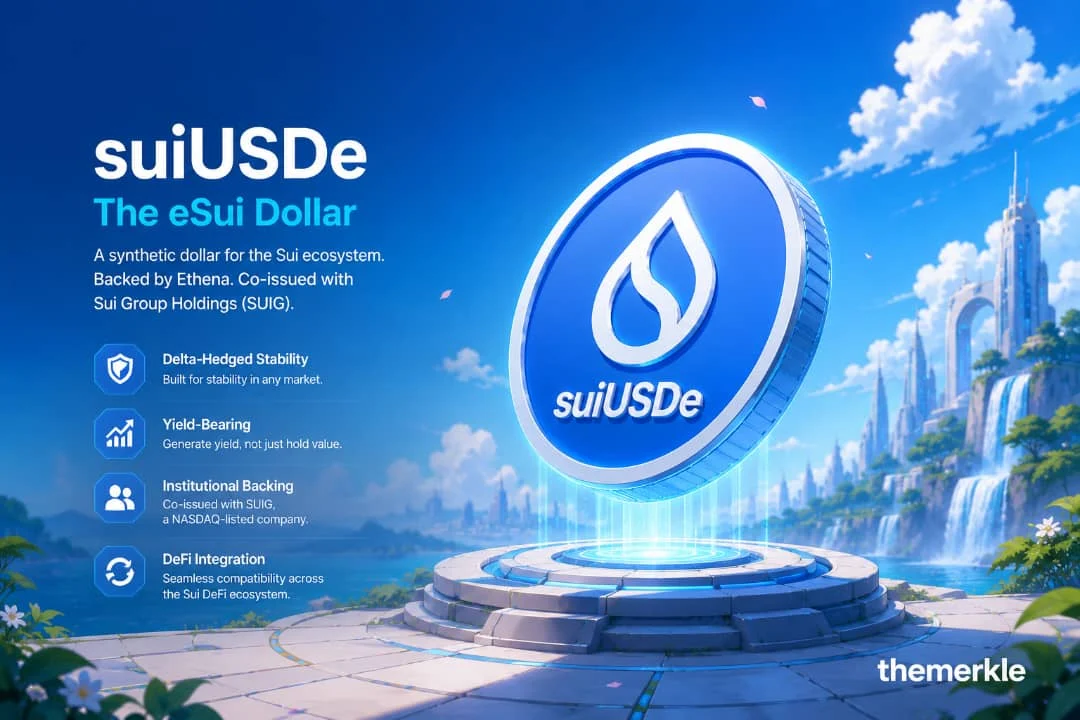
The digital asset landscape is witnessing a pivotal moment with the official unveiling of a dedicated landing page for suiUSDe, formally known as the eSui Dollar. This development, announced via Ethena Eco’s official channels, underscores the growing maturity and cross-chain ambition of synthetic dollar protocols. suiUSDe is the result of a strategic collaboration between Ethena, a prominent decentralized finance (DeFi) protocol renowned for its USDe synthetic dollar, and Sui Group Holdings (NASDAQ: SUIG), a publicly traded company. The creation of this centralized information hub is not merely a cosmetic update; it represents a critical step in enhancing transparency, fostering user understanding, and solidifying the asset’s position within the burgeoning Sui blockchain ecosystem. The token has already seen significant integration, becoming an active component within various DeFi protocols across Sui, indicating a robust and immediate utility upon its introduction.
The Genesis of suiUSDe: A Unique Partnership
The partnership between Ethena and Sui Group Holdings stands out in the often-insular world of decentralized finance. Ethena brings to the table its battle-tested mechanism for synthetic dollar issuance, first popularized with USDe on the Ethereum network. This mechanism eschews the traditional fiat-backed stablecoin model, instead relying on a delta-hedging strategy involving a combination of collateral assets and corresponding short futures positions. This approach aims to maintain a stable peg while generating yield, a distinct advantage over zero-yield, fiat-backed alternatives. Ethena’s USDe has rapidly ascended to become one of the largest synthetic dollars in the crypto space, having navigated significant market volatility since its inception, proving the resilience of its innovative model.
Sui Group Holdings, on the other hand, represents the vanguard of traditional finance’s cautious yet increasingly active foray into the blockchain realm. As a NASDAQ-listed entity, SUIG operates under stringent regulatory oversight, financial reporting requirements, and direct accountability to shareholders – a stark contrast to the typically permissionless and often anonymous nature of many DeFi projects. The decision for a public company to co-issue a synthetic dollar is a profound statement, moving beyond passive crypto asset holdings to active participation in on-chain product development. This collaboration bridges the credibility and regulatory adherence of traditional finance with the innovation and efficiency of decentralized technology.
Understanding the Mechanics of suiUSDe
At its core, suiUSDe operates on the same robust principles that govern Ethena’s flagship USDe. Unlike conventional stablecoins that maintain a 1:1 peg to a fiat currency like the US dollar by holding equivalent reserves in bank accounts or short-term treasuries, suiUSDe employs a "synthetic" approach. Its stability is derived from a delta-neutral strategy. This involves holding a basket of liquid crypto assets (such as Ethereum or staked Ethereum derivatives) as collateral, simultaneously opening short futures positions of equivalent value on centralized exchanges. The short positions are designed to offset price fluctuations in the underlying collateral. If the value of the collateral rises, the short position loses value, and vice versa, theoretically maintaining a net neutral exposure to price changes.
This intricate mechanism allows suiUSDe to generate yield. The yield primarily stems from two sources: the staking rewards earned on the underlying collateral (e.g., Ethereum staking yield) and the funding rates paid on the short futures positions. In positive market conditions, funding rates are often positive, meaning traders holding long positions pay those holding short positions, further contributing to the yield. This innovative structure positions suiUSDe as a yield-bearing dollar asset, an attractive proposition for users seeking returns beyond mere price stability. The successful operation of this model on Ethereum, enduring various market stresses and periods of high volatility, provides a strong testament to its viability and is a primary reason for its expansion to the Sui blockchain.
The Sui Blockchain: A Fertile Ground for Innovation
Sui is a high-performance Layer 1 blockchain designed for speed, scalability, and low transaction costs, built on the Move programming language. Its unique object-centric data model and parallel execution capabilities enable it to process transactions with remarkable efficiency, making it an ideal environment for sophisticated DeFi applications. Despite its technological prowess and a rapidly expanding ecosystem, Sui has historically faced a gap in its DeFi infrastructure: a reliable, yield-bearing, and liquid dollar-denominated asset.
The introduction of suiUSDe directly addresses this critical need. For DeFi protocols on Sui, having access to a robust synthetic dollar that not only offers stability but also generates inherent yield opens up new avenues for lending markets, liquidity pools, and other financial primitives. Prior to suiUSDe, the options for such assets were limited, often relying on bridged stablecoins with varying levels of liquidity and less integrated yield mechanisms. The integration of suiUSDe into existing Sui DeFi protocols from day one signifies a deliberate and well-coordinated launch, ensuring immediate utility and fostering deeper liquidity within the ecosystem. For Ethena, this expansion to Sui serves as a crucial validation of its mechanism’s portability and adaptability across different blockchain architectures. Each successful deployment on a new chain transforms Ethena from a single-product protocol into a foundational category builder within the synthetic asset space.
A Public Company’s Bold Step: Sui Group Holdings’ Strategic Play
The involvement of Sui Group Holdings (SUIG) is arguably one of the most compelling aspects of this entire development. Publicly traded companies operate under a framework of rigorous disclosure requirements, corporate governance, and fiduciary duties to shareholders. Their decisions are scrutinized by regulators, investors, and the market at large. For SUIG to co-issue a synthetic dollar, an asset class still navigating evolving regulatory landscapes, represents a significant strategic commitment. This move signals a profound shift beyond the relatively passive strategy of simply holding cryptocurrencies on a balance sheet, as seen with some pioneering public companies. Instead, SUIG is actively participating in the creation and distribution of a core DeFi primitive.
This engagement by SUIG suggests several potential strategic motivations. Firstly, it positions the company at the forefront of financial innovation, diversifying its revenue streams beyond its existing business models. Secondly, it could be seen as a move to capitalize on the growth of the Sui ecosystem, aligning its corporate interests with the success of a cutting-edge blockchain platform. Thirdly, it adds a layer of institutional credibility and, perhaps, a degree of perceived regulatory ‘comfort’ to suiUSDe, given SUIG’s compliance obligations. While DeFi generally operates outside traditional regulatory perimeters, the involvement of a NASDAQ-listed entity inherently brings an element of traditional financial scrutiny, which could be seen as both a challenge and an opportunity for broader acceptance. This active co-issuance represents a far more engaged and potentially higher-reward bet on the future of decentralized finance. If suiUSDe achieves widespread adoption and success, Sui Group Holdings stands to benefit directly from its growth, representing a novel form of exposure for a public company in the crypto space.
Timeline of Integration and Development
While specific dates for initial discussions remain undisclosed, the trajectory of suiUSDe’s launch can be inferred through public announcements and market actions. The partnership between Ethena and Sui Group Holdings would have necessitated extensive due diligence and technical collaboration, likely spanning several months. This preparatory phase would have focused on adapting Ethena’s smart contract architecture to the Sui blockchain’s Move language, ensuring security audits, and establishing the operational frameworks for collateral management and delta hedging.
The initial rollout likely saw suiUSDe being integrated into key DeFi protocols on Sui, enabling its immediate use in lending, borrowing, and liquidity provision. This stealthier, functional launch allowed the asset to gain traction and prove its utility in a live environment. The recent unveiling of the dedicated landing page marks the formal public-facing announcement, signifying a readiness to scale and onboard a wider user base. This phased approach – functional integration followed by comprehensive informational resources – is a common strategy in the mature stages of crypto product launches, allowing for iterative development and market feedback.
Broader Market Context: The Rise of Synthetic Assets and Stablecoin Evolution
The launch of suiUSDe occurs within a dynamic and rapidly evolving stablecoin and synthetic asset market. The total market capitalization of stablecoins has grown exponentially, exceeding hundreds of billions of dollars, becoming the bedrock of the broader crypto economy. However, this growth has also highlighted the varying risk profiles and centralization concerns associated with different stablecoin models. Fiat-backed stablecoins, while dominant, face increasing regulatory scrutiny regarding their reserves and often offer no yield. Algorithmic stablecoins have largely struggled to maintain their peg under stress, leading to significant market events.
Synthetic dollars like USDe and now suiUSDe represent a third, increasingly popular paradigm. They aim to offer a decentralized, transparent, and yield-bearing alternative that mitigates single-point-of-failure risks associated with centralized custodians while avoiding the inherent fragility of purely algorithmic designs. This model has attracted significant capital and attention, positioning Ethena as a leader in this niche. The expansion of such assets across multiple Layer 1 blockchains like Sui signals a broader trend towards interoperability and the development of a multi-chain financial ecosystem where users can access consistent, yield-generating dollar assets regardless of their preferred blockchain environment. This cross-chain proliferation is critical for establishing synthetic dollars as a truly global and ubiquitous DeFi primitive.
The Imperative of Transparency: Why a Dedicated Website Matters
In the complex world of decentralized finance, transparency and user education are paramount, especially for novel financial instruments like synthetic dollars. The initial article correctly identifies that a dedicated website, while seemingly a minor detail, is actually a foundational element for widespread adoption. Synthetic dollars are not intuitively understood by the average user. Questions abound: How does it maintain its peg? Where does the yield come from? What are the underlying risks? How is the collateral managed? These are not questions that can be adequately answered through scattered social media posts, fragmented forum discussions, or buried documentation within technical whitepapers.
A well-designed, centralized landing page serves as the single source of truth. It provides clear, concise explanations of suiUSDe’s mechanics, its collateralization strategy, risk factors, and integration points within the Sui ecosystem. This accessibility and clarity are crucial for building trust and encouraging adoption. DeFi users are notoriously risk-averse when it comes to products they cannot readily comprehend. Products with opaque or difficult-to-access information often face an uphill battle for liquidity and user engagement, regardless of the underlying soundness of their design. The investment in a polished, informative website signals Ethena and Sui Group Holdings’ commitment to user education and long-term viability, moving beyond merely attracting liquidity to fostering genuine understanding and confidence. This emphasis on clear communication distinguishes suiUSDe from many nascent tokens that prioritize rapid deployment over comprehensive user resources.
Implications and Future Outlook
The launch of suiUSDe carries significant implications across several domains:
- For the Sui Ecosystem: It fills a critical void, providing a native, yield-bearing dollar asset that can catalyze further DeFi development, attract more users, and deepen liquidity within the Sui network. This could accelerate Sui’s growth as a competitive Layer 1 blockchain.
- For Ethena: It validates the cross-chain viability of its synthetic dollar model, paving the way for further expansion into other blockchain ecosystems. This diversification strengthens Ethena’s position as a leading provider of decentralized financial infrastructure.
- For Sui Group Holdings: It positions the NASDAQ-listed company as an active innovator in the digital asset space, potentially attracting a new class of investors interested in the convergence of traditional and decentralized finance. It also sets a precedent for how public companies might engage with blockchain technology beyond simple asset holdings.
- Regulatory Landscape: The involvement of a public company like SUIG in co-issuing a synthetic dollar is likely to draw increased attention from financial regulators. While Ethena operates as a decentralized protocol, SUIG’s regulatory obligations may influence the design and disclosure requirements around suiUSDe, potentially setting new standards for transparency in the synthetic asset space.
- Institutional Adoption: This collaboration could serve as a blueprint for other traditional financial institutions looking to enter DeFi. The blend of a proven decentralized protocol with the institutional backing of a public company offers a model that could accelerate mainstream adoption of synthetic assets.
Risks and Considerations
Despite the significant promise, suiUSDe, like all financial instruments, is not without risks. Its reliance on a delta-hedging strategy involves counterparty risk associated with centralized exchanges where short positions are held. There is also smart contract risk, though Ethena’s contracts have undergone rigorous audits. The yield generated is not guaranteed and can fluctuate based on market conditions, particularly funding rates. Furthermore, the evolving regulatory landscape surrounding stablecoins and synthetic assets could introduce unforeseen challenges. Users are always advised to conduct thorough due diligence and understand the underlying mechanics and risks before engaging with any decentralized financial product.
In conclusion, the dedicated landing page for suiUSDe represents more than just a website launch; it is a declaration of intent. It signifies a mature phase in the partnership between Ethena and Sui Group Holdings, an affirmation of Ethena’s robust synthetic dollar model, and a strategic enhancement for the Sui blockchain’s DeFi ecosystem. This convergence of decentralized innovation with public company backing could well be a harbinger of the next wave of institutional engagement in the digital asset economy, setting a new benchmark for transparency and cross-chain functionality in the rapidly expanding world of synthetic finance.