


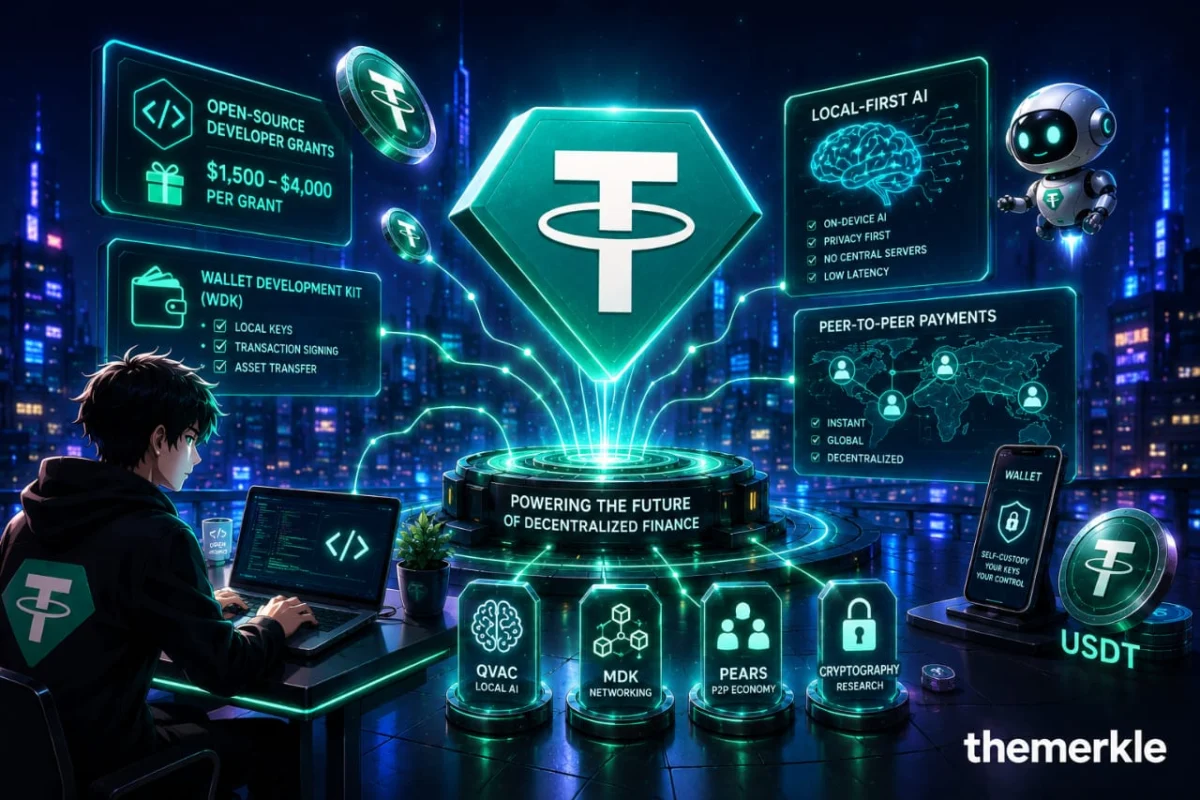
Tether, the issuer of the world’s largest stablecoin, USDT, has significantly amplified its commitment to the decentralized technology space with the launch of a new developer grants program. Announced on May 11, the initiative is specifically designed to provide financial backing for the creation of open-source tools crucial for local-first AI systems and robust, independent payment infrastructure. This strategic move signals a broader organizational objective to diminish reliance on centralized cloud services, custodial platforms, and third-party APIs, while simultaneously accelerating the development of truly peer-to-peer financial applications.
The grant program is structured to provide financial support to developers working within Tether’s open technology stack. Unlike traditional funding cycles, grants will be disbursed upon the achievement of predefined technical milestones, fostering a results-driven development environment. In an ambitious declaration made in May 2023, Tether confirmed that there would be no capped upper limits on the total grants pool, positioning this as one of the most significant open-source funding endeavors undertaken by any entity within the cryptocurrency sector this year.
Grant awards, ranging from $1,500 to $4,000, will be paid in USDT or Bitcoin, depending on the nature of the assigned work and the developer’s preference. The scope of eligible projects is broad, encompassing critical areas such as wallet tooling, browser plugins, e-commerce integration, advanced AI tooling research, and information systems engineering for cryptography research. This comprehensive approach underscores Tether’s vision for an interconnected ecosystem of decentralized applications.
This announcement marks a pivotal moment for the broader cryptocurrency sector, which is increasingly gravitating towards automation and the development of autonomous applications. These future-forward applications, powered by artificial intelligence, are envisioned to interact and operate seamlessly within self-custodial financial infrastructures, moving away from centralized control. Tether explicitly stated on its social media channels that this initiative is a fulfillment of its "commitment to develop technology that operates without an intrusive intermediary," reinforcing its dedication to core decentralized principles.
The Strategic Imperative for Local-First AI Infrastructure
At the heart of Tether’s new initiative lies QVAC, the designated local-first AI platform that underpins its broader vision. QVAC is engineered from the ground up to facilitate on-device AI inference, thereby eliminating the necessity for remote servers or reliance on centralized cloud infrastructure. Tether articulates a critical concern regarding modern AI systems, citing their inherent risks and latency issues. The primary problem stems from end-user data frequently traversing third-party processing services, which not only inflates operational costs but also significantly increases potential exposure and privacy vulnerabilities.
Tether draws a compelling parallel between this dependency in AI and the existing challenges within many contemporary crypto applications. Despite considerable advancements in blockchain settlement technologies, a substantial number of decentralized applications (dApps) continue to rely on centralized exchanges, custodial services, or hosted APIs for crucial functionalities. These dependencies, as Tether argues, represent significant weak points that undermine the very essence of decentralization, creating potential single points of failure and control that contradict the ethos of blockchain technology.
The emphasis on local-first AI systems through the Tether grants program is therefore a direct response to these systemic vulnerabilities. The program prioritizes the development of tools capable of running entirely on-device, independent of centralized systems. By championing AI models like those facilitated by QVAC, Tether is enabling applications to analyze data locally, ensuring that sensitive user information remains on the user’s device rather than being transmitted to third-party servers.
This paradigm shift has gained considerable relevance given the burgeoning use of AI agents, which are increasingly tasked with managing payments, communications, and various financial operations autonomously. Local-first systems offer substantial advantages, including a significant reduction in risks associated with data collection, lower operational costs due to decreased reliance on external infrastructure, and enhanced robustness against potential outages or censorship. Tether posits that decentralized AI holds the transformative potential to lay the foundational groundwork for the peer-to-peer financial infrastructure of tomorrow.
Developers receiving grants are expressly encouraged to innovate systems that prioritize local control over data processing, identity management, and financial transactions. This strategic positioning by Tether establishes it as a direct challenger to the prevailing cloud computing model, wherein dominant technology firms exert ownership and control over the infrastructure for both AI and financial applications. The program also mirrors a broader trend within crypto markets, where stablecoin issuers are evolving beyond mere token providers to become pivotal infrastructure sellers, recognizing the competitive advantage in building foundational layers for the digital economy. As rivalry intensifies across various blockchain ecosystems, Tether is strategically expanding its influence into critical sectors such as AI, payments, developer tools, and decentralized computing.
Getting Wallet Hosting Right: A Core Tech Priority
A fundamental aspect of Tether’s new grants program is the concerted effort to advance its Wallet Development Kit (WDK). The WDK is an open-source framework meticulously designed to empower developers to seamlessly integrate self-custody wallets directly within their applications. This addresses a critical need within the decentralized ecosystem, where genuine self-sovereignty often remains elusive due to underlying centralized components.
Tether explicitly states that the "WDK enables fully local key generation, transaction signing, and asset transfer without any reliance on hosted APIs or custodial services." This capability is revolutionary, as it allows for true on-device control over digital assets. The WDK’s versatility is further enhanced by its ability to operate across diverse environments, including desktop, mobile, and embedded systems. This flexibility offers developers unparalleled freedom in constructing secure and independent payment systems or innovative AI-driven applications, paving the way for a new generation of truly decentralized user experiences.
Tether identifies inadequate wallet infrastructure as one of the most significant roadblocks preventing decentralized applications from realizing their full potential for autonomy. The company highlights a critical paradox: while blockchain transactions themselves are inherently decentralized, many dApps continue to rely on centralized solutions for crucial functions such as wallet connectivity, user authentication, and backend processing. These dependencies create points of vulnerability and control that contradict the decentralized ethos of the underlying blockchain.
The WDK aims to systematically eliminate many of these lingering dependencies through its on-device application capabilities. This newfound independence not only fortifies the security and privacy of user assets but also significantly streamlines integration into automated systems and sophisticated AI workflows, which are increasingly becoming the backbone of next-generation financial applications.
Beyond the WDK, the grants program extends its support to other integral components of Tether’s open-source ecosystem, including QVAC (for local-first AI), MDK, and Pears. Furthermore, grants are available for essential supporting work such as documentation, the creation of onboarding resources, decentralized networking research, advanced cryptography studies, and integration tooling. Each grant is characterized by a set payout, clearly defined task requirements, and hard deadlines. This structured approach, according to Tether, is intentionally designed to facilitate quicker execution and yield more tangible development results compared to the often protracted and less defined timelines of traditional venture-style grant programs.
Tether’s Evolution Beyond Stablecoins: A Broader Strategic Shift
Tether’s introduction of this new developer grants initiative serves as yet another compelling testament to the company’s profound evolution beyond its initial role as merely the issuer of USDT, the largest stablecoin by market capitalization. In recent years, Tether has strategically diversified its investments and operational focus, expanding into critical areas such as Bitcoin infrastructure, a wide array of decentralized solutions, advanced AI systems, peer-to-peer networking protocols, and educational initiatives. This multifaceted expansion underscores a long-term vision that transcends the stablecoin market itself.
A clear demonstration of this commitment can be seen in Tether’s previous philanthropic and strategic investments. The company has notably awarded several $100,000 grants to bolster the BTCPay Server Foundation, a pivotal open-source payments project within the Bitcoin ecosystem. Furthermore, it has contributed $250,000 to OpenSats, an organization dedicated to funding Bitcoin developers and crucial open-source infrastructure, thereby reinforcing the foundational layers of the decentralized internet.
Beyond direct software funding, Tether has also heavily invested in educational endeavors, most notably through its "Plan B from Lugano" initiative. This program, based in Switzerland, has provided over 500 student grants, consistently hosted annual startup pitch competitions, and pledged a substantial sum of up to CHF 5 million for development initiatives through 2030. These investments highlight Tether’s recognition that technological advancement requires not only financial capital but also human capital and a vibrant ecosystem of innovation and learning.
The most recent announcement regarding these developer grants strongly suggests that Tether views AI infrastructure and decentralized payments as intrinsically intertwined arenas, poised to drive the next wave of cryptocurrency adoption. As stablecoins continue to gain traction and increasingly integrate into mainstream financial systems globally, the competitive landscape is rapidly shifting. Competition is no longer solely focused on the issuance of digital dollars but is profoundly evolving around the fundamental infrastructure that supports these transactions and enables their utility in novel ways.
Instead of merely rolling out more digital dollars, companies like Tether are now competing to establish and nurture the foundational networks for machine-to-machine payments, the development of autonomous financial agents, and the proliferation of truly self-sovereign applications. This strategic pivot positions Tether not just as a financial services provider but as a key architect of the future digital economy, emphasizing open-source development and decentralized control as core tenets for sustainable growth and innovation. The implications extend far beyond the crypto sphere, touching on fundamental questions of data ownership, privacy, and the future architecture of the internet itself.
Broader Impact and Implications for the Digital Economy
Tether’s bold foray into funding local-first AI and independent payment infrastructure is poised to have multi-layered implications across the digital economy. Firstly, it significantly reinforces the Web3 ethos of decentralization, privacy, and user sovereignty. By actively sponsoring projects that reduce reliance on centralized intermediaries, Tether is directly contributing to the resilience and censorship-resistance of the emerging digital infrastructure. This move could inspire other major players in the crypto and tech sectors to re-evaluate their own dependencies and accelerate their investments in decentralized solutions.
Secondly, the initiative serves as a powerful catalyst for innovation at the intersection of AI and blockchain technology. The concept of "local-first AI" addresses critical concerns surrounding data privacy and security, which are paramount as AI models become more sophisticated and integrated into daily life. By enabling AI inference on-device, Tether is championing a model where users retain greater control over their data, mitigating risks associated with large-scale data breaches and surveillance. This could accelerate the development of privacy-preserving AI applications, from personal financial assistants to decentralized identity solutions.
Thirdly, the focus on robust wallet tooling and independent payment infrastructure through the WDK directly tackles one of the most persistent bottlenecks in decentralized application development. The current reliance on centralized wallet solutions or APIs often creates a fragmented and less secure user experience. By fostering truly self-custodial and integrated payment systems, Tether is paving the way for more seamless, secure, and autonomous financial transactions within dApps. This could significantly enhance user adoption and trust in decentralized finance (DeFi) by removing existing points of friction and vulnerability.
Furthermore, this strategic pivot positions Tether as a formidable infrastructure provider, moving beyond its stablecoin issuer identity. In an increasingly competitive landscape where blockchain ecosystems vie for developer talent and network effects, offering comprehensive developer tools and funding becomes a crucial differentiator. This could attract a new wave of developers to build on Tether’s open-source stack, fostering a vibrant ecosystem that extends the utility of USDT and other digital assets. Analysts suggest that this expansion into foundational technology strengthens Tether’s long-term relevance and market leadership, even as the stablecoin market matures and potentially faces increased regulatory scrutiny.
The long-term vision articulated by Tether – one of machine-to-machine payments, autonomous financial agents, and self-sovereign applications – aligns with broader global trends towards automation and the Internet of Things (IoT). As smart contracts and AI agents become more prevalent, the demand for secure, efficient, and decentralized payment rails will only intensify. Tether’s grants program is an early investment in this future, aiming to build the foundational components necessary for a truly autonomous digital economy where value can flow freely and securely without intermediaries. This proactive approach underscores a recognition that the future of finance is not just about digital currencies, but about the intelligent, interconnected infrastructure that enables them.
Disclosure: This is not trading or investment advice. Always do your research before buying any cryptocurrency or investing in any services.














