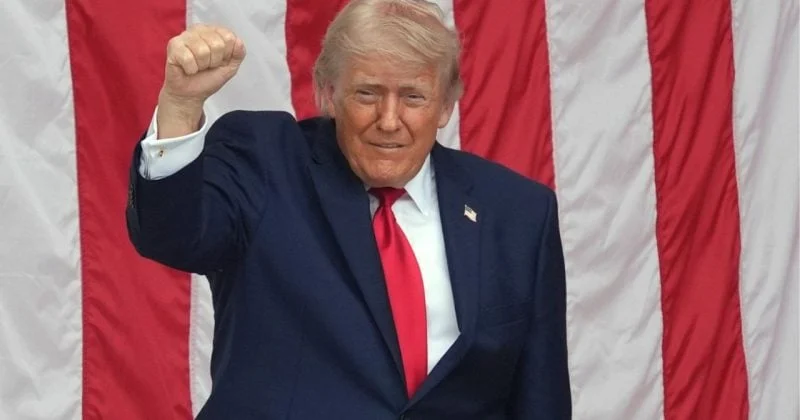
The United States digital asset industry, which has spent nearly a decade lobbying Washington for a comprehensive regulatory framework, now finds its most significant legislative victory teetering on the edge of collapse. The Digital Asset Market Clarity Act of 2025, popularly known as the CLARITY Act, has become the center of a high-stakes political standoff in the Senate. Despite possessing the kind of bipartisan momentum rarely seen in modern financial regulation, the bill’s progress has been halted by a growing controversy surrounding the personal financial interests of its most prominent advocate: President Donald Trump. While the legislation aims to provide the "rules of the road" that crypto firms have long demanded, the President’s sprawling portfolio of digital asset ventures has handed his political opponents a potent weapon to delay or potentially kill the bill entirely.
The legislative journey of the CLARITY Act began with a decisive victory in the House of Representatives in July 2025, where it passed with a robust 294-134 vote. This bipartisan showing suggested a clear mandate for reform, reflecting a desire to move beyond the "regulation by enforcement" era that characterized much of the early 2020s. The momentum carried the bill into the Senate Banking Committee, where it narrowly advanced on May 14, 2026, with a 15-9 vote. However, the bill now faces the daunting "60-vote" threshold required to overcome a filibuster in the full Senate. To reach this number, the administration must secure the support of at least several Senate Democrats, many of whom have expressed deep reservations about the ethics of the President signing a law that could directly inflate his own net worth.
A Chronology of the CLARITY Act and the Rise of the Trump Crypto Portfolio
The tension between policy and personal profit has its roots in the 2024 presidential campaign, during which Donald Trump pivoted from a crypto-skeptic to a self-proclaimed "crypto president." Following his inauguration, the administration moved quickly to fulfill campaign promises regarding digital assets. By early 2025, the White House began coordinating closely with SEC Chair Paul Atkins and leadership at the Commodity Futures Trading Commission (CFTC) to draft a bill that would resolve the long-standing jurisdictional disputes between the two agencies.
As the CLARITY Act moved through the drafting stages in early 2025, the Trump family simultaneously expanded its footprint in the private crypto sector. The launch of World Liberty Financial, a decentralized finance (DeFi) protocol associated with the Trump family, signaled a new era of presidential involvement in nascent technology markets. This was followed by the meteoric rise of the TRUMP memecoin and the administration’s vocal support for domestic Bitcoin mining operations, some of which reportedly involve family-linked investment vehicles.
By the time the House passed the bill in July 2025, analysts estimated the Trump family’s digital asset holdings and related business ventures to be valued in the billions of dollars. This unprecedented overlap between executive policy-making and private wealth accumulation set the stage for the current legislative impasse. When the Senate Banking Committee took up the bill in early 2026, the discussion shifted from technical definitions of "decentralization" to the ethics of presidential "self-dealing."
The Core Provisions of the Digital Asset Market Clarity Act
To understand why the bill is so contentious, it is necessary to examine its intended impact on the market. The CLARITY Act is designed to replace the current patchwork of court rulings and agency guidance with a codified statutory framework. Its primary objective is to draw clear jurisdictional boundaries between the Securities and Exchange Commission (SEC) and the CFTC.
Under the proposed law, the SEC would retain oversight of digital assets that function as investment contracts (securities), while the CFTC would be granted expanded authority over "digital commodities." Crucially, the bill creates a "pathway to decentralization," a legal mechanism by which a project that begins as a security can eventually be classified as a commodity once it meets specific technical and governance criteria. This provision is seen as essential for the growth of the DeFi sector, as it would allow developers to launch tokens without the permanent burden of SEC registration, provided the network becomes sufficiently autonomous.
Furthermore, the act addresses gaps in spot market oversight. Currently, the CFTC has limited authority over the underlying markets for commodities like Bitcoin, primarily intervening in cases of fraud or manipulation. The CLARITY Act would grant the CFTC direct regulatory supervision over digital asset exchanges, mandating higher standards for consumer protection, asset custody, and market transparency. For the crypto industry, these rules represent a "legitimacy stamp" that could unlock trillions of dollars in institutional capital currently sitting on the sidelines due to regulatory uncertainty.
The Trump Factor: Conflict of Interest as a Legislative Barrier
Despite the technical merits of the bill, the "Trump Factor" has become an inescapable hurdle. Senate Democrats, led by high-profile critics such as Chris Van Hollen of Maryland, Elizabeth Warren of Massachusetts, and Ruben Gallego of Arizona, have argued that the CLARITY Act is uniquely tailored to benefit the President’s specific business interests.
Senator Van Hollen has been particularly vocal, suggesting that the bill’s provisions regarding DeFi and memecoins appear to provide a "regulatory green light" for projects like World Liberty Financial. "We are being asked to vote on a framework that could overnight increase the valuation of the President’s private holdings by hundreds of millions, if not billions, of dollars," Van Hollen stated during a recent committee hearing. "Without ironclad ethics provisions that force divestment or create a blind trust, this isn’t public policy—it’s a private windfall."
Senator Elizabeth Warren has echoed these concerns, focusing on the anti-money laundering (AML) aspects of the bill. She argues that the current version of the CLARITY Act is "too soft" on the illicit finance risks associated with DeFi and private mining operations—areas where the Trump family is heavily invested. The demand from the Democratic caucus is clear: they want stringent conflict-of-interest guardrails that would prevent any elected official or their immediate family from profiting from the specific asset classes regulated by the bill.
Supporting Data: The Market’s Reaction and Economic Stakes
The economic stakes of the CLARITY Act’s success or failure are substantial. According to data from market research firms, the total market capitalization of the digital asset industry surged by 22% in the weeks following the House’s passage of the bill in July 2025, as investors priced in the likelihood of a stable regulatory environment. However, since the Senate Banking Committee’s narrow vote in May 2026, market volatility has returned, with Bitcoin and Ethereum trading in a horizontal range as traders weigh the risks of a legislative stalemate.
Industry groups, such as the Blockchain Association and the Chamber of Digital Commerce, have released reports suggesting that a failure to pass the CLARITY Act by the end of 2026 could result in a significant "capital flight." These reports estimate that up to $50 billion in venture capital and infrastructure investment could be diverted to jurisdictions with clearer rules, such as the European Union under its Markets in Crypto-Assets (MiCA) regulation, or financial hubs in Asia like Hong Kong and Singapore.
Furthermore, traditional banking interests have entered the fray. Major financial institutions, including JPMorgan Chase and Goldman Sachs, have expressed cautious support for the bill, provided it includes provisions that allow banks to engage in digital asset custody without punitive capital requirements. The friction between these traditional giants and the emerging crypto-native firms adds another layer of complexity to the Senate negotiations.
The Midterm Countdown and the "Poison Pill" Strategy
The primary enemy of the CLARITY Act is now the calendar. With the 2026 midterm elections approaching, the window for passing complex, controversial legislation is rapidly closing. Historically, as the election cycle heats up, members of Congress become increasingly averse to taking difficult votes that could be used against them in campaign advertisements.
For Democrats, the ethics argument serves as a "procedural weapon" that does not require them to be ideologically opposed to crypto itself. Many moderate Democrats represent states with burgeoning tech sectors and would prefer to see regulatory clarity. However, the optics of supporting a bill that enriches the sitting President’s family are politically toxic. By demanding ethics provisions that the White House is unlikely to accept, Democrats can effectively stall the bill while appearing to take a principled stand on government integrity.
The White House, for its part, has shown little inclination to compromise on the ethics front. President Trump has characterized the demands for divestment as a "partisan witch hunt" designed to sabotage American leadership in the digital economy. SEC Chair Paul Atkins has attempted to bridge the gap by emphasizing the bill’s broader benefits for the American consumer, but these technical arguments often fall on deaf ears in a hyper-polarized Senate.
Analysis of Implications: A Future of Fragmentation?
If the CLARITY Act fails to pass before the midterms, the implications for the digital asset industry are profound. The most immediate result would be a return to the status quo of "regulation by litigation." In the absence of a federal mandate, the SEC and CFTC would likely resume their aggressive enforcement actions, leading to years of protracted legal battles in the federal courts.
Furthermore, a legislative failure would exacerbate the fragmentation of the global crypto market. While the U.S. remains the world’s largest financial market, its inability to provide a clear legal framework contrasts sharply with the progress made by other G20 nations. This "regulatory vacuum" could undermine the dollar’s role in the digital economy, particularly as stablecoins—many of which are currently dollar-backed—look for more stable legal homes outside of U.S. jurisdiction.
The irony of the situation is not lost on industry observers. The president who made "making America the crypto capital of the world" a cornerstone of his economic platform may be the primary reason the country fails to achieve that goal. His personal financial entanglements have transformed a bipartisan policy objective into a lightning rod for political controversy.
Conclusion: The Path Forward
The fate of the CLARITY Act currently rests in the hands of a small group of Senate negotiators. To move the bill forward, the administration would likely need to agree to some form of enhanced disclosure or restricted trading for high-ranking officials involved in digital asset policy. However, given the President’s historical resistance to such measures, the outlook remains uncertain.
As the summer of 2026 approaches, the digital asset industry finds itself in a familiar position: waiting for Washington to act. While the CLARITY Act offers a vision of a regulated, transparent, and thriving crypto market, that vision remains obscured by the shadow of political and personal conflict. Whether the "Crypto President" can navigate these ethical waters to deliver on his legislative promises will be the defining story of the 119th Congress. For now, the bill remains a symbol of both the industry’s immense potential and the deep-seated political divisions that continue to hamper its progress in the United States.