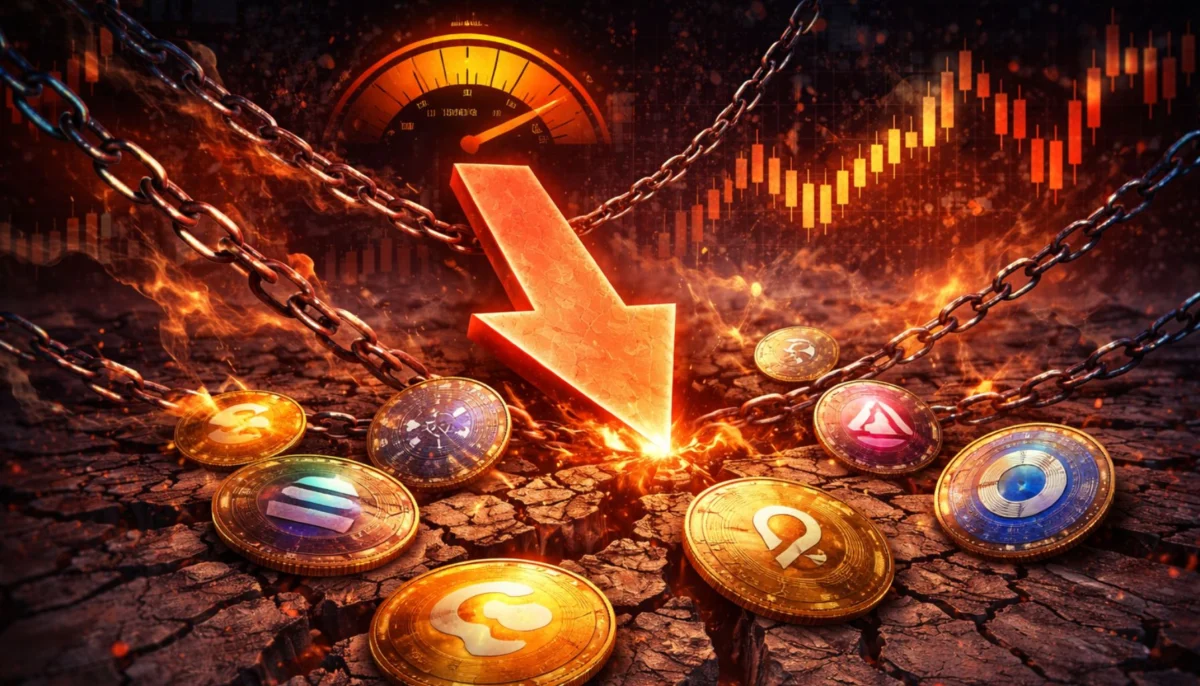
The long-anticipated "altseason," a cyclical phenomenon in the cryptocurrency market where alternative digital assets outperform Bitcoin, has failed to materialize in the current market cycle, giving way instead to a structural devaluation of the broader asset class. While investors spent much of 2024 and the early months of 2025 waiting for a rotation of capital from Bitcoin into smaller-cap tokens, the reality has been a consistent erosion of value. According to recent data and analysis from industry experts, the altcoin market is currently facing its most significant existential crisis since its inception, characterized by a staggering number of assets reaching all-time lows and a fundamental breakdown in liquidity.
Findings published by prominent market analyst Darkfost via CryptoQuant indicate that more than 40% of all altcoins have either reached their all-time low (ATL) or are currently trading within a range that suggests an imminent breach of those levels. This figure is particularly alarming when compared to historical benchmarks. During the height of the 2022 bear market—a period defined by the collapses of the Terra-Luna ecosystem and the FTX exchange—the percentage of altcoins hitting all-time lows peaked at approximately 38%. The fact that the current cycle has surpassed this threshold suggests that the market is dealing with issues far more systemic than a standard price correction.
The Structural Reckoning: A Market Divided
The current state of the altcoin market is being described by analysts not as a temporary setback, but as a "reckoning." In previous cycles, most notably in 2017 and 2021, the cryptocurrency market followed a predictable path: Bitcoin would lead a rally, followed by Ethereum, and eventually, the gains would trickle down into mid-cap and small-cap "altcoins." This "waterfall" effect relied on a relatively concentrated pool of assets and a unified investor base.
However, the 2024-2025 cycle has deviated sharply from this historical precedent. While Bitcoin has reached multiple new all-time highs and seen significant institutional adoption through Spot Exchange-Traded Funds (ETFs), altcoins have largely been left behind. The data provided by Darkfost highlights a "death cross" in the aggregate altcoin market cap (excluding the top 10 assets), where the 50-week moving average has crossed below the 100-week moving average. This technical signal often precedes prolonged periods of stagnation or further decline, indicating that the momentum required to spark a traditional altseason is currently non-existent.
The 47 Million Token Problem: Liquidity Dilution
One of the most critical factors contributing to the altcoin collapse is the unprecedented explosion in the number of digital assets. The crypto market is no longer a curated list of a few hundred or even a few thousand projects. Darkfost’s analysis points to a staggering structural reality: there are now more than 47 million cryptocurrencies in existence across various blockchain networks.

The distribution of these tokens is heavily concentrated on high-throughput networks that have lowered the barrier to entry for token creation:
- Solana: Over 22 million tokens have been launched on the network, driven largely by the rise of automated token deployment platforms and the memecoin craze.
- Base: Coinbase’s Layer-2 solution has seen the creation of over 18 million tokens.
- BNB Smart Chain: This network continues to host over 4 million assets.
The total pool of capital available in the cryptocurrency market has not grown in proportion to this astronomical increase in asset supply. This has resulted in "liquidity dilution" on a scale never before seen in financial markets. Instead of capital flowing into a handful of promising "blue-chip" altcoins, it is being spread across an effectively infinite number of tokens. This fragmentation means that even when new capital enters the space, it is insufficient to move the needle for the vast majority of assets, leaving them structurally fragile and prone to rapid devaluations.
Macroeconomic Headwinds and the Risk-Off Sentiment
While internal liquidity issues are a primary driver of the altcoin decline, the external macroeconomic environment has acted as a catalyst for the sell-off. Geopolitical tensions in Eastern Europe and the Middle East, combined with persistent inflationary concerns and fluctuating interest rate policies from the Federal Reserve, have created a "risk-off" environment for global investors.
In the hierarchy of financial assets, altcoins occupy the most speculative tier. They are typically the first assets to be sold during periods of uncertainty and the last to recover. The "60/40" portfolio—a traditional investment strategy consisting of 60% stocks and 40% bonds—saw its worst performance in decades in 2022 and has remained volatile through 2024. As traditional investors retreat to the safety of cash, gold, or Bitcoin (which is increasingly viewed as "digital gold"), the altcoin market has been deprived of the "retail mania" that historically fueled its exponential growth.
Furthermore, the volatility created by geopolitical instability falls disproportionately on assets with thin liquidity. For many altcoins, a relatively small sell order can trigger a double-digit percentage drop in price, creating a feedback loop of fear and further liquidation.
Technical Analysis: Breaking the Floor
The technical health of the altcoin market, when viewed through the "OTHERS" chart (which tracks the total crypto market cap excluding the top 10 assets), provides a grim outlook. As of late March 2025, this index stands at approximately $173.12 billion. While this represents a minor weekly gain of 1.88%, the broader context is one of total retracement.

At the peak of the 2024 cycle, this index reached nearly $480 billion. Since that high, the market has collapsed by 64%, effectively erasing all gains made during the bull run that began in mid-2023. The market has now returned to price levels last seen nearly two years ago.
Key technical indicators include:
- Moving Average Breakdown: The price has fallen below the 50-week, 100-week, and 200-week moving averages. All three indicators are now sloping downward, suggesting a long-term bearish trend.
- Failed Support: The $190 billion level, which served as a definitive floor throughout the corrections of 2023 and early 2024, has been decisively broken. The market is now testing this level from below, treating it as resistance rather than support.
- The 2022 Low Reference: The bottom of the 2022 bear market for this index was approximately $80 billion. With the current support at $173 billion looking precarious, analysts warn that if the downward trend continues, a return to those multi-year lows is a statistical possibility.
Market Reactions and the Flight to Quality
The reaction from the broader crypto community has been one of disillusionment. For years, the prevailing narrative was that "utility" and "technological innovation" would eventually lead to a decoupling of altcoins from Bitcoin’s price action. However, the current data suggests that the market is instead moving toward a "flight to quality."
Institutional investors, who have become the dominant force in the market following the approval of Bitcoin and Ethereum ETFs, have shown little interest in the vast majority of the 47 million existing tokens. Their focus remains strictly on assets with clear regulatory status, deep liquidity, and institutional-grade custody solutions. This has left the retail-driven altcoin market in a "zombie state," where projects with no significant trading volume or active development continue to drift toward zero.
Inferred reactions from venture capital firms also indicate a shift in strategy. Many firms that previously funded "low-float, high-FDV (Fully Diluted Valuation)" projects are facing significant losses as those tokens hit the market and find no buyers. The era of "vapo-ware" and speculative launches appears to be ending, replaced by a demand for sustainable revenue models and real-world application.
Chronology of a Failed Altseason
To understand how the market reached this point, it is necessary to look at the timeline of the 2023-2025 cycle:

- Late 2023: Optimism grows as Bitcoin begins its ascent ahead of the ETF approvals. Altcoins see modest gains in anticipation of a "rotation."
- January 2024: Bitcoin ETFs are approved in the U.S. Bitcoin dominates market share, while altcoins remain stagnant.
- March 2024: Bitcoin hits a new all-time high. The "OTHERS" index peaks at $480 billion. Expectations for an altseason reach a fever pitch.
- Mid-2024: The launch of Ethereum ETFs fails to produce a sustained rally in the DeFi or L2 sectors. The explosion of memecoin deployment on Solana begins to drain liquidity from "utility" projects.
- Late 2024: Geopolitical tensions escalate. The altcoin market begins a steady decline, breaking key support levels at $300 billion and $250 billion.
- Early 2025: Darkfost and other analysts confirm that 40% of the market is at all-time lows. The "Death Cross" is confirmed on the weekly charts.
Implications for the Future of Digital Assets
The current "altcoin winter" is likely to have lasting implications for the structure of the cryptocurrency industry. The era of the "unfiltered" altseason, where every token rises regardless of its merit, may be over. In its place, a more mature and discerning market is emerging.
For investors, the distinction between "resilient" assets and "irrelevant" ones has never been more critical. The 47 million tokens currently in existence represent a massive amount of "noise" that the market is currently in the process of filtering out. While extreme underperformance often creates long-term buying opportunities, those opportunities are likely confined to a tiny fraction of the total market.
As the industry moves forward, the focus is expected to shift away from mere token issuance toward actual network utility and capital efficiency. The current reckoning, while painful for many market participants, may be a necessary step in the evolution of the digital asset class—purging the excess liquidity and unsustainable projects that have characterized the market for the last several years. For now, the "altseason" remains a ghost of previous cycles, leaving a market that must finally reconcile its infinite supply with its finite demand.